Species · Flowering plants
Red Trillium Trillium erectum
The scientific name of the Red Trillium is Trillium erectum. It is a species of flowering plant in the family Melanthiaceae (bunchflower family), order Liliales.
- Scientific name
- Trillium erectum L.
- Common name
- Red Trillium
- Genus
- Trillium
- Family
- Melanthiaceae (Bunchflower Family)
- Order
- Liliales
- Class
- Liliopsida
- Red List category
- LC Least Concern
- Recorded in
- 2 countries
- Name status
- accepted in the Catalogue of Life

Overview
The species is native to eastern North America and occurs in woodland habitats. It produces a single flower with three petals and has a fetid odor resembling that of a wet dog.
Written 26 November 2026 from the sources listed below. Each statement was checked against the passage it cites; statements that could not be supported were removed.
Appearance
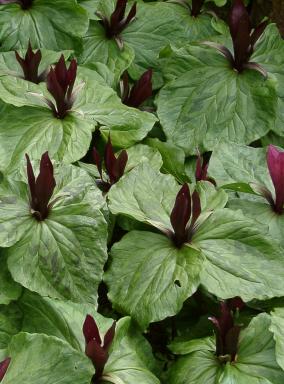
The plant has three large green leaves arranged in a whorl beneath its flower. It produces a single flower with three sepals, three petals, six stamens and three fused carpels.[1][2]
The petals can be dark reddish brown, maroon, purple, pale yellow or white. The ovary is dark purple to maroon regardless of the flower's petal color.[3][4]
The petals have prominent, netted veins and a coarse, stiff texture. The flowers produce a fetid odor resembling that of a wet dog.[5][6][7]
The plant typically grows between 20 and 40 cm tall and can reach approximately 40 cm in height and 30 cm in spread. Its flowers measure approximately 6.5 cm across, and its leaves can grow up to 17.5 cm long.[8][9][10][11]
Habitat
Red trillium occurs in rich, moist woodland habitats, open dry woods and rich mesic woods. It typically occurs in drier habitats and on acidic soils.[12][13][14]
The species can also be found within laurel and rhododendron thickets.[15]
The species is native to eastern North America. Its native range extends from northern Georgia to Quebec and New Brunswick, and it occurs as far west as Michigan and southern Ontario.[16][17][18]
The species occurs from Manitoba east to Nova Scotia and south to Georgia and Alabama. It is recorded in New Brunswick, Nova Scotia, Ontario and Quebec in Canada, and in Georgia, North Carolina, Tennessee, Virginia and West Virginia in the United States.[19][20][21]
Behaviour
Red trillium is a spring ephemeral whose life cycle is synchronized with the forests where it grows. Its flowers typically appear between late March and June.[22][23]
The species can survive winter temperatures as low as −35 °C.[24]
The plant persists through an underground rhizome.[25]
Conservation
The species was classified as globally secure as of October 2019. It is classified as critically imperiled in Delaware, Illinois and Rhode Island.[26][27]
Uses
The root has traditionally been used by Indigenous peoples of North America as an aid in childbirth. Root tea has been used to address menstrual disorders and has traditionally been used to induce childbirth and assist with labor.[28][29][30]
The Cherokee used a poultice made from the whole plant to treat tumors, inflammation and ulcers.[31]
Red trillium is cultivated as an ornamental flowering plant. The species has received the Royal Horticultural Society's Award of Garden Merit.[32][33]
Classification of the Red Trillium
| Kingdom | Plantae |
|---|---|
| Subkingdom | Pteridobiotina |
| Phylum | Tracheophyta |
| Class | Liliopsida |
| Order | Liliales |
| Family | Melanthiaceae (Bunchflower Family) |
| Genus | Trillium (Toadshade) |
| Species | Trillium erectum L. |
Where the Red Trillium is found
Checklists and occurrence records place Trillium erectum in 2 countries across North America. GBIF holds 44,618 georeferenced records of it.
Countries
Regions and cities with the most records
- Ontario, Canada 7,644
- Quebec, Canada 5,395
- Vermont, United States 4,657
- New York, United States 4,241
- Massachusetts, United States 4,169
- Pennsylvania, United States 3,074
- New Hampshire, United States 2,113
- Palmer, United States 2,099
- North Carolina, United States 1,770
- Maine, United States 1,547
- Connecticut, United States 1,223
- Ottawa, Canada 818
- Gatineau, Canada 793
- Tennessee, United States 790
- Ottawa South, Canada 786
- Aylmer, Canada 776
- Ohio, United States 775
- Vanier, Canada 768
- Dorval, Canada 729
- Laval, Canada 728
- Val-des-Arbres, Canada 726
- Nepean, Canada 722
- Laval-des-Rapides, Canada 716
- Cartierville, Canada 711
- Mont-Royal, Canada 706
- L'Ancienne-Lorette, Canada 702
- Neufchâtel-Est–Lebourgneuf, Canada 702
- Gloucester, Canada 691
- Pierrefonds-Roxboro, Canada 686
- Dollard-Des Ormeaux, Canada 685
- Côte-Saint-Luc, Canada 684
- Saint-Vincent-de-Paul, Canada 667
- Québec, Canada 664
- Montréal-Nord, Canada 662
- West Virginia, United States 656
- Pointe-Claire, Canada 655
6 more countries have a few records outside this range
These countries hold a few records of Trillium erectum but lie outside the range the checklists give for it. Such records are often zoo or garden specimens, museum material or vagrants, so the species is not counted as occurring there.
A number beside a place is its count of GBIF occurrence records. A place without a number comes from a checklist alone. Records show where a species has been observed or collected, which can include escapes and vagrants.
Common names
English
- Red Trillium
- Beth Root
- Stinking Benjamin
- Wet Dog Trillium
- Wet Dog Wakerobin
- Birthroot
- Birthwort
- Ill-scented Trillium
- Ill-scented Wakerobin
- Purple Trillium
- Red Benjamin
- Wake-robin
- Wakerobin
Names in 13 other languages
- Chinese
- 褐花延齡草
- Czech
- trojčetka vzpřímená
- Danish
- Treblad
- Estonian
- püstine kolmiklill
- Finnish
- punakolmilehti
- French
- trille dressé, trille rouge
- Lithuanian
- Stačioji trilija
- Polish
- trójlist wyprostowany
- Portuguese
- Benjamin-vermelho, Lírio-do-bosque, Trílio-vermelho
- Russian
- Триллиум красный, Триллиум прямостоячий
- Slovak
- trojlist vzpriamený
- Swedish
- purpurtreblad
- Ukrainian
- Триліум прямостоячий
Synonyms
40 other scientific names have been used for this species and are now treated as synonyms of Trillium erectum.
- Trillium acuminatum Raf.
- Trillium atropurpureum M.A.Curtis ex L.C.Beck
- Trillium atropurpureum Raf.
- Trillium divaricatum Raf.
- Trillium erectum f. albiflorum R.Hoffm.
- Trillium erectum f. albiflorum , Ralph Hoffm. Proc. Boston Soc. Nat. Hist.
- Trillium erectum f. brevipedicellatum Louis-Marie
- Trillium erectum f. cahnae (Farw.) Louis-Marie
- Trillium erectum f. erectum
- Trillium erectum f. luteum Louis-Marie
- Trillium erectum f. nigrescens Louis-Marie
- Trillium erectum f. pallidandrum Vict. & J.Rousseau
- Trillium erectum f. parviflorum Louis-Marie
- Trillium erectum f. parvum Louis-Marie
- Trillium erectum f. polymerum Vict.
- Trillium erectum f. rubrostriatum Louis-Marie
- Trillium erectum f. sessiloides B.Boivin
- Trillium erectum f. viridiflorum (Curtis) Peattie
- Trillium erectum subsp. rubrum Clute
- Trillium erectum var. atropurpureum (Michx.) Pursh
- Trillium erectum var. blandum Jennison
- Trillium erectum var. blandum L.
- Trillium erectum var. cahnae Farw.
- Trillium erectum var. declinatum A.Gray
- Trillium erectum var. erectum
- Trillium erectum var. flavum Torr.
- Trillium erectum var. giganteum Louis-Marie
- Trillium erectum var. horizontale Louis-Marie
- Trillium erectum var. viridiflorum Curtis
- Trillium flavum Raf.
- Trillium foetidum Salisb.
- Trillium nutans Raf.
- Trillium pendulum Willd.
- Trillium purpureum Elliott
- Trillium rhombifolium Raf., Autik. Bot
- Trillium rhomboideum Michx.
- Trillium rhomboideum var. atropurpureum Michx.
- Trillium rhomboideum var. rhomboideum
- Trillium spatulatum Raf.
- Trillium obovatum Pursh ambiguous synonym
Related species
-
 White TrilliumTrillium grandiflorum
-
 Pacific TrilliumTrillium ovatum
-
 Nodding TrilliumTrillium cernuum
-
 Painted TrilliumTrillium undulatum
-
 ToadshadeTrillium sessile
-
 Prairie TrilliumTrillium recurvatum
-
 Little Sweet TrilliumTrillium cuneatum
-
 Giant TrilliumTrillium chloropetalum
Compare
Questions and answers
What is the scientific name of the Red Trillium?
The scientific name of the Red Trillium is Trillium erectum. Written with its author, the full name is Trillium erectum L..
Which family does the Red Trillium belong to?
Trillium erectum belongs to the family Melanthiaceae, in the order Liliales and the class Liliopsida.
Where is the Red Trillium found?
Checklists and occurrence records place Trillium erectum in 2 countries: United States and Canada.
What is the conservation status of the Red Trillium?
The IUCN Red List category recorded for Trillium erectum is Least Concern (LC).
What other names does the Red Trillium have?
Trillium erectum is also known in English as Beth Root, Stinking Benjamin, Wet Dog Trillium, Wet Dog Wakerobin, Birthroot and Birthwort.
What is the name for the red flower with three petals?
Red trillium is a flowering plant that produces a single flower with three petals.[2]
Sources
Passages the profile rests on
- The plant has three large green leaves arranged in a whorl beneath its flower. Source passage: “deep red, three-petaled flowers growing above three large green whorled leaves.” — documents.dps.ny.gov
- The plant produces a single flower with three sepals, three petals, six stamens and three fused carpels. Source passage: “a single trimerous flower with three sepals, three petals, two whorls of three stamens each, and three carpels” — English Wikipedia
- The petals can be dark reddish brown, maroon, purple, pale yellow or white. Source passage: “The petals are dark reddish brown, maroon, purple, pale yellow, or white.” — English Wikipedia
- The ovary is dark purple to maroon regardless of the flower's petal color. Source passage: “The ovary is dark purple to maroon regardless of petal color.” — English Wikipedia
- The flowers produce a fetid odor resembling that of a wet dog. Source passage: “The fetid odor is described as that of a wet dog.” — English Wikipedia
- The flowers have prominent, netted veins on their petals. Source passage: “petals with prominent, netted veins” — English Wikipedia
- The petals are coarse and stiff in texture. Source passage: “petals that are coarse and stiff in texture” — English Wikipedia
- The plant typically grows between 20 and 40 cm tall. Source passage: “The plant reaches 20 to 40 centimeters in height (8 to 16 inches).” — fs.usda.gov
- The plant can reach approximately 40 cm in height and 30 cm in spread. Source passage: “It grows to about 40 cm (16 in) in height with a spread of 30 cm (12 in).” — English Wikipedia
- The flowers measure approximately 6.5 cm across. Source passage: “about 6.5 centimeters wide (2.5 inches)” — fs.usda.gov
- The leaves can grow up to 17.5 cm long. Source passage: “which can be up to 17.5 centimeters long (7 inches).” — fs.usda.gov
- The species occurs in rich, moist woodland habitats. Source passage: “Red trillium is found in rich, moist woods” — fs.usda.gov
- The species typically occurs in drier habitats and on acidic soils. Source passage: “Red trillium tends to occur in drier habitats and is typically found on acid soils” — fs.usda.gov
- The species occurs in open dry and rich mesic woods. Source passage: “in open dry or rich mesic woods” — fs.usda.gov
- The species can be found within laurel and rhododendron thickets. Source passage: “within laurel and rhododendron thickets.” — fs.usda.gov
- The species is native to eastern North America. Source passage: “Trillium erectum is native to eastern North America.” — English Wikipedia
- Its native range extends from northern Georgia to Quebec and New Brunswick. Source passage: “Its range extends from northern Georgia in the southeastern United States to Quebec and New Brunswick in eastern Canada” — English Wikipedia
- The species occurs as far west as Michigan and southern Ontario. Source passage: “and as far west as Michigan and southern Ontario.” — English Wikipedia
- The species is recorded in the Canadian provinces of New Brunswick, Nova Scotia, Ontario and Quebec. Source passage: “Canada: New Brunswick, Nova Scotia, Ontario, Quebec” — English Wikipedia
- The species is recorded in Georgia, North Carolina, Tennessee, Virginia and West Virginia in the United States. Source passage: “Georgia, Illinois, Indiana, Kentucky, Maine, Maryland, Massachusetts, Michigan, New Hampshire, New Jersey, New York, North Carolina, Ohio, Pennsylvania, Rhode Island, South Carolina, Tennessee, Vermont, Virginia, West Virginia” — English Wikipedia
- The species occurs from Manitoba east to Nova Scotia and south to Georgia and Alabama. Source passage: “from Manitoba, Canada east to Nova Scotia, south to Georgia and Alabama” — fs.usda.gov
- The species is a spring ephemeral whose life cycle is synchronized with the forests where it grows. Source passage: “a spring ephemeral plant whose life-cycle is synchronized with that of the forests in which it lives.” — English Wikipedia
- The flowers typically appear between late March and June. Source passage: “Flowers are typically seen from late March through June.” — fs.usda.gov
- The species can survive winter temperatures as low as −35 °C. Source passage: “surviving temperatures down to −35 °C (−31 °F).” — English Wikipedia
- The plant persists through an underground rhizome. Source passage: “persists by means of an underground rhizome.” — English Wikipedia
- The species was classified as globally secure as of October 2019. Source passage: “As of October 2019, Trillium erectum is globally secure.” — English Wikipedia
- The species is classified as critically imperiled in Delaware, Illinois and Rhode Island. Source passage: “It is critically imperiled in Delaware, Illinois, and Rhode Island.” — English Wikipedia
- The root has traditionally been used by Indigenous peoples of North America as an aid in childbirth. Source passage: “The root of the red trillium was used by various indigenous peoples of North America as an aid in childbirth” — English Wikipedia
- Root tea has been used to address menstrual disorders. Source passage: “Root tea was used for menstrual disorders” — English Wikipedia
- Root tea has traditionally been used to induce childbirth and assist with labor. Source passage: “Native Americans used root tea for menstrual disorders, to induce childbirth, and to aid in labor.” — fs.usda.gov
- The Cherokee used a poultice made from the whole plant to treat tumors, inflammation and ulcers. Source passage: “The Cherokee peoples used a poultice of the whole plant to treat tumors, inflammation, and ulcers.” — English Wikipedia
- The species is cultivated as an ornamental flowering plant. Source passage: “Trillium erectum is cultivated as a flowering ornamental plant.” — English Wikipedia
- The species has received the Royal Horticultural Society's Award of Garden Merit. Source passage: “It has received the Award of Garden Merit from the Royal Horticultural Society.” — English Wikipedia
Data
- Catalogue of Life, 2026-10-16 XR cc by
- Global Biodiversity Information Facility CC BY 4.0
- Wikidata CC0
- GeoNames CC BY 4.0
- Wikimedia Commons per image; credit shown with each image
- Within the Catalogue of Life, this name comes from The World Checklist of Vascular Plants (WCVP) cc by
References
- Sp. Pl.: 340 (1753) where the name was published
This species in other databases
- Catalogue of Life 58TXL
- Wikidata Q3539177
- iNaturalist 50855
- World Flora Online wfo-0000751087
- GRIN 402741
Page built on 28 November 2026. See how the catalog is made and all sources and licences.
Cite this page
ScientificNames.org. (2026). Trillium erectum (Red Trillium). Retrieved November 28, 2026, from https://scientificnames.org/species/trillium-erectum
“Trillium erectum (Red Trillium).” ScientificNames.org, 2026, scientificnames.org/species/trillium-erectum. Accessed 28 Nov. 2026.
ScientificNames.org. “Trillium erectum (Red Trillium).” Accessed November 28, 2026. https://scientificnames.org/species/trillium-erectum.
@misc{scientificnames_trillium_erectum_red_trillium,
  author = {{ScientificNames.org}},
  title = {Trillium erectum (Red Trillium)},
  year = {2026},
  url = {https://scientificnames.org/species/trillium-erectum},
  note = {Accessed 2026-11-28}
}