Species · Flowering plants
Bear-grass Xerophyllum tenax
The scientific name of the Bear-grass is Xerophyllum tenax. It is a species of flowering plant in the family Melanthiaceae (bunchflower family), order Liliales.
- Scientific name
- Xerophyllum tenax (Pursh) Nutt.
- Common name
- Bear-grass
- Genus
- Xerophyllum
- Family
- Melanthiaceae (Bunchflower Family)
- Order
- Liliales
- Class
- Liliopsida
- Recorded in
- 2 countries
- Name status
- accepted in the Catalogue of Life
Overview
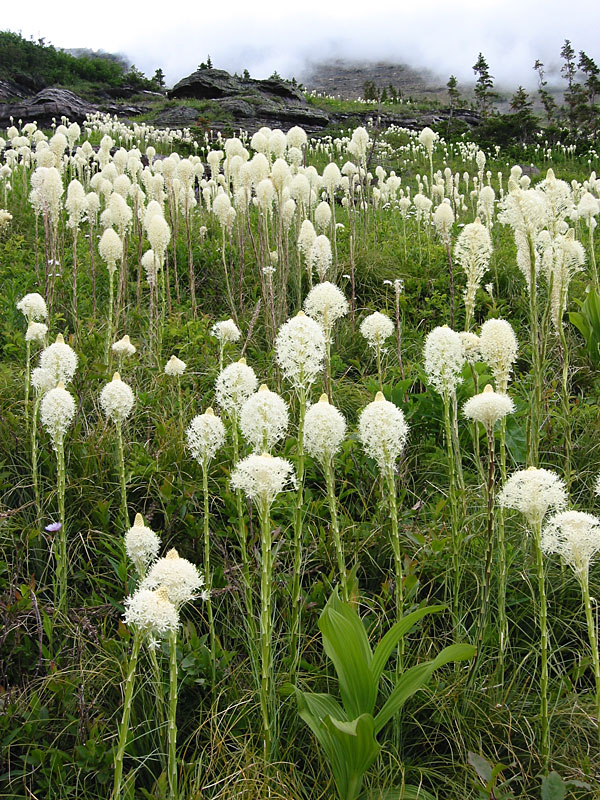
Xerophyllum tenax grows in subalpine meadows, coastal mountains, forest understories, and low ground in California's coastal fog belt. It has long, narrow leaves, white flowers, and fibrous foliage used by Native Americans to weave baskets.
Written 26 November 2026 from the sources listed below. Each statement was checked against the passage it cites; statements that could not be supported were removed.
Appearance
Its flowers are white and slightly fragrant, with six sepals and six stamens. Its seeds are small and tan-colored.[1][2][3]
The plant typically grows between 15 and 150 centimetres tall. Under preferred habitat and ideal conditions, it can exceed 1.2 metres in height.[4][5]
Habitat
Bear-grass grows in subalpine meadows, coastal mountains, and forest understories. It also occurs on low ground in California's coastal fog belt.[6][7][8]
The species occurs in western North America from British Columbia south to California and east to Wyoming. It occurs as far south as Monterey County in California and is common on the Olympic Peninsula, in the Cascades, northern Sierra Nevada, and Rocky Mountains.[9][10][11][12]
The plant grows more vigorously in areas with moderate to low canopy cover. Dense, shaded forests are associated with smaller and less productive plants, while open, disturbed habitats support larger plants with greater reproductive output.[13][14][15]
Diet
Bears feed on the plant's softer leaf bases. Deer and elk consume its flowers and other parts.[16][17]
Behaviour
Bear-grass typically flowers at irregular intervals influenced by moisture and temperature. Individual plants rarely flower in consecutive years, and depending on environmental conditions, plants may flower annually or only once in a decade.[18][19][20]
The plant can be among the first species to sprout in an area after it has been scorched by fire.[21]
Reproduction and life cycle
Bear-grass produces seeds that germinate following a cold period lasting 12 to 16 weeks. Smoke-water significantly increased the germination rates of its seeds in one study.[22][23]
Conservation
Bear-grass has rhizomes that survive fires. The plant is an important component of the fire ecology of its native regions.[24][25]
Uses
The plant's fibrous leaves become white when dried. They are tough, durable, easily dyed, and suitable for manipulation into tight waterproof weaves.[26][27]
Native Americans used bear-grass leaves to weave baskets. The Hupa used the plant to create border patterns in baskets.[28][29]
Native Americans historically roasted the plant's rootstock for food and ate its pods after cooking them.[30][31]
Native Americans braided dried leaves for use as adornments on traditional buckskin dresses and jewelry.[32]
Classification of the Bear-grass
| Kingdom | Plantae |
|---|---|
| Subkingdom | Pteridobiotina |
| Phylum | Tracheophyta |
| Class | Liliopsida |
| Order | Liliales |
| Family | Melanthiaceae (Bunchflower Family) |
| Genus | Xerophyllum (Beargrass) |
| Species | Xerophyllum tenax (Pursh) Nutt. |
Where the Bear-grass is found
Checklists and occurrence records place Xerophyllum tenax in 2 countries across North America. GBIF holds 10,584 georeferenced records of it.
Countries
Regions and cities with the most records
- Washington, United States 2,907
- Oregon, United States 2,253
- Montana, United States 1,739
- California, United States 1,205
- Idaho, United States 639
- British Columbia, Canada 506
- Alberta, Canada 491
- San Rafael, United States 84
- Santa Rosa, United States 70
- Agua Caliente, United States 66
- Washougal, United States 54
- Missoula, United States 52
- Monterey, United States 52
- Pacific Grove, United States 52
- Seaside, United States 52
- Marina, United States 51
- Rohnert Park, United States 51
- Novato, United States 44
- Camas, United States 35
- Richmond, United States 34
- Ashland, United States 33
- Napa, United States 25
- Live Oak, United States 21
- Santa Cruz, United States 19
- Wyoming, United States 19
- San Pablo, United States 14
- Windsor, United States 14
- Battle Ground, United States 12
- Troutdale, United States 10
- Bozeman, United States 8
- Columbia City, United States 8
- Mercer Island, United States 8
- Seattle, United States 8
- Gresham, United States 7
- Petaluma, United States 7
- Bellevue, United States 6
1 more country has a few records outside this range
These countries hold a few records of Xerophyllum tenax but lie outside the range the checklists give for it. Such records are often zoo or garden specimens, museum material or vagrants, so the species is not counted as occurring there.
A number beside a place is its count of GBIF occurrence records. A place without a number comes from a checklist alone. Records show where a species has been observed or collected, which can include escapes and vagrants.
Common names
English
- Bear-grass
- Indian Basket Grass
- Indian Basket-grass
- Bear-lily
- Beargrass
- Common Beargrass
- Elk-grass
- Elkgrass
- Fire-lily
- Quip-quip
- Soap Grass
- Western Turkey-beard
Names in 10 other languages
- Danish
- Bjørnegræs
- Estonian
- harilik karuhein
- Finnish
- karhunheinä
- French
- Herbe d'ours, xérophylle, xérophylle de l'Ouest
- German
- Bärengras
- Polish
- miądrzyga tęga
- Slovak
- sucholist húževnatý
- Swedish
- björnlilja
- chr
- ᏔᏆᎵ
- clm
- ƛ̕ə́ƛ̕
Synonyms
3 other scientific names have been used for this species and are now treated as synonyms of Xerophyllum tenax.
- Helonias tenax Pursh
- Xerophyllum douglasii S.Watson
- Melanthium spicatum Walter ambiguous synonym
Related species
-
 Eastern TurkeybeardXerophyllum asphodeloides
-
 White TrilliumTrillium grandiflorum
-
 California Corn LilyVeratrum californicum
-
 White VeratrumVeratrum album
-
 Death CamasToxicoscordion venenosum
-
 False HelleboreVeratrum viride
-
 Herb ParisParis quadrifolia
-
 Red TrilliumTrillium erectum
Compare
Questions and answers
What is the scientific name of the Bear-grass?
The scientific name of the Bear-grass is Xerophyllum tenax. Written with its author, the full name is Xerophyllum tenax (Pursh) Nutt..
Which family does the Bear-grass belong to?
Xerophyllum tenax belongs to the family Melanthiaceae, in the order Liliales and the class Liliopsida.
Where is the Bear-grass found?
Checklists and occurrence records place Xerophyllum tenax in 2 countries: United States and Canada.
What other names does the Bear-grass have?
Xerophyllum tenax is also known in English as Indian Basket Grass, Indian Basket-grass, Bear-lily, Beargrass, Common Beargrass and Elk-grass.
Sources
Passages the profile rests on
- Its flowers are white and slightly fragrant. Source passage: “a tightly packed raceme bears slightly fragrant white flowers.” — English Wikipedia
- Its flowers have six sepals and six stamens. Source passage: “These have six sepals and six stamens.” — English Wikipedia
- Its seeds are small and tan-colored. Source passage: “The plant produces small, tan-colored seeds” — English Wikipedia
- The plant typically grows between 15 and 150 centimetres tall. Source passage: “Xerophyllum tenax is a perennial herb that can grow to 15–150 centimetres (6–59 in) in height.” — English Wikipedia
- Under preferred habitat and ideal conditions, the plant can exceed 1.2 metres in height. Source passage: “Beargrass can grow to be a little over 1.2 metres (4 ft) tall when in a preferred habitat and ideal conditions.” — English Wikipedia
- The species grows in subalpine meadows and coastal mountains. Source passage: “in subalpine meadows and coastal mountains” — English Wikipedia
- The species also occurs on low ground in California's coastal fog belt. Source passage: “and also on low ground in the California coastal fog belt” — English Wikipedia
- The species grows in forest understories. Source passage: “The species typically grows in forest understories” — English Wikipedia
- The species occurs in western North America from British Columbia south to California and east to Wyoming. Source passage: “The plant is found mostly in western North America from British Columbia south to California and east to Wyoming” — English Wikipedia
- The species occurs as far south as Monterey County in California. Source passage: “as far south as Monterey County.” — English Wikipedia
- The species is common on the Olympic Peninsula. Source passage: “It is common on the Olympic Peninsula” — English Wikipedia
- The species is common in the Cascades, northern Sierra Nevada, and Rocky Mountains. Source passage: “and in the Cascades, northern Sierra Nevada and Rockies.” — English Wikipedia
- The plant grows more vigorously in areas with moderate to low canopy cover. Source passage: “The density and vigor of beargrass tends to be more robust in areas with moderate to low canopy cover” — English Wikipedia
- Dense, shaded forests are associated with smaller and less productive plants. Source passage: “In denser, shaded forests, the plant tends to be smaller and less productive.” — English Wikipedia
- Open, disturbed habitats support larger plants with greater reproductive output. Source passage: “with plants growing larger and reproducing more in open, disturbed habitats.” — English Wikipedia
- Bears feed on the plant's softer leaf bases. Source passage: “Bears eat the softer leaf bases” — English Wikipedia
- Deer and elk consume the plant's flowers and other parts. Source passage: “Deer and elk eat the flowers and other parts of the plant.” — English Wikipedia
- The plant typically flowers at irregular intervals influenced by moisture and temperature. Source passage: “the plant typically blooms at irregular intervals, depending on environmental factors such as moisture and temperature.” — English Wikipedia
- Individual plants rarely flower in consecutive years. Source passage: “back-to-back blooming of individual plants is rare.” — English Wikipedia
- Depending on environmental conditions, plants may flower annually or only once in a decade. Source passage: “plants may bloom every year or only once every decade” — English Wikipedia
- The plant can be among the first species to sprout in an area after it has been scorched by fire. Source passage: “The plant thrives with periodic burns and is often the first plant to sprout in a scorched area.” — English Wikipedia
- The plant produces seeds that germinate following a cold period lasting 12 to 16 weeks. Source passage: “which germinate after a cold period of 12 to 16 weeks.” — English Wikipedia
- Smoke-water significantly increased the germination rates of the plant's seeds in one study. Source passage: “One study found that smoke-water significantly increased the germination rates of beargrass seeds compared to controls.” — English Wikipedia
- The plant has rhizomes that survive fires. Source passage: “It has rhizomes which survive fire that clears dead and dying plant matter from the surface of the ground.” — English Wikipedia
- The plant is an important component of the fire ecology of its native regions. Source passage: “X. tenax is an important part of the fire ecology of regions where it is native.” — English Wikipedia
- The plant's fibrous leaves become white when dried. Source passage: “The fibrous leaves, which turn white as they dry” — English Wikipedia
- The leaves are tough, durable, easily dyed, and suitable for manipulation into tight waterproof weaves. Source passage: “are tough, durable, and easily dyed and manipulated into tight waterproof weaves.” — English Wikipedia
- Native Americans used the leaves to weave baskets. Source passage: “Native Americans have woven the plant in baskets” — English Wikipedia
- The Hupa used the plant to create border patterns in baskets. Source passage: “the Hupa, who use it to create a border pattern.” — English Wikipedia
- Native Americans historically roasted the plant's rootstock for food. Source passage: “Native Americans historically roasted the rootstock for food” — English Wikipedia
- Native Americans ate the plant's pods after cooking them. Source passage: “they also ate the pods, which are good cooked.” — English Wikipedia
- Native Americans braided dried leaves for use as adornments on traditional buckskin dresses and jewelry. Source passage: “Native Americans also braid dried leaves and adorn them on traditional buckskin dresses and jewelry.” — English Wikipedia
Data
- Catalogue of Life, 2026-10-16 XR cc by
- Global Biodiversity Information Facility CC BY 4.0
- Wikidata CC0
- GeoNames CC BY 4.0
- Wikimedia Commons per image; credit shown with each image
- Within the Catalogue of Life, this name comes from The World Checklist of Vascular Plants (WCVP) cc by
References
- Gen. N. Amer. Pl. 1: 235 (1818) where the name was published
This species in other databases
- Catalogue of Life 5CD9M
- Wikidata Q1019121
- iNaturalist 59524
- World Flora Online wfo-0000751972
- GRIN 451620
Page built on 28 November 2026. See how the catalog is made and all sources and licences.
Cite this page
ScientificNames.org. (2026). Xerophyllum tenax (Bear-grass). Retrieved November 28, 2026, from https://scientificnames.org/species/xerophyllum-tenax
“Xerophyllum tenax (Bear-grass).” ScientificNames.org, 2026, scientificnames.org/species/xerophyllum-tenax. Accessed 28 Nov. 2026.
ScientificNames.org. “Xerophyllum tenax (Bear-grass).” Accessed November 28, 2026. https://scientificnames.org/species/xerophyllum-tenax.
@misc{scientificnames_xerophyllum_tenax_bear_grass,
  author = {{ScientificNames.org}},
  title = {Xerophyllum tenax (Bear-grass)},
  year = {2026},
  url = {https://scientificnames.org/species/xerophyllum-tenax},
  note = {Accessed 2026-11-28}
}