Subfamily · Insects
Myrmicinae
Myrmicinae is a subfamily in the family Formicidae (ant). The Catalogue of Life lists 7,837 species in it, 7,608 of them living.
- Scientific name
- Myrmicinae Lepeletier de Saint-Fargeau, 1835
- Rank
- subfamily
- Belongs to
- Formicidae (Ant)
- Species
- 7,837
- Direct members
- 36
- Name status
- accepted in the Catalogue of Life
Best-known species of Myrmicinae
-
 Red Imported Fire AntSolenopsis invicta
-
 Pharaoh AntMonomorium pharaonis
- Asian Marauder AntCarebara diversa
-
 Electric AntWasmannia auropunctata
-
 Maricopa Harvester AntPogonomyrmex maricopa
-
 African Big-headed AntPheidole megacephala
-
 European Fire AntMyrmica rubra
-
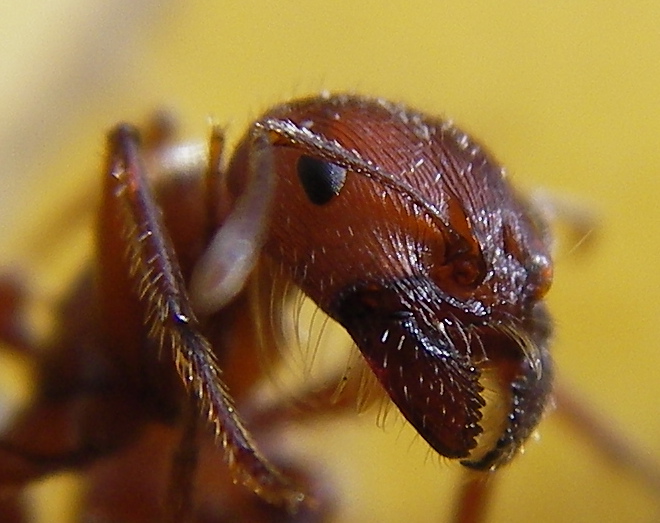 Red Harvester AntPogonomyrmex barbatus
- Atta laevigata
- Immigrant Pavement AntTetramorium immigrans
- Monomorium carbonarium
-
 Chicatana Leafcutter AntAtta mexicana
Members of Myrmicinae
36 in all. Those with an English name come first.
| Scientific name | Common name | Rank | Species |
|---|---|---|---|
| Eoformica extinct | genus | 6 | |
| Fallomyrma extinct | genus | 4 | |
| Electromyrmex extinct | genus | 2 | |
| Afromyrma extinct | genus | 1 | |
| Myrmecites extinct | genus | 6 | |
| Incertogaster extinct | genus | 3 | |
| Bilobomyrma extinct | genus | 2 | |
| Agastomyrma extinct | genus | 1 | |
| Boltonidris extinct | genus | 1 | |
| Miosolenopsis extinct | genus | 1 | |
| Crematogastrini | tribe | 3,218 | |
| Attini | tribe | 2,860 | |
| Solenopsidini | tribe | 796 | |
| Stenammini | tribe | 527 | |
| Myrmicini | tribe | 239 | |
| Pogonomyrmecini | tribe | 130 | |
| Eotemnothorax extinct | genus | 18 | |
| Biamomyrma extinct | genus | 3 | |
| Solenopsites extinct | genus | 3 | |
| Sinomyrmex extinct | genus | 2 | |
| Brachytarsites extinct | genus | 1 | |
| Cephalomyrmex extinct | genus | 1 | |
| Clavipetiola extinct | genus | 1 | |
| Eocenidris extinct | genus | 1 | |
| Eomyrmex extinct | genus | 1 | |
| Fushunomyrmex extinct | genus | 1 | |
| Lelejus extinct | genus | 1 | |
| Orbigastrula extinct | genus | 1 | |
| Promyrmicium | genus | 1 | |
| Quadrulicapito extinct | genus | 1 | |
| Quineangulicapito extinct | genus | 1 | |
| Sphaerogasterites extinct | genus | 1 | |
| Wumyrmex extinct | genus | 1 | |
| Zhangidris extinct | genus | 1 | |
| Nitidulus | genus | ||
| Triglyphotrix | genus |
Classification
| Kingdom | Animalia |
|---|---|
| Phylum | Arthropoda |
| Subphylum | Hexapoda |
| Class | Insecta (Insect) |
| Order | Hymenoptera (Ants) |
| Suborder | Apocrita (Ants) |
| Infraorder | Aculeata |
| Superfamily | Formicoidea |
| Family | Formicidae (Ant) |
| Subfamily | Myrmicinae Lepeletier de Saint-Fargeau, 1835 |
Sources
- Catalogue of Life, 2026-10-16 XR cc by
- Within the Catalogue of Life, this name comes from An Online Catalog of the Ants of the World cc by
References
- Lepeletier de Saint-Fargeau, A. (1835). Histoire naturelle des insectes. Hyménoptères. Tome I (p. 547 pp.). Roret, Paris. https://antcat.org/documents/5708/lepeletier-de-saint-fargeau_1835-histoire-naturelle-des-insectes-hymenopteres-tome-i.pdf Link
- Mayr, G. (1855). Formicina austriaca. Beschreibung der bisher im österreichischen Kaiserstaate aufgefundenen Ameisen, nebst Hinzufügung jener in Deutschland, in der Schweiz und in Italien vorkommenden Arten. Verhandlungen Der Zoologisch-Botanischen Vereins in Wien, 5, 273–478. https://antcat.org/documents/2121/4443.pdf Link
- Mayr, G. (1861). Die europäischen Formiciden. Nach der analytischen Methode bearbeitet (p. 80 pp.). C. Gerolds Sohn, Wien. https://antcat.org/documents/2123/8104.pdf Link
- Mayr, G. (1865). Formicidae. In Novara Expedition, Reise der Österreichischen Fregatte “Novara” um die Erde in den Jahren 1857, 1858, 1859. Zoologischer Theil. Bd. II. Abt. 1 (p. In:). https://antcat.org/documents/6498/mayr__g-_1865-_formicidae-_in___reise_der_osterreichischen_fregatte_-novara-_um_die_erde_in_den_jahren_1857__1858__1859-_zoologischer_theil-_bd-_ii-_abt-_1.pdf Link
- Mayr, G. (1867). Adnotationes in monographiam formicidarum Indo-Neerlandicarum. Tijdschrift Voor Entomologie, 10, 33–117. https://antcat.org/documents/2145/4367.pdf Link
- Mayr, G. (1868). Formicidae novae Americanae collectae a Prof. P. de Strobel. Annuario Della Società Dei Naturalisti E Matematici, Modena, 3, 161–178. https://antcat.org/documents/2148/4369.pdf Link
- Forel, A. (1874). Les fourmis de la Suisse. Systématique, notices anatomiques et physiologiques, architecture, distribution géographique, nouvelles expériences et observations de moeurs. Neue Denkschriften Der Allgemeinen Schweizerischen Gesellschaft Für Die Gesammten Naturwissenschaften, 26, 1–452. https://antcat.org/documents/1303/3910.pdf Link
- André, Ern. (1874). Description des fourmis d’Europe pour servir à l’étude des insectes myrmécophiles. [part]. Revue et Magasin de Zoologie Pure et Appliquée, (3)2, 161–192. https://antcat.org/references/142475 Link
- Forel, A. (1878). Études myrmécologiques en 1878 (première partie) avec l’anatomie du gésier des fourmis. Bulletin de La Société Vaudoise Des Sciences Naturelles, 15, 337–392. https://antcat.org/documents/1309/3912.pdf Link
- Saunders, E. (1880). Synopsis of the British Heterogyna and fossorial Hymenoptera. Transactions of the Entomological Society of London, 1880, 201–304. https://antcat.org/documents/2663/3592.pdf Link
- Cresson, E. T. Sr. (1887). Synopsis of the families and genera of the Hymenoptera of America, north of Mexico, together with a catalogue of the described species, and bibliography. Transactions of the American Entomological Society, Suppl. Vol., 1887, 1–351. https://antcat.org/documents/5920/cresson_1887_trans_am_entomol_soc-hymenoptera_north_america.pdf Link
- Nasonov, N. V. (1889). Contribution to the natural history of the ants primarily of Russia. 1. Contribution to the ant fauna of Russia. [In Russian.]. Izvestiya Imperatorskago Obshchestva Lyubitelei Estestvoznaniya Antropologii I Etnografii Pri Imperatorskom Moskovskom Universitete, 58, 1–78. https://antcat.org/references/127508 Link
- Forel, A. (1891). Les Formicides. [part]. In A. Grandidier, Histoire physique, naturelle, et politique de Madagascar. Volume XX. Histoire naturelle des Hyménoptères. Deuxième partie (28e fascicule) (p. In:). https://antcat.org/documents/1330/6734.pdf Link
- Lameere, A. (1892). Note sur les fourmis de la Belgique. Annales de La Société Entomologique de Belgique, 36, 61–69. https://antcat.org/references/126777 Link
- Dalla Torre, K. W. (1893). Catalogus Hymenopterorum hucusque descriptorum systematicus et synonymicus. Vol. 7. Formicidae (Heterogyna) (p. 289 pp.). W. Engelmann, Leipzig. https://antcat.org/documents/838/7602.pdf Link
- Emery, C. (1895). Die Gattung Dorylus Fab. und die systematische Eintheilung der Formiciden. Zoologische Jahrbücher. Abteilung Für Systematik, Geographie Und Biologie Der Tiere, 8, 685–778. https://antcat.org/documents/1115/3790.pdf Link
- Emery, C. (1896). Clef analytique des genres de la famille des Formicides, pour la détermination des neutres. Annales de La Société Entomologique de Belgique, 40, 172–189. https://antcat.org/documents/1121/3796.pdf Link
- Forel, A. (1902). Les Formicides de l’Empire des Indes et de Ceylan. Part IX. Journal of the Bombay Natural History Society, 14, 520–546. https://antcat.org/documents/1398/3985.pdf Link
- Bingham, C. T. (1903). The fauna of British India, including Ceylon and Burma. Hymenoptera, Vol. II. Ants and Cuckoo-wasps (p. 506 pp.). Taylor and Francis, London. https://antcat.org/documents/226/8153.pdf Link
- Ruzsky, M. (1905). The ants of Russia. (Formicariae Imperii Rossici). Systematics, geography and data on the biology of Russian ants. Part I. [In Russian.]. Trudy Obshchestva Estestvoispytatelei Pri Imperatorskom Kazanskom Universitete, 38(4-6), 1–800. https://antcat.org/references/128184 Link
- Wasmann, E. (1906). Zur Kenntniss der Ameisen und Ameisengäste von Luxemburg. Archives. Institut Grand-Ducal de Luxembourg, (n.s.)1(1/2), 104–124. https://antcat.org/documents/3162/2972.pdf Link
- Handlirsch, A. (1907). Die fossilen Insekten und die Phylogenie der rezenten Formen. Ein Handbuch für Paläontologen und Zoologen. Lieferung 6 (p. pp. 801–960.). Wilhelm Engelmann, Leipzig. https://antcat.org/references/125751 Link
- Bondroit, J. (1910). Les fourmis de Belgique. Annales de La Société Entomologique de Belgique, 53, 479–500. https://antcat.org/documents/272/6457.pdf Link
- Wheeler, W. M. (1910). Ants: their structure, development and behavior (p. xxv + 663 pp.). Columbia University Press, New York. https://antcat.org/documents/7245/7245 Link
- Emery, C. (1912). Études sur les Myrmicinae. [I-IV.]. Annales de La Société Entomologique de Belgique, 56, 94–105. https://antcat.org/documents/1180/3855.pdf Link
In other databases
Cite this page
ScientificNames.org. (2026). Myrmicinae. Retrieved November 26, 2026, from https://scientificnames.org/taxon/myrmicinae
“Myrmicinae.” ScientificNames.org, 2026, scientificnames.org/taxon/myrmicinae. Accessed 26 Nov. 2026.
ScientificNames.org. “Myrmicinae.” Accessed November 26, 2026. https://scientificnames.org/taxon/myrmicinae.
@misc{scientificnames_myrmicinae,
  author = {{ScientificNames.org}},
  title = {Myrmicinae},
  year = {2026},
  url = {https://scientificnames.org/taxon/myrmicinae},
  note = {Accessed 2026-11-26}
}