Species · Insects
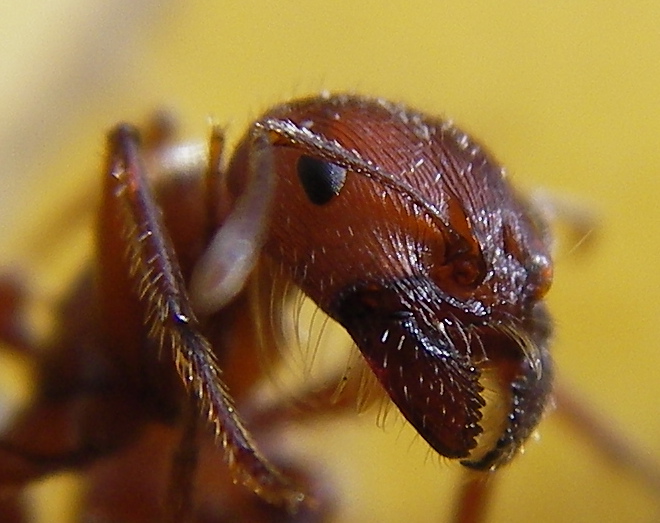
Maricopa Harvester Ant Pogonomyrmex maricopa
The scientific name of the Maricopa Harvester Ant is Pogonomyrmex maricopa. It is a species of insect in the family Formicidae (ant), order Hymenoptera. The name dates from 1914.
- Scientific name
- Pogonomyrmex maricopa Wheeler, 1914
- Common name
- Maricopa Harvester Ant
- Genus
- Pogonomyrmex
- Family
- Formicidae (Ant)
- Order
- Hymenoptera
- Class
- Insecta
- Recorded in
- 2 countries
- Name status
- accepted in the Catalogue of Life

Overview
Pogonomyrmex maricopa builds cemented nest caps containing approximately 60% calcium carbonate that protect its nests from erosion during high winds.
Written 26 November 2026 from the sources listed below. Each statement was checked against the passage it cites; statements that could not be supported were removed.
Habitat
The species constructs nests in fine sand dune areas.[1]
Appearance
The species' nest mounds can incorporate rocks and gravel. Its cemented nest caps consist of approximately 60% calcium carbonate.[2][3]
Behaviour
The species builds cemented nest caps that protect its nests from erosion during high winds. Partial erosion of the caps contributes calcium carbonate to sand dune soils.[4][5]
An alkaloid in the species' venom releases an alarm pheromone that chemically alerts nearby ants.[6]
The species contributes to decomposition by carrying dead insect carcasses underground. This transport enriches soil for plants and crops.[7][8]
A sting from this species can cause intense human pain lasting four to eight hours.[9]
The species has a reported venom LD50 of 0.12 mg/kg when injected intravenously into mice. Twelve stings can kill a rat weighing 2 kg.[10][11]
Its venom contains amino acids, peptides, proteins, alkaloids, terpenes, polysaccharides, biogenic amines, and organic acids.[12][13]
Classification of the Maricopa Harvester Ant
| Kingdom | Animalia |
|---|---|
| Phylum | Arthropoda |
| Subphylum | Hexapoda |
| Class | Insecta (Insect) |
| Order | Hymenoptera (Ants) |
| Suborder | Apocrita (Ants) |
| Infraorder | Aculeata |
| Superfamily | Formicoidea |
| Family | Formicidae (Ant) |
| Subfamily | Myrmicinae |
| Tribe | Pogonomyrmecini |
| Genus | Pogonomyrmex (Harvester Ants) |
| Species | Pogonomyrmex maricopa Wheeler, 1914 |
Where the Maricopa Harvester Ant is found
Checklists and occurrence records place Pogonomyrmex maricopa in 2 countries. GBIF holds 2,074 georeferenced records of it.
Countries
Regions and cities with the most records
- Arizona, United States 631
- New Mexico, United States 290
- Utah, United States 227
- Texas, United States 222
- Sonora, Mexico 137
- Chihuahua, Mexico 120
- Catalina Foothills, United States 112
- Casas Adobes, United States 96
- Hermosillo, Mexico 96
- Flowing Wells, United States 94
- Tucson, United States 86
- Tanque Verde, United States 85
- Oro Valley, United States 84
- Rio Rancho, United States 71
- Albuquerque, United States 70
- South Valley, United States 69
- Hurricane, United States 63
- California, United States 56
- Drexel Heights, United States 53
- El Paso, United States 48
- Ciudad Juárez, Mexico 47
- Sunland Park, United States 43
- Saint George, United States 39
- Washington, United States 39
- Socorro, United States 32
- Green Valley, United States 31
- Socorro Mission Number 1 Colonia, United States 27
- Somerton, United States 25
- Sahuarita, United States 24
- Las Cruces, United States 21
- Fountain Hills, United States 19
- Nevada, United States 17
- Yuma, United States 17
- Apache Junction, United States 16
- Coahuila, Mexico 15
- Horizon City, United States 15
A number beside a place is its count of GBIF occurrence records. A place without a number comes from a checklist alone. Records show where a species has been observed or collected, which can include escapes and vagrants.
Common names
English
- Maricopa Harvester Ant
Synonyms
4 other scientific names have been used for this species and are now treated as synonyms of Pogonomyrmex maricopa.
- Pogonomyrmex californicus barnesi Smith, 1929
- Pogonomyrmex californicus maricopa Wheeler, 1914
- Pogonomyrmex californicus sinaloanus Olsen, 1934
- Pogonomyrmex maricopa barnesi Smith, 1929
Related species
-
 Red Harvester AntPogonomyrmex barbatus
-
 Florida Harvester AntPogonomyrmex badius
-
 Western Harvester AntPogonomyrmex occidentalis
-
 California Harvester AntPogonomyrmex californicus
-
 Rough Harvester AntPogonomyrmex rugosus
-
 Comanche Harvester AntPogonomyrmex comanche
-
 Bicolored Harvester AntPogonomyrmex bicolor
-
 Pogonomyrmex anergismus
Compare
Questions and answers
What is the scientific name of the Maricopa Harvester Ant?
The scientific name of the Maricopa Harvester Ant is Pogonomyrmex maricopa. Written with its author, the full name is Pogonomyrmex maricopa Wheeler, 1914.
Which family does the Maricopa Harvester Ant belong to?
Pogonomyrmex maricopa belongs to the family Formicidae, in the order Hymenoptera and the class Insecta.
Where is the Maricopa Harvester Ant found?
Checklists and occurrence records place Pogonomyrmex maricopa in 2 countries: United States and Mexico.
How venomous is the Maricopa harvester ant?
The species has a reported venom LD50 of 0.12 mg/kg when injected intravenously into mice. Twelve stings can kill a rat weighing 2 kg. Its venom contains amino acids, peptides, proteins, alkaloids, terpenes, polysaccharides, biogenic amines, and organic acids.[10][11][12][13]
What happens if a harvester ant bites you?
A sting from the Maricopa harvester ant can cause intense human pain lasting four to eight hours.[9]
Sources
Passages the profile rests on
- The species constructs nests in fine sand dune areas. Source passage: “The ants construct cemented caps on the sand mound nests in a fine sand dune area.” — English Wikipedia
- The species' nest mounds can incorporate rocks and gravel. Source passage: “Their nest mounds are likely to incorporate rocks and gravel.” — English Wikipedia
- The cemented nest caps consist of approximately 60% calcium carbonate. Source passage: “The caps are approximately 60% calcium carbonate” — English Wikipedia
- The species builds cemented nest caps that protect its nests from erosion during high winds. Source passage: “protect the nest structure from being eroded away during high-wind periods.” — English Wikipedia
- Partial erosion of the nest caps contributes calcium carbonate to sand dune soils. Source passage: “Partial erosion of the cemented caps adds calcium carbonate to the sand dune soils.” — English Wikipedia
- An alkaloid in the species' venom releases an alarm pheromone that chemically alerts nearby ants. Source passage: “an alkaloid poison that releases an "alarm" pheromone which chemically alerts other ants in the vicinity.” — English Wikipedia
- The species contributes to decomposition by carrying dead insect carcasses underground. Source passage: “by dragging dead carcasses of insects underground” — English Wikipedia
- The species' underground transport of dead insect carcasses enriches soil for plants and crops. Source passage: “thereby enriching soil for plants and crops.” — English Wikipedia
- A sting from this species can cause intense human pain lasting four to eight hours. Source passage: “In humans, a Pogonomyrmex sting produces intense pain that can last from four to eight hours.” — English Wikipedia
- The species has a reported venom LD50 of 0.12 mg/kg when injected intravenously into mice. Source passage: “Its LD50 value is 0.12 mg/kg (injected intravenously in mice)” — English Wikipedia
- Twelve stings from this species can kill a rat weighing 2 kg. Source passage: “12 stings can kill a 2-kg rat.” — English Wikipedia
- The species' venom contains amino acids, peptides, and proteins. Source passage: “the venom of the Maricopa harvester ant consists of amino acids, peptides, and proteins.” — English Wikipedia
- The species' venom also contains alkaloids, terpenes, polysaccharides, biogenic amines, and organic acids. Source passage: “It also encompasses alkaloids, terpenes, polysaccharides, biogenic amines, and organic acids.” — English Wikipedia
Data
- Catalogue of Life, 2026-10-16 XR cc by
- Global Biodiversity Information Facility CC BY 4.0
- Wikidata CC0
- GeoNames CC BY 4.0
- Wikimedia Commons per image; credit shown with each image
- iNaturalist per image; credit shown with each image
- Within the Catalogue of Life, this name comes from An Online Catalog of the Ants of the World cc by
References
- Wheeler, W. M. (1914). New and little known harvesting ants of the genus Pogonomyrmex. Psyche (Cambridge), 21, 149–157. https://antcat.org/documents/3485/10601.pdf Link where the name was published
This species in other databases
Page built on 28 November 2026. See how the catalog is made and all sources and licences.
Cite this page
ScientificNames.org. (2026). Pogonomyrmex maricopa (Maricopa Harvester Ant). Retrieved November 28, 2026, from https://scientificnames.org/species/pogonomyrmex-maricopa
“Pogonomyrmex maricopa (Maricopa Harvester Ant).” ScientificNames.org, 2026, scientificnames.org/species/pogonomyrmex-maricopa. Accessed 28 Nov. 2026.
ScientificNames.org. “Pogonomyrmex maricopa (Maricopa Harvester Ant).” Accessed November 28, 2026. https://scientificnames.org/species/pogonomyrmex-maricopa.
@misc{scientificnames_pogonomyrmex_maricopa_maricopa_harvester_ant,
  author = {{ScientificNames.org}},
  title = {Pogonomyrmex maricopa (Maricopa Harvester Ant)},
  year = {2026},
  url = {https://scientificnames.org/species/pogonomyrmex-maricopa},
  note = {Accessed 2026-11-28}
}