Species · Insects
Red Harvester Ant Pogonomyrmex barbatus
The scientific name of the Red Harvester Ant is Pogonomyrmex barbatus. It is a species of insect in the family Formicidae (ant), order Hymenoptera. The name dates from 1858.
- Scientific name
- Pogonomyrmex barbatus (Smith, 1858)
- Common name
- Red Harvester Ant
- Genus
- Pogonomyrmex
- Family
- Formicidae (Ant)
- Order
- Hymenoptera
- Class
- Insecta
- Recorded in
- 2 countries
- Name status
- accepted in the Catalogue of Life
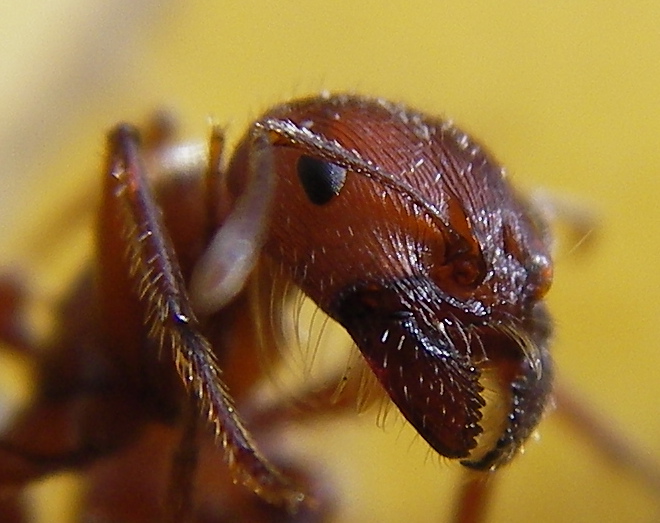
Overview
The species is native to the southwestern United States, with a range extending into Mexico. Workers are generally red, measure approximately 5–7 mm in length, and collect seeds as their primary food source.
Written 26 November 2026 from the sources listed below. Each statement was checked against the passage it cites; statements that could not be supported were removed.
Appearance
Workers are generally red, with variations in light and dark coloration. Adult ants measure approximately 5–7 mm in length, and workers are monomorphic, although some variation in size occurs.[1][2][3]
The species has 12-segmented antennae without a club. The underside of the head bears a row of hairs called a psammaphore, and the epinotum bears a pair of spines.[4][5][6]
Habitat
The species prefers arid chaparral habitats. In the United States, it nests in soil on open land at comparatively low elevations and may occur more frequently in cultivated land than in uncultivated land because of food availability.[7][8][9]
Nests are established in barren circular areas with a single entrance hole. The nesting area averages approximately 12 feet in diameter and ranges from 3 to 35 feet.[10][11]
Nests consist of multiple tunnels and chambers used for seed storage. One reported nest extended 15 feet underground and contained 436 chambers.[12][13]
Diet
Seeds constitute the primary food source of the species. The ants also collect dead insects while foraging and consume scavenged arthropod flesh.[14][15][16]
Collected foods include alfalfa, burr clover, Johnson grass, oats, wheat, Bermuda grass, wild sunflower, mesquite, and beans.[17]
Behaviour
The ants grind collected seeds into a bread-like consistency before storing them in granaries. These seed stores can provide food for the colony throughout the year.[18][19]
Chemical signals guide foraging ants as far as 50–60 metres from their nest. Foraging trails may extend approximately 200 feet from the nest entrance.[20][21]
Nest patrollers emerge before other foraging workers to assess foraging safety and profitability. Colonies regulate foraging activity through chemical communication and feedback between returning and departing workers.[22][23]
Workers perform five major nonreproductive tasks: foraging, nest maintenance, defense, midden work, and convening. Worker roles are flexible and are influenced by chemical interactions.[24][25]
The species defends its colonies vigorously against perceived or actual attacks. Colonies may be delayed by one to three hours when competing ants plug their nest entrances.[26][27]
Reproduction and life cycle
New colonies are established through mating flights, which most commonly occur following rainfall during August and September. Males take flight before females and swarm above a landmark.[28][29][30]
Females fly from their nests into male swarms and select one or two males for mating. A newly mated queen establishes a new colony after locating a suitable nesting site.[31][32]
The primary brood of nonreproductive workers emerges approximately six to eight weeks after colony founding. Some populations exhibit genetic queen-worker caste determination.[33][34]
Conservation
Populations of the species have declined over time. Competition for food with invasive red imported fire ants and Argentine ants has frequently been suggested as a cause of population decline.[35][36]
Uses
The species contributes to seed dispersal through myrmecochory.[37]
Similar species
The Red Harvester Ant is frequently mistaken for fire ants, despite not being closely related to any native or introduced fire ant species.[38]
Classification of the Red Harvester Ant
| Kingdom | Animalia |
|---|---|
| Phylum | Arthropoda |
| Subphylum | Hexapoda |
| Class | Insecta (Insect) |
| Order | Hymenoptera (Ants) |
| Suborder | Apocrita (Ants) |
| Infraorder | Aculeata |
| Superfamily | Formicoidea |
| Family | Formicidae (Ant) |
| Subfamily | Myrmicinae |
| Tribe | Pogonomyrmecini |
| Genus | Pogonomyrmex (Harvester Ants) |
| Species | Pogonomyrmex barbatus (Smith, 1858) |
Where the Red Harvester Ant is found
Checklists and occurrence records place Pogonomyrmex barbatus in 2 countries. GBIF holds 11,546 georeferenced records of it.
Countries
Regions and cities with the most records
- Texas, United States 6,484
- Arizona, United States 2,037
- New Mexico, United States 469
- San Antonio, United States 299
- McAllen, United States 289
- Mission, United States 262
- Alton, United States 260
- Austin, United States 255
- Reynosa, Mexico 254
- Pharr, United States 253
- Corpus Christi, United States 244
- Lubbock, United States 233
- México, Mexico 228
- Oklahoma, United States 211
- Sierra Vista, United States 185
- Tanque Verde, United States 179
- Fort Worth, United States 164
- Wichita Falls, United States 162
- Coahuila, Mexico 154
- Alamo, United States 153
- San Salvador Atenco, Mexico 147
- Chiconcuac, Mexico 145
- Santa María Chimalhuacán, Mexico 143
- San Juan, United States 138
- Tepexpan, Mexico 131
- Chicoloapan de Juárez, Mexico 129
- Tezoyuca, Mexico 129
- Donna, United States 128
- Santa María Tulantongo, Mexico 128
- Ciudad Nezahualcoyotl, Mexico 127
- Converse, United States 127
- Catalina Foothills, United States 125
- San Miguel Coatlinchán, Mexico 123
- Ojo de Agua, Mexico 120
- San Martín Azcatepec, Mexico 119
- Tecámac de Felipe Villanueva, Mexico 118
A number beside a place is its count of GBIF occurrence records. A place without a number comes from a checklist alone. Records show where a species has been observed or collected, which can include escapes and vagrants.
Common names
English
- Red Harvester Ant
Names in 4 other languages
- Dutch
- Rode maaimier, Rode oogstmier
- French
- Fourmi rouge moissonneuse
- Russian
- Бородатый муравей-жнец
- Spanish
- Hormiga cosechadora roja
Synonyms
4 other scientific names have been used for this species and are now treated as synonyms of Pogonomyrmex barbatus.
- Myrmica barbata Smith, 1858
- Myrmica molefaciens Buckley, 1860
- Pogonomyrmex barbatus nigrescens Wheeler, 1902
- Pogonomyrmex molefaciens (Buckley, 1860)
Related species
-
 Maricopa Harvester AntPogonomyrmex maricopa
-
 Florida Harvester AntPogonomyrmex badius
-
 Western Harvester AntPogonomyrmex occidentalis
-
 California Harvester AntPogonomyrmex californicus
-
 Rough Harvester AntPogonomyrmex rugosus
-
 Comanche Harvester AntPogonomyrmex comanche
-
 Bicolored Harvester AntPogonomyrmex bicolor
-
 Pogonomyrmex anergismus
Compare
Questions and answers
What is the scientific name of the Red Harvester Ant?
The scientific name of the Red Harvester Ant is Pogonomyrmex barbatus. Written with its author, the full name is Pogonomyrmex barbatus (Smith, 1858).
Which family does the Red Harvester Ant belong to?
Pogonomyrmex barbatus belongs to the family Formicidae, in the order Hymenoptera and the class Insecta.
Where is the Red Harvester Ant found?
Checklists and occurrence records place Pogonomyrmex barbatus in 2 countries: United States and Mexico.
What do red harvester ants eat?
Seeds are their primary food source. They also collect dead insects and consume scavenged arthropod flesh.[14][15][16]
Sources
Passages the profile rests on
- Workers are generally red, with variations in light and dark coloration. Source passage: “Pogonomyrmex barbatus is generally red in color with some light/dark variations.” — urbanentomology.tamu.edu
- Adult ants measure approximately 5–7 mm in length. Source passage: “These large (5 to 7 mm) ants” — English Wikipedia
- Workers are monomorphic, although some variation in their size occurs. Source passage: “The workers of this species are monomorphic (one size) although variations in size occur.” — urbanentomology.tamu.edu
- The species has 12-segmented antennae without a club. Source passage: “They have 12-segmented antennae without a club” — urbanentomology.tamu.edu
- The underside of the head bears a row of hairs called a psammaphore. Source passage: “Have a row of hairs on the underside of the head (psammaphore)” — urbanentomology.tamu.edu
- The epinotum bears a pair of spines. Source passage: “The epinotum is armed with a pair of spines.” — urbanentomology.tamu.edu
- The species prefers arid chaparral habitats. Source passage: “These large (5 to 7 mm) ants prefer arid chaparral habitats” — English Wikipedia
- In the United States, the species nests in soil on open land at comparatively low elevations. Source passage: “In the United States, Pogonomyrmex barbatus occurs in areas of comparatively low elevations, nesting in soil on open land.” — urbanentomology.tamu.edu
- The species may occur more frequently in cultivated land than in uncultivated land because of food availability. Source passage: “They may be more commonly found in cultivated land than non-cultivated because of the available food.” — urbanentomology.tamu.edu
- Nests are established in barren circular areas with a single entrance hole. Source passage: “They nest in barren circular areas of varying size with a single entry hole.” — urbanentomology.tamu.edu
- The nesting area averages approximately 12 feet in diameter and ranges from 3 to 35 feet. Source passage: “The nesting area averages about 12 feet in diameter but may range from 3 feet to 35 feet.” — urbanentomology.tamu.edu
- Nests consist of multiple tunnels and chambers used for seed storage. Source passage: “Nests are constructed consisting of many tunnels and chambers where the workers store seeds” — urbanentomology.tamu.edu
- One reported nest extended 15 feet underground and contained 436 chambers. Source passage: “one nest reportedly extended 15 feet deep and contained 436 chambers.” — urbanentomology.tamu.edu
- Seeds constitute the primary food source of the species. Source passage: “The main food source for red harvester ants usually consists of seeds” — English Wikipedia
- The species also collects dead insects while foraging. Source passage: “Dead insects are also collected during foraging.” — English Wikipedia
- The species consumes scavenged arthropod flesh in addition to seeds. Source passage: “seeds, which are the main food source, along with scavenged arthropod flesh.” — urbanentomology.tamu.edu
- The species collects alfalfa, burr clover, Johnson grass, oats, wheat, Bermuda grass, wild sunflower, mesquite, and beans. Source passage: “They prefer small seeds and gather Alfalfa, burr clover, Johnson grass, oats, wheat, Bermuda grass, wild sunflower, mesquite, beans, and others.” — urbanentomology.tamu.edu
- The ants grind collected seeds into a bread-like consistency before storing them in granaries. Source passage: “The food is first ground to a bread-like consistency using the ants' large mandibles, and is then stored in a granary” — English Wikipedia
- Seed stores can provide food for the colony throughout the year. Source passage: “assuring the colony access to food year-round.” — English Wikipedia
- Chemical signals guide foraging ants as far as 50–60 metres from their nest. Source passage: “Ant foraging is guided by chemical signals that lead the ants up to 50–60 m from the nest at times.” — English Wikipedia
- Foraging trails may extend approximately 200 feet from the nest entrance. Source passage: “Foraging trails may extend outward for 200 feet, becoming less distinct farther away from the nest.” — urbanentomology.tamu.edu
- Nest patrollers emerge before other foraging workers to assess foraging safety and profitability. Source passage: “On a given day, nest patrollers emerge first from the nest to assess the safety and profitability of foraging.” — English Wikipedia
- Colonies regulate foraging activity through chemical communication and feedback between returning and departing workers. Source passage: “Foraging is regulated using positive and negative feedback loops.” — English Wikipedia
- Workers perform five major nonreproductive tasks: foraging, nest maintenance, defense, midden work, and convening. Source passage: “Within nonreproductive P. barbatus worker ants, five major tasks are performed: foraging, maintenance of the nest, defense, midden work, and convening.” — English Wikipedia
- Worker roles are flexible and are influenced by chemical interactions. Source passage: “Roles are not constant and chemical interactions determine when certain ants engage in certain activities.” — English Wikipedia
- The species defends its colonies vigorously against perceived or actual attacks. Source passage: “Harvester ants defend their colonies vigorously against real or perceived attacks, whether by large or small animals.” — English Wikipedia
- Colonies may be delayed by one to three hours when competing ants plug their nest entrances. Source passage: “This delays activity of P. barbatus for one to three hours” — English Wikipedia
- New colonies are established through mating flights. Source passage: “New colonies are formed by mating flights.” — urbanentomology.tamu.edu
- Mating flights most commonly occur following rainfall during August and September. Source passage: “They occur most commonly following rain during August and September.” — urbanentomology.tamu.edu
- Males take flight before females and swarm above a landmark. Source passage: “Males take flight first and swarm above a landmark.” — urbanentomology.tamu.edu
- Females fly from their nests into male swarms and select one or two males for mating. Source passage: “Females emerge from the nest and fly into the swarm and select one or two males and mating follows.” — urbanentomology.tamu.edu
- A newly mated queen establishes a new colony after locating a suitable nesting site. Source passage: “The newly mated queen finds a suitable nesting site to start a new colony.” — urbanentomology.tamu.edu
- The primary brood of nonreproductive workers emerges approximately six to eight weeks after colony founding. Source passage: “Over the course of the following six to eight weeks, the primary brood of nonreproductive worker ants emerges” — English Wikipedia
- Some populations exhibit genetic queen-worker caste determination. Source passage: “Some Pogonomyrmex barbatus populations have a unique system of genetic queen-worker caste determination” — pmc.ncbi.nlm.nih.gov
- Populations of the species have declined over time. Source passage: “Over the years, their numbers have been declining” — English Wikipedia
- Competition for food with invasive red imported fire ants and Argentine ants has frequently been suggested as a cause of population decline. Source passage: “this has often been attributed to competition for food with the invasive red imported fire ant and the Argentine ant.” — English Wikipedia
- The species contributes to seed dispersal through myrmecochory. Source passage: “an ant-plant interaction through which the ants gain nutrients and the plants benefit through seed dispersal.” — English Wikipedia
- The red harvester ant is frequently mistaken for fire ants despite not being closely related to any native or introduced fire ant species. Source passage: “Red harvester ants are often mistaken for fire ants, but are not closely related to any fire ant species, native or introduced.” — English Wikipedia
- The species is native to the southwestern United States. Source passage: “are native to the Southwestern United States.” — English Wikipedia
- Its range extends from Kansas and Oklahoma through western Texas into Mexico, and southward through New Mexico and Arizona. Source passage: “ranges from Kansas and Oklahoma through western Texas into Mexico and southward through New Mexico and Arizona.” — urbanentomology.tamu.edu
- The species occurs sporadically in extreme southern Utah. Source passage: “It occurs sporadically in extreme southern Utah.” — urbanentomology.tamu.edu
Data
- Catalogue of Life, 2026-10-16 XR cc by
- Global Biodiversity Information Facility CC BY 4.0
- Wikidata CC0
- GeoNames CC BY 4.0
- Wikimedia Commons per image; credit shown with each image
- Within the Catalogue of Life, this name comes from An Online Catalog of the Ants of the World cc by
References
- Smith, F. (1858). Catalogue of hymenopterous insects in the collection of the British Museum. Part VI. Formicidae (p. 216 pp.). British Museum, London. https://antcat.org/documents/2734/8127.pdf Link where the name was published
This species in other databases
Page built on 30 November 2026. See how the catalog is made and all sources and licences.
Cite this page
ScientificNames.org. (2026). Pogonomyrmex barbatus (Red Harvester Ant). Retrieved November 30, 2026, from https://scientificnames.org/species/pogonomyrmex-barbatus
“Pogonomyrmex barbatus (Red Harvester Ant).” ScientificNames.org, 2026, scientificnames.org/species/pogonomyrmex-barbatus. Accessed 30 Nov. 2026.
ScientificNames.org. “Pogonomyrmex barbatus (Red Harvester Ant).” Accessed November 30, 2026. https://scientificnames.org/species/pogonomyrmex-barbatus.
@misc{scientificnames_pogonomyrmex_barbatus_red_harvester_ant,
  author = {{ScientificNames.org}},
  title = {Pogonomyrmex barbatus (Red Harvester Ant)},
  year = {2026},
  url = {https://scientificnames.org/species/pogonomyrmex-barbatus},
  note = {Accessed 2026-11-30}
}