Species · Fishes
Spiny Chromis Acanthochromis polyacanthus
The scientific name of the Spiny Chromis is Acanthochromis polyacanthus. It is a species of fish in the family Pomacentridae (damselfishes), order Perciformes. The name dates from 1855.
- Scientific name
- Acanthochromis polyacanthus (Bleeker, 1855)
- Common name
- Spiny Chromis
- Genus
- Acanthochromis
- Family
- Pomacentridae (Damselfishes)
- Order
- Perciformes
- Class
- Teleostei
- Red List category
- LC Least Concern
- Environment
- marine
- Recorded in
- 8 countries
- Name status
- accepted in the Catalogue of Life

Overview
The Spiny Chromis is the only species in the genus Acanthochromis. It occurs in the western Pacific Ocean, including western and central Indonesia, the Philippine islands except Luzon, and Melanesia. Adults exhibit geographic variation in coloration across the species' range.
Written 26 November 2026 from the sources listed below. Each statement was checked against the passage it cites; statements that could not be supported were removed.
Appearance
Adults exhibit geographic variation in coloration across the species' range. Juveniles typically have a yellow stripe running along their flanks.[1][2]
The species has 17 dorsal-fin spines and 14 to 16 dorsal-fin rays. It has two anal-fin spines and 14 to 16 anal-fin rays.[3][4]
Adults can reach a maximum length of 14 centimetres.[5]
Habitat
The Spiny Chromis usually inhabits coral reefs. It occurs at depths between 1 and 65 metres and is usually found at depths of 4 to 20 metres.[6][7][8]
Diet
The species consumes plankton and algae. It steals algae from damselfish that cultivate algae.[9][10]
Adult individuals feed on plankton. Juveniles consume mucus produced by their parents' skin.[11][12]
Behaviour
Adults exhibit sedentary behaviour.[13]
Reproduction and life cycle
Parents protect their offspring from the egg stage through hatching until they become fully developed juveniles. Offspring commonly settle on reefs close to their hatching locations.[14][15]
Classification of the Spiny Chromis
| Kingdom | Animalia |
|---|---|
| Phylum | Chordata |
| Subphylum | Vertebrata |
| Infraphylum | Gnathostomata |
| Parvphylum | Osteichthyes |
| Gigaclass | Actinopterygii |
| Superclass | Actinopteri |
| Class | Teleostei (Teleost) |
| Order | Perciformes |
| Family | Pomacentridae (Damselfishes) |
| Genus | Acanthochromis |
| Species | Acanthochromis polyacanthus (Bleeker, 1855) |
Where the Spiny Chromis is found
Checklists and occurrence records place Acanthochromis polyacanthus in 8 countries. GBIF holds 7,995 georeferenced records of it.
Countries
- Australia 6,786
- Indonesia 248
- New Caledonia 5
- Papua New Guinea 61
- Philippines 293
- Solomon Islands 509
- Timor Leste 10
- Vanuatu 83
Regions and cities with the most records
- Queensland, Australia 326
- Townsville, Australia 198
- Port-Vila, Vanuatu 41
- Manado, Indonesia 40
- Western Province, Solomon Islands 27
- Bauan, Philippines 18
- Bitung, Indonesia 16
- San Pascual, Philippines 16
- Taal, Philippines 12
- Batangas, Philippines 10
- Culion, Philippines 10
- Labuan Bajo, Indonesia 10
- Madang, Papua New Guinea 10
- Central Province, Solomon Islands 7
- El Nido, Philippines 6
- Kalabahi, Indonesia 6
- Madang Province, Papua New Guinea 6
- Puerto Princesa, Philippines 6
- Western Australia, Australia 6
- Calapan, Philippines 5
- San Jose, Philippines 5
- Shefa, Vanuatu 5
- Rosario, Philippines 4
- Sitangkai, Philippines 4
- Honiara, Solomon Islands 3
- Maluku, Indonesia 3
- Mansalay, Philippines 3
- Milne Bay Province, Papua New Guinea 3
- Tandai, Solomon Islands 3
A number beside a place is its count of GBIF occurrence records. A place without a number comes from a checklist alone. Records show where a species has been observed or collected, which can include escapes and vagrants.
Common names
English
- Spiny Chromis
- Spiny Puller
- Spiny-tail Puller
- Spotty-tail
Names in 9 other languages
- Catalan
- Castanyoleta espinosa
- Chinese
- 多刺棘光鰓雀鯛
- Czech
- sapínek mnohotrnný
- Danish
- Tornet safirfisk
- Dutch
- Zwaluwstaartjuffertje
- French
- Chromis à épines
- German
- Schwalbenschwanz-Riffbarsch
- Italian
- Castagnola spinosa
- Portuguese
- Donzela-de-espinho
Synonyms
9 other scientific names have been used for this species and are now treated as synonyms of Acanthochromis polyacanthus.
- Abudefduf jordani Seale, 1906
- Acanthochromis polyacathus (Bleeker, 1855)
- Acanthochromis polycanthus (Bleeker, 1855)
- Acanthocromis polyacanthus (Bleeker, 1855)
- Chromis desmostigma Fowler & Bean, 1928
- Dascyllus polyacanthus Bleeker, 1855
- Heptadecanthus brevipinnis De Vis, 1885
- Heptadecanthus longicaudis Alleyne & MacLeay, 1877
- Heptadecanthus maculosus De Vis, 1885
Related species
-
 Ocellaris ClownfishAmphiprion ocellaris
-
 GaribaldiHypsypops rubicundus
-
 Sergeant MajorAbudefduf saxatilis
-
 Blacktail HumbugDascyllus melanurus
-
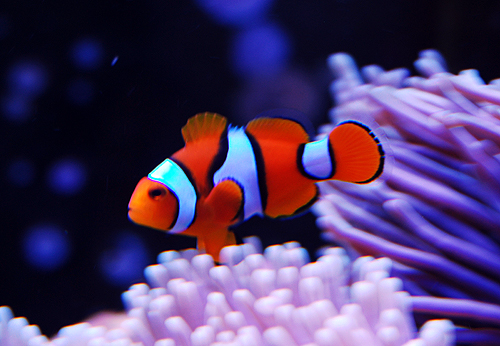 Orange ClownfishAmphiprion percula
-
 Green ChromisChromis viridis
-
 Threespot DascyllusDascyllus trimaculatus
-
 Clark's AnemonefishAmphiprion clarkii
Compare
Questions and answers
What is the scientific name of the Spiny Chromis?
The scientific name of the Spiny Chromis is Acanthochromis polyacanthus. Written with its author, the full name is Acanthochromis polyacanthus (Bleeker, 1855).
Which family does the Spiny Chromis belong to?
Acanthochromis polyacanthus belongs to the family Pomacentridae, in the order Perciformes and the class Teleostei.
Where is the Spiny Chromis found?
Checklists and occurrence records place Acanthochromis polyacanthus in 8 countries, including Australia, Solomon Islands, Philippines, Indonesia, Vanuatu and Papua New Guinea.
What is the conservation status of the Spiny Chromis?
The IUCN Red List category recorded for Acanthochromis polyacanthus is Least Concern (LC).
What other names does the Spiny Chromis have?
Acanthochromis polyacanthus is also known in English as Spiny Puller, Spiny-tail Puller and Spotty-tail.
Sources
Passages the profile rests on
- Adults exhibit geographic variation in coloration across the species' range. Source passage: “This species occurs in a wide range of colour variations, depending on geographic location.” — English Wikipedia
- Juveniles typically have a yellow stripe running along their flanks. Source passage: “Juveniles typically display a yellow stripe along their flanks.” — English Wikipedia
- The species has 17 dorsal-fin spines and 14 to 16 dorsal-fin rays. Source passage: “Its fins have 17 dorsal spines, 14 to 16 dorsal rays” — English Wikipedia
- The species has two anal-fin spines and 14 to 16 anal-fin rays. Source passage: “2 anal spines, and 14 to 16 anal rays.” — English Wikipedia
- Adults can reach a maximum length of 14 centimetres. Source passage: “Spiny chromis individuals can grow up to a maximum size of 14 centimetres (5.5 in) as adults.” — English Wikipedia
- The species usually inhabits coral reefs. Source passage: “This fish usually lives in coral reefs.” — English Wikipedia
- The species occurs at depths between 1 and 65 metres. Source passage: “This fish is found at a depth range of 1 to 65 metres (3.3 to 213.3 ft)” — English Wikipedia
- The species is usually found at depths of 4 to 20 metres. Source passage: “but is usually found at a depth range of 4 to 20 metres (13 to 66 ft).” — English Wikipedia
- The species consumes plankton and algae. Source passage: “This fish is planktivorous and algivorous” — English Wikipedia
- The species steals algae from damselfish that cultivate algae. Source passage: “and steals algae from algae-farming species of damselfish.” — English Wikipedia
- Juveniles consume mucus produced by their parents' skin. Source passage: “Juveniles consume mucus secreted from their parent's skin” — English Wikipedia
- Adult individuals feed on plankton. Source passage: “Adults feed on plankton.” — australian.museum
- Adults exhibit sedentary behaviour. Source passage: “sedentary behaviour of adults” — English Wikipedia
- Parents protect their offspring from the egg stage through hatching until they become fully developed juveniles. Source passage: “the parents protect their brood from the egg stage (which are laid on the reef), through hatching and onto the fully developed juvenile stage.” — English Wikipedia
- Offspring commonly settle on reefs close to their hatching locations. Source passage: “the offspring often take up residence on the reef not far from where they were hatched.” — English Wikipedia
Data
- Catalogue of Life, 2026-10-16 XR cc by
- Global Biodiversity Information Facility CC BY 4.0
- Wikidata CC0
- GeoNames CC BY 4.0
- Wikimedia Commons per image; credit shown with each image
- Within the Catalogue of Life, this name comes from World Register of Marine Species cc by
This species in other databases
- Catalogue of Life 64DY4
- Wikidata Q1851735
- iNaturalist 319335
- WoRMS urn:lsid:marinespecies.org:taxname:279469
- ITIS 170199
Page built on 26 November 2026. See how the catalog is made and all sources and licences.
Cite this page
ScientificNames.org. (2026). Acanthochromis polyacanthus (Spiny Chromis). Retrieved November 26, 2026, from https://scientificnames.org/species/acanthochromis-polyacanthus
“Acanthochromis polyacanthus (Spiny Chromis).” ScientificNames.org, 2026, scientificnames.org/species/acanthochromis-polyacanthus. Accessed 26 Nov. 2026.
ScientificNames.org. “Acanthochromis polyacanthus (Spiny Chromis).” Accessed November 26, 2026. https://scientificnames.org/species/acanthochromis-polyacanthus.
@misc{scientificnames_acanthochromis_polyacanthus_spiny_chromis,
  author = {{ScientificNames.org}},
  title = {Acanthochromis polyacanthus (Spiny Chromis)},
  year = {2026},
  url = {https://scientificnames.org/species/acanthochromis-polyacanthus},
  note = {Accessed 2026-11-26}
}