Species · Fishes
Ocellaris Clownfish Amphiprion ocellaris
The scientific name of the Ocellaris Clownfish is Amphiprion ocellaris. It is a species of fish in the family Pomacentridae (damselfishes), order Perciformes. The name dates from 1830.
- Scientific name
- Amphiprion ocellaris Cuvier, 1830
- Common name
- Ocellaris Clownfish
- Genus
- Amphiprion
- Family
- Pomacentridae (Damselfishes)
- Order
- Perciformes
- Class
- Teleostei
- Red List category
- LC Least Concern
- Environment
- marine
- Recorded in
- 13 countries
- Name status
- accepted in the Catalogue of Life

Overview
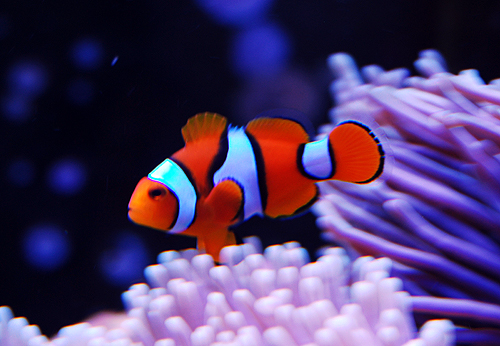
Amphiprion ocellaris inhabits coral reefs, outer reef slopes, and sheltered lagoons at depths reaching 15 meters. It typically has an orange to reddish-brown body with three white bands outlined by thin black markings and a rounded caudal fin.
Written 26 November 2026 from the sources listed below. Each statement was checked against the passage it cites; statements that could not be supported were removed.
Appearance
The Ocellaris Clownfish typically has an orange to reddish-brown body with three white bands outlined in black. Some populations have black bodies with white bands instead of the usual orange coloration.[1][2]
The middle white band extends forward toward the head at its center. The caudal fin is rounded.[3][4]
The species has 11 dorsal spines, 17 pectoral rays, and 34 to 48 scales along its lateral line. Thin black bands separate the orange body coloration from the white bands.[5][6][7]
The maximum reported total length is 11 cm. Females are larger than males.[8][9]
Habitat
The Ocellaris Clownfish inhabits coral reefs and sheltered lagoons at depths reaching 15 meters. It occurs on outer reef slopes and in sheltered lagoons, generally in small groups.[10][11]
The species associates with the sea anemones Heteractis magnifica, Stichodactyla gigantea, and Stichodactyla mertensii. Its tropical marine habitats are associated with rocky or coral reefs.[12][13]
Juveniles move from surface waters toward the bottom when searching for a host anemone.[14]
Diet
The Ocellaris Clownfish feeds on algae, copepods, zooplankton, and isopods. It also obtains food from its host anemone, including dead tentacles and prey captured by the anemone.[15][16][17]
Behaviour
The Ocellaris Clownfish is active during daylight hours and is territorial toward its host anemone. It forms a symbiotic relationship with host sea anemones.[18][19][20]
Mucus protects the fish from the stinging tentacles of its host anemone. Juveniles entering an occupied anemone may experience aggression from resident fish and be driven away.[21][22]
Reproduction and life cycle
The Ocellaris Clownfish is protandrous hermaphroditic, with individuals developing first as males and potentially becoming females later. If the female disappears or dies, the largest male can change sex and become female.[23][24]
Breeding pairs are monogamous. Before spawning, the male prepares a nest on bare rock near the protective tentacles of the host anemone.[25][26]
Females lay eggs over approximately one to two hours. Each female produces between 100 and 1,000 eggs, depending on her age, and the eggs measure approximately 3–4 mm in length.[27][28][29]
Eggs generally hatch after six to eight days, with incubation duration influenced by water temperature. The male performs most egg-care duties, including fanning the eggs and removing infertile or fungus-damaged eggs.[30][31]
The planktonic larval stage lasts approximately eight to twelve days. Spawning is concentrated around the full moon and usually takes place in the morning.[32][33]
Conservation
Local populations have been affected by collection for the aquarium trade. The species is not listed as endangered or threatened on the IUCN Red List.[34][35]
Habitat degradation affecting coral reefs is identified as a potential future threat.[36]
Uses
The Ocellaris Clownfish is used in the tropical fish aquarium trade and in research because it can be bred easily.[37][38]
The species is successfully raised in aquaculture facilities to reduce pressure on wild populations supplying the aquarium trade.[39]
Similar species
Amphiprion percula is a closely related species distinguished by its thicker black body markings. The Ocellaris Clownfish typically has 11 dorsal-fin spines, compared with 10 in Amphiprion percula.[40][41]
Classification of the Ocellaris Clownfish
| Kingdom | Animalia |
|---|---|
| Phylum | Chordata |
| Subphylum | Vertebrata |
| Infraphylum | Gnathostomata |
| Parvphylum | Osteichthyes |
| Gigaclass | Actinopterygii |
| Superclass | Actinopteri |
| Class | Teleostei (Teleost) |
| Order | Perciformes |
| Family | Pomacentridae (Damselfishes) |
| Subfamily | Amphiprioninae |
| Genus | Amphiprion (Clownfish) |
| Species | Amphiprion ocellaris Cuvier, 1830 |
Where the Ocellaris Clownfish is found
Checklists and occurrence records place Amphiprion ocellaris in 13 countries. GBIF holds 3,614 georeferenced records of it.
Countries
- India 48
- Indonesia 1,379
- Israel 4
- Japan 303
- Jordan 3
- Malaysia 525
- Myanmar 11
- Philippines 851
- Singapore 145
- Sri Lanka 3
- Taiwan 20
- Thailand 315
- Vietnam 7
Regions and cities with the most records
- Donggongon, Malaysia 166
- Petagas, Malaysia 166
- Putatan, Malaysia 166
- Kota Kinabalu, Malaysia 165
- Amlapura, Indonesia 136
- Amlapura city, Indonesia 136
- Bedugul, Indonesia 136
- Bukit Timah, Singapore 125
- Jurong East, Singapore 125
- Jurong Town, Singapore 125
- Queenstown Estate, Singapore 125
- Singapore, Singapore 125
- Anak Bukit, Singapore 124
- Novena, Singapore 124
- MacPherson, Singapore 119
- Marine Parade, Singapore 114
- Boon Lay, Singapore 112
- Jurong West, Singapore 111
- Bukit Panjang New Town, Singapore 109
- Sabah, Malaysia 104
- Keat Hong Village, Singapore 101
- Choa Chu Kang New Town, Singapore 99
- Eunos, Singapore 99
- Teck Whye, Singapore 99
- Yew Tee, Singapore 84
- Ang Mo Kio New Town, Singapore 81
- Bauan, Philippines 81
- Bitung, Indonesia 81
- Dumaguete, Philippines 80
- Kinarut, Malaysia 78
- San Pascual, Philippines 72
- Danao, Philippines 62
- Sibulan, Philippines 55
- Bali, Indonesia 53
- Batangas, Philippines 52
- El Nido, Philippines 51
5 more countries have a few records outside this range
These countries hold a few records of Amphiprion ocellaris but lie outside the range the checklists give for it. Such records are often zoo or garden specimens, museum material or vagrants, so the species is not counted as occurring there.
A number beside a place is its count of GBIF occurrence records. A place without a number comes from a checklist alone. Records show where a species has been observed or collected, which can include escapes and vagrants.
Common names
English
- Ocellaris Clownfish
- Anemone Demoiselle
- Black Anemonefish
- Black Clownfish
- Black Ocellaris Clown
- Common Clown
- False Percula Clownfish
- Frostbite Anemonefish
- Frostbite Clownfish
- Juggalo Clownfish
- Nemo
- Ocellaris Anemonefish
- Puller
- Snowflake Anemonefish
- Snowflake Clownfish
- Western Clown Anemonefish
- Western Clownfish
- Wyoming White Clownfish
- Clown Anemonefish
- Common Clownfish
- False Clown Anemonefish
Names in 28 other languages
- Catalan
- Peix pallasso, Peix pallasso ocel·lat
- Chinese
- 公子小丑, 眼斑雙鋸魚
- Czech
- klaun očkatý
- Danish
- Almindelig klovnfisk
- Dutch
- Drieband anemoonvis
- Estonian
- Harilik meriroosahven
- Finnish
- Vuokkokala
- French
- Poisson-clown à trois bandes
- German
- Falscher Clownfisch
- Hungarian
- Közönséges bohóchal
- Indonesian
- Ikan giru Ocellaris
- Italian
- Falso pesce pagliaccio, Pesce pagliaccio comune, Pesce pagliaccio comune occidentale, Pesce pagliaccio occidentale, Pesce pagliaccio ocellato
- Japanese
- Kakure-kumanomi, カクレクマノミ
- Kazakh
- Анемон балығы
- Lithuanian
- Netikrasis jūrų klounas
- Malay
- Badut, Bombin, Gombing, Inggu, Inggu badut, Rombin
- Mandarin Chinese
- 眼斑海葵魚, 眼斑海葵鱼
- Norwegian Bokmål
- Ocellaris klovnefisk
- Polish
- Amfiprion okoniowy, Błazenek okoniowy
- Portuguese
- Peixe-Palhaço-Comum
- Russian
- Obyknovennaya rybka-kloun, Анемоновая рыба, Клоун оцеллярис, Обыкновенный амфиприон
- Spanish
- Falso pez percula, Pez Payaso común, Pez payaso negro
- Swedish
- Vanlig clownfisk
- Thai
- ปลาการ์ตูนส้มขาว
- Turkish
- Adi Soytarı Balığı
- Ukrainian
- Анемонова риба, Риба-клоун звичайна
- bar
- Foischer Clownfiesch
- tbk
- Tau ng lanagan
Synonyms
3 other scientific names have been used for this species and are now treated as synonyms of Amphiprion ocellaris.
- Amphiprion bicolor Castelnau, 1873
- Amphiprion melanurus Cuvier, 1830
- Glyphisodon melanurus Cuvier, 1829
Related species
-
 Orange ClownfishAmphiprion percula
-
 Clark's AnemonefishAmphiprion clarkii
-
 Tomato ClownfishAmphiprion frenatus
-
 Pink Skunk ClownfishAmphiprion perideraion
-
 Barrier Reef AnemonefishAmphiprion akindynos
-
 Red Sea ClownfishAmphiprion bicinctus
-
 Saddleback ClownfishAmphiprion polymnus
-
 Wide-band AnemonefishAmphiprion latezonatus
Compare
Questions and answers
What is the scientific name of the Ocellaris Clownfish?
The scientific name of the Ocellaris Clownfish is Amphiprion ocellaris. Written with its author, the full name is Amphiprion ocellaris Cuvier, 1830.
Which family does the Ocellaris Clownfish belong to?
Amphiprion ocellaris belongs to the family Pomacentridae, in the order Perciformes and the class Teleostei.
Where is the Ocellaris Clownfish found?
Checklists and occurrence records place Amphiprion ocellaris in 13 countries, including Indonesia, Philippines, Malaysia, Thailand, Japan and Singapore.
What is the conservation status of the Ocellaris Clownfish?
The IUCN Red List category recorded for Amphiprion ocellaris is Least Concern (LC).
What other names does the Ocellaris Clownfish have?
Amphiprion ocellaris is also known in English as Anemone Demoiselle, Black Anemonefish, Black Clownfish, Black Ocellaris Clown, Common Clown and False Percula Clownfish.
Is Nemo a percula or ocellaris?
Nemo is a name recorded for the Ocellaris Clownfish, Amphiprion ocellaris.[42][43]
How to tell percula from ocellaris?
Amphiprion ocellaris has thinner black bands separating its orange body coloration from its white bands, while Amphiprion percula has thicker black body markings. Ocellaris typically has 11 dorsal-fin spines, compared with 10 in Amphiprion percula.[7][40][41]
What do ocellaris clownfish eat?
They eat algae, copepods, zooplankton, and isopods. They also obtain food from their host anemone, including dead tentacles and prey captured by the anemone.[15][16][17]
Sources
Passages the profile rests on
- Amphiprion ocellaris typically has an orange to reddish-brown body with three white bands outlined in black. Source passage: “The coloration of its body is orange to reddish-brown, but it can also be black in some particular areas such as the Northern Territory in Australia. It has three vertical white stripes outlined with a fine black line.” — English Wikipedia
- Some populations have black bodies with white bands instead of the usual orange coloration. Source passage: “Black A. ocellaris , with white bands and black coloring instead of orange, are found off the Northern Territory of Australia (Allen 1997).” — animaldiversity.org
- The middle white band extends forward toward the head at its center. Source passage: “The middle band bulges forward toward the head centrally.” — floridamuseum.ufl.edu
- The caudal fin is rounded. Source passage: “Amphiprion ocellaris has a rounded caudal fin” — animaldiversity.org
- The species has 11 dorsal spines and 17 pectoral rays. Source passage: “There are 11 dorsal spines and 17 pectoral rays that help to distinguish it from the closely related Amphiprion percula .” — animaldiversity.org
- The species has 34 to 48 scales along its lateral line. Source passage: “one lateral line with interruptions and 34 to 48 scales along the lateral line.” — floridamuseum.ufl.edu
- The species has thin black bands separating its orange body coloration from its white bands, unlike the thicker bands of Amphiprion percula. Source passage: “The clown anemonefish has thin black bands, sometimes so thin that they may appear to have no black bands at all, while the orange clownfish has thick black bands separating the orange and white coloration of the body.” — floridamuseum.ufl.edu
- The species reaches a maximum reported total length of 11 cm. Source passage: “The maximum reported total length of the clown anemonefish is 4.3 inches (11.0 cm).” — floridamuseum.ufl.edu
- Females are larger than males. Source passage: “Females are larger than males in this species.” — animaldiversity.org
- The species inhabits coral reefs and sheltered lagoons at depths reaching 15 meters. Source passage: “Amphiprion ocellaris inhabits coral reefs (Allen 1997) and sheltered lagoons up to a depth of 15 meters (Myers 1999).” — animaldiversity.org
- The species occurs on outer reef slopes and in sheltered lagoons, generally in small groups. Source passage: “Amphiprion ocellaris typically lives in small groups on outer reef slopes or in sheltered lagoons at a maximal depth of 15 meters.” — English Wikipedia
- The species associates with the sea anemones Heteractis magnifica, Stichodactyla gigantea, and Stichodactyla mertensii. Source passage: “They form symbiotic associations with the anemones Heteractis magnifica (most commonly), Stichodactyla gigantea, and Stichodactyla mertensii.” — floridamuseum.ufl.edu
- The species inhabits tropical marine environments associated with rocky or coral reefs. Source passage: “The clown anemonefish is a non-migratory species that lives in tropical, marine habitats associated with rocky or coral reefs.” — floridamuseum.ufl.edu
- Juveniles move from surface waters toward the bottom when searching for a host anemone. Source passage: “As they change from larvae to juvenile fish, usually within a day, the fish moves from the surface to the bottom in search of a host anemone (Fautin and Allen 1992).” — animaldiversity.org
- The species feeds on algae, copepods, and zooplankton. Source passage: “Generally, the A. ocellaris feed on algae, copepods, and zooplankton.” — English Wikipedia
- Its diet also includes isopods. Source passage: “This anemonefish forages on algae, copepods, isopods, and zooplankton” — floridamuseum.ufl.edu
- The species obtains food from its host anemone, including dead tentacles and prey captured by the anemone. Source passage: “The anemonefish will eat the dead tentacles of the anemone and any uneaten prey that is captured by the stinging tentacles of the anemone.” — floridamuseum.ufl.edu
- The species is active during daylight hours. Source passage: “Amphiprion ocellaris is a diurnal fish.” — English Wikipedia
- The species is territorial toward its host anemone. Source passage: “They are territorial to the specific anemone they inhabit and are monogamous (Thresher 1984).” — animaldiversity.org
- The species forms a symbiotic relationship with host sea anemones. Source passage: “Once they find their anemone, they form a symbiotic relationship with them.” — English Wikipedia
- Mucus protects the fish from the stinging tentacles of its host anemone. Source passage: “Anemonefishes are protected from the sting of the anemone by their mucus (Fautin and Allen 1992).” — animaldiversity.org
- Juveniles entering an occupied anemone may experience aggression from resident fish and be driven away. Source passage: “Because of the hierarchical dynamics within the anemone, the new juvenile fish enters the system at the bottom and is exposed to the worst aggression and may be driven away (Thresher 1984).” — animaldiversity.org
- The species is protandrous hermaphroditic, with individuals developing first as males and potentially becoming females later. Source passage: “This group is characterized by being protandrous hermaphrodites, meaning that all individuals develop first into males and then possibly into females later (Myers 1999).” — animaldiversity.org
- If the female disappears or dies, the largest male can change sex and become female. Source passage: “More than one anemonefish may reside in the same anemone, however if the female were to be removed from the group or die, the largest male would then become female.” — floridamuseum.ufl.edu
- Breeding pairs are monogamous. Source passage: “This anemonefish is territorial with its host anemone and mating pairs are monogamous.” — floridamuseum.ufl.edu
- The male prepares a nest on bare rock near the protective tentacles of the host anemone before spawning. Source passage: “Prior to spawning, nest preparation is done by the male, where substrate is cleared to make a nest on bare rock, but near enough to the anemone to still have protection from the overhanging tentacles (Thresher 1984).” — animaldiversity.org
- Females lay eggs over approximately one to two hours. Source passage: “She lays eggs for about one to two hours, and then leaves the nest for the male to fertilize the eggs.” — English Wikipedia
- Eggs measure approximately 3–4 mm in length. Source passage: “Eggs are approximately 3-4 mm in length” — animaldiversity.org
- A female produces between 100 and 1,000 eggs, depending on her age. Source passage: “She lays eggs that are orange in color, measuring 3-4 mm in length and numbering from 100-1,000 depending upon the age of the fish.” — floridamuseum.ufl.edu
- Eggs generally hatch after six to eight days, with incubation duration influenced by water temperature. Source passage: “Incubation is affected by water temperature, the cooler the water, the longer incubation period, but in general it requires 6-8 days before hatching occurs (Thresher 1984).” — animaldiversity.org
- The male performs most egg-care duties, including fanning the eggs and removing infertile or fungus-damaged eggs. Source passage: “Males account for the majority of the egg care, but females are involved sporadically. Main duties include fanning the eggs and eating eggs that are infertile or damaged by fungus (Thresher 1984).” — animaldiversity.org
- The planktonic larval stage lasts approximately eight to twelve days. Source passage: “The planktonic larval stage lasts from 8-12 days” — animaldiversity.org
- Spawning is concentrated around the full moon and usually takes place in the morning. Source passage: “Spawning is concentrated around the full moon and usually occurs in the morning.” — animaldiversity.org
- Local populations have been affected by collection for the aquarium trade. Source passage: “In some areas, local populations of the clown anemonefish have been impacted by over-collecting for the aquarium trade.” — floridamuseum.ufl.edu
- The species is not listed as endangered or threatened on the IUCN Red List according to the document. Source passage: “However, at this time, the clown anemonefish is not listed on the World Conservation Union (IUCN) Redlist as an endangered or threatened species.” — floridamuseum.ufl.edu
- Habitat degradation affecting coral reefs is identified as a potential future threat. Source passage: “Other future threats may be habitat degradation through environmental impacts on coral reefs.” — floridamuseum.ufl.edu
- The species is used in the tropical fish aquarium trade. Source passage: “Amphiprion ocellaris are utilized as part of the tropical fish aquarium trade.” — English Wikipedia
- The species is used in research because it can be bred easily. Source passage: “In addition, A. ocellaris are used in research since they can be bred easily.” — English Wikipedia
- The species is successfully raised in aquaculture facilities to reduce pressure on wild populations supplying the aquarium trade. Source passage: “The clown anemonefish is also successfully raised in aquaculture facilities which decreases the pressure on wild populations to supply the saltwater aquarium trade.” — floridamuseum.ufl.edu
- Amphiprion percula is a closely related species that can be distinguished by its thicker black body markings. Source passage: “A. ocellaris is often confused with Amphiprion percula, which possesses exactly the same colours and patterns at first sight but distinguishes itself by the thickness of the black outlines.” — English Wikipedia
- Amphiprion ocellaris typically has 11 dorsal-fin spines, compared with 10 in Amphiprion percula. Source passage: “Additionally, A. ocellaris has a taller dorsal fin, and typically possesses 11 dorsal-fin spines vs. 10 spines in Amphiprion percula.” — English Wikipedia
- The USGS species profile records clown anemonefish as the common name of Amphiprion ocellaris. Source passage: “Common name: clown anemonefish” — nas.er.usgs.gov
- The species is also known by the names false percula clownfish and common clownfish. Source passage: “The ocellaris clownfish (Amphiprion ocellaris), also known as the false percula clownfish or common clownfish, is a marine fish belonging to the family” — inaturalist.org
Data
- Catalogue of Life, 2026-10-16 XR cc by
- Global Biodiversity Information Facility CC BY 4.0
- Wikidata CC0
- GeoNames CC BY 4.0
- Wikimedia Commons per image; credit shown with each image
- Within the Catalogue of Life, this name comes from World Register of Marine Species cc by
References
- Cuvier, G., & Valenciennes, A. (1830). Histoire naturelle des poissons. Tome cinquième. Livre cinquième. Des Sciénoïdes. Livre cinquième. Des Sciénoïdes. v. 5: i–xxviii + 1–499 + 4 pp., Pls. 100–140. [Cuvier authored volume. i–xx + 1–374 in Strasbourg edition.]. where the name was published
This species in other databases
- Catalogue of Life D55Y
- Wikidata Q1126155
- iNaturalist 132688
- WoRMS urn:lsid:marinespecies.org:taxname:278400
- ITIS 615174
Page built on 29 November 2026. See how the catalog is made and all sources and licences.
Cite this page
ScientificNames.org. (2026). Amphiprion ocellaris (Ocellaris Clownfish). Retrieved November 29, 2026, from https://scientificnames.org/species/amphiprion-ocellaris
“Amphiprion ocellaris (Ocellaris Clownfish).” ScientificNames.org, 2026, scientificnames.org/species/amphiprion-ocellaris. Accessed 29 Nov. 2026.
ScientificNames.org. “Amphiprion ocellaris (Ocellaris Clownfish).” Accessed November 29, 2026. https://scientificnames.org/species/amphiprion-ocellaris.
@misc{scientificnames_amphiprion_ocellaris_ocellaris_clownfish,
  author = {{ScientificNames.org}},
  title = {Amphiprion ocellaris (Ocellaris Clownfish)},
  year = {2026},
  url = {https://scientificnames.org/species/amphiprion-ocellaris},
  note = {Accessed 2026-11-29}
}