Species · Flowering plants
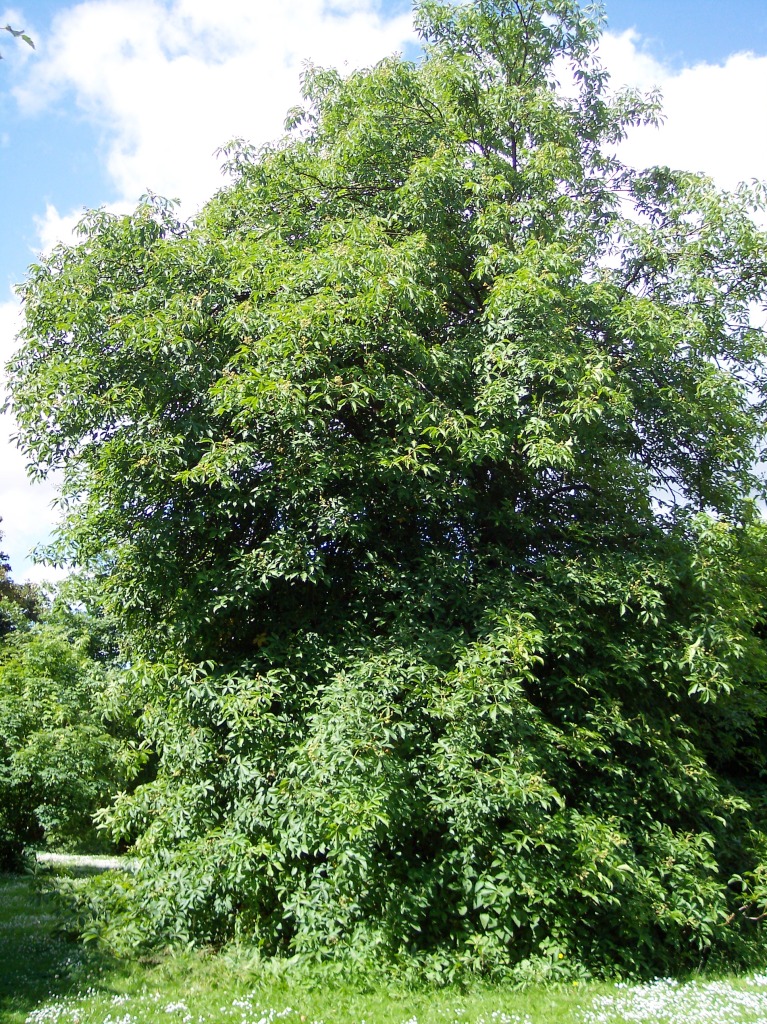
Japanese Horse-chestnut Aesculus turbinata
The scientific name of the Japanese Horse-chestnut is Aesculus turbinata. It is a species of flowering plant in the family Sapindaceae (soapberry family), order Sapindales.
- Scientific name
- Aesculus turbinata Blume
- Common name
- Japanese Horse-chestnut
- Genus
- Aesculus
- Family
- Sapindaceae (Soapberry Family)
- Order
- Sapindales
- Class
- Magnoliopsida
- Red List category
- LC Least Concern
- Recorded in
- 3 countries
- Name status
- accepted in the Catalogue of Life

Overview
Aesculus turbinata, common name Japanese horse-chestnut (tochinoki (トチノキ, 栃の木) or tochi (トチ, 栃, 橡)), is native to Japan but cultivated elsewhere. It is a tree up to 30 metres (98 feet) tall. Flowers are white to pale yellowish with red spots. Capsules are dark brown, obovoid to pyriform.
Classification of the Japanese Horse-chestnut
| Kingdom | Plantae |
|---|---|
| Subkingdom | Pteridobiotina |
| Phylum | Tracheophyta |
| Class | Magnoliopsida |
| Order | Sapindales |
| Family | Sapindaceae (Soapberry Family) |
| Subfamily | Hippocastanoideae |
| Tribe | Hippocastaneae |
| Genus | Aesculus (Buckeye) |
| Species | Aesculus turbinata Blume |
Where the Japanese Horse-chestnut is found
Checklists and occurrence records place Aesculus turbinata in 3 countries across Asia. GBIF holds 3,256 georeferenced records of it.
Countries where it is native or its origin is not stated
Countries where it has been introduced
Regions and cities with the most records
- Iwate, Japan 1,085
- Gunma, Japan 211
- Akita, Japan 196
- Aomori, Japan 140
- Midori, Japan 138
- Nagano, Japan 138
- Kiryū, Japan 137
- Tokyo, Japan 84
- Fuchū, Japan 66
- Wakayama, Japan 66
- Kokubunji, Japan 63
- Komae, Japan 60
- Inagi, Japan 59
- Chōfu, Japan 58
- Musashino, Japan 57
- Nishi-Tokyo-shi, Japan 56
- Koganei, Japan 55
- Higashikurume, Japan 53
- Kiyose, Japan 53
- Kodaira, Japan 52
- Chūō, Japan 50
- Minato City, Japan 50
- Nakano, Japan 50
- Tokyo, Japan 50
- Ōta, Japan 50
- Kita, Japan 49
- Wako, Japan 48
- Katsushika, Japan 47
- Kawaguchi, Japan 47
- Asaka, Japan 46
- Kawasaki, Japan 46
- Shimotoda, Japan 45
- Warabi, Japan 45
- Urayasu, Japan 44
- Hatogaya-honchō, Japan 43
- Shiki, Japan 43
9 more countries have a few records outside this range
These countries hold a few records of Aesculus turbinata but lie outside the range the checklists give for it. Such records are often zoo or garden specimens, museum material or vagrants, so the species is not counted as occurring there.
Range as the checklists state it
China [I]; South Korea [I]; Japan (Hokkaido, Honshu, Shikoku, Kyushu)
A number beside a place is its count of GBIF occurrence records. A place without a number comes from a checklist alone. Records show where a species has been observed or collected, which can include escapes and vagrants.
Common names
English
- Japanese Horse-chestnut
Names in 14 other languages
- Chinese
- 七叶树, 日本七叶树, 日本七叶树(七叶树)
- Czech
- jírovec japonský
- Dutch
- Japanse paardenkastanje
- Estonian
- jaapani hobukastan
- Finnish
- japaninhevoskastanja
- French
- marronnier du Japon
- German
- japanische Rosskastanie
- Japanese
- tochi-no-ki, トチノキ, 栃の木
- Korean
- 칠엽수
- Polish
- Kasztanowiec japoński
- Russian
- Конский каштан кубарчатый
- Slovak
- pagaštan vrtidlovitý
- Swedish
- japansk hästkastanj
- Ukrainian
- Гіркокаштан японський
Synonyms
7 other scientific names have been used for this species and are now treated as synonyms of Aesculus turbinata.
- Aesculus dissimilis Blume
- Aesculus japonica C.K.Schneid.
- Aesculus sinensis Hort. ex Bean
- Aesculus turbinata f. pubescens (Rehder) Ohwi ex Yas.Endo
- Aesculus turbinata var. pubescens Rehder
- Pawia dissimilis (Blume) Kuntze
- Pawia turbinata (Blume) Kuntze
Related species
-
 Horse-chestnutAesculus hippocastanum
-
 Ohio BuckeyeAesculus glabra
- Aesculus californica
-
 Sweet BuckeyeAesculus flava
-
 Red BuckeyeAesculus pavia
-
 Red Horse-chestnutAesculus × carnea
-
 Bottlebrush BuckeyeAesculus parviflora
-
 Indian Horse-chestnutAesculus indica
Compare
Questions and answers
What is the scientific name of the Japanese Horse-chestnut?
The scientific name of the Japanese Horse-chestnut is Aesculus turbinata. Written with its author, the full name is Aesculus turbinata Blume.
Which family does the Japanese Horse-chestnut belong to?
Aesculus turbinata belongs to the family Sapindaceae, in the order Sapindales and the class Magnoliopsida.
Where is the Japanese Horse-chestnut found?
Checklists and occurrence records place Aesculus turbinata in 3 countries, including Japan.
What is the conservation status of the Japanese Horse-chestnut?
The IUCN Red List category recorded for Aesculus turbinata is Least Concern (LC).
Sources
Data
- Catalogue of Life, 2026-10-16 XR cc by
- Global Biodiversity Information Facility CC BY 4.0
- Wikidata CC0
- English Wikipedia CC BY-SA 4.0
- GeoNames CC BY 4.0
- Wikimedia Commons per image; credit shown with each image
- iNaturalist per image; credit shown with each image
- Within the Catalogue of Life, this name comes from Synonymic Checklists of the Vascular Plants of the World cc by
References
- Blume. (1847). Rumphia 3: 195 (1847). where the name was published
This species in other databases
- Catalogue of Life 65BMG
- Wikidata Q1132580
- iNaturalist 410413
- World Flora Online wfo-0000522367
- GRIN 1637
Page built on 26 November 2026. See how the catalog is made and all sources and licences.
Cite this page
ScientificNames.org. (2026). Aesculus turbinata (Japanese Horse-chestnut). Retrieved November 26, 2026, from https://scientificnames.org/species/aesculus-turbinata
“Aesculus turbinata (Japanese Horse-chestnut).” ScientificNames.org, 2026, scientificnames.org/species/aesculus-turbinata. Accessed 26 Nov. 2026.
ScientificNames.org. “Aesculus turbinata (Japanese Horse-chestnut).” Accessed November 26, 2026. https://scientificnames.org/species/aesculus-turbinata.
@misc{scientificnames_aesculus_turbinata_japanese_horse_chestnut,
  author = {{ScientificNames.org}},
  title = {Aesculus turbinata (Japanese Horse-chestnut)},
  year = {2026},
  url = {https://scientificnames.org/species/aesculus-turbinata},
  note = {Accessed 2026-11-26}
}