Species · Flowering plants
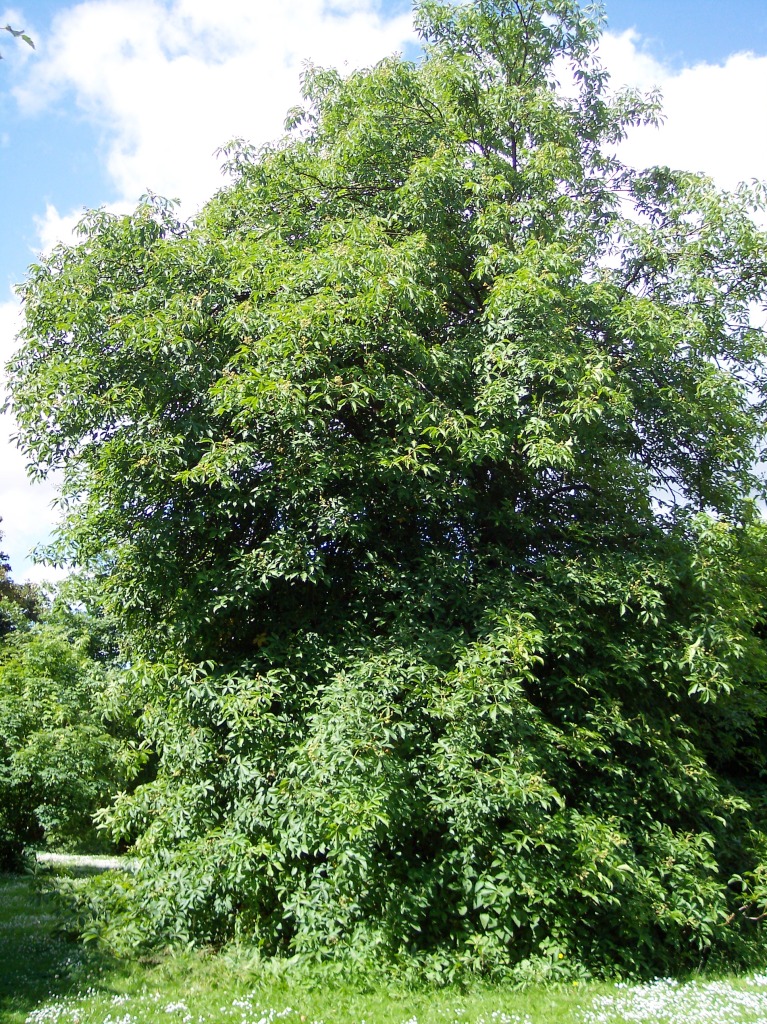
Red Horse-chestnut Aesculus × carnea
The scientific name of the Red Horse-chestnut is Aesculus × carnea. It is a species of flowering plant in the family Sapindaceae (soapberry family), order Sapindales.
- Scientific name
- Aesculus × carnea Hayne
- Common name
- Red Horse-chestnut
- Genus
- Aesculus
- Family
- Sapindaceae (Soapberry Family)
- Order
- Sapindales
- Class
- Magnoliopsida
- Recorded in
- 8 countries
- Name status
- accepted in the Catalogue of Life

Overview
Aesculus × carnea is widely planted throughout Europe and is locally naturalised in England, with rarer naturalised occurrences in Ireland, Scotland and Wales. It is an artificial hybrid with dull red flowers, palmately compound leaves and leathery fruit capsules.
Written 26 November 2026 from the sources listed below. Each statement was checked against the passage it cites; statements that could not be supported were removed.
Appearance
The red horse-chestnut has dull red flowers arranged in panicles at the ends of branches. Its flower panicles measure 12–20 centimetres in length.[1][2]
Its deciduous leaves are dark green, coarse and often rough, wrinkled or irregular. They are palmately compound, with five large toothed leaflets, and the central leaflets can reach 25 centimetres in length.[3][4][5]
Its fruit consists of pale brown, leathery capsules containing one to three seeds. Ripe capsules have a thornless outer covering that splits into three pieces and measure approximately four centimetres in diameter.[6][7][8]
Habitat
The red horse-chestnut is planted in large gardens and parks. It is widely planted throughout Europe.[9][10]
Behaviour
The red horse-chestnut sheds its leaves seasonally.[11]
The tree typically reaches 15–25 metres in height and occasionally grows to 28 metres. Its trunk can reach a diameter of one metre.[12][13]
Reproduction and life cycle
The red horse-chestnut flowers in May and produces fruit in autumn.[14]
The species is tetraploid as a result of chromosome doubling in its diploid parent species. It produces viable seeds that breed true, resulting in offspring identical or nearly identical to the parent tree.[15][16]
Conservation
The red horse-chestnut is very vulnerable to a canker disease affecting its trunk and branches. The causal agent of the disease is unknown.[17][18]
The species often has a short lifespan because of the canker disease affecting its trunk and branches.[19]
Uses
The red horse-chestnut is used as an ornamental tree because of its red flowers and resilience to environmental degradation.[20]
Similar species
The red horse-chestnut is an artificial hybrid between Aesculus hippocastanum and Aesculus pavia. Its morphological features are typically intermediate between those of its two parent species.[21][22]
It inherits its red flowers from Aesculus pavia.[23]
The hybrid originated in Germany around 1818, although its exact origin is uncertain.[24]
Classification of the Red Horse-chestnut
| Kingdom | Plantae |
|---|---|
| Subkingdom | Pteridobiotina |
| Phylum | Tracheophyta |
| Class | Magnoliopsida |
| Order | Sapindales |
| Family | Sapindaceae (Soapberry Family) |
| Subfamily | Hippocastanoideae |
| Tribe | Hippocastaneae |
| Genus | Aesculus (Buckeye) |
| Species | Aesculus × carnea Hayne |
Where the Red Horse-chestnut is found
Checklists and occurrence records place Aesculus × carnea in 8 countries across Europe and North America. GBIF holds 5,682 georeferenced records of it.
Countries where it is native or its origin is not stated
Countries where it has been introduced
Regions and cities with the most records
- England, United Kingdom 4,262
- London, United Kingdom 383
- Camden Town, United Kingdom 381
- Chalk Farm, United Kingdom 378
- Willesden, United Kingdom 378
- City of Westminster, United Kingdom 377
- Cricklewood, United Kingdom 376
- Harlesden, United Kingdom 366
- Islington, United Kingdom 362
- Shepherds Bush, United Kingdom 360
- Stepney, United Kingdom 360
- Shadwell, United Kingdom 359
- Stratford, United Kingdom 358
- Canning Town, United Kingdom 357
- Archway, United Kingdom 356
- Highbury, United Kingdom 356
- Barnes, United Kingdom 355
- Fulham, United Kingdom 355
- West Ham, United Kingdom 354
- Golders Green, United Kingdom 351
- Streatham, United Kingdom 351
- Acton, United Kingdom 350
- Brockley, United Kingdom 347
- Earlsfield, United Kingdom 347
- Blackheath, United Kingdom 346
- Wembley, United Kingdom 343
- Catford, United Kingdom 341
- Harringay, United Kingdom 341
- Manor Park, United Kingdom 341
- Mitcham, United Kingdom 341
- Walthamstow, United Kingdom 340
- Wood Green, United Kingdom 338
- Muswell Hill, United Kingdom 335
- Tottenham, United Kingdom 335
- Morden, United Kingdom 334
- Richmond, United Kingdom 333
19 more countries have a few records outside this range
These countries hold a few records of Aesculus × carnea but lie outside the range the checklists give for it. Such records are often zoo or garden specimens, museum material or vagrants, so the species is not counted as occurring there.
Range as the checklists state it
England [I] (England [I], Wales [I], Isle of Man [I], Scotland [I]); Ireland [I] (Ireland [I], Northern Ireland [I]); Germany [I]; France [I]; Channel Isl. [I] (Alderney [I]); Slovakia [I]; Hungary [I]; USA (Kentucky)
A number beside a place is its count of GBIF occurrence records. A place without a number comes from a checklist alone. Records show where a species has been observed or collected, which can include escapes and vagrants.
Common names
English
- Red Horse-chestnut
- Flowering Horse-chestnut
Names in 6 other languages
- Asturian
- castañal de la india arrosada
- Chinese
- 红花七叶树
- Dutch
- Rode paardenkastanje
- French
- marronnier rouge
- German
- rote Rosskastanie
- Swedish
- rödblommig hästkastanj
Synonyms
9 other scientific names have been used for this species and are now treated as synonyms of Aesculus × carnea.
- Aesculus carnea J.Zeyh.
- Aesculus hippocastanum var. carnea (Hayne) Jess.
- Aesculus rubicunda Lodd.
- Aesculus spectabilis Dippel
- Aesculus xcarnea Hayne
- Aesculus × carnea var. carnea
- Aesculus × carnea var. plantierensis (André) Rehder
- Aesculus × plantierensis André
- Pawia rubicunda (Lodd. ex Dippel) Kuntze
Related species
-
 Horse ChestnutAesculus hippocastanum
-
 Ohio BuckeyeAesculus glabra
-
 Aesculus californica
-
 Yellow BuckeyeAesculus flava
-
 Red BuckeyeAesculus pavia
-
 Bottlebrush BuckeyeAesculus parviflora
-
 Indian Horse-chestnutAesculus indica
-
 Japanese Horse-chestnutAesculus turbinata
Compare
Questions and answers
What is the scientific name of the Red Horse-chestnut?
The scientific name of the Red Horse-chestnut is Aesculus × carnea. Written with its author, the full name is Aesculus × carnea Hayne.
Which family does the Red Horse-chestnut belong to?
Aesculus × carnea belongs to the family Sapindaceae, in the order Sapindales and the class Magnoliopsida.
Where is the Red Horse-chestnut found?
Checklists and occurrence records place Aesculus × carnea in 8 countries, including United States and Canada.
What other names does the Red Horse-chestnut have?
Aesculus × carnea is also known in English as Flowering Horse-chestnut.
What are the pros and cons of a ruby red horse chestnut tree?
The red horse-chestnut is used as an ornamental tree because of its red flowers and resilience to environmental degradation. Its disadvantages include vulnerability to a canker disease affecting its trunk and branches, which often results in a short lifespan.[19][17][20]
Sources
Passages the profile rests on
- Its flowers are dull red and grow in panicles at the ends of branches. Source passage: “The flowers are dull red, borne on 12–20 cm long panicles on branch ends” — English Wikipedia
- Its flower panicles measure 12–20 centimetres in length. Source passage: “borne on 12–20 cm long panicles on branch ends” — English Wikipedia
- Its leaves are deciduous, dark green, coarse and often rough, wrinkled or irregular. Source passage: “The leaves are deciduous, dark green, coarse and often rough and wrinkled or irregular” — English Wikipedia
- Its leaves are palmately compound, with five large toothed leaflets. Source passage: “they are palmately compound, each leaf divided into five large, toothed leaflets” — English Wikipedia
- Its central leaflets can reach 25 centimetres in length. Source passage: “the central leaflet the largest, up to 25 cm long.” — English Wikipedia
- Its fruit consists of pale brown, leathery capsules containing one to three seeds. Source passage: “producing pale brown leathery fruit capsules 4 cm diameter containing 1–3 seeds in autumn.” — English Wikipedia
- Its ripe fruit has a leathery, thornless outer covering that splits into three pieces. Source passage: “in a leathery, thornless pericarp that splits into three pieces when ripe” — pmc.ncbi.nlm.nih.gov
- Its fruit capsules measure approximately four centimetres in diameter. Source passage: “fruit capsules 4 cm diameter” — English Wikipedia
- The species is planted in large gardens and parks. Source passage: “It is a popular tree in large gardens and parks” — English Wikipedia
- The species is widely planted throughout Europe. Source passage: “widely planted throughout Europe.” — English Wikipedia
- The species sheds its leaves seasonally. Source passage: “The leaves are deciduous” — English Wikipedia
- The tree typically reaches 15–25 metres in height, occasionally growing to 28 metres. Source passage: “It grows to 15–25 metres (49–82 ft) tall, rarely to 28 metres (92 ft)” — English Wikipedia
- Its trunk can reach a diameter of one metre. Source passage: “with a trunk diameter of up to 1 m” — English Wikipedia
- The species flowers in May and produces fruit in autumn. Source passage: “flowering in May and producing pale brown leathery fruit capsules 4 cm diameter containing 1–3 seeds in autumn.” — English Wikipedia
- The species is tetraploid as a result of chromosome doubling in its diploid parent species. Source passage: “It is a tetraploid plant, arising from autopolyploidy with chromosome doubling of its diploid parent species.” — English Wikipedia
- The species produces viable seeds that breed true, resulting in offspring identical or nearly identical to the parent tree. Source passage: “It is fertile, producing viable seeds that breed true, the progeny identical or near-identical to the parent tree.” — English Wikipedia
- The species is very vulnerable to a canker disease affecting its trunk and branches. Source passage: “It is very vulnerable to a canker disease on the trunk and branches” — English Wikipedia
- The causal agent of the canker disease affecting the species is unknown. Source passage: “It has no known causal agent” — English Wikipedia
- The species often has a short lifespan because of a canker disease affecting its trunk and branches. Source passage: “which results in heavily disfigured bark, and often a short lifespan for the trees.” — English Wikipedia
- The species is used as an ornamental tree because of its red flowers and resilience to environmental degradation. Source passage: “This species has remarkable resilience to environmental degradation, rendering it, alongside its beautiful red flowers, a true ornament of nature.” — pmc.ncbi.nlm.nih.gov
- The species is an artificial hybrid between Aesculus hippocastanum and Aesculus pavia. Source passage: “an artificial hybrid between Aesculus hippocastanum (European horse-chestnut) and Aesculus pavia (red buckeye).” — English Wikipedia
- Its morphological features are typically intermediate between those of its two parent species. Source passage: “Aesculus × carnea has features typically intermediate between the parent species” — English Wikipedia
- The species inherits its red flowers from Aesculus pavia. Source passage: “but it inherits the red flowers of Ae. pavia.” — English Wikipedia
- The hybrid originated in Germany around 1818, although its exact origin is uncertain. Source passage: “Its exact origin is uncertain, arising in Germany around 1818.” — English Wikipedia
- The species is locally naturalised in England and occurs more rarely as a naturalised plant in Ireland, Scotland and Wales. Source passage: “It is locally naturalised in England, and more rarely so in Ireland, Scotland, and Wales.” — English Wikipedia
Data
- Catalogue of Life, 2026-10-16 XR cc by
- Global Biodiversity Information Facility CC BY 4.0
- Wikidata CC0
- GeoNames CC BY 4.0
- Wikimedia Commons per image; credit shown with each image
- Within the Catalogue of Life, this name comes from Synonymic Checklists of the Vascular Plants of the World cc by
References
- Hayne. Abbild. Fremd. Holzart. 25 (1825). where the name was published
This species in other databases
Page built on 27 November 2026. See how the catalog is made and all sources and licences.
Cite this page
ScientificNames.org. (2026). Aesculus × carnea (Red Horse-chestnut). Retrieved November 27, 2026, from https://scientificnames.org/species/aesculus-x-carnea
“Aesculus × carnea (Red Horse-chestnut).” ScientificNames.org, 2026, scientificnames.org/species/aesculus-x-carnea. Accessed 27 Nov. 2026.
ScientificNames.org. “Aesculus × carnea (Red Horse-chestnut).” Accessed November 27, 2026. https://scientificnames.org/species/aesculus-x-carnea.
@misc{scientificnames_aesculus_x_carnea_red_horse_chestnut,
  author = {{ScientificNames.org}},
  title = {Aesculus × carnea (Red Horse-chestnut)},
  year = {2026},
  url = {https://scientificnames.org/species/aesculus-x-carnea},
  note = {Accessed 2026-11-27}
}