Species · Flowering plants
Texas Hummingbird Mint Agastache cana
The scientific name of the Texas Hummingbird Mint is Agastache cana. It is a species of flowering plant in the family Lamiaceae (mint family), order Lamiales.
- Scientific name
- Agastache cana (Hook.) Wooton & Standl.
- Common name
- Texas Hummingbird Mint
- Genus
- Agastache
- Family
- Lamiaceae (Mint Family)
- Order
- Lamiales
- Class
- Magnoliopsida
- Red List category
- LC Least Concern
- Recorded in
- 2 countries
- Name status
- accepted in the Catalogue of Life

Overview
The species is native to New Mexico and western Texas, where it grows in mountainous areas. It is distinguished by dark pink flower clusters, grayish-green leaves, and a mint bubblegum fragrance.
Written 26 November 2026 from the sources listed below. Each statement was checked against the passage it cites; statements that could not be supported were removed.
Appearance
Texas Hummingbird Mint has grayish-green leaves with a mint bubblegum fragrance. It has an erect growth habit, ovate leaves, a semi-woody structure, and profuse branching.[1][2]
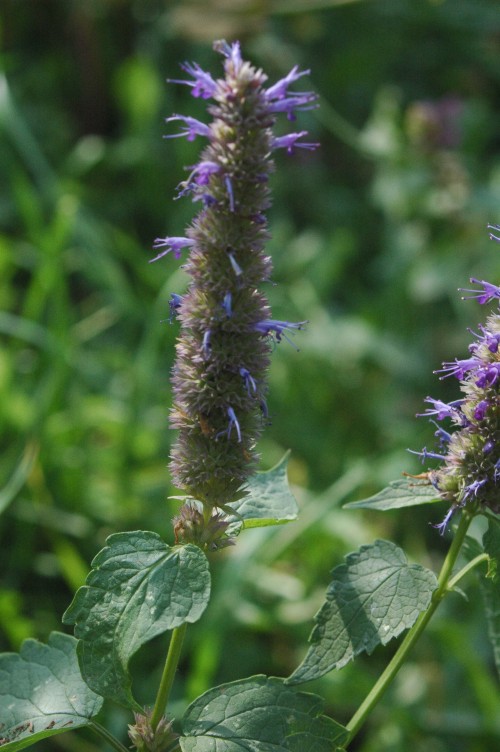
Its flowers consist of five fused, bilaterally symmetrical petals arranged in a tube shape. Two petals extend forward like a visor, while the other three form a reflexed lip.[3][4]
The flowers grow in whorls accompanied by compact spikes and form dark pink clusters above the foliage. The plant produces fruit that divides into four dark nutlets, each approximately 2 mm long.[5][6][7][8]
Individual plants average approximately 3 feet in height and 2 feet in width.[9]
Habitat
Texas Hummingbird Mint grows in mountainous areas of New Mexico and western Texas, including southern mountainous areas at elevations of approximately 5,000–6,000 feet.[10][11]
The plant grows in crevices and cracks of granite cliffs, along canyon edges, and on dry slopes with neutral-pH soil.[12][13]
It prefers well-drained soil and full sun exposure. It can also thrive in contained growing areas and herb gardens.[14][15]
Behaviour
Texas Hummingbird Mint is drought-tolerant and can endure temperatures as low as −20 °F. It requires medium amounts of water to sustain itself.[16][17][18]
The plant attracts bees, butterflies, and hummingbirds. Butterflies are attracted to the scent of its flowers, while hummingbirds are attracted to its sweet nectar and tubular blossoms.[19][20][21]
Reproduction and life cycle
The flowers contain both male and female reproductive parts. The species actively reproduces throughout the growing season.[22][23]
Flowering begins in early June and continues until late September. The flower spikes remain throughout the growing season from early summer to late fall.[24][25]
Uses
Texas Hummingbird Mint is edible as an herb. Its dried flowers and leaves can be used to prepare tea.[26][27]
The plant is cultivated ornamentally in rock gardens in Texas, New Mexico, and Arizona. It has also been used to attract broad-tailed hummingbirds for migration pattern studies.[28][29]
Classification of the Texas Hummingbird Mint
| Kingdom | Plantae |
|---|---|
| Subkingdom | Pteridobiotina |
| Phylum | Tracheophyta |
| Class | Magnoliopsida |
| Order | Lamiales |
| Family | Lamiaceae (Mint Family) |
| Subfamily | Nepetoideae |
| Tribe | Mentheae |
| Subtribe | Nepetinae |
| Genus | Agastache (Giant Hyssop) |
| Species | Agastache cana (Hook.) Wooton & Standl. |
Where the Texas Hummingbird Mint is found
Checklists and occurrence records place Agastache cana in 2 countries across North America. GBIF holds 181 georeferenced records of it.
Countries
Regions and cities with the most records
- Texas, United States 28
- New Mexico, United States 12
- Sunland Park, United States 10
- El Paso, United States 9
- Apex, United States 5
- Cary, United States 5
- Ciudad Juárez, Mexico 5
- Garner, United States 5
- Holly Springs, United States 5
- Morrisville, United States 5
- North Carolina, United States 5
- Raleigh, United States 5
- Saint George, United States 4
- Utah, United States 4
- Washington, United States 4
- Horizon City, United States 3
- Chihuahua, Mexico
- Sonora, Mexico
Range as the checklists state it
USA (New Mexico, Texas); Mexico (Chihuahua, Sonora)
A number beside a place is its count of GBIF occurrence records. A place without a number comes from a checklist alone. Records show where a species has been observed or collected, which can include escapes and vagrants.
Common names
English
- Texas Hummingbird Mint
- Double Bubble Mint
- Grayish-white Giant Hyssop
- Hoary Balm of Gilead
- Wild Hyssop
Names in 3 other languages
- Chinese
- 灰藿香
- Finnish
- kesäiiso
- Swedish
- lila kolibrimynta
Synonyms
3 other scientific names have been used for this species and are now treated as synonyms of Agastache cana.
- Cedronella cana Hook.
- Cedronella hastifolia Regel
- Cedronella mexicana var. cana (Hook.) A.Gray
Related species
-
 Anise HyssopAgastache foeniculum
-
 Korean MintAgastache rugosa
-
 Nettleleaf Giant-hyssopAgastache urticifolia
-
 Mexican Giant HyssopAgastache mexicana
-
 Yellow Giant-hyssopAgastache nepetoides
-
 Purple Giant-hyssopAgastache scrophulariifolia
-
 Mountain Giant HyssopAgastache pallidiflora
- Small-leaf Giant HyssopAgastache parvifolia
Compare
Questions and answers
What is the scientific name of the Texas Hummingbird Mint?
The scientific name of the Texas Hummingbird Mint is Agastache cana. Written with its author, the full name is Agastache cana (Hook.) Wooton & Standl..
Which family does the Texas Hummingbird Mint belong to?
Agastache cana belongs to the family Lamiaceae, in the order Lamiales and the class Magnoliopsida.
Where is the Texas Hummingbird Mint found?
Checklists and occurrence records place Agastache cana in 2 countries: United States and Mexico.
What is the conservation status of the Texas Hummingbird Mint?
The IUCN Red List category recorded for Agastache cana is Least Concern (LC).
What other names does the Texas Hummingbird Mint have?
Agastache cana is also known in English as Double Bubble Mint, Grayish-white Giant Hyssop, Hoary Balm of Gilead and Wild Hyssop.
Is Agastache an invasive plant?
The species is described as actively reproducing throughout the growing season, but no information establishes whether it is invasive.[23]
Sources
Passages the profile rests on
- Agastache cana has grayish-green leaves with a mint bubblegum fragrance. Source passage: “The grayish-green colored leaves (cana means grey) has a mint bubblegum fragrance.” — English Wikipedia
- The plant has an erect growth habit, ovate leaves, a semi-woody structure, and profuse branching. Source passage: “It is an erect perennial species with ovate leaves, semi-woody structure, and profuse branching.” — English Wikipedia
- Its flowers consist of five fused, bilaterally symmetrical petals arranged in a tube shape. Source passage: “The flowers of the mosquito plant are 5 zygomorphic petals fused into a tube shape.” — English Wikipedia
- Two flower petals extend forward like a visor, while the other three form a reflexed lip. Source passage: “Two of these petals extend forward like a visor, while the other 3 petals form a reflexed lip.” — English Wikipedia
- The flowers grow in whorls accompanied by compact spikes. Source passage: “The flowers are arranged in whorls accompanied by compact spikes.” — English Wikipedia
- The flowers form dark pink clusters that rise above the foliage. Source passage: “The tubular shape flower blossoms as dark pink clusters and towers over the mint scented foliage.” — English Wikipedia
- The plant produces fruit that divides into four dark nutlets. Source passage: “The fruit that arise from these plants divide into 4 dark nutlets” — English Wikipedia
- Each dark nutlet is approximately 2 mm long. Source passage: “each about 2 mm long.” — English Wikipedia
- Individual plants average approximately 3 feet in height and 2 feet in width. Source passage: “Individuals of this species grow to an average height of 3 feet by 2 feet wide in a shrub habit.” — English Wikipedia
- The species grows in mountainous areas of New Mexico and western Texas. Source passage: “The Mosquito Plant is native to New Mexico and western Texas, where it grows in mountainous areas” — English Wikipedia
- The species occurs in southern mountainous areas at elevations of approximately 5,000–6,000 feet. Source passage: “This species is generally found in New Mexico and Texas in southern mountains at elevations of about 5,000–6,000 feet.” — English Wikipedia
- The plant grows in crevices and cracks of granite cliffs and along canyon edges. Source passage: “They can be found in crevices and cracks of granite cliffs or in canyon edges.” — English Wikipedia
- The species grows on dry slopes with neutral-pH soil. Source passage: “These elevations provide dry slopes and neutral pH soil for A. cana.” — English Wikipedia
- The plant prefers well-drained soil and full sun exposure. Source passage: “It prefers to grow in well-drained soil and needs full exposure to sun.” — English Wikipedia
- The species can thrive in contained growing areas and herb gardens. Source passage: “A. cana thrives in contained areas and herb gardens.” — English Wikipedia
- Agastache cana is a drought-tolerant plant. Source passage: “A. cana is a drought-tolerant organism” — English Wikipedia
- The species can endure temperatures as low as −20 °F. Source passage: “can endure cold temperatures up to −20 °F.” — English Wikipedia
- The plant requires medium amounts of water to sustain itself. Source passage: “It needs medium amounts of water to sustain itself.” — English Wikipedia
- The plant attracts bees, butterflies, and hummingbirds. Source passage: “It is an attractant of bees, butterflies, and hummingbirds.” — English Wikipedia
- Butterflies are attracted to the scent of the flowers. Source passage: “Butterflies are essentially drawn in by the scent of the flowers” — English Wikipedia
- Hummingbirds are attracted to the plant's sweet nectar and tubular blossoms. Source passage: “hummingbirds are attracted to the sweet nectar and tubular-shaped blossoms” — English Wikipedia
- The flowers of Agastache cana contain both male and female reproductive parts. Source passage: “The flowers are hermaphroditic, which means the flower contains both male and female parts.” — English Wikipedia
- The species actively reproduces throughout the growing season. Source passage: “A. cana is a prolific organism, which means it actively reproduces all growing season.” — English Wikipedia
- The plant begins flowering in early June and continues until late September. Source passage: “It begins to blossom in early June and continues to bloom until late September.” — English Wikipedia
- The plant's flower spikes remain throughout the growing season from early summer to late fall. Source passage: “These spikes remain through the growing season from early summer to late fall.” — English Wikipedia
- The species is edible as an herb. Source passage: “It is also known to be an herb that is edible.” — English Wikipedia
- The dried flowers and leaves can be used to prepare tea. Source passage: “Dried petals of the flower and leaves can be used in tea.” — English Wikipedia
- The plant is cultivated ornamentally in rock gardens in Texas, New Mexico, and Arizona. Source passage: “This species is used for ornamental purposes for many rock garden homes in Texas, New Mexico, and Arizona.” — English Wikipedia
- The plant has been used to attract broad-tailed hummingbirds for migration pattern studies. Source passage: “The mosquito plant has obtained recognition for attracting broad-tailed hummingbirds that are used for migration pattern studies.” — English Wikipedia
Data
- Catalogue of Life, 2026-10-16 XR cc by
- Global Biodiversity Information Facility CC BY 4.0
- Wikidata CC0
- GeoNames CC BY 4.0
- Wikimedia Commons per image; credit shown with each image
- Within the Catalogue of Life, this name comes from Synonymic Checklists of the Vascular Plants of the World cc by
References
- Wooton & Standl. (1913). Contr. U.S. Natl. Herb. 16: 166 (1913). where the name was published
This species in other databases
Page built on 28 November 2026. See how the catalog is made and all sources and licences.
Cite this page
ScientificNames.org. (2026). Agastache cana (Texas Hummingbird Mint). Retrieved November 28, 2026, from https://scientificnames.org/species/agastache-cana
“Agastache cana (Texas Hummingbird Mint).” ScientificNames.org, 2026, scientificnames.org/species/agastache-cana. Accessed 28 Nov. 2026.
ScientificNames.org. “Agastache cana (Texas Hummingbird Mint).” Accessed November 28, 2026. https://scientificnames.org/species/agastache-cana.
@misc{scientificnames_agastache_cana_texas_hummingbird_mint,
  author = {{ScientificNames.org}},
  title = {Agastache cana (Texas Hummingbird Mint)},
  year = {2026},
  url = {https://scientificnames.org/species/agastache-cana},
  note = {Accessed 2026-11-28}
}