Species · Flowering plants
Nettleleaf Giant-hyssop Agastache urticifolia
The scientific name of the Nettleleaf Giant-hyssop is Agastache urticifolia. It is a species of flowering plant in the family Lamiaceae (mint family), order Lamiales.
- Scientific name
- Agastache urticifolia (Benth.) Kuntze
- Common name
- Nettleleaf Giant-hyssop
- Genus
- Agastache
- Family
- Lamiaceae (Mint Family)
- Order
- Lamiales
- Class
- Magnoliopsida
- Recorded in
- 2 countries
- Name status
- accepted in the Catalogue of Life

Overview
Agastache urticifolia is native to western North America, ranging from British Columbia through California to Colorado. It has widely spaced toothed leaves and dense spikes of pink or purple flowers.
Written 26 November 2026 from the sources listed below. Each statement was checked against the passage it cites; statements that could not be supported were removed.
Habitat
Nettleleaf Giant-hyssop occurs in many different habitat types across its native range. It grows in shaded locations and habitats associated with sagebrush, aspen, and ponderosa pine.[1][2]
Appearance
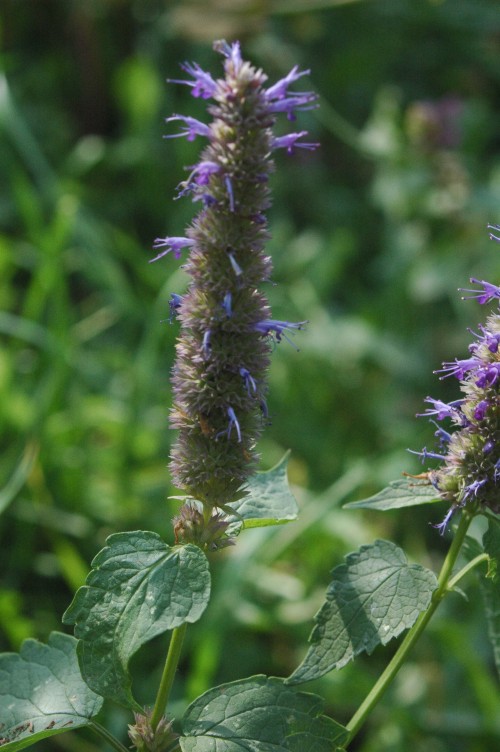
Nettleleaf Giant-hyssop is an aromatic perennial herb with an upright stem and widely spaced leaves. The leaves are lance-shaped to almost triangular, with toothed edges, and can reach 8 centimeters in length and 7 centimeters in width.[3][4][5]
The plant can grow to a height of 5 feet. Its flowers are arranged in dense spikes containing numerous individual flowers, which have elongated sepals with bright purple tips and tubular corollas in pink or purple shades.[6][7][8]
The fruit is a light-brown, fuzzy nutlet approximately 2 millimeters long.[9]
Uses
The dried leaves and flowers can be used to prepare tea. The plant has also been used medicinally to treat rheumatism, stomach upset, and colds.[10][11]
Several Native American groups have used the plant medicinally, particularly its leaves.[12]
Classification of the Nettleleaf Giant-hyssop
| Kingdom | Plantae |
|---|---|
| Subkingdom | Pteridobiotina |
| Phylum | Tracheophyta |
| Class | Magnoliopsida |
| Order | Lamiales |
| Family | Lamiaceae (Mint Family) |
| Subfamily | Nepetoideae |
| Tribe | Mentheae |
| Subtribe | Nepetinae |
| Genus | Agastache (Giant Hyssop) |
| Species | Agastache urticifolia (Benth.) Kuntze |
Where the Nettleleaf Giant-hyssop is found
Checklists and occurrence records place Agastache urticifolia in 2 countries across North America. GBIF holds 7,063 georeferenced records of it.
Countries
Regions and cities with the most records
- California, United States 1,382
- Utah, United States 876
- Idaho, United States 821
- Oregon, United States 667
- Colorado, United States 461
- Nevada, United States 331
- Cottonwood Heights, United States 271
- Holladay, United States 219
- East Millcreek, United States 202
- Washington, United States 182
- British Columbia, Canada 171
- Montana, United States 163
- Wyoming, United States 142
- Highland, United States 136
- Truckee, United States 132
- Pleasant Grove, United States 123
- Orem, United States 117
- Sandy, United States 111
- American Fork, United States 107
- Draper, United States 106
- South Lake Tahoe, United States 103
- Ashland, United States 97
- Midvale, United States 77
- Millcreek, United States 72
- Murray, United States 57
- Provo, United States 54
- Pocatello, United States 47
- North Ogden, United States 45
- Boise, United States 44
- Carson City, United States 44
- South Salt Lake, United States 43
- Lehi, United States 41
- Springville, United States 38
- Pullman, United States 36
- Ogden, United States 35
- Moscow, United States 33
4 more countries have a few records outside this range
These countries hold a few records of Agastache urticifolia but lie outside the range the checklists give for it. Such records are often zoo or garden specimens, museum material or vagrants, so the species is not counted as occurring there.
Range as the checklists state it
Canada (British Columbia); USA (California, Colorado, Idaho, Montana, Nevada, Oregon, Utah, Washington State, Wyoming)
A number beside a place is its count of GBIF occurrence records. A place without a number comes from a checklist alone. Records show where a species has been observed or collected, which can include escapes and vagrants.
Common names
English
- Nettleleaf Giant-hyssop
- Horse Mint
- Horsemint Giant Hyssop
- Horsemint Giant-hyssop
- Nettle-leaf Giant Hyssop
- Nettle-leaved Giant-hyssop
Names in 6 other languages
- Chinese
- 蕁麻葉藿香
- Finnish
- hammasiiso
- French
- agastache à feuilles d'ortie
- Norwegian Bokmål
- neslekoreamynte
- Russian
- Многоколосник крапиволистный
- Swedish
- nässelisop
Synonyms
3 other scientific names have been used for this species and are now treated as synonyms of Agastache urticifolia.
- Agastache urticifolia var. urticifolia
- Lophanthus urticifolius Benth.
- Vleckia urticifolia (Benth.) Raf.
Subspecies and varieties
Related species
-
 Anise HyssopAgastache foeniculum
-
 Korean MintAgastache rugosa
-
 Mexican Giant HyssopAgastache mexicana
-
 Yellow Giant-hyssopAgastache nepetoides
-
 Texas Hummingbird MintAgastache cana
-
 Purple Giant-hyssopAgastache scrophulariifolia
-
 Mountain Giant HyssopAgastache pallidiflora
- Small-leaf Giant HyssopAgastache parvifolia
Compare
Questions and answers
What is the scientific name of the Nettleleaf Giant-hyssop?
The scientific name of the Nettleleaf Giant-hyssop is Agastache urticifolia. Written with its author, the full name is Agastache urticifolia (Benth.) Kuntze.
Which family does the Nettleleaf Giant-hyssop belong to?
Agastache urticifolia belongs to the family Lamiaceae, in the order Lamiales and the class Magnoliopsida.
Where is the Nettleleaf Giant-hyssop found?
Checklists and occurrence records place Agastache urticifolia in 2 countries: United States and Canada.
What other names does the Nettleleaf Giant-hyssop have?
Agastache urticifolia is also known in English as Horse Mint, Horsemint Giant Hyssop, Horsemint Giant-hyssop, Nettle-leaf Giant Hyssop and Nettle-leaved Giant-hyssop.
Where is Agastache native to?
Nettleleaf Giant-hyssop is native to western North America, ranging from British Columbia through California to Colorado.[13]
Can you eat Agastache?
The dried leaves and flowers of Nettleleaf Giant-hyssop can be used to prepare tea.[10]
Sources
Passages the profile rests on
- The species occurs in many different habitat types across its native range. Source passage: “where it grows in many habitat types.” — English Wikipedia
- The species grows in shaded locations and habitats associated with sagebrush, aspen, and ponderosa pine. Source passage: “in shade, Sagebrush, aspen, ponderosa pine.” — extension.usu.edu
- The plant is an aromatic perennial herb with an upright stem and widely spaced leaves. Source passage: “This is an aromatic perennial herb growing an erect stem with widely spaced leaves” — English Wikipedia
- Its leaves are lance-shaped to almost triangular, with toothed edges. Source passage: “each lance-shaped to nearly triangular and toothed.” — English Wikipedia
- The leaves can reach 8 centimeters in length and 7 centimeters in width. Source passage: “The leaves are up to 8 centimeters long and 7 wide.” — English Wikipedia
- The flowers are arranged in dense spikes containing numerous individual flowers. Source passage: “The inflorescence is a dense spike of many flowers.” — English Wikipedia
- Individual flowers have elongated sepals with bright purple tips and tubular corollas in pink or purple shades. Source passage: “Each flower has long sepals tipped with bright purple and tubular corollas in shades of pink and purple.” — English Wikipedia
- The plant can grow to a height of 5 feet. Source passage: “Horsemint grows up to 5 feet tall” — extension.usu.edu
- The fruit is a light-brown, fuzzy nutlet approximately 2 millimeters long. Source passage: “The fruit is a light brown, fuzzy nutlet about 2 millimeters long.” — English Wikipedia
- The dried leaves and flowers can be used to prepare tea. Source passage: “The dried leaves and flowers can be made into tea.” — English Wikipedia
- The plant has been used medicinally to treat rheumatism, stomach upset, and colds. Source passage: “It has been used medicinally to treat rheumatism, upset stomachs, and colds.” — English Wikipedia
- Several Native American groups have used the plant medicinally, particularly its leaves. Source passage: “The plant was used medicinally by several Native American groups, especially the leaves.” — English Wikipedia
- The species is native to western North America, ranging from British Columbia through California to Colorado. Source passage: “It is native to western North America from British Columbia to California to Colorado” — English Wikipedia
Data
- Catalogue of Life, 2026-10-16 XR cc by
- Global Biodiversity Information Facility CC BY 4.0
- Wikidata CC0
- GeoNames CC BY 4.0
- Wikimedia Commons per image; credit shown with each image
- Within the Catalogue of Life, this name comes from Synonymic Checklists of the Vascular Plants of the World cc by
References
- Kuntze. (1891). Revis. Gen. Pl. 2: 511 (1891). where the name was published
This species in other databases
- Catalogue of Life 65Q6K
- Wikidata Q4691442
- iNaturalist 63316
- World Flora Online wfo-0000907273
- GRIN 318669
Page built on 29 November 2026. See how the catalog is made and all sources and licences.
Cite this page
ScientificNames.org. (2026). Agastache urticifolia (Nettleleaf Giant-hyssop). Retrieved November 29, 2026, from https://scientificnames.org/species/agastache-urticifolia
“Agastache urticifolia (Nettleleaf Giant-hyssop).” ScientificNames.org, 2026, scientificnames.org/species/agastache-urticifolia. Accessed 29 Nov. 2026.
ScientificNames.org. “Agastache urticifolia (Nettleleaf Giant-hyssop).” Accessed November 29, 2026. https://scientificnames.org/species/agastache-urticifolia.
@misc{scientificnames_agastache_urticifolia_nettleleaf_giant_hyssop,
  author = {{ScientificNames.org}},
  title = {Agastache urticifolia (Nettleleaf Giant-hyssop)},
  year = {2026},
  url = {https://scientificnames.org/species/agastache-urticifolia},
  note = {Accessed 2026-11-29}
}