Species · Flowering plants
Yellow Giant-hyssop Agastache nepetoides
The scientific name of the Yellow Giant-hyssop is Agastache nepetoides. It is a species of flowering plant in the family Lamiaceae (mint family), order Lamiales.
- Scientific name
- Agastache nepetoides (L.) Kuntze
- Common name
- Yellow Giant-hyssop
- Genus
- Agastache
- Family
- Lamiaceae (Mint Family)
- Order
- Lamiales
- Class
- Magnoliopsida
- Recorded in
- 2 countries
- Name status
- accepted in the Catalogue of Life

Overview
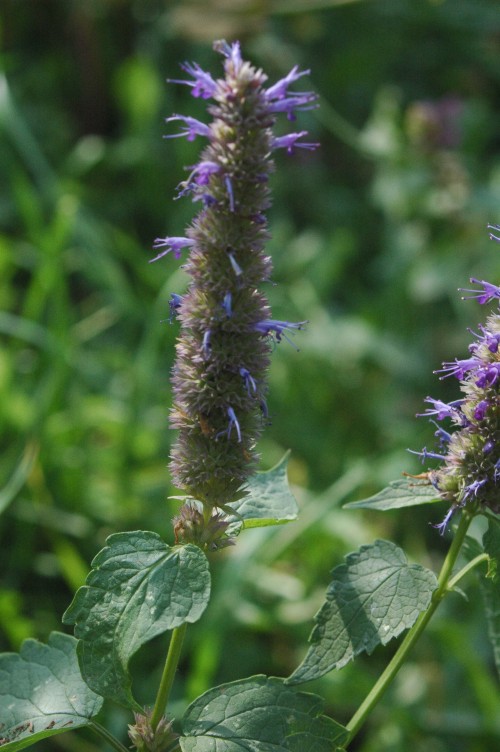
Yellow giant-hyssop is a perennial flowering plant in the Lamiaceae family. It occurs naturally in meadows, lowland woods, thickets and upland deciduous woods. It has a hairless, winged, four-angled stem and greenish-yellow flowers.
Written 26 November 2026 from the sources listed below. Each statement was checked against the passage it cites; statements that could not be supported were removed.
Appearance
Yellow giant-hyssop has an erect stem with few branches. Its central stem has four angles rather than a round cross-section, and the stem is hairless and winged.[1][2][3]
Its thin leaves are ovate or ovate-lanceolate and grow in opposite pairs along the stem. They have coarse teeth along their edges and lack the fragrance commonly associated with some other mint-family plants.[4][5][6][7]
Its greenish-yellow flowers grow in individual spikes at the ends of the central stem and major secondary stems.[8][9]
The plant reaches a height of 1.2–2.1 metres. Its leaves measure 5–15 centimetres long and 3–7 centimetres wide, while its flower spikes measure approximately 10–41 centimetres in length.[10][11][12]
Habitat
Yellow giant-hyssop occurs naturally in meadows. It also inhabits lowland woods, thickets and upland deciduous woods.[13][14][15]
Diet
The flowers of yellow giant-hyssop attract bees.[16]
Behaviour
Only a small number of flowers within each densely packed flower spike bloom simultaneously.[17]
Reproduction and life cycle
Yellow giant-hyssop flowers in late summer.[18]
Conservation
Yellow giant-hyssop is listed as endangered in Connecticut and Georgia.[19][20]
It is listed as threatened in New York State, Vermont and Wisconsin.[21][22][23]
Classification of the Yellow Giant-hyssop
| Kingdom | Plantae |
|---|---|
| Subkingdom | Pteridobiotina |
| Phylum | Tracheophyta |
| Class | Magnoliopsida |
| Order | Lamiales |
| Family | Lamiaceae (Mint Family) |
| Subfamily | Nepetoideae |
| Tribe | Mentheae |
| Subtribe | Nepetinae |
| Genus | Agastache (Giant Hyssop) |
| Species | Agastache nepetoides (L.) Kuntze |
Where the Yellow Giant-hyssop is found
Checklists and occurrence records place Agastache nepetoides in 2 countries across North America. GBIF holds 3,857 georeferenced records of it.
Countries
Regions and cities with the most records
- Illinois, United States 527
- Pennsylvania, United States 284
- Indiana, United States 199
- Missouri, United States 190
- Wisconsin, United States 174
- Kansas, United States 173
- Ontario, Canada 170
- Middleton, United States 110
- Madison, United States 102
- Virginia, United States 101
- Michigan, United States 94
- Fitchburg, United States 88
- Berwyn, United States 85
- Cicero, United States 83
- Elmwood Park, United States 83
- Maywood, United States 82
- Oak Park, United States 77
- Ohio, United States 76
- Arkansas, United States 70
- Franklin Park, United States 69
- Maryland, United States 68
- Melrose Park, United States 68
- Bellwood, United States 67
- Evanston, United States 66
- Skokie, United States 66
- Wilmette, United States 66
- Morton Grove, United States 65
- Niles, United States 65
- New York, United States 64
- Westchester, United States 64
- Bensenville, United States 61
- Elk Grove Village, United States 60
- Iowa, United States 60
- Park Ridge, United States 60
- Brookfield, United States 58
- Lemont, United States 58
3 more countries have a few records outside this range
These countries hold a few records of Agastache nepetoides but lie outside the range the checklists give for it. Such records are often zoo or garden specimens, museum material or vagrants, so the species is not counted as occurring there.
Range as the checklists state it
Canada (Ontario, Québec); USA (Alabama, Arkansas, Connecticut, District of Columbia, Delaware, Georgia, Iowa, Illinois, Indiana, Kansas, Kentucky, Massachusetts, Maryland, Michigan, Minnesota, Missouri, North Carolina, Nebraska, New Jersey, New York, Ohio, Oklahoma, Pennsylvania, South Carolina, South Dakota, Tennessee, Virginia, Vermont, Wisconsin, West Virginia)
A number beside a place is its count of GBIF occurrence records. A place without a number comes from a checklist alone. Records show where a species has been observed or collected, which can include escapes and vagrants.
Common names
English
- Yellow Giant-hyssop
- Catnip Giant-hyssop
Names in 4 other languages
- Chinese
- 黃藿香
- French
- agastache faux-népète, agastache faux-népéta
- Russian
- Многоколосник котовниковидный
- Swedish
- gul anisisop
Synonyms
4 other scientific names have been used for this species and are now treated as synonyms of Agastache nepetoides.
- Hyssopus nepetoides L.
- Lophanthus nepetoides (L.) Benth.
- Nepeta altissima Schrank
- Vleckia nepetoides (L.) Raf.
Related species
-
 Anise HyssopAgastache foeniculum
-
 Korean MintAgastache rugosa
-
 Nettleleaf Giant-hyssopAgastache urticifolia
-
 Mexican Giant HyssopAgastache mexicana
-
 Texas Hummingbird MintAgastache cana
-
 Purple Giant-hyssopAgastache scrophulariifolia
-
 Mountain Giant HyssopAgastache pallidiflora
- Small-leaf Giant HyssopAgastache parvifolia
Compare
Questions and answers
What is the scientific name of the Yellow Giant-hyssop?
The scientific name of the Yellow Giant-hyssop is Agastache nepetoides. Written with its author, the full name is Agastache nepetoides (L.) Kuntze.
Which family does the Yellow Giant-hyssop belong to?
Agastache nepetoides belongs to the family Lamiaceae, in the order Lamiales and the class Magnoliopsida.
Where is the Yellow Giant-hyssop found?
Checklists and occurrence records place Agastache nepetoides in 2 countries: United States and Canada.
What other names does the Yellow Giant-hyssop have?
Agastache nepetoides is also known in English as Catnip Giant-hyssop.
Where is Agastache native to?
Yellow giant-hyssop is native to the central and eastern United States and Canada. Its United States native range extends west to Nebraska, south to Georgia, east to Massachusetts, and north to the Canadian border. In Canada, it is native to Quebec and Ontario.[24][25][26]
Sources
Passages the profile rests on
- The plant has an erect stem with few branches. Source passage: “growing to 1.2–2.1 m (4–7 ft) tall as an erect stem with few branches.” — English Wikipedia
- Its central stem has four angles rather than a round cross-section. Source passage: “the central stem is 4-angled as opposed to round.” — English Wikipedia
- Its stem is hairless and winged. Source passage: “The stem is also hairless, or glabrous, and winged.” — English Wikipedia
- Its leaves are thin and ovate or ovate-lanceolate. Source passage: “The leaves are thin, ovate or ovate-lanceolate” — English Wikipedia
- Its leaves grow in opposite pairs along the stem. Source passage: “They are arranged oppositely on the stem” — English Wikipedia
- Its leaves have coarse teeth along their edges. Source passage: “and are coarsely toothed.” — English Wikipedia
- Its leaves lack the fragrance commonly associated with some other mint-family plants. Source passage: “The leaves do not have the fragrance usually associated with some other members of the mint family.” — English Wikipedia
- Its flowers are greenish-yellow. Source passage: “The flowers are greenish-yellow” — English Wikipedia
- Its flowers grow in individual spikes at the ends of the central stem and major secondary stems. Source passage: “appear as individual spikes at the end of the central stem and major secondary stems.” — English Wikipedia
- The plant reaches a height of 1.2–2.1 metres. Source passage: “growing to 1.2–2.1 m (4–7 ft) tall” — English Wikipedia
- Its leaves measure 5–15 centimetres long and 3–7 centimetres wide. Source passage: “measure 5–15 cm (2–6 in) long and 3–7 cm (1–3 in) across.” — English Wikipedia
- Its flower spikes measure approximately 10–41 centimetres in length. Source passage: “Each spike is about 10–41 cm (4–16 in) long.” — English Wikipedia
- The species occurs naturally in meadows. Source passage: “Its natural habitat is meadows, lowland woods and thickets, and upland deciduous woods.” — English Wikipedia
- The species inhabits lowland woods and thickets. Source passage: “lowland woods and thickets” — English Wikipedia
- The species inhabits upland deciduous woods. Source passage: “upland deciduous woods.” — English Wikipedia
- Its flowers attract bees. Source passage: “and are very attractive to bees.” — English Wikipedia
- Only a small number of flowers within each densely packed spike bloom simultaneously. Source passage: “Only a few of the densely packed flowers are in bloom at the same time.” — English Wikipedia
- The species flowers in late summer. Source passage: “The flowers bloom in the late summer” — English Wikipedia
- The species is listed as endangered in Connecticut. Source passage: “It is listed as endangered in Connecticut and Georgia” — English Wikipedia
- The species is listed as endangered in Georgia. Source passage: “It is listed as endangered in Connecticut and Georgia” — English Wikipedia
- The species is listed as threatened in New York State. Source passage: “and as threatened in New York (state), Vermont, and Wisconsin.” — English Wikipedia
- The species is listed as threatened in Vermont. Source passage: “and as threatened in New York (state), Vermont, and Wisconsin.” — English Wikipedia
- The species is listed as threatened in Wisconsin. Source passage: “and as threatened in New York (state), Vermont, and Wisconsin.” — English Wikipedia
- The species is native to the central and eastern United States and Canada. Source passage: “native to the central and eastern United States and Canada.” — English Wikipedia
- Its United States native range extends west to Nebraska, south to Georgia, east to Massachusetts, and north to the Canadian border. Source passage: “The plant is native in the United States from Nebraska to the west, Georgia to the south, Massachusetts to the east, and the Canadian border to the north.” — English Wikipedia
- In Canada, the species is native to Quebec and Ontario. Source passage: “In Canada, it is native in Quebec and Ontario.” — English Wikipedia
- The United States Fish and Wildlife Service records catnip giant hyssop as a common name for Agastache nepetoides. Source passage: “Scientific Name Agastache nepetoides Common Name catnip giant hyssop yellow giant hyssop” — fws.gov
- The United States Fish and Wildlife Service also records yellow giant hyssop as a common name for the species. Source passage: “Common Name catnip giant hyssop yellow giant hyssop” — fws.gov
Data
- Catalogue of Life, 2026-10-16 XR cc by
- Global Biodiversity Information Facility CC BY 4.0
- Wikidata CC0
- GeoNames CC BY 4.0
- Wikimedia Commons per image; credit shown with each image
- Within the Catalogue of Life, this name comes from Synonymic Checklists of the Vascular Plants of the World cc by
References
- Kuntze. (1891). Revis. Gen. Pl. 2: 511 (1891). where the name was published
This species in other databases
- Catalogue of Life 6626F
- Wikidata Q15339634
- iNaturalist 129634
- World Flora Online wfo-0000904334
- GRIN 312122
Page built on 27 November 2026. See how the catalog is made and all sources and licences.
Cite this page
ScientificNames.org. (2026). Agastache nepetoides (Yellow Giant-hyssop). Retrieved November 27, 2026, from https://scientificnames.org/species/agastache-nepetoides
“Agastache nepetoides (Yellow Giant-hyssop).” ScientificNames.org, 2026, scientificnames.org/species/agastache-nepetoides. Accessed 27 Nov. 2026.
ScientificNames.org. “Agastache nepetoides (Yellow Giant-hyssop).” Accessed November 27, 2026. https://scientificnames.org/species/agastache-nepetoides.
@misc{scientificnames_agastache_nepetoides_yellow_giant_hyssop,
  author = {{ScientificNames.org}},
  title = {Agastache nepetoides (Yellow Giant-hyssop)},
  year = {2026},
  url = {https://scientificnames.org/species/agastache-nepetoides},
  note = {Accessed 2026-11-27}
}