Species · Flowering plants
Mountain Giant Hyssop Agastache pallidiflora
The scientific name of the Mountain Giant Hyssop is Agastache pallidiflora. It is a species of flowering plant in the family Lamiaceae (mint family), order Lamiales.
- Scientific name
- Agastache pallidiflora (A.Heller) Rydb.
- Common name
- Mountain Giant Hyssop
- Genus
- Agastache
- Family
- Lamiaceae (Mint Family)
- Order
- Lamiales
- Class
- Magnoliopsida
- Recorded in
- 2 countries
- Name status
- accepted in the Catalogue of Life

Overview
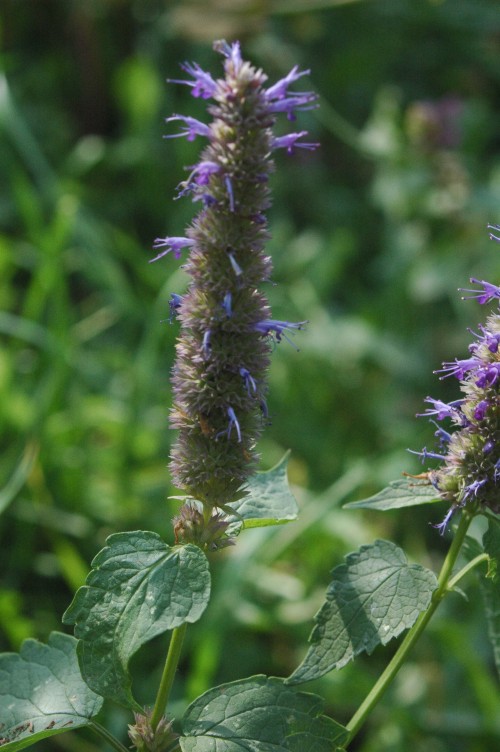
Mountain Giant Hyssop is a perennial herb in the Lamiaceae family. It grows in moist canyons. Its flower petals range from white to purple.
Written 27 November 2026 from the sources listed below. Each statement was checked against the passage it cites; statements that could not be supported were removed.
Appearance
Mountain Giant Hyssop is a perennial herb with simple, opposite leaves. Its leaves are semi-evergreen.[1][2]
The flower petals range from white to purple. The plant can grow up to 120 cm tall.[3][4]
Habitat
Mountain Giant Hyssop grows in moist canyons.[5]
Reproduction and life cycle
Mountain Giant Hyssop flowers from July through October.[6]
Uses
The Ramah Navajo use the plant as a ceremonial chant lotion. The dried, pulverized root is used as a dusting powder for sores or cankers.[7][8]
The Ramah use the plant as a fumigant for what is called deer infection. They also use it for protection from witches.[9][10]
Similar species
New Mexico giant hyssop and Bill Williams Mountain giant hyssop are other common names for the species. Horse is also listed as a common name.[11][12][13]
Classification of the Mountain Giant Hyssop
| Kingdom | Plantae |
|---|---|
| Subkingdom | Pteridobiotina |
| Phylum | Tracheophyta |
| Class | Magnoliopsida |
| Order | Lamiales |
| Family | Lamiaceae (Mint Family) |
| Subfamily | Nepetoideae |
| Tribe | Mentheae |
| Subtribe | Nepetinae |
| Genus | Agastache (Giant Hyssop) |
| Species | Agastache pallidiflora (A.Heller) Rydb. |
Where the Mountain Giant Hyssop is found
Checklists and occurrence records place Agastache pallidiflora in 2 countries across North America. GBIF holds 1,129 georeferenced records of it.
Countries
Regions and cities with the most records
- New Mexico, United States 370
- Arizona, United States 192
- Colorado, United States 66
- Enchanted Hills, United States 41
- Flagstaff, United States 37
- Rio Rancho, United States 30
- Texas, United States 22
- Alamogordo, United States 12
- Albuquerque, United States 5
- Chihuahua, Mexico 4
- Sierra Vista, United States 4
- Coahuila, Mexico 3
- Nuevo León, Mexico 3
- Sonora, Mexico 1
A number beside a place is its count of GBIF occurrence records. A place without a number comes from a checklist alone. Records show where a species has been observed or collected, which can include escapes and vagrants.
Common names
English
- Mountain Giant Hyssop
- New Mexico Giant Hyssop
Names in 2 other languages
- Chinese
- 山藿香
- Swedish
- blek kolibrimynta
Synonyms
One other scientific name has been used for this species and is now treated as a synonym of Agastache pallidiflora.
- Agastache pallidiflora subsp. typica Lint & Epling
Subspecies and varieties
- Agastache pallidiflora subsp. neomexicana (New Mexico Giant Hyssop) subspecies
- Agastache pallidiflora subsp. pallidiflora subspecies
- Agastache pallidiflora var. gilensis variety
- Agastache pallidiflora var. greenei variety
- Agastache pallidiflora var. havardii variety
Related species
-
 Anise HyssopAgastache foeniculum
-
 Korean MintAgastache rugosa
-
 Nettleleaf Giant-hyssopAgastache urticifolia
-
 Mexican Giant HyssopAgastache mexicana
-
 Yellow Giant-hyssopAgastache nepetoides
-
 Texas Hummingbird MintAgastache cana
-
 Purple Giant-hyssopAgastache scrophulariifolia
- Small-leaf Giant HyssopAgastache parvifolia
Compare
Questions and answers
What is the scientific name of the Mountain Giant Hyssop?
The scientific name of the Mountain Giant Hyssop is Agastache pallidiflora. Written with its author, the full name is Agastache pallidiflora (A.Heller) Rydb..
Which family does the Mountain Giant Hyssop belong to?
Agastache pallidiflora belongs to the family Lamiaceae, in the order Lamiales and the class Magnoliopsida.
Where is the Mountain Giant Hyssop found?
Checklists and occurrence records place Agastache pallidiflora in 2 countries: United States and Mexico.
What other names does the Mountain Giant Hyssop have?
Agastache pallidiflora is also known in English as New Mexico Giant Hyssop.
Sources
Passages the profile rests on
- The species is a perennial herb with simple, opposite leaves. Source passage: “It is a perennial herb that grows up to 4 ft (120 cm) tall. Leaves are semi-evergreen, simple and opposite in arrangement.” — English Wikipedia
- Its leaves are semi-evergreen. Source passage: “Leaves are semi-evergreen, simple and opposite in arrangement.” — English Wikipedia
- Its flower petals range from white to purple. Source passage: “Flower petals are white to purple in color” — English Wikipedia
- The plant can grow up to 120 cm tall. Source passage: “It is a perennial herb that grows up to 4 ft (120 cm) tall.” — English Wikipedia
- The species grows in moist canyons. Source passage: “It grows in moist canyons.” — English Wikipedia
- The species flowers from July through October. Source passage: “Flower petals are white to purple in color and bloom July to October.” — English Wikipedia
- The Ramah Navajo use the plant as a ceremonial chant lotion. Source passage: “It is used by the Ramah Navajo as a ceremonial chant lotion” — English Wikipedia
- The dried, pulverized root is used as a dusting powder for sores or cankers. Source passage: “the dried, pulverized root used as dusting powder for sores or cankers.” — English Wikipedia
- The Ramah use the plant as a fumigant for what the source calls deer infection. Source passage: “The Ramah also use it a fumigant for "deer infection"” — English Wikipedia
- The Ramah use the plant for protection from witches. Source passage: “and to protect from witches.” — English Wikipedia
- The species is identified as New Mexico giant hyssop in one source. Source passage: “commonly known as New Mexico giant hyssop” — English Wikipedia
- The species is also known by the common name Bill Williams Mountain giant hyssop. Source passage: “or Bill Williams Mountain giant hyssop” — English Wikipedia
- Horse is listed as another common name in the Arizona plant reference. Source passage: “Other common names. Mountain giant hyssop. horse ...” — yavapaiplants.extension.arizona.edu
Data
- Catalogue of Life, 2026-10-16 XR cc by
- Global Biodiversity Information Facility CC BY 4.0
- Wikidata CC0
- GeoNames CC BY 4.0
- Wikimedia Commons per image; credit shown with each image
- Within the Catalogue of Life, this name comes from Synonymic Checklists of the Vascular Plants of the World cc by
References
- (A.Heller) Rydb. where the name was published
This species in other databases
- Catalogue of Life 6626G
- Wikidata Q4691436
- iNaturalist 158081
- World Flora Online wfo-0000904857
- GRIN 458063
Page built on 28 November 2026. See how the catalog is made and all sources and licences.
Cite this page
ScientificNames.org. (2026). Agastache pallidiflora (Mountain Giant Hyssop). Retrieved November 28, 2026, from https://scientificnames.org/species/agastache-pallidiflora
“Agastache pallidiflora (Mountain Giant Hyssop).” ScientificNames.org, 2026, scientificnames.org/species/agastache-pallidiflora. Accessed 28 Nov. 2026.
ScientificNames.org. “Agastache pallidiflora (Mountain Giant Hyssop).” Accessed November 28, 2026. https://scientificnames.org/species/agastache-pallidiflora.
@misc{scientificnames_agastache_pallidiflora_mountain_giant_hyssop,
  author = {{ScientificNames.org}},
  title = {Agastache pallidiflora (Mountain Giant Hyssop)},
  year = {2026},
  url = {https://scientificnames.org/species/agastache-pallidiflora},
  note = {Accessed 2026-11-28}
}