Species · Reptiles
Green Vine Snake Ahaetulla nasuta
The scientific name of the Green Vine Snake is Ahaetulla nasuta. It is a species of reptile in the family Colubridae (colubrid), order Squamata. The name dates from 1789.
- Scientific name
- Ahaetulla nasuta (Lacépède, 1789)
- Common name
- Green Vine Snake
- Genus
- Ahaetulla
- Family
- Colubridae (Colubrid)
- Order
- Squamata
- Class
- Reptilia
- Red List category
- LC Least Concern
- Recorded in
- 10 countries
- Name status
- accepted in the Catalogue of Life
Overview
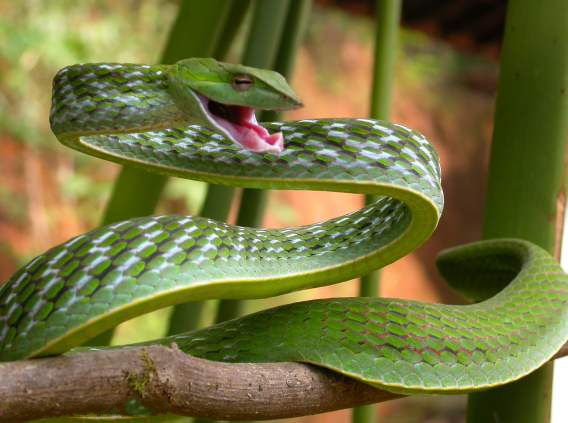
The species is endemic to Sri Lanka, where it occurs in lowland and montane rainforests. It has a long, slender body, a very pointed snout, and coloration ranging from bright green to pale brownish.
Written 26 November 2026 from the sources listed below. Each statement was checked against the passage it cites; statements that could not be supported were removed.
Appearance
The Green vine snake has a long, slender body and a very pointed snout. It can reach a total length of 1.9 metres.[1][2]
Its coloration ranges from bright green to pale brownish. A yellow line runs along each side of the lower surface of its body, and the skin between its scales has a black-and-white pattern.[3][4][5]
The species has horizontal pupils.[6]
Habitat
The Green vine snake occurs in lowland forests and bush habitats. It is often found near streams and human settlements.[7][8]
The species is endemic to Sri Lanka. Its confirmed distribution includes the wet zone of Sri Lanka and the Sri Lankan lowland and montane rainforests.[9][10][11]
Diet
The Green vine snake primarily feeds on lizards and frogs. It occasionally eats other snakes, birds, and mammals.[12][13]
Behaviour
The Green vine snake is active during the day and is arboreal. It occasionally descends from trees to search for food.[14][15][16]
The species hunts slowly while using camouflage. It sometimes extends its body and sways slowly to imitate a tree branch.[17][18]
When disturbed, the Green vine snake may expand its body to expose its black-and-white scale markings. When threatened, it may open its mouth as a defensive display.[19][20]
Reproduction and life cycle
The Green vine snake is ovoviviparous. The young develop inside the mother's body while enclosed within an egg membrane.[21][22]
The species may be capable of delayed fertilization. A female kept isolated at London Zoo from August 1885 gave birth in August 1888.[23][24]
Classification of the Green Vine Snake
| Kingdom | Animalia |
|---|---|
| Phylum | Chordata |
| Subphylum | Vertebrata |
| Infraphylum | Gnathostomata |
| Parvphylum | Osteichthyes |
| Megaclass | Tetrapoda |
| Class | Reptilia (Reptile) |
| Order | Squamata (Snakes) |
| Suborder | Serpentes (Snakes) |
| Infraorder | Alethinophidia |
| Family | Colubridae (Colubrid) |
| Subfamily | Ahaetuliinae |
| Genus | Ahaetulla (Asian Longnosed Whipsnakes) |
| Species | Ahaetulla nasuta (Lacépède, 1789) |
Where the Green Vine Snake is found
Checklists and occurrence records place Ahaetulla nasuta in 10 countries across Asia. GBIF holds 1,118 georeferenced records of it.
Countries
- Bhutan
- Cambodia 9
- India 202
- Indonesia 4
- Malaysia 8
- Myanmar 110
- Nepal 8
- Sri Lanka 655
- Thailand 107
- Vietnam 15
Regions and cities with the most records
- Kandy, Sri Lanka 81
- Gampola, Sri Lanka 76
- Mandalay Region, Myanmar 52
- Tamil Nadu, India 35
- Karnataka, India 33
- Matale, Sri Lanka 30
- Dambulla, Sri Lanka 24
- Maharashtra, India 21
- Sagaing Region, Myanmar 21
- Someshwar, India 19
- Kyaukpadaung, Myanmar 14
- Tīrthahalli, India 14
- Vadavalli, India 14
- Narasimhanaickenpalayam, India 13
- Weligama, Sri Lanka 13
- Bentota, Sri Lanka 12
- Beruwala, Sri Lanka 12
- Idaiyarpālaiyam, India 12
- Magway, Myanmar 12
- Rakkiyapālaiyam, India 12
- Tudiyalūr, India 12
- Vīrakeralam, India 12
- Periyanayakkanpalaiyam, India 11
- Vellakkinar, India 11
- Matara, Sri Lanka 10
- Kalutara, Sri Lanka 9
- Kataragama, Sri Lanka 9
- Ratnapura, Sri Lanka 9
- Unamaucheri, India 9
- Chengalpattu, India 8
- Gūduvāncheri, India 8
- Kurunegala, Sri Lanka 8
- Madambakkam, India 8
- Maraimalainagar, India 8
- Perunkalattu, India 8
- Srīperumbūdūr, India 8
1 more country has a few records outside this range
These countries hold a few records of Ahaetulla nasuta but lie outside the range the checklists give for it. Such records are often zoo or garden specimens, museum material or vagrants, so the species is not counted as occurring there.
Range as the checklists state it
Sri Lanka, Bhutan
A number beside a place is its count of GBIF occurrence records. A place without a number comes from a checklist alone. Records show where a species has been observed or collected, which can include escapes and vagrants.
Common names
English
- Green Vine Snake
- Long-nosed Tree Snake
- Long-nosed Whip Snake
- Sri Lanka Green Vine Snake
- Sri Lanka Long-nosed Tree Snake
- Sri Lanka Long-nosed Whipsnake
- Sri Lankan Green Vine Snake
- Sri Lankan Long-nosed Tree Snake
- Sri Lankan Long-nosed Whipsnake
Names in 12 other languages
- Catalan
- Serp Liana Verda d'Sri Lanka
- Chinese
- 長鼻樹蛇
- Czech
- bičovka nosatá
- Danish
- Spidssnudet Grøn Piskesnog
- French
- Serpent liane nasique
- German
- Baumschnüffler, Nasen-Peitschennatter, Nasenpeitschennatter
- Lithuanian
- Smailiasnukė rimbagyvatė
- Polish
- Biczowąż długonosy
- Portuguese
- Cobra-cipó-cingalesa
- Russian
- Длиннорылая плетевидка
- Sinhala
- ඇහැටුල්ලා
- Thai
- งูเขียวปากแหนบศรีลังกา
Synonyms
9 other scientific names have been used for this species and are now treated as synonyms of Ahaetulla nasuta.
- Ahaetulla mycterizans Link, 1807
- Drijinus nasutus
- Dryophis hammatorhynchus Fitzinger, 1826
- Dryophis mycterizans cineroventer Wall, 1908
- Dryophis mycterizans rhodonotus Wall, 1921
- Dryophis mycterizans tephrogaster Wall, 1908
- Dryophis nasuta Lacépède, 1789
- Coluber mycterizans Russell, 1796 ambiguous synonym
- Coluber nasutus Lacépède, 1789 ambiguous synonym
Related species
-
 Asian Vine SnakeAhaetulla prasina
-
 Ahaetulla oxyrhyncha
-
 Malayan WhipsnakeAhaetulla mycterizans
-
 Brown-speckled WhipsnakeAhaetulla pulverulenta
-
 Variable Vine SnakeAhaetulla anomala
-
 Indian BronzebackAhaetulla dispar
-
 Laudankia Vine SnakeAhaetulla laudankia
-
 Western Ghats BronzebackAhaetulla perroteti
Compare
Questions and answers
What is the scientific name of the Green Vine Snake?
The scientific name of the Green Vine Snake is Ahaetulla nasuta. Written with its author, the full name is Ahaetulla nasuta (Lacépède, 1789).
Which family does the Green Vine Snake belong to?
Ahaetulla nasuta belongs to the family Colubridae, in the order Squamata and the class Reptilia.
Where is the Green Vine Snake found?
Checklists and occurrence records place Ahaetulla nasuta in 10 countries, including Sri Lanka, India, Myanmar, Thailand, Vietnam and Cambodia.
What is the conservation status of the Green Vine Snake?
The IUCN Red List category recorded for Ahaetulla nasuta is Least Concern (LC).
What other names does the Green Vine Snake have?
Ahaetulla nasuta is also known in English as Long-nosed Tree Snake, Long-nosed Whip Snake, Sri Lanka Green Vine Snake, Sri Lanka Long-nosed Tree Snake, Sri Lanka Long-nosed Whipsnake and Sri Lankan Green Vine Snake.
How venomous is a green vine snake?
The Green vine snake is mildly venomous. Its bites can cause localized pain, swelling, bruising, and numbness in humans. Symptoms typically resolve within three days.[25][26][27]
Is vine snake harmless?
The Green vine snake is mildly venomous. Its bites can cause localized pain, swelling, bruising, and numbness in humans.[25][26]
How toxic is a vine snake?
The Green vine snake is mildly venomous. Symptoms of a bite typically resolve within three days.[25][27]
Sources
Passages the profile rests on
- Ahaetulla nasuta has a long, slender body and a very pointed snout. Source passage: “It is long and slender, reaching up to 1.9 m (6 ft 3 in) in length, with a very pointed snout.” — English Wikipedia
- Ahaetulla nasuta can reach a total length of 1.9 metres. Source passage: “reaching up to 1.9 m (6 ft 3 in) in length” — English Wikipedia
- Its coloration ranges from bright green to pale brownish. Source passage: “It is bright green to pale brownish in color” — English Wikipedia
- A yellow line runs along each side of the lower surface of its body. Source passage: “with a yellow line along each side of the body's lower surface” — English Wikipedia
- The skin between its scales has a black-and-white pattern. Source passage: “black-and-white patterned interstitial skin between the scales.” — English Wikipedia
- Ahaetulla nasuta has horizontal pupils. Source passage: “They are the only species of snake with horizontal pupils” — English Wikipedia
- Ahaetulla nasuta occurs in lowland forests and bush habitats. Source passage: “It is found in lowland forest and bush” — English Wikipedia
- The species is often found near streams and human settlements. Source passage: “often near streams and human settlements.” — English Wikipedia
- Ahaetulla nasuta is endemic to Sri Lanka. Source passage: “is a venomous, slender green tree snake endemic to Sri Lanka.” — English Wikipedia
- The species' confirmed distribution includes the wet zone of Sri Lanka. Source passage: “the 'true' A. nasuta (from which the species was originally described) being restricted to the wet zone of Sri Lanka” — English Wikipedia
- Its distribution includes the Sri Lankan lowland and montane rainforests. Source passage: “including the Sri Lanka lowland and montane rainforests” — English Wikipedia
- Ahaetulla nasuta primarily feeds on lizards and frogs. Source passage: “It primarily feeds on lizards and frogs” — English Wikipedia
- The species occasionally eats other snakes, birds, and mammals. Source passage: “but also occasionally other snakes, birds, and mammals.” — English Wikipedia
- Ahaetulla nasuta is active during the day. Source passage: “The Sri Lankan green vine snake is diurnal and arboreal” — English Wikipedia
- The species is arboreal. Source passage: “The Sri Lankan green vine snake is diurnal and arboreal” — English Wikipedia
- Ahaetulla nasuta occasionally descends from trees to search for food. Source passage: “occasionally descending from the trees to search for food.” — English Wikipedia
- The species hunts slowly while using camouflage. Source passage: “It is a slow-moving camouflage hunter” — English Wikipedia
- Ahaetulla nasuta sometimes extends its body and sways slowly to imitate a tree branch. Source passage: “often extending its body and slowly swaying in imitation of a tree branch.” — English Wikipedia
- When disturbed, the species may expand its body to expose black-and-white scale markings. Source passage: “When disturbed, they may expand their bodies to show a black and white scale marking” — English Wikipedia
- When threatened, Ahaetulla nasuta may open its mouth as a defensive display. Source passage: “and open their mouths in a threat display.” — English Wikipedia
- Ahaetulla nasuta is ovoviviparous. Source passage: “The species is ovoviviparous” — English Wikipedia
- The young develop inside the mother's body while enclosed within an egg membrane. Source passage: “giving birth to young that grow within the body of the mother, enclosed within the egg membrane.” — English Wikipedia
- Ahaetulla nasuta may be capable of delayed fertilization. Source passage: “They may be capable of delayed fertilization” — English Wikipedia
- A female kept isolated at London Zoo from August 1885 gave birth in August 1888. Source passage: “as a female in the London zoo kept in isolation from August 1885 gave birth in August 1888.” — English Wikipedia
- Ahaetulla nasuta is mildly venomous. Source passage: “The snake is mildly venomous.” — English Wikipedia
- Bites from Ahaetulla nasuta can cause localized pain, swelling, bruising, and numbness in humans. Source passage: “causing localized pain, swelling, bruising, and numbness” — English Wikipedia
- The symptoms of a bite typically resolve within three days. Source passage: “that typically resolves within three days.” — English Wikipedia
Data
- Catalogue of Life, 2026-10-16 XR cc by
- Global Biodiversity Information Facility CC BY 4.0
- Wikidata CC0
- GeoNames CC BY 4.0
- Wikimedia Commons per image; credit shown with each image
- Within the Catalogue of Life, this name comes from The Reptile Database cc by
References
- Lacepede, B. G. E. (1789) Histoire Naturelle des Quadrupedes Ovipares et de Serpens. Vol. 2. lmprimerie du Roi, Hotel de Thou, Paris, 671 pp. https: // doi. org / 10.5962 / bhl. title. 50642 where the name was published
- Lacepède, B. G. E. (1789). Histoire Naturelle des Quadrupèdes Ovipares et de Serpens. Vol.2. Lmprimerie Du Roi, Hôtel de Thou, Paris, 671 Pp.
- Bonnaterre, P. J. (1790). Ophiologie, in Tableau encyclopédique et méthodique des trois règnes de la nature. Panconoke, Paris, XLIV + 76 Pp + 43 Plates.
- Russell, P. (1796). An account of Indian serpents collected on the coast of Coromandel, containing descriptions and drawings of each species, together with experiments and remarks on their several poisons. George Nicol, London, 90 Pp.
- Link, H. F. (1807). Beschreibung der Naturalien-Sammlung der Universität zu Rostock, zweite Abtheilung. Adlers Erben, Rostock, Pp. 51-100.
- Bell, T. (1825). On Leptophina, a group of serpents comprising the Genus Drynus of Merrem, and a newly formed Genus proposed to be named Leptophis. The Zoological Journal, 2: 322-329.
- Schlegel, H. (1837). Essai sur la physionomie des serpens. Partie Descriptive. La Haye (J. Kips, J. HZ. Et W. P. Van Stockum), 606 S. + Xvi.
- Duméril, A. M. C., Bibron, G. & DUMÉRIL, A. H. A.,. (1854). Erpétologie générale ou histoire naturelle complète des reptiles. Tome septième. Deuxième partie, comprenant l’histoire des serpents venimeux. Paris, Librairie Encyclopédique de Roret: I-Xii + 781-1536.
- Boulenger, George A. (1890). The Fauna of British India, Including Ceylon and Burma. Reptilia and Batrachia. Taylor & Francis, London, Xviii, 541 Pp.
- Boulenger, G. A. (1896). Catalogue of the snakes in the British Museum, Vol. 3. London (Taylor & Francis), Xiv + 727 Pp.
- Wall, F. (1908). Remarks on some recently acquired snakes. J. Bombay Nat. Hist. Soc. 18: 778-784.
- Wall, F. (1908). A new color variety of the common green whip-snake (Cryophis mycterizans). J. Bombay Nat. Hist. Soc. 18: 919.
- Wall, F. (1910). Remarks on the varieties and distribution of the common Green Whip Snake (Dryophis mycterizans). J. Bombay Nat. Hist. Soc. 20: 229.
- Wall, F. (1910). Varieties of the common Green Whip Snake (Dryophis mycterizans). J. Bombay Nat. Hist. Soc. 20: 524.
- Cochran, D. M. (1930). The herpetological results made by Dr. Hugh Smith in Siam from 1923 to 1929. Proc. US Natl. Mus. 77 (11): 1-39 [1931].
- Smith, M. A. (1943). The Fauna of British India, Ceylon and Burma, Including the Whole of the Indo-Chinese Sub-Region. Reptilia and Amphibia. 3 (Serpentes). Taylor and Francis, London. 583 Pp.
- Constable, JOHN D. (1949). Reptiles from the Indian Peninsula in the Museum of Comparative Zoology. Bull. Mus. Comp. Zool. Harvard 103: 59-160.
- Taylor, Edward H. (1953). Report on a collection of Ceylonese serpents. Univ. Kansas Sci. Bull. 35 (14): 1615-1624.
- Taylor, E. H. (1965). The serpents of Thailand and adjacent waters. Univ. Kansas Sci. Bull. 45 (9): 609-1096.
- Sharma, R. C. (1976). Records of the reptiles of Goa. Records Zool. Survey India 71 (1975): 149-167.
- Inger, Robert F.;Shaffer, H. Bradley;Koshy, Mammen;Bakde, Ramesh. (1984). A report on a collection of amphibians and reptiles from the Ponmudi, Kerala, South India. J. Bombay Nat. Hist. Soc. 81 (3): 551-570.
- ICZN. (1987). Opinion 1463. De Lacepede 1788-1789, Histoire Naturelle des Serpens and later editions: rejected as a non-binominal work. Bull. Zool. Nomenclature 44(4): 265-267.
- Dowling, H.G., & Jenner, J.V. (1988). Snakes of Burma: checklist of reported species and bibliography. Smithsonian Herp. Inf. Serv. (76): 19 Pp.
- Golder, F. (1989). Ahaetulla nasuta (LACÉPÈDE, 1789), Haltung und Nachzucht. Salamandra 25 (2): 65-72.
- Zug, G. R., & Mitchell, J. C. (1995). Amphibians and Reptiles of the Royal Chitwan National Park, Nepal. Asiatic Herpetological Research 6: 172-180.
This species in other databases
Page built on 26 November 2026. See how the catalog is made and all sources and licences.
Cite this page
ScientificNames.org. (2026). Ahaetulla nasuta (Green Vine Snake). Retrieved November 26, 2026, from https://scientificnames.org/species/ahaetulla-nasuta
“Ahaetulla nasuta (Green Vine Snake).” ScientificNames.org, 2026, scientificnames.org/species/ahaetulla-nasuta. Accessed 26 Nov. 2026.
ScientificNames.org. “Ahaetulla nasuta (Green Vine Snake).” Accessed November 26, 2026. https://scientificnames.org/species/ahaetulla-nasuta.
@misc{scientificnames_ahaetulla_nasuta_green_vine_snake,
  author = {{ScientificNames.org}},
  title = {Ahaetulla nasuta (Green Vine Snake)},
  year = {2026},
  url = {https://scientificnames.org/species/ahaetulla-nasuta},
  note = {Accessed 2026-11-26}
}