Species · Reptiles
Ahaetulla oxyrhyncha
Ahaetulla oxyrhyncha has no English name on record in the checklists used here. It is a species of reptile in the family Colubridae (colubrid), order Squamata. The name dates from 1825.
- Scientific name
- Ahaetulla oxyrhyncha (Bell, 1825) Mallik & Srikanthan & Pal & D’Souza & Shanker & Ganesh, 2020
- Genus
- Ahaetulla
- Family
- Colubridae (Colubrid)
- Order
- Squamata
- Class
- Reptilia
- Recorded in
- 1 country
- Name status
- accepted in the Catalogue of Life

Overview
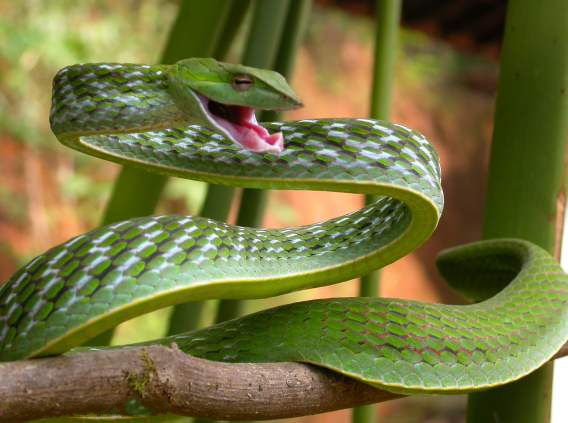
The species occurs across the drier plains and low hilly areas of peninsular India. It has a slender, usually bright grassy green body, two white lines along its body and horizontally oriented pupils.
Written 26 November 2026 from the sources listed below. Each statement was checked against the passage it cites; statements that could not be supported were removed.
Similar species
Ahaetulla oxyrhyncha was formerly misclassified as Ahaetulla nasuta. Although it was described as distinct in 1825, it was subsequently treated as the same species as Ahaetulla nasuta.[1][2]
Ahaetulla oxyrhyncha has a substantially larger body and a longer snout than Ahaetulla nasuta.[3][4]
Appearance
The species has a thin, slender body that is usually bright grassy green. Two white lines run along the body, separating its dorsal and ventral regions.[5][6]
The species has horizontally oriented pupils and a longer snout than Ahaetulla nasuta.[7][4]
Habitat
The species occurs in arid and semi-arid environments, including dry deciduous forests and scrub forests.[8][9][10]
It has been recorded in and around villages and countryside human settlements, as well as in some city parks.[11][12]
The species occurs across the drier plains and low hilly areas of peninsular India. It is absent from the Western Ghats rainforest.[13][14][15]
Diet
Behaviour
The species is active during daylight hours and has an arboreal lifestyle.[18][19]
While hunting, it uses camouflage to resemble branches. It relies on camouflage and binocular vision when hunting among foliage.[20][21]
The species is depicted displaying a threat posture in photographic material.[22]
Conservation
A misconception that the species pecks people's eyes has contributed to its widespread indiscriminate killing.[23]
Classification of Ahaetulla oxyrhyncha
| Kingdom | Animalia |
|---|---|
| Phylum | Chordata |
| Subphylum | Vertebrata |
| Infraphylum | Gnathostomata |
| Parvphylum | Osteichthyes |
| Megaclass | Tetrapoda |
| Class | Reptilia (Reptile) |
| Order | Squamata (Snakes) |
| Suborder | Serpentes (Snakes) |
| Infraorder | Alethinophidia |
| Family | Colubridae (Colubrid) |
| Subfamily | Ahaetuliinae |
| Genus | Ahaetulla (Asian Longnosed Whipsnakes) |
| Species | Ahaetulla oxyrhyncha (Bell, 1825) Mallik & Srikanthan & Pal & D’Souza & Shanker & Ganesh, 2020 |
Origin of the name. Etymology. Latin, alluding to the pointed rostral scale; oxyus = sharp, rhynchus = of the nose / snout, literally meaning sharp-snouted.
This name was added to the Catalogue of Life from a contributing dataset by automated merging and has not yet been reviewed by its editors.
Where Ahaetulla oxyrhyncha is found
Checklists and occurrence records place Ahaetulla oxyrhyncha in 1 country. GBIF holds 18 georeferenced records of it.
Countries
A number beside a place is its count of GBIF occurrence records. A place without a number comes from a checklist alone. Records show where a species has been observed or collected, which can include escapes and vagrants.
Related species
-
 Green Vine SnakeAhaetulla nasuta
-
 Asian Vine SnakeAhaetulla prasina
-
 Malayan WhipsnakeAhaetulla mycterizans
-
 Brown Vine SnakeAhaetulla pulverulenta
-
 Variable Vine SnakeAhaetulla anomala
-
 Günther's Vine SnakeAhaetulla dispar
-
 Laudankia Vine SnakeAhaetulla laudankia
-
 Bronze-headed Vine SnakeAhaetulla perroteti
Compare
Questions and answers
Is Ahaetulla poisonous?
Ahaetulla oxyrhyncha is mildly venomous. Bites can cause localized pain, swelling and bruising, as well as numbness that generally resolves within three days. Bites generally do not require medical attention, although bites near vital organs can produce more severe reactions.[24][25][26][27][28][29][30]
Sources
Passages the profile rests on
- The species was formerly misclassified as Ahaetulla nasuta. Source passage: “Formerly misclassified as A. nasuta” — English Wikipedia
- The species was described as distinct in 1825 but was subsequently treated as the same species as Ahaetulla nasuta. Source passage: “It was described as a distinct species in 1825 based on drawings of snakes from Vishakapatnam, but later considered as same species and confused with A. nasuta” — English Wikipedia
- The species has a substantially larger body than Ahaetulla nasuta. Source passage: “A. oxyrhyncha is actually a much larger-bodied species” — English Wikipedia
- The species has a longer snout than Ahaetulla nasuta. Source passage: “that also has a much longer snout.” — English Wikipedia
- The species has a thin, slender body that is usually bright grassy green. Source passage: “A thin and slender-bodied snake that is usually bright grassy green in colour.” — English Wikipedia
- Two white lines run along the body, separating its dorsal and ventral regions. Source passage: “A pair of white lines extend throughout its body length demarcating the back and under belly parts.” — English Wikipedia
- The species has horizontally oriented pupils. Source passage: “They have unique horizontal pupil in the eye.” — English Wikipedia
- The species occurs in arid and semi-arid environments. Source passage: “including arid to semi-arid habitats” — English Wikipedia
- The species inhabits dry deciduous forests. Source passage: “and in dry deciduous forests” — English Wikipedia
- The species occurs in scrub forests. Source passage: “open areas such as scrub forests” — English Wikipedia
- The species has been recorded in and around villages and countryside human settlements. Source passage: “This species has been often sighted in and around human habitations in villages and countrysides” — English Wikipedia
- The species has also been observed in some city parks. Source passage: “and even in some city Parks.” — English Wikipedia
- The species occurs across the drier plains of peninsular India. Source passage: “This species is distributed throughout the drier plains and low hilly tracts of Peninsular India” — English Wikipedia
- The species occurs in low hilly areas of peninsular India. Source passage: “and low hilly tracts of Peninsular India” — English Wikipedia
- The species is absent from the Western Ghats rainforest. Source passage: “except the Western Ghats rainforest.” — English Wikipedia
- The species hunts lizards. Source passage: “for hunting lizards and frogs” — English Wikipedia
- The species hunts frogs. Source passage: “for hunting lizards and frogs” — English Wikipedia
- The species is active during daylight hours. Source passage: “The Indian vine snake or long-nosed vine snake (Ahaetulla oxyrhyncha) is a species of diurnal” — English Wikipedia
- The species has an arboreal lifestyle. Source passage: “is a species of diurnal, mildly venomous, arboreal snake” — English Wikipedia
- The species uses camouflage to resemble branches while hunting. Source passage: “using their slender bodies and camouflage to mimic branches for hunting lizards and frogs” — English Wikipedia
- The species relies on camouflage and binocular vision when hunting among foliage. Source passage: “They are diurnal (active during the day) and rely on their perfect camouflage and binocular vision for hunting in foliage.” — English Wikipedia
- The species is depicted displaying a threat posture in the document's photographic material. Source passage: “Tamil Nadu (e) showing threat display” — gbif.org
- A misconception that the species pecks people's eyes has contributed to its widespread indiscriminate killing. Source passage: “Often mistakenly believed to peck out peoples' eyes, this misconception has led to widespread wanton killing of this species.” — English Wikipedia
- The species is mildly venomous. Source passage: “is a species of diurnal, mildly venomous, arboreal snake” — English Wikipedia
- Bites can cause localized pain in humans. Source passage: “causing localized pain, swelling, bruising, and numbness that typically resolves within three days.” — English Wikipedia
- Bites can cause localized swelling in humans. Source passage: “causing localized pain, swelling, bruising, and numbness that typically resolves within three days.” — English Wikipedia
- Bites can cause bruising in humans. Source passage: “causing localized pain, swelling, bruising, and numbness that typically resolves within three days.” — English Wikipedia
- Bites can cause numbness that generally resolves within three days. Source passage: “and numbness that typically resolves within three days.” — English Wikipedia
- Bites generally do not require medical attention. Source passage: “Bites typically do not require medical attention” — English Wikipedia
- Bites near vital organs can produce more severe reactions. Source passage: “but some cases involving bites near vital organs could be more severe” — English Wikipedia
Data
- Catalogue of Life, 2026-10-16 XR cc by
- Global Biodiversity Information Facility CC BY 4.0
- Wikidata CC0
- GeoNames CC BY 4.0
- Wikimedia Commons per image; credit shown with each image
- Within the Catalogue of Life, this name comes from Disentangling vines: a study of morphological crypsis and genetic divergence in vine snakes (Squamata: Colubridae: Ahaetulla) with the description of five new species from Peninsular India cc0
References
- Mallik, Ashok Kumar;Srikanthan, Achyuthan N.;Pal, Saunak P.;D’Souza, Princia Margaret;Shanker, Kartik;Ganesh, Sumaithangi Rajagopalan. (2020). Disentangling vines: a study of morphological crypsis and genetic divergence in vine snakes (Squamata: Colubridae: Ahaetulla) with the description of five new species from Peninsular India. Zootaxa, 4874(1), 1–62. https://doi.org/10.11646/zootaxa.4874.1.1 Link where the name was published
This species in other databases
Page built on 28 November 2026. See how the catalog is made and all sources and licences.
Cite this page
ScientificNames.org. (2026). Ahaetulla oxyrhyncha. Retrieved November 28, 2026, from https://scientificnames.org/species/ahaetulla-oxyrhyncha
“Ahaetulla oxyrhyncha.” ScientificNames.org, 2026, scientificnames.org/species/ahaetulla-oxyrhyncha. Accessed 28 Nov. 2026.
ScientificNames.org. “Ahaetulla oxyrhyncha.” Accessed November 28, 2026. https://scientificnames.org/species/ahaetulla-oxyrhyncha.
@misc{scientificnames_ahaetulla_oxyrhyncha,
  author = {{ScientificNames.org}},
  title = {Ahaetulla oxyrhyncha},
  year = {2026},
  url = {https://scientificnames.org/species/ahaetulla-oxyrhyncha},
  note = {Accessed 2026-11-28}
}