Species · Reptiles
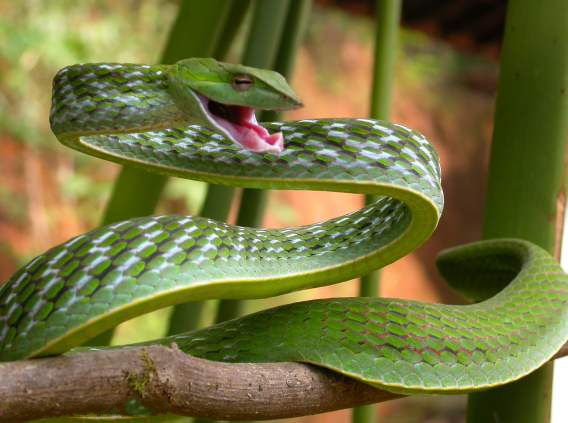
Bronze-headed Vine Snake Ahaetulla perroteti
The scientific name of the Bronze-headed Vine Snake is Ahaetulla perroteti. It is a species of reptile in the family Colubridae (colubrid), order Squamata. The name dates from 1854.
- Scientific name
- Ahaetulla perroteti (Duméril, Bibron & Duméril, 1854)
- Common name
- Bronze-headed Vine Snake
- Genus
- Ahaetulla
- Family
- Colubridae (Colubrid)
- Order
- Squamata
- Class
- Reptilia
- Red List category
- EN Endangered
- Recorded in
- 1 country
- Name status
- accepted in the Catalogue of Life

Overview
Ahaetulla perroteti inhabits open montane grasslands above the tree line in high-elevation hills above 1,600 m. Males are bright green above, while females have drab brownish-grey upper coloration.
Written 26 November 2026 from the sources listed below. Each statement was checked against the passage it cites; statements that could not be supported were removed.
Appearance
Males are bright green on their upper surfaces and yellowish or pale green underneath, with a green lateral line. Females have drab brownish-grey upper coloration and a yellowish underside.[1][2]
The snout is projecting and bluntly pointed, without a dermal appendage. The dorsal scales form 15 rows at midbody, and the scales on the sacral region are keeled.[3][4]
The species has 138–140 ventral scales and 70–82 subcaudal scales. The upper labials number eight, rarely nine, with the fourth and fifth entering the eye.[5][6][7]
The total length, including the tail, is approximately 61 cm. The tail measures approximately 14 cm.[8][9]
Habitat
The Bronze-headed Vine Snake inhabits open montane grasslands above the tree line. It occurs in high-elevation hills above 1,600 m.[10][11]
Diet
The species feeds mainly on lizards and frogs.[12]
Behaviour
The species is active during daylight hours and is terrestrial. Individuals have been observed basking in full sunlight.[13][14][15]
It rarely, if ever, climbs trees.[16]
Reproduction and life cycle
The Bronze-headed Vine Snake is viviparous.[17]
Conservation
The species is endemic to a geographically restricted region of the Western Ghats. It may have the smallest geographic range among Indian Ahaetulla species.[18][19]
The species is mildly venomous and has rear fangs.[20]
Classification of the Bronze-headed Vine Snake
| Kingdom | Animalia |
|---|---|
| Phylum | Chordata |
| Subphylum | Vertebrata |
| Infraphylum | Gnathostomata |
| Parvphylum | Osteichthyes |
| Megaclass | Tetrapoda |
| Class | Reptilia (Reptile) |
| Order | Squamata (Snakes) |
| Suborder | Serpentes (Snakes) |
| Infraorder | Alethinophidia |
| Family | Colubridae (Colubrid) |
| Subfamily | Ahaetuliinae |
| Genus | Ahaetulla (Asian Longnosed Whipsnakes) |
| Species | Ahaetulla perroteti (Duméril, Bibron & Duméril, 1854) |
Where the Bronze-headed Vine Snake is found
Checklists and occurrence records place Ahaetulla perroteti in 1 country across Asia. GBIF holds 36 georeferenced records of it.
Countries
Regions and cities with the most records
- Tamil Nadu, India 9
- Kerala, India 7
- Ambattur, India 4
- Avadi, India 4
- Chennai, India 4
- Injambakkam, India 4
- Jalladiampet, India 4
- Kaikalapettai, India 4
- Kattivākkam, India 4
- Kullattūr, India 4
- Madhavaram, India 4
- Madipakkam, India 4
- Maduraivayal, India 4
- Maduravoyal, India 4
- Manali, India 4
- Mathur, India 4
- Meenambakkam, India 4
- Mugalivakkam, India 4
- Nalambūr, India 4
- Neelankarai, India 4
- Nerkunram, India 4
- Nāravārikuppam, India 4
- Pallikaranai, India 4
- Pallāvaram, India 4
- Polichalur, India 4
- Poonamalle, India 4
- Porur, India 4
- Puzhal, India 4
- Pādiyanallūr, India 4
- Ramapuram, India 4
- Reddipālaiyam, India 4
- Saint Thomas Mount, India 4
- Tiruvottiyūr, India 4
- Vīrarāghavapuram, India 4
- Kallamchavadi, India 3
- Kollivāyal, India 3
Range as the checklists state it
India (Western Ghats, Kerala, Tamil Nadu ?), elelvation 1980 m to 2300 m
A number beside a place is its count of GBIF occurrence records. A place without a number comes from a checklist alone. Records show where a species has been observed or collected, which can include escapes and vagrants.
Common names
English
- Bronze-headed Vine Snake
- Nilgiri Vine Snake
- Perrotet's Vine Snake
- Western Ghats Bronzeback
Names in 2 other languages
- Chinese
- 印度瘦蛇
- Russian
- Нильгеррийская плетевидка
Synonyms
4 other scientific names have been used for this species and are now treated as synonyms of Ahaetulla perroteti.
- Dryophis perroteti (Duméril, Bibron & Duméril, 1854)
- Dryophis tropidococcyx Günther, 1858
- Leptophis canarensis Jerdon, 1854
- Psammophis perroteti Duméril, Bibron & Duméril, 1854
Related species
-
 Green Vine SnakeAhaetulla nasuta
-
 Asian Vine SnakeAhaetulla prasina
-
 Ahaetulla oxyrhyncha
-
 Malayan WhipsnakeAhaetulla mycterizans
-
 Brown Vine SnakeAhaetulla pulverulenta
-
 Variable Vine SnakeAhaetulla anomala
-
 Günther's Vine SnakeAhaetulla dispar
-
 Laudankia Vine SnakeAhaetulla laudankia
Compare
Questions and answers
What is the scientific name of the Bronze-headed Vine Snake?
The scientific name of the Bronze-headed Vine Snake is Ahaetulla perroteti. Written with its author, the full name is Ahaetulla perroteti (Duméril, Bibron & Duméril, 1854).
Which family does the Bronze-headed Vine Snake belong to?
Ahaetulla perroteti belongs to the family Colubridae, in the order Squamata and the class Reptilia.
Where is the Bronze-headed Vine Snake found?
Checklists and occurrence records place Ahaetulla perroteti in 1 country: India.
What is the conservation status of the Bronze-headed Vine Snake?
The IUCN Red List category recorded for Ahaetulla perroteti is Endangered (EN).
What other names does the Bronze-headed Vine Snake have?
Ahaetulla perroteti is also known in English as Nilgiri Vine Snake, Perrotet's Vine Snake and Western Ghats Bronzeback.
What species are found in the Western Ghats?
The Bronze-headed Vine Snake (Ahaetulla perroteti) is endemic to the Nilgiri Hills of the Western Ghats in southern India. It occurs in Kerala and Tamil Nadu, with recorded localities including Mukurthi National Park, Silent Valley, Siruvani Peak, and Vellarimala, also known as Camel's Hump.[21][22][23]
Sources
Passages the profile rests on
- Males are bright green on their upper surfaces and yellowish or pale green underneath, with a green lateral line. Source passage: “Males are bright green above, yellowish or pale green beneath, with a green lateral line.” — English Wikipedia
- Females have drab brownish-grey upper coloration and a yellowish underside. Source passage: “Females are drab brownish grey with a yellowish venter.” — English Wikipedia
- The snout is projecting and bluntly pointed, without a dermal appendage. Source passage: “The snout is obtusely pointed and projecting, without dermal appendage” — English Wikipedia
- The dorsal scales form 15 rows at midbody, and the scales on the sacral region are keeled. Source passage: “The dorsal scales are in 15 rows at midbody, and those on the sacral region are keeled.” — English Wikipedia
- The species has 138–140 ventral scales. Source passage: “The ventrals number 138–140.” — English Wikipedia
- The species has 70–82 subcaudal scales. Source passage: “the subcaudals number 70–82.” — English Wikipedia
- The upper labials number eight, rarely nine, with the fourth and fifth entering the eye. Source passage: “There are 8 (rarely 9) upper labials, the fourth and fifth entering the eye.” — English Wikipedia
- The total length, including the tail, is approximately 61 cm. Source passage: “The total length (tail included) is 2 ft (61 cm).” — English Wikipedia
- The tail measures approximately 14 cm. Source passage: “The tail is 5.5 in (14 cm).” — English Wikipedia
- The species inhabits open montane grasslands above the tree line. Source passage: “found actively moving about on open montane grassland above the tree line.” — English Wikipedia
- The species occurs in high-elevation hills above 1,600 m. Source passage: “It occurs in high-elevation hills, above 1,600 m (5,200 ft), of Kerala and Tamil Nadu states.” — English Wikipedia
- The species feeds mainly on lizards and frogs. Source passage: “It feeds mainly on lizards and frogs.” — English Wikipedia
- The species is active during daylight hours. Source passage: “Ahaetulla perroteti is a diurnal, terrestrial snake” — English Wikipedia
- The species is terrestrial. Source passage: “Ahaetulla perroteti is a diurnal, terrestrial snake” — English Wikipedia
- Individuals have been observed basking in full sunlight. Source passage: “It is seen basking in full sunlight.” — English Wikipedia
- The species rarely, if ever, climbs trees. Source passage: “It rarely if ever ascends trees.” — English Wikipedia
- The species is viviparous. Source passage: “Ahaetulla perroteti is viviparous.” — English Wikipedia
- The species may have the smallest geographic range among Indian Ahaetulla species. Source passage: “Perhaps it has the smallest geographic range of all Indian Ahaetulla species.” — English Wikipedia
- The species is described as endemic to a geographically restricted region of the Western Ghats. Source passage: “The species is endemic to the Western Ghats in South India.” — English Wikipedia
- The species is mildly venomous and has rear fangs. Source passage: “a species of mildly venomous, rear-fanged snake” — English Wikipedia
- The species is endemic to the Nilgiri Hills of the Western Ghats in southern India. Source passage: “Ahaetulla perroteti is endemic to the Nilgiri Hills of the Western Ghats, in south India.” — English Wikipedia
- The species occurs in Kerala and Tamil Nadu. Source passage: “It occurs in high-elevation hills, above 1,600 m (5,200 ft), of Kerala and Tamil Nadu states.” — English Wikipedia
- Recorded localities include Mukurthi National Park, Silent Valley, Siruvani Peak, and Vellarimala, also known as Camel's Hump. Source passage: “This species is known from the Upper Nilgiris, including Mukurthi National Park, Silent Valley, Siruvani peak, and Vellarimala or Camel's Hump.” — English Wikipedia
Data
- Catalogue of Life, 2026-10-16 XR cc by
- Global Biodiversity Information Facility CC BY 4.0
- Wikidata CC0
- GeoNames CC BY 4.0
- Wikimedia Commons per image; credit shown with each image
- Within the Catalogue of Life, this name comes from The Reptile Database cc by
References
- Dumeril, A. M. C., Bibron, G. & Dumeril, A. H. A. (1854) Erpetologie generale ou histoire naturelle complete des reptiles. Tome septieme. Deuxieme partie, comprenant l'histoire des serpents venimeux. Paris, Librairie Encyclopedique de Roret: i-xii + 781 - 1536. https: // doi. org / 10.5962 / bhl. title. 118790 where the name was published
- Duméril, A. M. C., Bibron, G. & DUMÉRIL, A. H. A.,. (1854). Erpétologie générale ou histoire naturelle complète des reptiles. Tome septième. Deuxième partie, comprenant l’histoire des serpents venimeux. Paris, Librairie Encyclopédique de Roret: I-Xii + 781-1536.
- Günther, A. (1858). Catalogue of Colubrine snakes of the British Museum. London, I - XVI, 1 - 281.
- Günther, A. (1860). Note on Psammophis perroteti. Ann. Mag. Nat. Hist. (3) 6: 428-429.
- Theobald, & WILLIAM. (1868). Catalogue of reptiles in the Museum of the Asiatic Society of Bengal. J. Asiatic Soc. Bengal, Calcutta, 37 (Extra Number 146): (2), Vi, 7-88.
- Theobald, & William. (1868). Catalogue of the reptiles of British Birma, embracing the provinces of Pegu, Martaban, and Tenasserim; with descriptions of new or little-known species. Zool. J. Linnean Soc. 10: 4-67.
- Boulenger, George A. (1890). The Fauna of British India, Including Ceylon and Burma. Reptilia and Batrachia. Taylor & Francis, London, Xviii, 541 Pp.
- Boulenger, G. A. (1896). Catalogue of the snakes in the British Museum, Vol. 3. London (Taylor & Francis), Xiv + 727 Pp.
- Wall, F. (1906). A Popular Treatise on the Common Indian Snakes. Part II. J. Bombay Nat. Hist. Soc. 17: 1-17.
- Smith, M. A. (1943). The Fauna of British India, Ceylon and Burma, Including the Whole of the Indo-Chinese Sub-Region. Reptilia and Amphibia. 3 (Serpentes). Taylor and Francis, London. 583 Pp.
- Constable, JOHN D. (1949). Reptiles from the Indian Peninsula in the Museum of Comparative Zoology. Bull. Mus. Comp. Zool. Harvard 103: 59-160.
- Sharma, R. C. (2004). Handbook Indian Snakes. AKHIL BOOKS, New Delhi, 292 Pp.
- Beolens, B., & Michael Watkins, a. M. G. (2011). The Eponym Dictionary of Reptiles. Johns Hopkins University Press, Baltimore, USA.
- Ganesh, S.R. and S.R. Chandramouli. (2011). On the nomenclature and taxonomy of the south Indian colubrid snake Ahaetulla perroteti (Duméril, Bibron & Duméril, 1854). Herpetological Bulletin (117).
- Bhupathy, Subramanian, & Sathishkumar, N. (2013). Status of reptiles in Meghamalai and its environs, Western Ghats, Tamil Nadu, India. Journal of Threatened Taxa 5 (15): 4953-4961.
- Wallach, Van; Kenneth L. Williams, Jeff Boundy. (2014). Snakes of the World: A Catalogue of Living and Extinct Species. [type catalogue]. Taylor and Francis, CRC Press, 1237 Pp.
- Palot, M. J. (2015). A checklist of reptiles of Kerala, India. Journal of Threatened Taxa 7(13): 8010–8022.
- Princy, J. Leona; P. Kannan, P. Santhosh Kumar & A. Samson. (2017). Predation of Raorchestes tinniens by Ahaetulla perroteti in Nilgiris, Tamil Nadu, India. Zoo’s Print 32: 15-18.
- Harrington, Sean M; Jordyn M de Haan, Lindsey Shapiro, Sara Ruane. (2018). Habits and characteristics of arboreal snakes worldwide: arboreality constrains body size but does not affect lineage diversification. Biological Journal of the Linnean Society 125 (1): 61–71.
- MALLIK, A. K., SRIKANTHAN, A. N., PAL, S. P., D’SOUZA, P. M., SHANKER, K., & GANESH, S. R. (2020). Disentangling vines: a study of morphological crypsis and genetic divergence in vine snakes (Squamata: Colubridae: Ahaetulla) with the description of five new species from Peninsular India. Zootaxa 4874 (1): 1-62. Link
- Ganesh, S.R.; S. Bhupathy, P. Karthik, G. Babu Rao & S. Babu. (2020). Catalogue of herpetological specimens from peninsular India at the Sálim Ali Centre for Ornithology & Natural History (SACON), India. JoTT 12 (9): 16123–16135.
This species in other databases
Page built on 28 November 2026. See how the catalog is made and all sources and licences.
Cite this page
ScientificNames.org. (2026). Ahaetulla perroteti (Bronze-headed Vine Snake). Retrieved November 28, 2026, from https://scientificnames.org/species/ahaetulla-perroteti
“Ahaetulla perroteti (Bronze-headed Vine Snake).” ScientificNames.org, 2026, scientificnames.org/species/ahaetulla-perroteti. Accessed 28 Nov. 2026.
ScientificNames.org. “Ahaetulla perroteti (Bronze-headed Vine Snake).” Accessed November 28, 2026. https://scientificnames.org/species/ahaetulla-perroteti.
@misc{scientificnames_ahaetulla_perroteti_bronze_headed_vine_snake,
  author = {{ScientificNames.org}},
  title = {Ahaetulla perroteti (Bronze-headed Vine Snake)},
  year = {2026},
  url = {https://scientificnames.org/species/ahaetulla-perroteti},
  note = {Accessed 2026-11-28}
}