Species · Reptiles
Asian Vine Snake Ahaetulla prasina
The scientific name of the Asian Vine Snake is Ahaetulla prasina. It is a species of reptile in the family Colubridae (colubrid), order Squamata. The name dates from 1827.
- Scientific name
- Ahaetulla prasina (Boie, 1827)
- Common name
- Asian Vine Snake
- Genus
- Ahaetulla
- Family
- Colubridae (Colubrid)
- Order
- Squamata
- Class
- Reptilia
- Red List category
- LC Least Concern
- Recorded in
- 15 countries
- Name status
- accepted in the Catalogue of Life

Overview
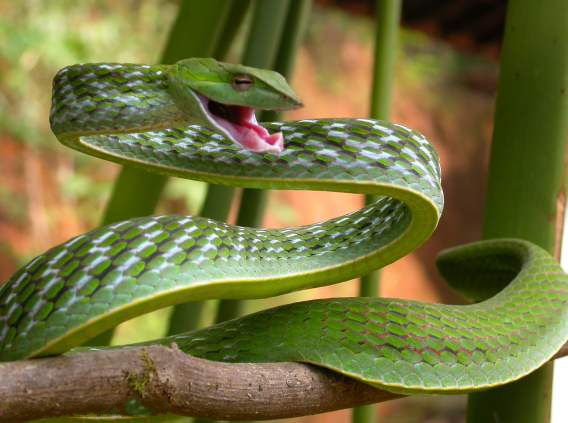
The Asian vine snake (Ahaetulla prasina) is an arboreal snake belonging to the family Colubridae, order Squamata, and class Reptilia. It occurs in Bangladesh, Bhutan, Brunei, Burma, Cambodia, China, India, Indonesia, Laos, Malaysia, the Philippines, Singapore, Thailand, and Vietnam. It is distinguished by its extremely slender body, long pointed snout, and coloration ranging from light brown to dull yellow-green, including fluorescent green.
Written 26 November 2026 from the sources listed below. Each statement was checked against the passage it cites; statements that could not be supported were removed.
Appearance
The Asian vine snake has an extremely slender body and a long, pointed snout that projects more than twice the length of its eye. Adult coloration ranges from light brown to dull yellow-green and can be fluorescent green.[1][2]
Adults can reach 1.8 metres in total length. The tail can reach 0.6 metres in length.[3][4]
Habitat
The Asian vine snake is arboreal and lives in trees. It occurs in Bangladesh, Bhutan, Brunei, Burma, Cambodia, China, India, Indonesia, Laos, Malaysia, the Philippines, Singapore, Thailand, and Vietnam.[5][6]
Diet
The Asian vine snake feeds on small reptiles and amphibians. Lizards and tree frogs are among its particularly important prey.[7][8]
Behaviour
The Asian vine snake is active during daylight hours.[9]
Conservation
The Asian vine snake is mildly venomous but is not considered a threat to humans.[10]
Uses
The Asian vine snake has become popular among reptile hobbyists through the pet trade.[11]
Similar species
The Asian vine snake resembles South American vine snakes. This resemblance results from convergent evolution rather than close evolutionary relatedness.[12][13]
Classification of the Asian Vine Snake
| Kingdom | Animalia |
|---|---|
| Phylum | Chordata |
| Subphylum | Vertebrata |
| Infraphylum | Gnathostomata |
| Parvphylum | Osteichthyes |
| Megaclass | Tetrapoda |
| Class | Reptilia (Reptile) |
| Order | Squamata (Snakes) |
| Suborder | Serpentes (Snakes) |
| Infraorder | Alethinophidia |
| Family | Colubridae (Colubrid) |
| Subfamily | Ahaetuliinae |
| Genus | Ahaetulla (Asian Longnosed Whipsnakes) |
| Species | Ahaetulla prasina (Boie, 1827) |
Where the Asian Vine Snake is found
Checklists and occurrence records place Ahaetulla prasina in 15 countries across Asia. GBIF holds 6,209 georeferenced records of it.
Countries
- Bangladesh 6
- Brunei 16
- Cambodia 63
- China 283
- India 38
- Indonesia 1,743
- Laos 36
- Macao 5
- Malaysia 583
- Myanmar 130
- Philippines 617
- Singapore 1,524
- Sri Lanka 5
- Thailand 866
- Vietnam 294
Regions and cities with the most records
- Ang Mo Kio New Town, Singapore 1,469
- Yio Chu Kang, Singapore 1,468
- Novena, Singapore 1,466
- Yishun New Town, Singapore 1,458
- Sungai Simpang, Singapore 1,456
- Sengkang New Town, Singapore 1,445
- Sembawang Estate, Singapore 1,439
- Woodlands, Singapore 1,408
- Bukit Timah, Singapore 1,358
- Queenstown Estate, Singapore 1,352
- Kampung Pasir Gudang Baru, Malaysia 1,316
- Masai, Malaysia 1,249
- Matilda Estate, Singapore 1,244
- Punggol, Singapore 1,210
- Bandar Seri Alam, Malaysia 1,192
- Pasir Gudang, Malaysia 1,131
- Anak Bukit, Singapore 1,127
- Bukit Panjang New Town, Singapore 1,111
- Teck Whye, Singapore 1,106
- Choa Chu Kang New Town, Singapore 1,105
- Marsiling, Singapore 1,104
- Yew Tee, Singapore 1,104
- Keat Hong Village, Singapore 1,095
- Singapore, Singapore 1,089
- Jurong East, Singapore 1,083
- MacPherson, Singapore 1,074
- Jurong Town, Singapore 1,072
- Jurong West, Singapore 1,072
- Eunos, Singapore 1,071
- Kampong Pasir Ris, Singapore 1,056
- Boon Lay, Singapore 1,054
- Johor Bahru, Malaysia 1,015
- Marine Parade, Singapore 1,010
- Taman Permas Jaya, Malaysia 976
- Ulu Bedok, Singapore 976
- Bedok New Town, Singapore 962
2 more countries have a few records outside this range
These countries hold a few records of Ahaetulla prasina but lie outside the range the checklists give for it. Such records are often zoo or garden specimens, museum material or vagrants, so the species is not counted as occurring there.
Range as the checklists state it
Myanmar (= Burma), Thailand (incl. Phuket), Cambodia; Laos; Vietnam (Hoa Binh), Malaysia (incl. Pulau Tioman, Pulau Pangkor, Johor: Pulau Besar), Singapore,
A number beside a place is its count of GBIF occurrence records. A place without a number comes from a checklist alone. Records show where a species has been observed or collected, which can include escapes and vagrants.
Common names
English
- Asian Vine Snake
- Boie's Whip Snake
- Gunther's Whip Snake
- Gunther’s Whip Snake
- Jade Vine Snake
- Oriental Whipsnake
Names in 5 other languages
- Chinese
- 绿瘦蛇
- German
- Grüne Peitschennatter
- Indonesian
- Ular gadung
- Slovenian
- orientalski strupeni gož
- Thai
- งูกล่อมนางนอน, งูง่วงกลางดง, งูเขียวปากจิ้งจก, งูเขียวหัวจิ้งจก
Synonyms
14 other scientific names have been used for this species and are now treated as synonyms of Ahaetulla prasina.
- Coluber mycterizans Raffles, 1822
- Dryinus prasinus (Boie, 1827)
- Dryophis prasinus Boie, 1827
- Dryophis prasinus chinensis Mell, 1930
- Dryophis preocularis Taylor, 1922
- Langaya nasuta Shaw, 1802
- Passerita prasina (Boie, 1827)
- Tragops prasinus (Boie, 1827)
- Tragops xanthozonius Duméril & Bibron, 1854: 826
- Ahaetulla prasina medioxima Lazell, 2002 ambiguous synonym
- Ahaetulla prasina preocularis (Taylor, 1922) ambiguous synonym
- Ahaetulla prasina suluensis Gaulke, 1994 ambiguous synonym
- Coluber nasutus Shaw, 1802 ambiguous synonym
- Dryophis prasinus flavescens Wall, 1910 ambiguous synonym
Subspecies and varieties
- Ahaetulla prasina medioxima subspecies
- Ahaetulla prasina prasina (Gunther’s Whip Snake) subspecies
- Ahaetulla prasina preocularis subspecies
- Ahaetulla prasina suluensis subspecies
Related species
-
 Green Vine SnakeAhaetulla nasuta
-
 Ahaetulla oxyrhyncha
-
 Malayan WhipsnakeAhaetulla mycterizans
-
 Brown Vine SnakeAhaetulla pulverulenta
-
 Variable Vine SnakeAhaetulla anomala
-
 Günther's Vine SnakeAhaetulla dispar
-
 Laudankia Vine SnakeAhaetulla laudankia
-
 Bronze-headed Vine SnakeAhaetulla perroteti
Compare
Questions and answers
What is the scientific name of the Asian Vine Snake?
The scientific name of the Asian Vine Snake is Ahaetulla prasina. Written with its author, the full name is Ahaetulla prasina (Boie, 1827).
Which family does the Asian Vine Snake belong to?
Ahaetulla prasina belongs to the family Colubridae, in the order Squamata and the class Reptilia.
Where is the Asian Vine Snake found?
Checklists and occurrence records place Ahaetulla prasina in 15 countries, including Indonesia, Singapore, Thailand, Philippines, Malaysia and Vietnam.
What is the conservation status of the Asian Vine Snake?
The IUCN Red List category recorded for Ahaetulla prasina is Least Concern (LC).
What other names does the Asian Vine Snake have?
Ahaetulla prasina is also known in English as Boie's Whip Snake, Gunther's Whip Snake, Gunther’s Whip Snake, Jade Vine Snake and Oriental Whipsnake.
How poisonous is a vine snake?
The Asian vine snake is mildly venomous but is not considered a threat to humans.[10]
Sources
Passages the profile rests on
- The species has an extremely slender body and a long, pointed snout that projects more than twice the length of its eye. Source passage: “The body form is extremely slender with a long, pointed, projecting snout that is rather more than twice as long as the eye.” — English Wikipedia
- Adult coloration ranges from light brown to dull yellow-green and can be fluorescent green. Source passage: “Adult colouration varies from light brown to dull yellow-green and often a startling fluorescent green.” — English Wikipedia
- Adults can reach 1.8 metres in total length. Source passage: “Adults may attain 1.8 m (6 feet) in total length” — English Wikipedia
- The tail can reach 0.6 metres in length. Source passage: “with a tail 0.6 m (2 feet) long.” — English Wikipedia
- Ahaetulla prasina is an arboreal snake that lives in trees. Source passage: “Ahaetulla prasina is an arboreal, moderately venomous species” — English Wikipedia
- Ahaetulla prasina occurs in Bangladesh, Bhutan, Brunei, Burma, Cambodia, China, India, Indonesia, Laos, Malaysia, the Philippines, Singapore, Thailand, and Vietnam. Source passage: “This snake has a wide distribution in Asia, where it occurs in Bangladesh, Bhutan, Brunei, Burma, Cambodia, China, India, Indonesia, Laos, Malaysia, Philippines, Singapore, Thailand, and Vietnam.” — English Wikipedia
- The species feeds on small reptiles and amphibians. Source passage: “The Asian vine snake feeds on small reptiles and amphibians, particularly lizards and tree frogs.” — English Wikipedia
- Lizards and tree frogs are among its particularly important prey. Source passage: “particularly lizards and tree frogs.” — English Wikipedia
- Ahaetulla prasina is active during daylight hours. Source passage: “It is diurnal, active during the day.” — English Wikipedia
- The species is mildly venomous but is not considered a threat to humans. Source passage: “It is a rear-fanged species and is mildly venomous but is not considered a threat to humans.” — English Wikipedia
- Ahaetulla prasina has become popular among reptile hobbyists through the pet trade. Source passage: “In recent years, it has entered the pet trade and has become quite popular among hobbyists.” — English Wikipedia
- Its appearance resembles that of South American vine snakes. Source passage: “Its appearance is very much like those of South American vine snakes.” — English Wikipedia
- The resemblance to South American vine snakes results from convergent evolution rather than close evolutionary relatedness. Source passage: “This is due to convergent evolution, as they are not closely related.” — English Wikipedia
Data
- Catalogue of Life, 2026-10-16 XR cc by
- Global Biodiversity Information Facility CC BY 4.0
- Wikidata CC0
- GeoNames CC BY 4.0
- Wikimedia Commons per image; credit shown with each image
- Within the Catalogue of Life, this name comes from The Reptile Database cc by
References
- Shaw, G. (1802). General Zoology, or Systematic Natural History. Vol.3, part 2. G. Kearsley, Thomas Davison, London: 313-615.
- Boie, F. (1827). Bemerkungen über Merrem’s Versuch eines Systems der Amphibien, 1. Lieferung: Ophidier. Isis von Oken 20: 508-566.
- Peters, & Wilhem Carl Hartwig. (1867). Herpetologische Notizen. Monatsber. Königl. Akad. Wiss. Berlin. 1867 (Januar): 13-37.
- Anderson, J. (1871). On some Indian reptiles. Proc. Zool. Soc. London 1871: 149-211.
- Fischer, J. G. (1886). Ueber eine Kollektion Reptilien und Amphibien von der Insel Nias und über eine zweite Art der Gattung Anniella GRAY. Abh. Naturw. Ver. Hamburg 19 (1): 3-10.
- Boulenger, G. A. (1897). List of the reptiles and batrachians collected by Mr. Alfred Everett in Lombok, Flores, Sumba and Saru, with descriptions of new species. Ann. Mag. Nat. Hist. (6) 19: 503-509.
- Evans, G. H. (1905). Notes on Burmese Reptiles. J. Bombay Nat. Hist. Soc. 16: 169-171.
- Wall, F. (1906). A Popular Treatise on the Common Indian Snakes. Part II. J. Bombay Nat. Hist. Soc. 17: 1-17.
- Lidth DE JEUDE, & VAN, T. W. (1922). Snakes from Sumatra. Zoologische Mededelingen 6: 239-253.
- Mertens, R. (1930). Die Amphibien und Reptilien der Inseln Bali, Lombok, Sumbawa und Flores. Senck. Naturf. Gesell., Frankfurt Am Main, Abhandl. 42(3): 117-344.
- Mell, R. (1931). List of Chinese snakes. Lingnan Sci. Jour., Canton, 8 [1929]: 199-219.
- Smedley, N. (1931). Amphibians and reptiles from the South Natuna Islands. Bull. Raffles Mus. No 6: 102-104.
- Bourret, R. (1934). Notes herpétologiques sur l’Indochine Française I. Ophidiens de Chapa. Bull. Gen. Instr. Pub. Hanoi 7 (March 1934): 129-138.
- Kopstein, F. (1938). Ein Beitrag zur Eierkunde und zur Fortpflanzung der Malaiischen Reptilien. Bull. Raffles Mus. No 14: 81-167.
- Smith, M. A. (1943). The Fauna of British India, Ceylon and Burma, Including the Whole of the Indo-Chinese Sub-Region. Reptilia and Amphibia. 3 (Serpentes). Taylor and Francis, London. 583 Pp.
- Bergman, R. A. M. (1956). The anatomy of Dryophis prasinus. Proc. Kon. Ned. Akad. Wet. Amsterdam, C 59:263-279.
- Deuve, J. (1961). Liste annotee des Serpents du Laos. Bull. Soc. Sci. Nat. Laos 1:5-32.
- Leviton, A. E. (1968). Contributions to a review of Philippine snakes, X. The snakes of the genus Ahaetulla. Philippine J. Sci. 96 (1): 73-90.
- Trutnau, L. (1986). Einige vorläufige Bemerkungen zur Herpetofauna der südthailändischen Insel Phuket. Herpetofauna 8 (43): 17-27.
- Bong Heang, & Kiew. (1987). An annotated checklist of the herpetofauna of Ulu Endau, Johore, Malaysia. Malayan Nature Journal 41 (2-3): 413-423.
- Dowling, H.G., & Jenner, J.V. (1988). Snakes of Burma: checklist of reported species and bibliography. Smithsonian Herp. Inf. Serv. (76): 19 Pp.
- Golder, F. (1989). Ahaetulla nasuta (LACÉPÈDE, 1789), Haltung und Nachzucht. Salamandra 25 (2): 65-72.
- Lazell, J., & Lu, W. (1990). Four remarkable reptiles from South China Sea islands, Hong Kong Territory. Asiatic Herpetological Research 3: 64-66.
- Blackburn, D. G. (1993). STANDARDIZED CRITERIA FOR THE RECOGNITION OF REPRODUCTIVE MODES IN SQUAMATE REPTILES. Herpetologica 49 (1): 118-132.
- Zhao, E., & Adler, K. (1993). Herpetology of China. SSAR, Oxford/Ohio, 1-522.
This species in other databases
Page built on 27 November 2026. See how the catalog is made and all sources and licences.
Cite this page
ScientificNames.org. (2026). Ahaetulla prasina (Asian Vine Snake). Retrieved November 27, 2026, from https://scientificnames.org/species/ahaetulla-prasina
“Ahaetulla prasina (Asian Vine Snake).” ScientificNames.org, 2026, scientificnames.org/species/ahaetulla-prasina. Accessed 27 Nov. 2026.
ScientificNames.org. “Ahaetulla prasina (Asian Vine Snake).” Accessed November 27, 2026. https://scientificnames.org/species/ahaetulla-prasina.
@misc{scientificnames_ahaetulla_prasina_asian_vine_snake,
  author = {{ScientificNames.org}},
  title = {Ahaetulla prasina (Asian Vine Snake)},
  year = {2026},
  url = {https://scientificnames.org/species/ahaetulla-prasina},
  note = {Accessed 2026-11-27}
}