Species · Flowering plants
Greenstripe (amaranth) Amaranthus acanthochiton
The scientific name of the Greenstripe (amaranth) is Amaranthus acanthochiton. It is a species of flowering plant in the family Amaranthaceae (amaranth family), order Caryophyllales.
- Scientific name
- Amaranthus acanthochiton (Torr.) Sauer
- Common name
- Greenstripe (amaranth)
- Genus
- Amaranthus
- Family
- Amaranthaceae (Amaranth Family)
- Order
- Caryophyllales
- Class
- Magnoliopsida
- Recorded in
- 2 countries
- Name status
- accepted in the Catalogue of Life

Overview
Amaranthus acanthochiton is native to Arizona, New Mexico, Texas, and Utah in the southwestern United States, and Chihuahua in northern Mexico. The species has separate male and female plants.
Written 26 November 2026 from the sources listed below. Each statement was checked against the passage it cites; statements that could not be supported were removed.
Appearance
The plant has slender leaves measuring 2–8 cm in length and 2–12 mm in width. Its flowers are pale green and grow in dense terminal spikes.[1][2]
Its seeds are brown and measure 1–1.3 mm in diameter. The plant grows to a height of 10–80 cm.[3][4]
Habitat
The species grows at elevations between 1,000 and 2,000 m. It is described as uncommon within its native range.[5][6]
Reproduction and life cycle
The species has separate male and female plants. Its seeds are contained in an achene measuring 2–2.5 mm.[7][8]
Conservation
The species is classified as critically endangered in Utah. In Arizona, it is described as endangered, although no status has been formally set.[9][10]
Uses
The Hopi people used the seeds as a food source. They also used the young leaves as a food source.[11][12]
Classification of the Greenstripe (amaranth)
| Kingdom | Plantae |
|---|---|
| Subkingdom | Pteridobiotina |
| Phylum | Tracheophyta |
| Class | Magnoliopsida |
| Order | Caryophyllales |
| Family | Amaranthaceae (Amaranth Family) |
| Subfamily | Amaranthoideae |
| Tribe | Amarantheae |
| Genus | Amaranthus (Amaranth) |
| Species | Amaranthus acanthochiton (Torr.) Sauer |
Where the Greenstripe (amaranth) is found
Checklists and occurrence records place Amaranthus acanthochiton in 2 countries across North America. GBIF holds 338 georeferenced records of it.
Countries
Regions and cities with the most records
- New Mexico, United States 59
- Texas, United States 59
- Arizona, United States 23
- Chihuahua, Mexico 22
- Horizon City, United States 18
- Sunland Park, United States 14
- Socorro Mission Number 1 Colonia, United States 13
- El Paso, United States 11
- Ciudad Juárez, Mexico 10
- Rio Rancho, United States 8
- Socorro, United States 7
- Albuquerque, United States 6
- Las Cruces, United States 6
- South Valley, United States 6
- Coahuila, Mexico
- Utah, United States
Range as the checklists state it
USA (Arizona, New Mexico, Texas, Utah); Mexico (Chihuahua, Coahuila)
A number beside a place is its count of GBIF occurrence records. A place without a number comes from a checklist alone. Records show where a species has been observed or collected, which can include escapes and vagrants.
Common names
English
- Greenstripe (amaranth)
Names in 1 other language
- Chinese
- 綠條莧
Synonyms
One other scientific name has been used for this species and is now treated as a synonym of Amaranthus acanthochiton.
- Acanthochiton wrightii Torr.
Related species
-
 Love Lies BleedingAmaranthus caudatus
-
 Green AmaranthAmaranthus viridis
-
 Redroot PigweedAmaranthus retroflexus
-
 AmaranthAmaranthus cruentus
-
 Chinese AmaranthAmaranthus tricolor
-
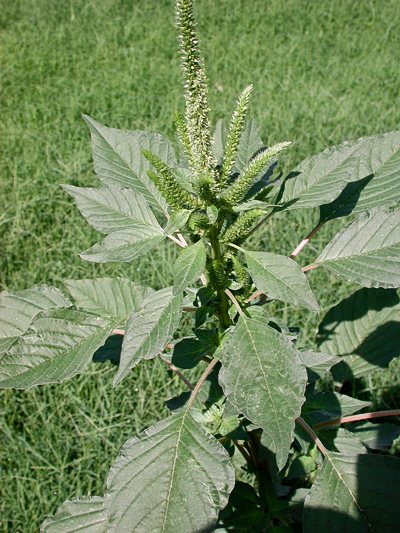 Palmer AmaranthAmaranthus palmeri
-
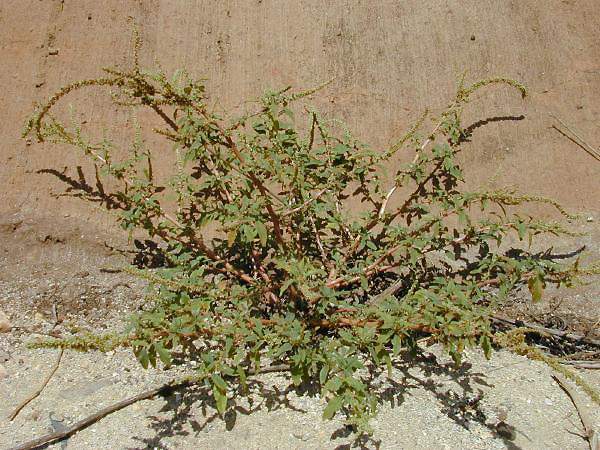 Spiny AmaranthAmaranthus spinosus
-
 Prince-of-Wales FeatherAmaranthus hypochondriacus
Compare
Questions and answers
What is the scientific name of the Greenstripe (amaranth)?
The scientific name of the Greenstripe (amaranth) is Amaranthus acanthochiton. Written with its author, the full name is Amaranthus acanthochiton (Torr.) Sauer.
Which family does the Greenstripe (amaranth) belong to?
Amaranthus acanthochiton belongs to the family Amaranthaceae, in the order Caryophyllales and the class Magnoliopsida.
Where is the Greenstripe (amaranth) found?
Checklists and occurrence records place Amaranthus acanthochiton in 2 countries: United States and Mexico.
Sources
Passages the profile rests on
- The plant has slender leaves measuring 2–8 cm in length and 2–12 mm in width. Source passage: “The leaves are slender, 2–8 cm long and 2–12 mm broad.” — English Wikipedia
- The flowers are pale green and grow in dense terminal spikes. Source passage: “The flowers are pale green, produced in dense terminal spikes.” — English Wikipedia
- The seeds are brown and measure 1–1.3 mm in diameter. Source passage: “The seeds are brown, 1–1.3 mm diameter” — English Wikipedia
- The plant grows to a height of 10–80 cm. Source passage: “It is a dioecious plant growing to 10–80 cm tall.” — English Wikipedia
- The species grows at elevations between 1,000 and 2,000 m. Source passage: “growing at elevations of 1000–2000 m” — English Wikipedia
- The species is described as uncommon within its native range. Source passage: “where it is uncommon.” — English Wikipedia
- The species has separate male and female plants. Source passage: “It is a dioecious plant” — English Wikipedia
- The seeds are contained in an achene measuring 2–2.5 mm. Source passage: “contained in a 2–2.5 mm achene.” — English Wikipedia
- The species is classified as critically endangered in Utah. Source passage: “It is critically endangered in Utah” — English Wikipedia
- The species is described as endangered in Arizona, although no status has been formally set. Source passage: “and endangered in Arizona (though no status has been set).” — English Wikipedia
- The Hopi people used the seeds as a food source. Source passage: “The seeds and young leaves were used by the Hopi Indians as a food source.” — English Wikipedia
- The Hopi people used the young leaves as a food source. Source passage: “The seeds and young leaves were used by the Hopi Indians as a food source.” — English Wikipedia
- The species is native to Arizona, New Mexico, Texas, and Utah in the southwestern United States. Source passage: “It is native to the southwestern United States (Arizona, New Mexico, Texas, and Utah)” — English Wikipedia
- The species is native to Chihuahua in northern Mexico. Source passage: “and northern Mexico (Chihuahua)” — English Wikipedia
Data
- Catalogue of Life, 2026-10-16 XR cc by
- Global Biodiversity Information Facility CC BY 4.0
- Wikidata CC0
- GeoNames CC BY 4.0
- Wikimedia Commons per image; credit shown with each image
- Within the Catalogue of Life, this name comes from Synonymic Checklists of the Vascular Plants of the World cc by
References
- Sauer. (1955). Madroño 13: 44 (1955). where the name was published
This species in other databases
- Catalogue of Life CGXC
- Wikidata Q4740152
- iNaturalist 122561
- World Flora Online wfo-0000530005
- GRIN 419315
Page built on 29 November 2026. See how the catalog is made and all sources and licences.
Cite this page
ScientificNames.org. (2026). Amaranthus acanthochiton (Greenstripe (amaranth)). Retrieved November 29, 2026, from https://scientificnames.org/species/amaranthus-acanthochiton
“Amaranthus acanthochiton (Greenstripe (amaranth)).” ScientificNames.org, 2026, scientificnames.org/species/amaranthus-acanthochiton. Accessed 29 Nov. 2026.
ScientificNames.org. “Amaranthus acanthochiton (Greenstripe (amaranth)).” Accessed November 29, 2026. https://scientificnames.org/species/amaranthus-acanthochiton.
@misc{scientificnames_amaranthus_acanthochiton_greenstripe_amaranth,
  author = {{ScientificNames.org}},
  title = {Amaranthus acanthochiton (Greenstripe (amaranth))},
  year = {2026},
  url = {https://scientificnames.org/species/amaranthus-acanthochiton},
  note = {Accessed 2026-11-29}
}