Species · Flowering plants
Common Tumbleweed Amaranthus albus
The scientific name of the Common Tumbleweed is Amaranthus albus. It is a species of flowering plant in the family Amaranthaceae (amaranth family), order Caryophyllales.
- Scientific name
- Amaranthus albus L.
- Common name
- Common Tumbleweed
- Genus
- Amaranthus
- Family
- Amaranthaceae (Amaranth Family)
- Order
- Caryophyllales
- Class
- Magnoliopsida
- Recorded in
- 72 countries
- Name status
- accepted in the Catalogue of Life

Overview
Larger plants become tumbleweeds after dying and drying out.
Written 26 November 2026 from the sources listed below. Each statement was checked against the passage it cites; statements that could not be supported were removed.
Appearance
Common tumbleweed is an annual herb with numerous branches. Its stems are erect or ascending, pale, and bushy-branched, and the plant can grow to a height of 50 centimetres.[1][2][3]
The leaves range from elliptic to spatulate or obovate in shape, with obtuse or retuse tips and short petioles.[4][5]
The flowers are small and greenish, growing in clusters in the leaf axils. Male and female flowers occur together in the same cluster.[6][7][8]
The bracts are green, rigid, and subulate, measuring two to four times the length of the sepals. Each flower has three approximately equal sepals that are less than one millimetre long.[9][10]
The fruit is a circumscissile utricle with a rugose wall that exceeds the calyx. The seeds are shiny, round, and dark red-brown.[11][12]
Habitat
Common tumbleweed commonly grows as a weed in cultivated and waste places.[13]
In North America, the species occurs at elevations below 2,200 metres.[14]
Behaviour
Larger plants become tumbleweeds after dying and drying out.[15]
Uses
The greens of the plant are reported as edible. In Cambodia, the leaves are sometimes cooked and eaten by people and are also used as feed for pigs.[16][17][18]
Classification of the Common Tumbleweed
| Kingdom | Plantae |
|---|---|
| Subkingdom | Pteridobiotina |
| Phylum | Tracheophyta |
| Class | Magnoliopsida |
| Order | Caryophyllales |
| Family | Amaranthaceae (Amaranth Family) |
| Subfamily | Amaranthoideae |
| Tribe | Amarantheae |
| Genus | Amaranthus (Amaranth) |
| Species | Amaranthus albus L. |
Where the Common Tumbleweed is found
Checklists and occurrence records place Amaranthus albus in 72 countries across Africa, Asia, Europe, North America, Oceania and South America. GBIF holds 28,107 georeferenced records of it.
Countries where it is native or its origin is not stated
Countries where it has been introduced
- Afghanistan 13
- Albania 3
- Algeria 19
- Andorra 2
- Argentina 32
- Armenia 5
- Australia 414
- Austria 423
- Azerbaijan 30
- Bangladesh
- Belarus 23
- Belgium 858
- Bulgaria 23
- Cambodia
- Chile 5
- China 63
- Croatia 25
- Cyprus 5
- Czechia 359
- Denmark 140
- Estonia 183
- France 4,141
- Georgia 5
- Germany 1,967
- Greece 495
- Hungary 111
- Iran 3
- Iraq 24
- Ireland
- Israel 552
- Italy 357
- Japan 94
- Kazakhstan 120
- Kyrgyzstan 10
- Latvia 17
- Lebanon
- Libya
- Liechtenstein
- Lithuania 1
- Luxembourg 15
- Malta
- Moldova 11
- Mongolia 12
- Montenegro 1
- Morocco 25
- New Zealand 10
- North Macedonia 1
- Poland 397
- Portugal 204
- Romania 1,105
- Saudi Arabia 6
- Slovakia 126
- Slovenia 3
- South Korea 15
- Spain 4,068
- Switzerland 530
- Syria 10
- Tajikistan 16
- Tunisia 2
- Turkey 80
- Turkmenistan 4
- Ukraine 629
- United Arab Emirates 1
- United Kingdom 650
- Uruguay 5
- Uzbekistan 47
Regions and cities with the most records
- California, United States 1,527
- Catalonia, Spain 1,398
- Provence-Alpes-Côte d'Azur, France 850
- Occitanie, France 714
- Auvergne-Rhône-Alpes, France 687
- Valencia, Spain 671
- England, United Kingdom 575
- Île-de-France, France 523
- Bavaria, Germany 455
- Gelderland, The Netherlands 427
- Beuningen, The Netherlands 385
- Elst, The Netherlands 375
- Nijmegen, The Netherlands 375
- Huissen, The Netherlands 355
- Bourgogne-Franche-Comté, France 341
- Groesbeek, The Netherlands 341
- Duiven, The Netherlands 336
- Arnhem, The Netherlands 301
- Velp, The Netherlands 300
- Pennsylvania, United States 262
- Wijchen, The Netherlands 261
- Zevenaar, The Netherlands 251
- Arizona, United States 249
- Gare, France 245
- Paris 03 Temple, France 245
- Paris 05 Panthéon, France 245
- Paris 13 Gobelins, France 245
- Quinze-Vingts, France 245
- Salpêtrière, France 245
- Maisons-Alfort, France 244
- Paris 02 Bourse, France 244
- Paris 07 Palais-Bourbon, France 244
- Paris 10 Entrepôt, France 244
- Bagnolet, France 243
- Le Perreux-sur-Marne, France 243
- Nogent-sur-Marne, France 243
9 more countries have a few records outside this range
These countries hold a few records of Amaranthus albus but lie outside the range the checklists give for it. Such records are often zoo or garden specimens, museum material or vagrants, so the species is not counted as occurring there.
Range as the checklists state it
England [I] (England [I], Wales [I], Scotland [I], Isles of Scilly [I]); Ireland [I] (Ireland [I]); Denmark [I]; Netherlands [I]; Belgium [I]; Luxembourg [I]; Germany [I]; Switzerland [I]; Liechtenstein [I]; Austria [I]; Poland [I]; Czech Republic [I]; Slovakia [I]; Hungary [I]; Portugal [I]; Spain [I]; Andorra [I]; Baleares [I]; France [I]; Channel Isl. [I]; Corsica [I]; Sardinia [I]; Italy [I]; Sicily [I]; Malta [I]; Slovenia [I]; Croatia [I]; Bosnia & Hercegovina [I]; Montenegro [I]; North Macedonia [I]; Albania [I]; Romania [I]; Bulgaria [I]; European Turkey [I]; Greece [I]; Crete [I]; Estonia [I]; Latvia [I]; Lithuania [I]; Belarus [I]; E-European Russia [I]; Moldova [I]; Ukraine [I]; Crimea [I]; Morocco [I]; Algeria [I]; Tunisia [I]; Libya [I]; Canary Isl. [I] (Gran Canaria [I]); Siberia [I] (Altay [I], Krasnoyarsk [I], Tuva [I], W-Siberia [I]); Russian Far East [I] (Upper Amur [I], Khabarovsk [I], Primorye [I]); Kazakhstan [I]; Turkmenistan [I]; Uzbekistan [I]; Kyrgyzstan [I]; Tajikistan [I]; Northern Caucasus [I]; Georgia [Caucasus] [I]; Armenia [I]; Azerbaijan [I]; East Aegaean Isl. [I] (incl. Rhodos [I]); Turkey [I] (E-Anatolia [I], Inner Anatolia [I], N-Anatolia [I]); Iraq [I] (NW-Iraq [I], SE-Iraq: Mesopotamia [I]); Iran [I] (N-Iran [I], Iranian Aserbaijan [I]); Afghanistan [I]; Cyprus [I] (E-Cyprus [I], N-Cyprus [I], S-Cyprus [I], W-Cyprus [I]); Lebanon [I] (C-Lebanon [I], coastal W-Lebanon [I]); Syria [I] (coastal W-Syria [I], Jazira [I], NW-Syria [I]); Israel [I] (coastal W-Israel [I], N-Israel [I]); Saudi Arabia [I]; United Arab Emirates [I]; China [I] (Hebei [I], Heilongjiang [I], Nei Mongol [I], Xinjiang [I]); Mongolia [I]; South Korea [I]; Japan [I]; Ryukyu Isl. [I]; Bangladesh [I]; Cambodia [I]; Australia [I] (Western Australia [I], South Australia [I], New South Wales [I], Victoria [I], Australian Capital Territory [I]); New Zealand [I]; Alaska; Canada (Alberta, British Columbia, Manitoba, New Brunswick, Newfoundland and Labrador, Nova Scotia, Ontario, Prince Edward Isl., Quebec, Saskatchewan); St. Pierre and Miquelon; USA (Alabama, Arizona, Arkansas, California, Colorado, Connecticut, Delaware, District of Columbia, Florida, Georgia, Idaho, Illinois, Indiana, Iowa, Kansas, Kentucky, Louisiana, Maine, Maryland, Massachusetts, Michigan, Minnesota, Mississippi, Missouri, Montana, Nebraska, Nevada, New Hampshire, New Jersey, New Mexico, New York, North Carolina, North Dakota, Ohio, Oklahoma, Oregon, Pennsylvania, Rhode Island, South Carolina, South Dakota, Tennessee, Texas, Utah, Vermont, Virginia, Washington State, West Virginia, Wisconsin, Wyoming); Uruguay [I]; Argentina [I]; Chile [I] (Coquimbo [I], Metropolitana de Santiago [I])
A number beside a place is its count of GBIF occurrence records. A place without a number comes from a checklist alone. Records show where a species has been observed or collected, which can include escapes and vagrants.
Common names
English
- Common Tumbleweed
- Prostrate Pigweed
- Stiff Tumbleweed
- Tumble Pigweed
- Tumbleweed
- Tumbleweed Amaranth
- White Amaranth
- White Pigweed
Names in 11 other languages
- Chinese
- bai xian, 白苋
- Czech
- laskavec bílý
- Dutch
- Witte amarant
- Finnish
- valkorevonhäntä
- French
- amarante blanche
- German
- Weißer Amarant, weißer Fuchsschwanz
- Norwegian Bokmål
- hvitamarant, kvitamarant
- Portuguese
- carurú-branco
- Slovenian
- beli ščir
- Swedish
- vit amarant
- Welsh
- Blodyn Amor Gwyn, Chwyn Moch Gwyn
Synonyms
15 other scientific names have been used for this species and are now treated as synonyms of Amaranthus albus.
- Amaranthus albus var. albus
- Amaranthus albus var. monosepalus Thell.
- Amaranthus albus var. parviflorus Moq.
- Amaranthus albus var. puberulus Thell.
- Amaranthus albus var. pubescens (Uline & W.L.Bray) Fernald
- Amaranthus albus var. rubicundus Thell.
- Amaranthus campestris Willd.
- Amaranthus gracilentus H.W.Kung
- Amaranthus graecizans var. pubescens Uline & W.L.Bray
- Amaranthus pubescens (Uline & W.L.Bray) Rydb.
- Euxolus albidus (L.) E.H.L.Krause
- Galliaria albida (L.) Bubani
- Glomeraria alba (L.) Cav.
- Amaranthus graecizans Cutanda ambiguous synonym
- Amaranthus littoralis Hornem. ambiguous synonym
Related species
-
 Love Lies BleedingAmaranthus caudatus
-
 Green AmaranthAmaranthus viridis
-
 Redroot PigweedAmaranthus retroflexus
-
 AmaranthAmaranthus cruentus
-
 Chinese AmaranthAmaranthus tricolor
-
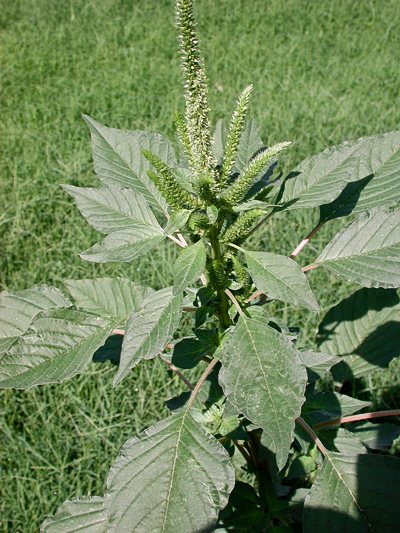 Palmer AmaranthAmaranthus palmeri
-
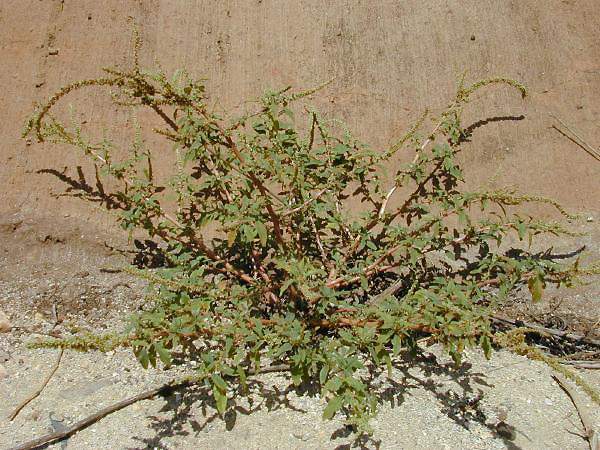 Spiny AmaranthAmaranthus spinosus
-
 Prince-of-Wales FeatherAmaranthus hypochondriacus
Compare
Questions and answers
What is the scientific name of the Common Tumbleweed?
The scientific name of the Common Tumbleweed is Amaranthus albus. Written with its author, the full name is Amaranthus albus L..
Which family does the Common Tumbleweed belong to?
Amaranthus albus belongs to the family Amaranthaceae, in the order Caryophyllales and the class Magnoliopsida.
Where is the Common Tumbleweed found?
Checklists and occurrence records place Amaranthus albus in 72 countries, including United States, Russia, The Netherlands, Canada, Sweden and Mexico.
What other names does the Common Tumbleweed have?
Amaranthus albus is also known in English as Prostrate Pigweed, Stiff Tumbleweed, Tumble Pigweed, Tumbleweed, Tumbleweed Amaranth and White Amaranth.
Is Amaranthus a vegetable?
The greens of common tumbleweed are reported as edible.[18]
Where are tumbleweeds native to?
Common tumbleweed is native to the tropical Americas.[19]
Sources
Passages the profile rests on
- Amaranthus albus is an annual herb that develops numerous branches. Source passage: “an annual herb growing up to 50 centimetres (20 in) tall, forming many branches.” — English Wikipedia
- The plant can grow to a height of 50 centimetres. Source passage: “growing up to 50 centimetres (20 in) tall” — English Wikipedia
- The stems are erect or ascending, pale, and bushy-branched. Source passage: “stems erect or ascending, bushy-branched, pale” — nathistoc.bio.uci.edu
- The leaves range from elliptic to spatulate or obovate in shape. Source passage: “lvs. elliptic to spatulate or obovate” — nathistoc.bio.uci.edu
- The leaves have obtuse or retuse tips and short petioles. Source passage: “obtuse or retuse, 1-6 cm. long, the petioles short” — nathistoc.bio.uci.edu
- The flowers are small and greenish and grow in clusters in the leaf axils. Source passage: “small, greenish flowers in clumps in the axils of the leaves.” — English Wikipedia
- Male and female flowers occur together in the same cluster. Source passage: “Male and female flowers are mixed together in the same clump.” — English Wikipedia
- The flowers are greenish and arranged in small axillary clusters. Source passage: “the fls. greenish, in small axillary clusters” — nathistoc.bio.uci.edu
- The bracts are green, rigid, and subulate, measuring two to four times the length of the sepals. Source passage: “bracts subulate, green, rigid, 2-4 times as long as sepals” — nathistoc.bio.uci.edu
- Each flower has three sepals that are approximately equal and less than one millimetre long. Source passage: “sepals 3, subequal, scarcely 1 mm. long” — nathistoc.bio.uci.edu
- The fruit is a circumscissile utricle with a rugose wall that exceeds the calyx. Source passage: “utricle circumscissile, this walled, rugose, exceeding calyx” — nathistoc.bio.uci.edu
- The seeds are shiny, round, and dark red-brown. Source passage: “seeds round, dark red-brown, shining” — nathistoc.bio.uci.edu
- The species commonly grows as a weed in cultivated and waste places. Source passage: “Common weed in cult. and waste places” — nathistoc.bio.uci.edu
- The species occurs in North America at elevations below 2,200 metres. Source passage: “through much of N. Am. below 2200 m.” — nathistoc.bio.uci.edu
- Larger plants become tumbleweeds after dying and drying out. Source passage: “Larger specimens turn into tumbleweeds when they die and dry out.” — English Wikipedia
- In Cambodia, the leaves are used as feed for pigs. Source passage: “the leaves of the plant (which is known as phti sâ in the Khmer language) are used as pig feed” — English Wikipedia
- In Cambodia, the leaves are sometimes cooked and eaten by people. Source passage: “and are sometimes cooked and eaten by people.” — English Wikipedia
- The greens of the plant are reported as edible. Source passage: “The greens are edible.” — nathistoc.bio.uci.edu
- The species is native to the tropical Americas. Source passage: “It is native to the tropical Americas” — English Wikipedia
Data
- Catalogue of Life, 2026-10-16 XR cc by
- Global Biodiversity Information Facility CC BY 4.0
- Wikidata CC0
- GeoNames CC BY 4.0
- Wikimedia Commons per image; credit shown with each image
- Within the Catalogue of Life, this name comes from Synonymic Checklists of the Vascular Plants of the World cc by
References
- L. (1759). Syst. Nat., ed. 10, 2: 1268 (1759). where the name was published
This species in other databases
Page built on 28 November 2026. See how the catalog is made and all sources and licences.
Cite this page
ScientificNames.org. (2026). Amaranthus albus (Common Tumbleweed). Retrieved November 28, 2026, from https://scientificnames.org/species/amaranthus-albus
“Amaranthus albus (Common Tumbleweed).” ScientificNames.org, 2026, scientificnames.org/species/amaranthus-albus. Accessed 28 Nov. 2026.
ScientificNames.org. “Amaranthus albus (Common Tumbleweed).” Accessed November 28, 2026. https://scientificnames.org/species/amaranthus-albus.
@misc{scientificnames_amaranthus_albus_common_tumbleweed,
  author = {{ScientificNames.org}},
  title = {Amaranthus albus (Common Tumbleweed)},
  year = {2026},
  url = {https://scientificnames.org/species/amaranthus-albus},
  note = {Accessed 2026-11-28}
}