Species · Flowering plants
Southern Amaranth Amaranthus australis
The scientific name of the Southern Amaranth is Amaranthus australis. It is a species of flowering plant in the family Amaranthaceae (amaranth family), order Caryophyllales.
- Scientific name
- Amaranthus australis (A.Gray) J.D.Sauer
- Common name
- Southern Amaranth
- Genus
- Amaranthus
- Family
- Amaranthaceae (Amaranth Family)
- Order
- Caryophyllales
- Class
- Magnoliopsida
- Recorded in
- 12 countries
- Name status
- accepted in the Catalogue of Life
Overview
Southern amaranth is a herbaceous flowering plant in the family Amaranthaceae and order Caryophyllales. It occurs in several southern states of the United States, Mexico, the West Indies, and South America. It usually reaches 1 to 3 metres in height, although some individuals grow up to 9 metres tall, with stems reaching 30 centimetres in diameter.
Written 27 November 2026 from the sources listed below. Each statement was checked against the passage it cites; statements that could not be supported were removed.
Appearance
Southern amaranth is a herbaceous plant. It usually reaches a height of 1 to 3 metres, although some individuals have been recorded growing up to 9 metres tall.[1][2][3]
Its stems can reach 30 centimetres in diameter.[4]
Habitat
Southern amaranth is frequently found in wetland areas. It occurs in several southern states of the United States, Mexico, the West Indies, and South America.[5][6]
The species is common in Florida and throughout the southern United States.[7]
Classification of the Southern Amaranth
| Kingdom | Plantae |
|---|---|
| Subkingdom | Pteridobiotina |
| Phylum | Tracheophyta |
| Class | Magnoliopsida |
| Order | Caryophyllales |
| Family | Amaranthaceae (Amaranth Family) |
| Subfamily | Amaranthoideae |
| Tribe | Amarantheae |
| Genus | Amaranthus (Amaranth) |
| Species | Amaranthus australis (A.Gray) J.D.Sauer |
Where the Southern Amaranth is found
Checklists and occurrence records place Amaranthus australis in 12 countries across Europe, North America and South America. GBIF holds 784 georeferenced records of it.
Countries where it is native or its origin is not stated
- Colombia 4
- Cuba 7
- French Guiana 5
- Guyana 3
- Haiti 5
- Jamaica 12
- Mexico 75
- Puerto Rico 5
- Suriname 25
- United States 634
- Venezuela 7
Countries where it has been introduced
Regions and cities with the most records
- Florida, United States 194
- Tabasco, Mexico 33
- Louisiana, United States 22
- Titusville, United States 20
- Apopka, United States 18
- Ocoee, United States 18
- Winter Garden, United States 18
- Gainesville, United States 17
- Wekiwa Springs, United States 16
- Mississippi, United States 15
- Veracruz, Mexico 14
- Pine Hills, United States 13
- Tavares, United States 13
- Bayshore Gardens, United States 12
- Lake Butler, United States 11
- Alabama, United States 10
- Michoacán, Mexico 10
- Frontera, Mexico 9
- Iona, United States 9
- Biloxi, United States 8
- Coatzacoalcos, Mexico 8
- Cocoa, United States 8
- Cosoleacaque, Mexico 8
- East Naples, United States 8
- Fraccionamiento Ciudad Olmeca, Mexico 8
- Golden Gate, United States 8
- Merritt Island, United States 8
- Minatitlán, Mexico 8
- Nanchital de Lázaro Cárdenas del Río, Mexico 8
- Zinapécuaro de Figueroa, Mexico 8
- Allende, Mexico 7
- Bonita Springs, United States 7
- Cape Coral, United States 7
- Daphne, United States 7
- Naples, United States 7
- Rockledge, United States 7
1 more country has a few records outside this range
These countries hold a few records of Amaranthus australis but lie outside the range the checklists give for it. Such records are often zoo or garden specimens, museum material or vagrants, so the species is not counted as occurring there.
Range as the checklists state it
Germany [I]; USA (Alabama, Arkansas, Florida, Georgia, Louisiana, Mississippi, North Carolina, Tennessee, Texas, Virginia); Mexico (Campeche, Quintana Roo, Tabasco, Tamaulipas, Veracruz); Cuba; Jamaica; Hispaniola (Haiti); Puerto Rico; Trinidad; Colombia (Chocó, Córdoba, Magdalena); Venezuela (Apure, Aragua, Carabobo, Delta Amacuro, Venezuela Distrito Federal, Sucre); Guyana; Surinam; French Guiana
A number beside a place is its count of GBIF occurrence records. A place without a number comes from a checklist alone. Records show where a species has been observed or collected, which can include escapes and vagrants.
Common names
English
- Southern Amaranth
Names in 2 other languages
- Chinese
- 南莧
- Swedish
- jätteamarant
Synonyms
6 other scientific names have been used for this species and are now treated as synonyms of Amaranthus australis.
- Acnida alabamensis Standl.
- Acnida australis A.Gray
- Acnida cannabina var. australis (A.Gray) Uline & W.L.Bray
- Acnida cannabina var. cuspidata (Bertero ex Spreng.) Moq.
- Acnida cuspidata Bertero ex Spreng.
- Acnida cannabina Chapm. ambiguous synonym
Related species
-
 Love Lies BleedingAmaranthus caudatus
-
 Green AmaranthAmaranthus viridis
-
 Redroot PigweedAmaranthus retroflexus
-
 AmaranthAmaranthus cruentus
-
 Chinese AmaranthAmaranthus tricolor
-
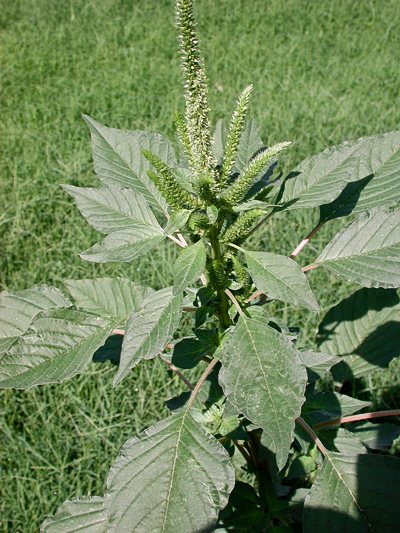 Palmer AmaranthAmaranthus palmeri
-
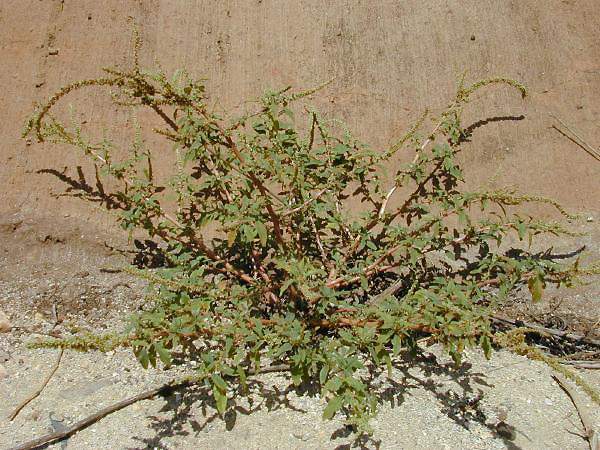 Spiny AmaranthAmaranthus spinosus
-
 Prince-of-Wales FeatherAmaranthus hypochondriacus
Compare
Questions and answers
What is the scientific name of the Southern Amaranth?
The scientific name of the Southern Amaranth is Amaranthus australis. Written with its author, the full name is Amaranthus australis (A.Gray) J.D.Sauer.
Which family does the Southern Amaranth belong to?
Amaranthus australis belongs to the family Amaranthaceae, in the order Caryophyllales and the class Magnoliopsida.
Where is the Southern Amaranth found?
Checklists and occurrence records place Amaranthus australis in 12 countries, including United States, Mexico, Suriname, Jamaica, Cuba and Venezuela.
Sources
Passages the profile rests on
- Amaranthus australis is a herbaceous plant. Source passage: “It is a herbaceous annual.” — English Wikipedia
- The plant usually reaches a height of 1 to 3 metres. Source passage: “The plant usually grows from 1 to 3 m (3.3 to 9.8 ft) in height” — English Wikipedia
- Some individuals have been recorded growing up to 9 metres tall. Source passage: “some have been known to grow up to 9 m (30 ft) high.” — English Wikipedia
- The stems can reach 30 centimetres in diameter. Source passage: “The stems can be up to 30 cm in diameter.” — English Wikipedia
- The species is frequently found in wetland areas. Source passage: “They are frequently found in wetland areas.” — English Wikipedia
- The species occurs in several southern states of the United States, Mexico, the West Indies, and South America. Source passage: “It is found in many southern states of the United States, Mexico, the West Indies, and South America.” — English Wikipedia
- The species is common in Florida and throughout the southern United States. Source passage: “Southern amaranth is common in Florida and across the southern United States.” — plant-directory.ifas.ufl.edu
Data
- Catalogue of Life, 2026-10-16 XR cc by
- Global Biodiversity Information Facility CC BY 4.0
- Wikidata CC0
- GeoNames CC BY 4.0
- Within the Catalogue of Life, this name comes from Synonymic Checklists of the Vascular Plants of the World cc by
References
- Sauer, J. D. (1955). Madroño 13: 15 (1955). where the name was published
This species in other databases
- Catalogue of Life CGY8
- Wikidata Q4740154
- iNaturalist 158242
- World Flora Online wfo-0000530063
- GRIN 315340
Page built on 27 November 2026. See how the catalog is made and all sources and licences.
Cite this page
ScientificNames.org. (2026). Amaranthus australis (Southern Amaranth). Retrieved November 27, 2026, from https://scientificnames.org/species/amaranthus-australis
“Amaranthus australis (Southern Amaranth).” ScientificNames.org, 2026, scientificnames.org/species/amaranthus-australis. Accessed 27 Nov. 2026.
ScientificNames.org. “Amaranthus australis (Southern Amaranth).” Accessed November 27, 2026. https://scientificnames.org/species/amaranthus-australis.
@misc{scientificnames_amaranthus_australis_southern_amaranth,
  author = {{ScientificNames.org}},
  title = {Amaranthus australis (Southern Amaranth)},
  year = {2026},
  url = {https://scientificnames.org/species/amaranthus-australis},
  note = {Accessed 2026-11-27}
}