Species · Flowering plants
Prostrate Pigweed Amaranthus blitoides
The scientific name of the Prostrate Pigweed is Amaranthus blitoides. It is a species of flowering plant in the family Amaranthaceae (amaranth family), order Caryophyllales.
- Scientific name
- Amaranthus blitoides S.Watson
- Common name
- Prostrate Pigweed
- Genus
- Amaranthus
- Family
- Amaranthaceae (Amaranth Family)
- Order
- Caryophyllales
- Class
- Magnoliopsida
- Recorded in
- 55 countries
- Name status
- accepted in the Catalogue of Life

Overview
Prostrate pigweed is an annual flowering plant in the family Amaranthaceae, order Caryophyllales, and class Magnoliopsida. It is believed to have originated in the central United States, possibly extending into the eastern United States, and has naturalized in almost all of temperate North America, South America, and Eurasia. It has a smooth, hairless surface.
Written 26 November 2026 from the sources listed below. Each statement was checked against the passage it cites; statements that could not be supported were removed.
Appearance
Prostrate pigweed has a smooth, hairless surface. It usually reaches a height of 0.6 m (2 ft 0 in) and can reach a maximum height of 1 m (3 ft 3 in).[1][2][3]
Habitat
Prostrate pigweed is believed to have originated in the central United States, possibly extending into the eastern United States. It has naturalized in almost all of temperate North America, as well as in South America and Eurasia.[4][5][6]
Reproduction and life cycle
Prostrate pigweed is an annual plant. It flowers from summer through fall.[7][8]
Conservation
Some authorities classify prostrate pigweed as an invasive species.[9]
Uses
The seeds of prostrate pigweed served as a food source for several Native American groups.[10]
The Zuni people initially consumed the seeds raw. Later, they ground the seeds with black corn meal, formed the mixture into balls, and ate them.[11][12]
Classification of the Prostrate Pigweed
| Kingdom | Plantae |
|---|---|
| Subkingdom | Pteridobiotina |
| Phylum | Tracheophyta |
| Class | Magnoliopsida |
| Order | Caryophyllales |
| Family | Amaranthaceae (Amaranth Family) |
| Subfamily | Amaranthoideae |
| Tribe | Amarantheae |
| Genus | Amaranthus (Amaranth) |
| Species | Amaranthus blitoides S.Watson |
Where the Prostrate Pigweed is found
Checklists and occurrence records place Amaranthus blitoides in 55 countries across Africa, Asia, Europe, North America and South America. GBIF holds 19,225 georeferenced records of it.
Countries where it is native or its origin is not stated
Countries where it has been introduced
- Albania 3
- Algeria 5
- Argentina 10
- Armenia 8
- Azerbaijan 10
- Belarus 4
- Bulgaria 19
- Cabo Verde 1
- China 65
- Croatia 17
- Czechia 46
- Egypt 11
- Estonia 37
- France 1,594
- Georgia 4
- Germany 707
- Gibraltar
- Greece 282
- Hungary 51
- Iran 12
- Israel 805
- Italy 193
- Kazakhstan 70
- Kyrgyzstan 3
- Latvia 1
- Lebanon 8
- Lithuania 1
- Malta 12
- Moldova 1
- Mongolia 23
- Montenegro 5
- Morocco 50
- Myanmar
- North Macedonia
- Poland 145
- Portugal 217
- Romania 753
- Slovakia 32
- Slovenia 1
- South Africa 2
- Spain 6,157
- Syria 30
- Tajikistan 3
- Tunisia 1
- Turkey 17
- Turkmenistan 2
- Ukraine 315
- United Kingdom 263
- Uzbekistan 21
Regions and cities with the most records
- Catalonia, Spain 2,698
- Valencia, Spain 1,386
- Gelderland, The Netherlands 1,193
- Beuningen, The Netherlands 1,117
- Elst, The Netherlands 1,097
- Nijmegen, The Netherlands 1,080
- Huissen, The Netherlands 1,053
- Groesbeek, The Netherlands 1,024
- Duiven, The Netherlands 1,022
- Velp, The Netherlands 961
- Arnhem, The Netherlands 941
- Zevenaar, The Netherlands 806
- Wijchen, The Netherlands 721
- California, United States 707
- Didam, The Netherlands 697
- Kleve, Germany 692
- Emmerich, Germany 580
- Île-de-France, France 521
- Wageningen, The Netherlands 460
- Bennekom, The Netherlands 414
- Figueres, Spain 391
- Gennep, The Netherlands 377
- Roses, Spain 365
- Rhenen, The Netherlands 355
- Oss, The Netherlands 351
- Tortosa, Spain 349
- Aulnay-sous-Bois, France 342
- Garges-lès-Gonesse, France 341
- Balearic Islands, Spain 339
- Le Blanc-Mesnil, France 339
- Sevran, France 337
- Amposta, Spain 335
- Bobigny, France 333
- Stains, France 333
- Bondy, France 332
- Noisy-le-Sec, France 332
13 more countries have a few records outside this range
These countries hold a few records of Amaranthus blitoides but lie outside the range the checklists give for it. Such records are often zoo or garden specimens, museum material or vagrants, so the species is not counted as occurring there.
Range as the checklists state it
England [I] (England [I]); Germany [I]; Poland [I]; Czech Republic [I]; Slovakia [I]; Hungary [I]; Portugal [I]; Spain [I]; Gibraltar [I]; Baleares [I]; France [I]; Italy [I]; Malta [I]; Slovenia [I]; Croatia [I]; Montenegro [I]; North Macedonia [I]; Albania [I]; Romania [I]; Bulgaria [I]; European Turkey [I]; Greece [I]; Crete [I]; Estonia [I]; Latvia [I]; Lithuania [I]; Belarus [I]; E-European Russia [I]; Moldova [I]; Ukraine [I]; Morocco [I]; Algeria [I]; Tunisia [I]; Egypt [I] (Nile Delta [I], Nile Valley [I], NW-coastal Egypt [I]); Azores [I] (Santa Maria Isl. [I]); Canary Isl. [I] (Tenerife [I]); Cape Verde Isl. [I] (Sao Vicente Isl. [I]); South Africa [I] (N-Cape Prov. [I]); Siberia [I] (Altay [I], Krasnoyarsk [I], Tuva [I], W-Siberia [I]); Russian Far East [I] (Upper Amur [I], Khabarovsk [I], Kuril Isl. [I], Primorye [I]); Kazakhstan [I]; Turkmenistan [I]; Uzbekistan [I]; Kyrgyzstan [I]; Tajikistan [I]; Northern Caucasus [I]; Georgia [Caucasus] [I]; Armenia [I]; Azerbaijan [I]; East Aegaean Isl. [I] (incl. Rhodos [I]); Turkey [I] (SSW-Anatolia [I]); Iran [I] (Iranian Aserbaijan [I]); Lebanon [I] (C-Lebanon [I]); Syria [I] (C-Syrian Desert [I], NW-Syria [I], Jbel Druze [I]); Israel [I] (coastal W-Israel [I], N-Israel [I]); Sinai peninsula [I] (N-Sinai [I]); China [I] (Beijing [I], Liaoning [I], Nei Mongol [I]); Mongolia [I]; Myanmar [I]; Alaska; Canada (Alberta, British Columbia, Manitoba, Ontario, Quebec, Saskatchewan); USA (Alabama, Arizona, Arkansas, California, Colorado, Connecticut, Delaware, District of Columbia, Florida, Georgia, Idaho, Illinois, Indiana, Iowa, Kansas, Kentucky, Louisiana, Maine, Maryland, Massachusetts, Michigan, Minnesota, Missouri, Montana, Nebraska, Nevada, New Hampshire, New Jersey, New Mexico, New York, North Dakota, Ohio, Oklahoma, Oregon, Pennsylvania, Rhode Island, South Carolina, South Dakota, Tennessee, Texas, Utah, Vermont, Virginia, Washington State, West Virginia, Wisconsin, Wyoming); Mexico (Sonora, Coahuila, etc.); Argentina [I] (La Pampa [I], Rio Negro [I])
A number beside a place is its count of GBIF occurrence records. A place without a number comes from a checklist alone. Records show where a species has been observed or collected, which can include escapes and vagrants.
Common names
English
- Prostrate Pigweed
- Mat Pigweed
- Matweed
- Matweed Amaranth
- Procumbent Pigweed
- Prostate Pigweed
- Prostrate Amaranth
Names in 28 other languages
- Arabic
- قطيفة منبطحة
- Catalan
- Blet menut, amarant blitoide
- Chinese
- bei mei xian, 北美苋, 北美莧
- Czech
- laskavec žmindovitý
- Dutch
- Nerfamarant
- Finnish
- lusikkarevonhäntä
- French
- amarante fausse-blette, amarante fausse-blite, amarante à feuilles marginées
- German
- Westamerikanischer Amarant, westamerikanischer Fuchsschwanz
- Hebrew
- ירבוז שרוע
- Hungarian
- labodás disznóparéj
- Italian
- Amaranto blitoide
- Japanese
- アメリカビユ
- Norwegian Bokmål
- meldeamarant
- Polish
- szarłat komosowaty
- Portuguese
- bredo, erva-aranha
- Romanian
- Stir tarator
- Russian
- Щирица жминдовидная
- Slovak
- láskavec blitovitý
- Slovenian
- razprostrti ščir
- Spanish
- Ceñiglo
- Swedish
- skedamarant
- Turkish
- Mordarı Mancarı
- Ukrainian
- Щириця лободова
- Welsh
- Blodyn Amor Gorweddol
- hsb
- Ameriski šćěrjenc
- mfy
- huee'e
- nav
- Naazkaadí
- srd
- Amarantu
Synonyms
14 other scientific names have been used for this species and are now treated as synonyms of Amaranthus blitoides.
- Amaranthus angustifolius f. nanus (Moq.) Thell.
- Amaranthus aragonensis Sennen
- Amaranthus blitoides f. densifolius (Uline & W.L.Bray) Raus
- Amaranthus blitoides f. thellungii (Sennen ex Thell.) Raus
- Amaranthus blitoides var. crassior Jeps.
- Amaranthus blitoides var. crassius Jeps.
- Amaranthus blitoides var. densifolius Uline & W.L.Bray
- Amaranthus blitoides var. flexuosus Sennen
- Amaranthus blitoides var. halophilus Aellen
- Amaranthus blitoides var. nanus (Moq.) Iamonico
- Amaranthus blitoides var. reverchonii Uline & W.L.Bray
- Amaranthus blitum var. nanus Moq.
- Amaranthus reverchonii (Uline & W.L.Bray) Kov.
- Galliaria blitoides (S.Watson) Nieuwl.
Subspecies and varieties
Related species
-
 Love Lies BleedingAmaranthus caudatus
-
 Green AmaranthAmaranthus viridis
-
 Redroot PigweedAmaranthus retroflexus
-
 AmaranthAmaranthus cruentus
-
 Chinese AmaranthAmaranthus tricolor
-
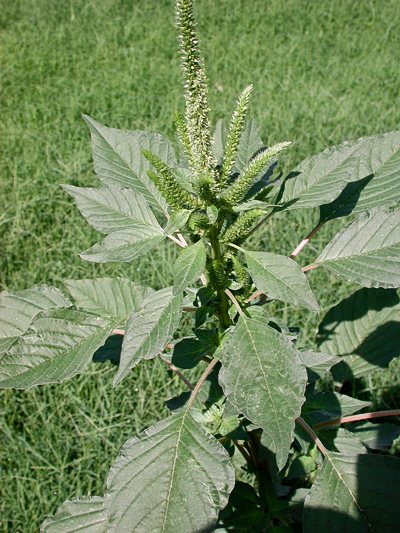 Palmer AmaranthAmaranthus palmeri
-
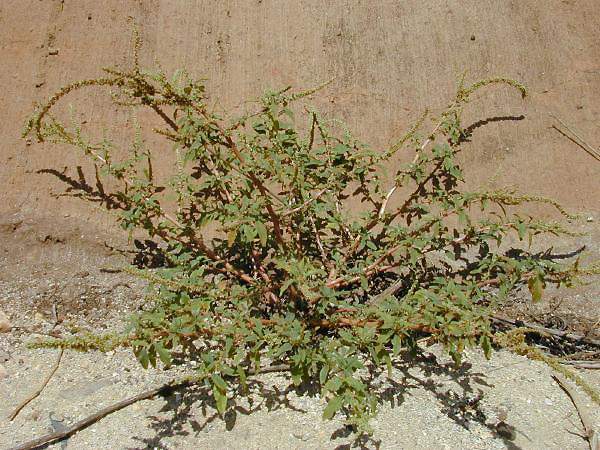 Spiny AmaranthAmaranthus spinosus
-
 Prince-of-Wales FeatherAmaranthus hypochondriacus
Compare
Questions and answers
What is the scientific name of the Prostrate Pigweed?
The scientific name of the Prostrate Pigweed is Amaranthus blitoides. Written with its author, the full name is Amaranthus blitoides S.Watson.
Which family does the Prostrate Pigweed belong to?
Amaranthus blitoides belongs to the family Amaranthaceae, in the order Caryophyllales and the class Magnoliopsida.
Where is the Prostrate Pigweed found?
Checklists and occurrence records place Amaranthus blitoides in 55 countries, including United States, The Netherlands, Russia, Belgium, Canada and Mexico.
What other names does the Prostrate Pigweed have?
Amaranthus blitoides is also known in English as Mat Pigweed, Matweed, Matweed Amaranth, Procumbent Pigweed, Prostate Pigweed and Prostrate Amaranth.
Sources
Passages the profile rests on
- Amaranthus blitoides has a smooth, hairless surface. Source passage: “is a glabrous annual plants species.” — English Wikipedia
- The plant usually reaches a height of 0.6 m (2 ft 0 in). Source passage: “It usually grows up to 0.6 m (2 ft 0 in)” — English Wikipedia
- The plant can reach a maximum height of 1 m (3 ft 3 in). Source passage: “though it may grow up to 1 m (3 ft 3 in).” — English Wikipedia
- The species is believed to have originated in the central United States, possibly extending into the eastern United States. Source passage: “It is believed to have been a native of the central and possibly eastern United States” — English Wikipedia
- The species has naturalized in almost all of temperate North America. Source passage: “it has naturalized in almost all of temperate North America.” — English Wikipedia
- The species has also naturalized in South America and Eurasia. Source passage: “It has also naturalized in South America and Eurasia.” — English Wikipedia
- Amaranthus blitoides is an annual plant. Source passage: “is a glabrous annual plants species.” — English Wikipedia
- The species flowers from summer through fall. Source passage: “It flowers in the summer to fall.” — English Wikipedia
- Some authorities classify Amaranthus blitoides as an invasive species. Source passage: “Some authorities list it as an invasive species.” — English Wikipedia
- The seeds of Amaranthus blitoides served as a food source for several Native American groups. Source passage: “The seeds of Amaranthus blitoides were used as a food source by a number of Native American groups.” — English Wikipedia
- The Zuni people initially consumed the seeds raw. Source passage: “Among the Zuni people, the seeds were originally eaten raw” — English Wikipedia
- The Zuni people later ground the seeds with black corn meal, formed the mixture into balls, and ate them. Source passage: “but later ground with black corn meal, made into balls and eaten.” — English Wikipedia
Data
- Catalogue of Life, 2026-10-16 XR cc by
- Global Biodiversity Information Facility CC BY 4.0
- Wikidata CC0
- GeoNames CC BY 4.0
- Wikimedia Commons per image; credit shown with each image
- Within the Catalogue of Life, this name comes from Synonymic Checklists of the Vascular Plants of the World cc by
References
- Watson, S. (1877). Proc. Amer. Acad. Arts 12: 273 (1877). where the name was published
This species in other databases
Page built on 26 November 2026. See how the catalog is made and all sources and licences.
Cite this page
ScientificNames.org. (2026). Amaranthus blitoides (Prostrate Pigweed). Retrieved November 26, 2026, from https://scientificnames.org/species/amaranthus-blitoides
“Amaranthus blitoides (Prostrate Pigweed).” ScientificNames.org, 2026, scientificnames.org/species/amaranthus-blitoides. Accessed 26 Nov. 2026.
ScientificNames.org. “Amaranthus blitoides (Prostrate Pigweed).” Accessed November 26, 2026. https://scientificnames.org/species/amaranthus-blitoides.
@misc{scientificnames_amaranthus_blitoides_prostrate_pigweed,
  author = {{ScientificNames.org}},
  title = {Amaranthus blitoides (Prostrate Pigweed)},
  year = {2026},
  url = {https://scientificnames.org/species/amaranthus-blitoides},
  note = {Accessed 2026-11-26}
}