Species · Flowering plants
Pigweed Amaranthus blitum
The scientific name of the Pigweed is Amaranthus blitum. It is a species of flowering plant in the family Amaranthaceae (amaranth family), order Caryophyllales.
- Scientific name
- Amaranthus blitum L.
- Common name
- Pigweed
- Genus
- Amaranthus
- Family
- Amaranthaceae (Amaranth Family)
- Order
- Caryophyllales
- Class
- Magnoliopsida
- Recorded in
- 140 countries
- Name status
- accepted in the Catalogue of Life

Overview
Pigweed is an annual flowering plant in the family Amaranthaceae. It is native to the Mediterranean region and naturalized in much of eastern North America, much of tropical Africa, Western Europe and Japan. It has green or purplish triangular leaves and spikes containing clusters of tiny male and female flowers.
Written 26 November 2026 from the sources listed below. Each statement was checked against the passage it cites; statements that could not be supported were removed.
Appearance
Pigweed is an erect or semi-prostrate plant with a single or branched stem. Its leaves are green or purplish, simple, roughly triangular and have entire margins, arranged spirally along the plant.[1][2][3][4][5]
Its stem can reach 1 metre in height. Its leaves can reach 10 centimetres in length, and its leaf stalks can reach approximately 10 centimetres.[6][7][8]
Its inflorescence is a spike containing clusters of tiny male and female flowers. Its fruits are small, globular capsules containing disc-shaped seeds.[9][10]
Habitat
Pigweed grows on waste ground and rubbish tips. It also occurs in cultivated areas.[11][12][13]
Reproduction and life cycle
Pigweed produces spikes containing both male and female flowers. Its small, globular fruits contain disc-shaped seeds.[14][15]
Behaviour
Pigweed can grow in either an erect or semi-prostrate form. It has become less frequent in southern England since the nineteenth century.[16][17]
Uses
Pigweed is collected from the wild for human consumption in many parts of the world.[18]
In Greece, the leaves and cooked tender shoots of Amaranthus blitum var. silvestre are eaten with olive oil, lemon and salt.[19]
In Lebanon, young shoots are prepared as a side dish. They are cooked with olive oil, onion, chilli and burghul, seasoned with salt and lemon, and eaten with pita.[20][21][22]
Similar species
Pigweed is considered closely related to Amaranthus viridis.[23]
Classification of the Pigweed
| Kingdom | Plantae |
|---|---|
| Subkingdom | Pteridobiotina |
| Phylum | Tracheophyta |
| Class | Magnoliopsida |
| Order | Caryophyllales |
| Family | Amaranthaceae (Amaranth Family) |
| Subfamily | Amaranthoideae |
| Tribe | Amarantheae |
| Genus | Amaranthus (Amaranth) |
| Species | Amaranthus blitum L. |
Where the Pigweed is found
Checklists and occurrence records place Amaranthus blitum in 140 countries across Africa, Asia, Europe, North America, Oceania and South America. GBIF holds 41,560 georeferenced records of it.
Countries where it is native or its origin is not stated
- Albania
- Algeria 5
- Angola 21
- Argentina 91
- Azerbaijan 13
- Bahamas 2
- Benin 6
- Bhutan 3
- Brazil 584
- Bulgaria 1
- Burkina Faso 3
- Burundi 6
- Cabo Verde 11
- Colombia 40
- Croatia 7
- Cuba
- Cyprus 1
- Democratic Republic of the Congo 26
- Dominica 1
- Ecuador 13
- Egypt 14
- Ethiopia 7
- France 15,512
- French Guiana 5
- Gabon 4
- Georgia 1
- Gibraltar
- Greece 18
- Guinea
- Guyana 10
- Hong Kong 5
- Indonesia 27
- Iran
- Israel 175
- Italy 423
- Ivory Coast 3
- Jersey 3
- Jordan 7
- Kenya 8
- Kosovo
- Lebanon 1
- Liberia 3
- Macao 12
- Malaysia 3
- Malta 1
- Martinique 4
- Mauritania
- Montenegro
- Morocco 5
- Mozambique 1
- Nigeria
- North Korea 12
- North Macedonia
- Norway 20
- Pakistan 28
- Paraguay 50
- Peru 10
- Portugal 1,739
- Puerto Rico 2
- Reunion 9
- Russia 371
- Rwanda 13
- Saint Kitts and Nevis 5
- Saudi Arabia 3
- Serbia 5
- Seychelles 3
- Slovenia 39
- South Sudan
- Spain 1,001
- Sudan
- Suriname 24
- Syria 2
- Tanzania 7
- The Netherlands 5,829
- Tunisia 4
- Turkey 5
- U.S. Virgin Islands 3
- Uganda 6
- United Arab Emirates 7
- Uruguay 9
- Venezuela 7
- Yemen
- Zambia
- Zimbabwe 1
Countries where it has been introduced
- American Samoa 2
- Australia 118
- Austria 517
- Bangladesh 2
- Belarus 44
- Belgium 3,783
- Bolivia 16
- Cameroon 13
- Canada 60
- China 188
- Czechia 227
- Denmark 126
- Estonia 12
- Finland 16
- Germany 2,569
- Guernsey 2
- Hungary 84
- India 54
- Ireland 1
- Japan 939
- Kazakhstan 15
- Kyrgyzstan 2
- Laos
- Latvia 10
- Liechtenstein 5
- Lithuania 1
- Luxembourg 26
- Madagascar 3
- Mauritius 11
- Mexico 6
- Moldova
- Nepal 12
- New Zealand 156
- Philippines 3
- Poland 345
- Romania 422
- Saint Helena 3
- Singapore 4
- Slovakia 105
- South Africa 33
- South Korea 624
- Sri Lanka 4
- Sweden 667
- Switzerland 1,990
- Taiwan 441
- Tajikistan 11
- Thailand 6
- Tonga 7
- Trinidad and Tobago 2
- Turkmenistan 1
- Ukraine 65
- United Kingdom 321
- United States 1,158
- Uzbekistan 19
- Vanuatu
- Vietnam 9
Regions and cities with the most records
- Centre-Val de Loire, France 3,935
- Bourgogne-Franche-Comté, France 2,558
- Auvergne-Rhône-Alpes, France 2,296
- Gelderland, The Netherlands 1,583
- Azores, Portugal 1,388
- Grand Est, France 1,252
- Pays de la Loire, France 1,177
- Elst, The Netherlands 1,174
- Beuningen, The Netherlands 1,173
- Nijmegen, The Netherlands 1,165
- Bavaria, Germany 1,132
- Huissen, The Netherlands 1,120
- Duiven, The Netherlands 1,062
- Groesbeek, The Netherlands 1,055
- Velp, The Netherlands 977
- Wijchen, The Netherlands 972
- Arnhem, The Netherlands 967
- Zevenaar, The Netherlands 932
- Berkel en Rodenrijs, The Netherlands 876
- Pijnacker, The Netherlands 867
- Bergschenhoek, The Netherlands 866
- Benthuizen, The Netherlands 819
- Nootdorp, The Netherlands 806
- Zoetermeer, The Netherlands 798
- Ypenburg, The Netherlands 785
- Delft, The Netherlands 784
- Rijswijk, The Netherlands 755
- Rotterdam, The Netherlands 751
- Voorburg, The Netherlands 751
- Didam, The Netherlands 741
- Kleve, Germany 713
- Schiedam, The Netherlands 711
- Sint-Amandsberg, Belgium 705
- Wondelgem, Belgium 702
- Gent, Belgium 696
- Gentbrugge, Belgium 690
6 more countries have a few records outside this range
These countries hold a few records of Amaranthus blitum but lie outside the range the checklists give for it. Such records are often zoo or garden specimens, museum material or vagrants, so the species is not counted as occurring there.
Range as the checklists state it
England [I] (England [I], Wales [I]); Ireland [I] (Ireland [I], Northern Ireland [I]); Denmark [I]; Sweden [I]; Finland [I]; Netherlands [I]; Belgium [I]; Luxembourg [I]; Germany [I]; Switzerland [I]; Liechtenstein [I]; Austria [I]; Poland [I]; Czech Republic [I]; Slovakia [I]; Hungary [I]; Portugal; Spain; Gibraltar; Baleares; France; Channel Isl. [I] (Guernsey [I]); Corsica; Sardinia; Italy; Sicily; Isole Pelagie (Lampedusa); Malta; +San Marino; Slovenia; Croatia; Bosnia & Hercegovina; Montenegro; Serbia; Kosovo; North Macedonia; Albania; Romania [I]; Bulgaria; European Turkey; Greece (incl. Kiklades); Crete; Estonia [I]; Latvia [I]; Lithuania [I]; Belarus [I]; European Russia [I]; Moldova [I]; Ukraine [I]; Crimea; Morocco; Algeria; Tunisia; Egypt (Nile Delta, Nile Valley, NW-coastal Egypt); Azores (Santa Maria Isl., Sao Miguel Isl., Terceira, Graciosa, Sao Jorge, Pico, Faial, Flores Isl., Corvo Isl.); Madeira (Madeira Isl.); Canary Isl. (Lanzarote, Fuerteventura, Gran Canaria, Tenerife, La Gomera, Hierro, La Palma); Cape Verde Isl. (Santo Antao Isl., Sao Vicente Isl., Ilha de Sao Nicolau, Ilha da Boa Vista, Ilha de Sao Tiago, Fogo Isl., Ilha Brava); Mauritania; Guinea; Ivory Coast; Benin; Nigeria; Cameroon [I]; Gabon; Congo [Brazzaville]; D. R. Congo [Zaire]; Sudan; South Sudan; Uganda; Kenya; Tanzania; Angola; Zambia; Zimbabwe; Mozambique; South Africa (KwaZulu-Natal [I], Cape Prov. [I]); Madagascar [I]; Mauritius [I]; La Réunion [I]; Agalega Isl. [I]; Ascension Isl. [I]; Siberia [I] (Altay [I], W-Siberia [I]); Russian Far East [I] (Upper Amur [I], Primorye [I]); Kazakhstan [I]; Turkmenistan [I]; Uzbekistan [I]; Kyrgyzstan [I]; Tajikistan [I]; Northern Caucasus; Georgia [Caucasus]; Azerbaijan; East Aegaean Isl. (Chios, Simi); Turkey (NW-Anatolia: Bithynia); Iran (EC-Iran, NE-Iran: Mts); Cyprus (E-Cyprus); Lebanon (coastal W-Lebanon); Syria (C-Syrian Desert); Israel (coastal W-Israel, coastal W-Israel, Rift Valley, N-Israel); Sinai peninsula (S-Sinai); Saudi Arabia (NE-Saudi Arabia, Hejaz); United Arab Emirates; Yemen (W-Yemen); China [I] (Anhui [I], Beijing [I], Fujian [I], Gansu [I], Guangdong [I], Guangxi [I], Guizhou [I], Hainan [I], Hebei [I], Heilongjiang [I], Henan [I], Hongkong [I], Hubei [I], Hunan [I], Jiangsu [I], Jiangxi [I], Jilin [I], Liaoning [I], Macao [I], Shaanxi [I], Shandong [I], Shanghai [I], Shanxi [I], Sichuan [I], Tianjin [I], Xinjiang [I], Yunnan [I], Zhejiang [I]); South Korea [I]; Japan [I]; Ryukyu Isl. [I]; Ogasawara Isl. (Chichijima, Hahajima); Taiwan [I]; Pakistan (Sind, N. W. Frontier Prov.); Nepal [I]; India [I] (throughout); Sri Lanka [I]; Bangladesh [I]; Thailand [I]; Laos [I]; Vietnam [I]; Singapore [I]; Sumatera [I]; South China Sea Isl. [I]; Sulawesi [I]; Philippines [I]; Jawa [I]; New Guinea [I]; Australia [I] (Western Australia [I], Queensland [I], New South Wales [I]); Lord Howe Isl. [I]; Norfolk Isl. [I]; New Zealand [I]; Vanuatu [I]; Tonga [I] ('Eua [I]); American Samoa [I] (Aunu'u [I]); Cook Isl. [I] (Rarotonga [I], Mangaia [I], Aitutaki [I], Ngaputoru Group [I], Palmerston [I]); Marshall Isl. [I] (Jaluit [I]); Hawaii [I] (Midway Isl. [I], Kauai [I], Oahu [I], Hawaii Isl. [I]); Canada [I] (Ontario [I], Quebec [I]); USA [I] (Alabama [I], California [I], Florida [I], Georgia [I], Louisiana [I], Maryland [I], Massachusetts [I], Mississippi [I], New Hampshire [I], New Jersey [I], New York [I], North Carolina [I], Ohio [I], Pennsylvania [I], South Carolina [I], Texas [I], Utah [I], Virginia [I]); Mexico [I]; Bahamas; Cuba; Puerto Rico; Dominica; St. Lucia; Trinidad & Tobago [I]; Colombia (Antioquia, Chocó, Cundinamarca, Nariño, Quindío, Tolima, Valle); Venezuela (Bolívar, Delta Amacuro, Venezuela Distrito Federal); Guyana; Surinam; French Guiana; Ecuador; Galápagos; Peru; Bolivia [I]; Brazil; S-Brazil (Rio Grande do Sul); Paraguay (Cordillera); Uruguay (San Jose); Argentina (Buenos Aires, Chaco, Corrientes, Formosa, Salta, Santa Fe, Tucumán)
A number beside a place is its count of GBIF occurrence records. A place without a number comes from a checklist alone. Records show where a species has been observed or collected, which can include escapes and vagrants.
Common names
English
- Pigweed
- Guernsey Pigweed
- Least Amaranth
- Livid Amaranth
- Purple Amaranth
- Slender Amaranth
Names in 22 other languages
- Arabic
- بقلة يمانية
- Azerbaijani
- Qırmızıbaldır qaratərə
- Chinese
- ao tou xian, 凹头苋, 野苋子, 野苋菜
- Czech
- laskavec hrubozel
- Danish
- Plet-amarant
- Dutch
- Kleine majer
- Finnish
- pinaattirevonhäntä
- French
- amarante blette, amarante blite, amarante livide, amarante sauvage
- German
- Bleifarbiger Amarant, Gemüse-Fuchsschwanz, Gewöhnlicher Aufsteigender Fuchsschwanz, aufsteigender Amarant, aufsteigender Fuchsschwanz
- Japanese
- イヌビユ
- Korean
- 개비름
- Lithuanian
- Uoginis burnotis
- Norwegian Bokmål
- blyamarant
- Polish
- szarłat siny
- Russian
- щирица жминда
- Slovenian
- goli ščir
- Spanish
- bledo
- Swahili
- Mchicha
- Swedish
- mållamarant
- Tamil
- முளைக்கீரை
- Welsh
- Blodyn Amor Guernsey
- hsb
- Wjesny šćěrjenc
Synonyms
74 other scientific names have been used for this species and are now treated as synonyms of Amaranthus blitum.
- Albersia arenaria Schur
- Albersia ascendens (Loisel.) Fourr.
- Albersia blitum (L.) Kunth
- Albersia blitum var. oleraceus (L.) Hook.fil.
- Albersia livida (L.) Kunth
- Albersia oleracea (L.) Kunth
- Amaranthus adscendens Rchb.
- Amaranthus alius E.H.L.Krause
- Amaranthus ascendens Loisel.
- Amaranthus ascendens var. oleraceus (L.) P.Fourn.
- Amaranthus ascendens var. oleraceus (L.) Thell. ex Priszter
- Amaranthus berchtoldii Seidl ex Opiz
- Amaranthus blitonius St.-Lag.
- Amaranthus blitum f. lividus (L.) Letz
- Amaranthus blitum f. prostratus Gaudin
- Amaranthus blitum f. rubens (Moq.) Hatus.
- Amaranthus blitum subsp. ascendens (Loisel.) Heukels
- Amaranthus blitum subsp. ascendens (Loisel.) Schübl. & G.Martens
- Amaranthus blitum subsp. oleraceus (L.) Costea
- Amaranthus blitum var. ascendens (Loisel.) DC.
- Amaranthus blitum var. blitum
- Amaranthus blitum var. oleraceus (L.) Hook.fil.
- Amaranthus blitum var. procumbens Gaudin
- Amaranthus circinnatus Poir.
- Amaranthus diffusus Dulac
- Amaranthus graecizans var. blitum (L.) Kuntze
- Amaranthus lividus f. lividus
- Amaranthus lividus subsp. ascendens (Loisel.) Wacht.
- Amaranthus lividus subsp. lividus
- Amaranthus lividus subsp. oleraceus (L.) Soó
- Amaranthus lividus var. ascendens (Loisel.) Thell.
- Amaranthus lividus var. ascendens (Loisel.) Hayw. & Druce
- Amaranthus lividus var. oleraceus (L.) Thell.
- Amaranthus obtusiflorus (Mart.) Kov.
- Amaranthus officinalis Gromov ex Trautv.
- Amaranthus oleraceus Rodsch.
- Amaranthus oleraceus var. maximus C.B.Clarke
- Amaranthus olitorius Besser
- Amaranthus prostratus var. subascendens DC.
- Amaranthus ruderalis Koch ex Moq.
Showing 40 of 74.
Subspecies and varieties
- Amaranthus blitum subsp. blitum (Livid Amaranth) subspecies
Related species
-
 Love Lies BleedingAmaranthus caudatus
-
 Green AmaranthAmaranthus viridis
-
 Redroot PigweedAmaranthus retroflexus
-
 AmaranthAmaranthus cruentus
-
 Chinese AmaranthAmaranthus tricolor
-
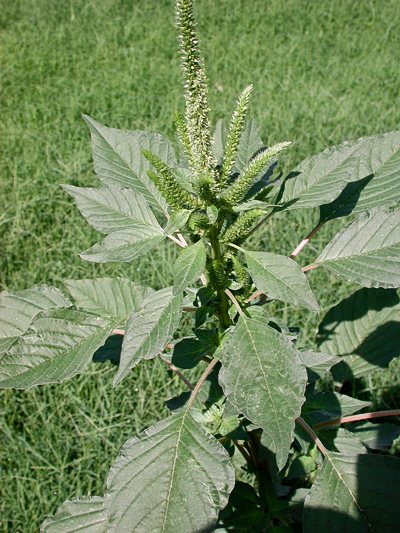 Palmer AmaranthAmaranthus palmeri
-
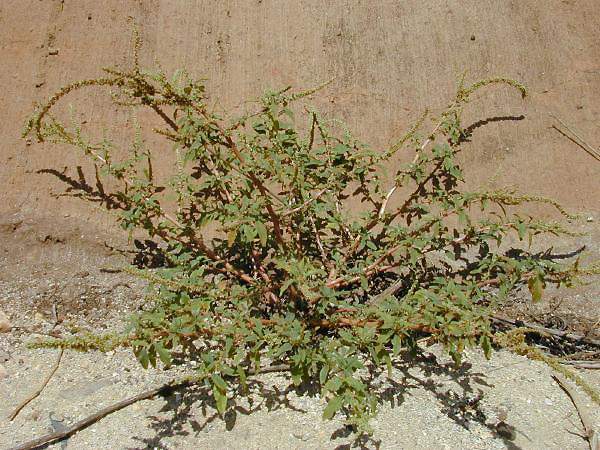 Spiny AmaranthAmaranthus spinosus
-
 Prince-of-Wales FeatherAmaranthus hypochondriacus
Compare
Questions and answers
What is the scientific name of the Pigweed?
The scientific name of the Pigweed is Amaranthus blitum. Written with its author, the full name is Amaranthus blitum L..
Which family does the Pigweed belong to?
Amaranthus blitum belongs to the family Amaranthaceae, in the order Caryophyllales and the class Magnoliopsida.
Where is the Pigweed found?
Checklists and occurrence records place Amaranthus blitum in 140 countries, including France, The Netherlands, Portugal, Spain, Brazil and Italy.
What other names does the Pigweed have?
Amaranthus blitum is also known in English as Guernsey Pigweed, Least Amaranth, Livid Amaranth, Purple Amaranth and Slender Amaranth.
What foods is amaranth found in?
Pigweed is collected from the wild for human consumption in many parts of the world. In Greece, its leaves and cooked tender shoots are eaten with olive oil, lemon and salt. In Lebanon, young shoots are cooked with olive oil, onion, chilli and burghul, seasoned with salt and lemon, and eaten with pita.[18][19][20][21][22]
Sources
Passages the profile rests on
- Amaranthus blitum is an erect or semi-prostrate annual plant. Source passage: “Amaranthus blitum is an erect or semi-prostrate annual plant.” — English Wikipedia
- The plant has a single or branched stem. Source passage: “The single or branched stem can grow to 1 metre (3+1⁄2 ft) tall.” — English Wikipedia
- Its leaves are green or purplish. Source passage: “The green or purplish leaves are up to 10 centimetres (4 in) long on stalks of a similar length and are arranged spirally.” — English Wikipedia
- Its leaves are simple, roughly triangular and have entire margins. Source passage: “They are simple, roughly triangular in shape and have entire margins.” — English Wikipedia
- Its leaves are arranged spirally along the plant. Source passage: “The green or purplish leaves are up to 10 centimetres (4 in) long on stalks of a similar length and are arranged spirally.” — English Wikipedia
- The plant's stem can reach 1 metre in height. Source passage: “The single or branched stem can grow to 1 metre (3+1⁄2 ft) tall.” — English Wikipedia
- Its leaves can reach 10 centimetres in length. Source passage: “The green or purplish leaves are up to 10 centimetres (4 in) long on stalks of a similar length and are arranged spirally.” — English Wikipedia
- Its leaf stalks can reach approximately 10 centimetres in length. Source passage: “The green or purplish leaves are up to 10 centimetres (4 in) long on stalks of a similar length and are arranged spirally.” — English Wikipedia
- Its inflorescence is a spike containing clusters of tiny male and female flowers. Source passage: “The inflorescence is a spike with the tiny male and female flowers clustered together.” — English Wikipedia
- Its fruits are small, globular capsules containing disc-shaped seeds. Source passage: “The fruits are small globular capsules containing disc-shaped seeds.” — English Wikipedia
- The species grows on waste ground. Source passage: “It is established in Guernsey and elsewhere as a casual plant, springing up on waste ground, rubbish tips and cultivated areas, probably from wool waste, coconut fibre or birdseed.” — English Wikipedia
- The species occurs on rubbish tips. Source passage: “It is established in Guernsey and elsewhere as a casual plant, springing up on waste ground, rubbish tips and cultivated areas, probably from wool waste, coconut fibre or birdseed.” — English Wikipedia
- The species occurs in cultivated areas. Source passage: “It is established in Guernsey and elsewhere as a casual plant, springing up on waste ground, rubbish tips and cultivated areas, probably from wool waste, coconut fibre or birdseed.” — English Wikipedia
- The species produces spikes containing both male and female flowers. Source passage: “The inflorescence is a spike with the tiny male and female flowers clustered together.” — English Wikipedia
- The species produces small globular fruits containing disc-shaped seeds. Source passage: “The fruits are small globular capsules containing disc-shaped seeds.” — English Wikipedia
- The species can grow in either an erect or semi-prostrate form. Source passage: “Amaranthus blitum is an erect or semi-prostrate annual plant.” — English Wikipedia
- The species has become less frequent in southern England since the nineteenth century. Source passage: “It occurred more frequently in scattered locations in southern England in the 19th century but has since decreased.” — English Wikipedia
- The species is collected from the wild for human consumption in many parts of the world. Source passage: “Although not cultivated, this plant is gathered from the wild and eaten in many parts of the world.” — English Wikipedia
- In Greece, the leaves and cooked tender shoots of Amaranthus blitum var. silvestre are eaten with olive oil, lemon and salt. Source passage: “The Greeks refer to A. blitum var. silvestre as vlita (Modern Greek: βλίτα) and eat the leaves and the cooked tender shoots, served with olive oil, lemon and salt.” — English Wikipedia
- In Lebanon, young shoots of the species are prepared as a side dish. Source passage: “In Lebanon (especially to the north) a side dish is made from the young shoots;” — English Wikipedia
- In Lebanon, the young shoots are cooked with olive oil, onion, chilli and burghul, then seasoned with salt and lemon. Source passage: “they are cooked in olive oil, onion, chilli, and burghul, seasoned with salt and lemon, and eaten with pita.” — English Wikipedia
- In Lebanon, the cooked young shoots are eaten with pita. Source passage: “they are cooked in olive oil, onion, chilli, and burghul, seasoned with salt and lemon, and eaten with pita.” — English Wikipedia
- The species is considered closely related to Amaranthus viridis. Source passage: “Amaranthus viridis, the slender amaranth or green amaranth, is closely related and edible.” — English Wikipedia
Data
- Catalogue of Life, 2026-10-16 XR cc by
- Global Biodiversity Information Facility CC BY 4.0
- Wikidata CC0
- GeoNames CC BY 4.0
- Wikimedia Commons per image; credit shown with each image
- Within the Catalogue of Life, this name comes from Synonymic Checklists of the Vascular Plants of the World cc by
References
- L. (1753). Sp. Pl. [Linnaeus] 2: 990 (1753). where the name was published
This species in other databases
Page built on 26 November 2026. See how the catalog is made and all sources and licences.
Cite this page
ScientificNames.org. (2026). Amaranthus blitum (Pigweed). Retrieved November 26, 2026, from https://scientificnames.org/species/amaranthus-blitum
“Amaranthus blitum (Pigweed).” ScientificNames.org, 2026, scientificnames.org/species/amaranthus-blitum. Accessed 26 Nov. 2026.
ScientificNames.org. “Amaranthus blitum (Pigweed).” Accessed November 26, 2026. https://scientificnames.org/species/amaranthus-blitum.
@misc{scientificnames_amaranthus_blitum_pigweed,
  author = {{ScientificNames.org}},
  title = {Amaranthus blitum (Pigweed)},
  year = {2026},
  url = {https://scientificnames.org/species/amaranthus-blitum},
  note = {Accessed 2026-11-26}
}