Species · Flowering plants
Crisp-leaved Amaranth Amaranthus crispus
The scientific name of the Crisp-leaved Amaranth is Amaranthus crispus. It is a species of flowering plant in the family Amaranthaceae (amaranth family), order Caryophyllales.
- Scientific name
- Amaranthus crispus (Lesp. & Thévenau) N.Terracc.
- Common name
- Crisp-leaved Amaranth
- Genus
- Amaranthus
- Family
- Amaranthaceae (Amaranth Family)
- Order
- Caryophyllales
- Class
- Magnoliopsida
- Recorded in
- 16 countries
- Name status
- accepted in the Catalogue of Life

Overview
The species is native to Argentina, Chile, and Uruguay and has been introduced into several other countries and territories. It is distinguished by leaves with conspicuously undulate, crisped-erose margins and green axillary flower clusters.
Written 27 November 2026 from the sources listed below. Each statement was checked against the passage it cites; statements that could not be supported were removed.
Appearance
Crisp-leaved Amaranth is an annual herb with sparse pubescence. Its stems grow prostrate or ascending, branch mainly from the base, and are minutely pubescent and extensively branched.[1][2][3]
The leaves have rhombic-ovate to oblong blades with conspicuously undulate, crisped-erose margins. Their tips are acute to subobtuse with a short mucro, and their petioles are shorter than the blades.[4][5][6]
The plant produces green axillary flower clusters. Its pistillate flowers have five tepals, while its staminate flowers have five tepals and five stamens.[7][8][9]
The fruits are ellipsoid or obovoid, indehiscent, and measure 1.5–2 mm. The seeds are smooth, lenticular to obovoid-lenticular, and black to dark reddish brown.[10][11]
The plant can reach a height of 0.5 metres. Its leaf blades usually measure 0.5–1.5 cm long and 0.3–0.8 cm wide, with maximum recorded dimensions of 2.5 by 1.5 cm; its flower clusters measure 3–10 mm.[12][13][14]
Habitat
Crisp-leaved Amaranth commonly grows in waste places and disturbed habitats. In its introduced North American range, it is occasionally found in waste places, particularly around seaports.[15][16]
The species is native to Argentina, Chile, and Uruguay. It has been introduced into Australia, Austria, Bulgaria, Crimea, the former Czechoslovakia, France, Hungary, Italy, Romania, Sardinia, the United States, and the former Yugoslavia.[17][18]
The species is recorded in Western Australia and in New Jersey in the northeastern United States.[19][20]
Behaviour
Crisp-leaved Amaranth flowers from summer into fall.[21]
Reproduction and life cycle
Staminate flowers occur intermixed with pistillate flowers.[22]
Classification of the Crisp-leaved Amaranth
| Kingdom | Plantae |
|---|---|
| Subkingdom | Pteridobiotina |
| Phylum | Tracheophyta |
| Class | Magnoliopsida |
| Order | Caryophyllales |
| Family | Amaranthaceae (Amaranth Family) |
| Subfamily | Amaranthoideae |
| Tribe | Amarantheae |
| Genus | Amaranthus (Amaranth) |
| Species | Amaranthus crispus (Lesp. & Thévenau) N.Terracc. |
Where the Crisp-leaved Amaranth is found
Checklists and occurrence records place Amaranthus crispus in 16 countries across Europe, North America and South America. GBIF holds 923 georeferenced records of it.
Countries where it is native or its origin is not stated
Countries where it has been introduced
- Austria 15
- Bulgaria
- Croatia 1
- Czechia 31
- France 57
- Germany 25
- Hungary 28
- Italy 10
- Moldova 1
- North Macedonia
- Romania 531
- Slovakia 7
- United States 45
Regions and cities with the most records
- Sibiu County, Romania 46
- Iași County, Romania 38
- Vaslui County, Romania 32
- Arad County, Romania 31
- Cisnădie, Romania 29
- Constanța County, Romania 29
- Sibiu, Romania 29
- Cordoba, Argentina 24
- Pantelimon, Romania 24
- Voluntari, Romania 24
- Bihor County, Romania 23
- Bucharest, Romania 23
- Popeşti-Leordeni, Romania 23
- Buzău County, Romania 22
- Iaşi, Romania 22
- Galați County, Romania 21
- Buenos Aires, Argentina 20
- Timiș County, Romania 20
- Tulcea County, Romania 20
- Satu Mare County, Romania 19
- La Pampa, Argentina 18
- Occitanie, France 18
- Ungheni, Moldova 18
- Huşi, Romania 16
- Bohnice, Czechia 15
- Brandýs nad Labem-Stará Boleslav, Czechia 15
- Braník, Czechia 15
- Chodov, Czechia 15
- Dejvice, Czechia 15
- Holešovice, Czechia 15
- Kobylisy, Czechia 15
- Košíře, Czechia 15
- Kralupy nad Vltavou, Czechia 15
- Královské Vinohrady, Czechia 15
- Krč, Czechia 15
- Letňany, Czechia 15
4 more countries have a few records outside this range
These countries hold a few records of Amaranthus crispus but lie outside the range the checklists give for it. Such records are often zoo or garden specimens, museum material or vagrants, so the species is not counted as occurring there.
Range as the checklists state it
Germany [I]; Austria [I]; Czech Republic [I]; Slovakia [I]; Hungary [I]; France [I]; Italy [I]; Croatia [I]; North Macedonia [I]; Romania [I]; Bulgaria [I]; European Russia [I]; Moldova [I]; USA [I] (New Jersey [I], New York [I], North Carolina [I], Virginia [I]); Uruguay (Montevideo); Argentina (Buenos Aires, La Pampa, Mendoza, Rio Negro, San Luis)
A number beside a place is its count of GBIF occurrence records. A place without a number comes from a checklist alone. Records show where a species has been observed or collected, which can include escapes and vagrants.
Common names
English
- Crisp-leaved Amaranth
Names in 2 other languages
- German
- Krauser Amarant
- Swedish
- krusamarant
Synonyms
5 other scientific names have been used for this species and are now treated as synonyms of Amaranthus crispus.
- Albersia crispa (Lesp. & Thévenau) Asch. ex Hausskn.
- Amaranthus crispus (Lesp. & Thévenau) A.Terracc.
- Amaranthus cristulatus Speg.
- Celosia crispus Lesp. & Thev.
- Euxolus crispus Lesp. & Thévenau
Related species
-
 Love Lies BleedingAmaranthus caudatus
-
 Green AmaranthAmaranthus viridis
-
 Redroot PigweedAmaranthus retroflexus
-
 AmaranthAmaranthus cruentus
-
 Chinese AmaranthAmaranthus tricolor
-
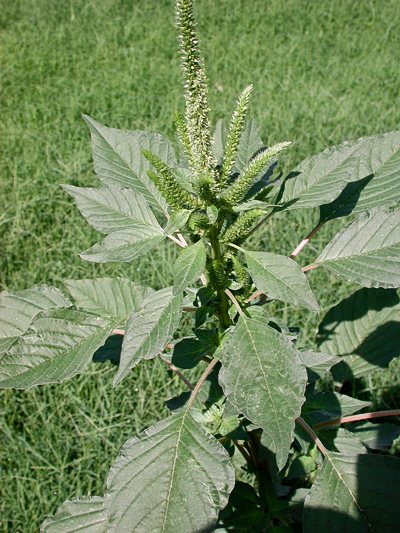 Palmer AmaranthAmaranthus palmeri
-
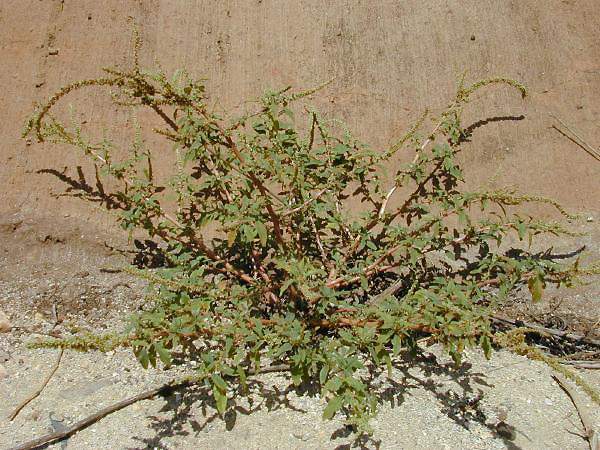 Spiny AmaranthAmaranthus spinosus
-
 Prince-of-Wales FeatherAmaranthus hypochondriacus
Compare
Questions and answers
What is the scientific name of the Crisp-leaved Amaranth?
The scientific name of the Crisp-leaved Amaranth is Amaranthus crispus. Written with its author, the full name is Amaranthus crispus (Lesp. & Thévenau) N.Terracc..
Which family does the Crisp-leaved Amaranth belong to?
Amaranthus crispus belongs to the family Amaranthaceae, in the order Caryophyllales and the class Magnoliopsida.
Where is the Crisp-leaved Amaranth found?
Checklists and occurrence records place Amaranthus crispus in 16 countries, including Argentina, Uruguay and Brazil.
Where does amaranth grow naturally?
Crisp-leaved Amaranth is native to Argentina, Chile, and Uruguay.[17]
Sources
Passages the profile rests on
- The plant is an annual herb with sparse pubescence. Source passage: “It is a herbaceous, sparsely pubescent annual plant.” — English Wikipedia
- The stems grow prostrate or ascending and branch mainly from the base. Source passage: “Stems prostrate to ascending, branched mainly from base” — worldfloraonline.org
- The stems are minutely pubescent and extensively branched. Source passage: “stem prostrate, much-branched, 2–6 dm, minutely pubescent” — worldfloraonline.org
- The leaves have rhombic-ovate to oblong blades with conspicuously undulate, crisped-erose margins. Source passage: “blade rhombic-ovate to oblong, 0.5-1.5(-2.5) × 0.3-0.8(-1.5) cm, base cuneate, margins crisped-erose, conspicuously undulate” — worldfloraonline.org
- The leaf blades have acute to subobtuse tips with a short mucro. Source passage: “apex acute to subobtuse, with short mucro.” — worldfloraonline.org
- The leaf petioles are shorter than their blades. Source passage: “petiole shorter than blade” — worldfloraonline.org
- The plant produces green axillary flower clusters. Source passage: “Inflorescences axillary glomerules, green” — worldfloraonline.org
- The plant has five tepals in its pistillate flowers. Source passage: “Pistillate flowers: tepals 5” — worldfloraonline.org
- The staminate flowers have five tepals and five stamens. Source passage: “Staminate flowers intermixed with pistillate; tepals 5; stamens 5.” — worldfloraonline.org
- The plant produces ellipsoid or obovoid, indehiscent fruits measuring 1.5–2 mm. Source passage: “Utricles ellipsoid or obovoid, 1.5-2 mm, slightly longer than tepals, smooth to slightly wrinkled, indehiscent.” — worldfloraonline.org
- Its seeds are smooth, lenticular to obovoid-lenticular, and black to dark reddish brown. Source passage: “Seeds black to dark reddish brown, lenticular to obovoid-lenticular, 0.7-1 mm diam., smooth.” — worldfloraonline.org
- The plant can reach a height of 0.5 metres. Source passage: “It can grow up to 0.5 m (1.5 ft) in height.” — English Wikipedia
- Its leaf blades usually measure 0.5–1.5 cm long and 0.3–0.8 cm wide, with maximum recorded dimensions of 2.5 by 1.5 cm. Source passage: “0.5-1.5(-2.5) × 0.3-0.8(-1.5) cm” — worldfloraonline.org
- Its flower clusters measure 3–10 mm. Source passage: “infls axillary, 3–10 mm” — worldfloraonline.org
- The species commonly grows in waste places and disturbed habitats. Source passage: “It usually grows in waste places, disturbed habitats, or near water.” — English Wikipedia
- In its introduced North American range, the species is occasionally found in waste places, particularly around seaports. Source passage: “occasionally found in waste places in our range, especially about seaports.” — worldfloraonline.org
- The species is native to Argentina, Chile, and Uruguay. Source passage: “It is native to Argentina, Chile and Uruguay” — English Wikipedia
- The species has been introduced into Australia, Austria, Bulgaria, Crimea, the former Czechoslovakia, France, Hungary, Italy, Romania, Sardinia, the United States, and the former Yugoslavia. Source passage: “has been introduced into Australia, Austria, Bulgaria, Crimea, the former Czechoslovakia, France, Hungary, Italy, Romania, Sardinia, the United States, and the former Yugoslavia.” — English Wikipedia
- The species is recorded in Western Australia. Source passage: “Australia Western Australia” — worldfloraonline.org
- The species is recorded in New Jersey in the northeastern United States. Source passage: “Northern America Northeastern U.S.A. New Jersey” — worldfloraonline.org
- The species flowers from summer into fall. Source passage: “It flowers in summer to fall.” — English Wikipedia
- Staminate flowers occur intermixed with pistillate flowers. Source passage: “Staminate flowers intermixed with pistillate” — worldfloraonline.org
Data
- Catalogue of Life, 2026-10-16 XR cc by
- Global Biodiversity Information Facility CC BY 4.0
- Wikidata CC0
- GeoNames CC BY 4.0
- Wikimedia Commons per image; credit shown with each image
- Within the Catalogue of Life, this name comes from Synonymic Checklists of the Vascular Plants of the World cc by
References
- N.Terracc. (1890). Rendiconti Reale Accad. Sci. Fis. 4: 188 (1890). where the name was published
This species in other databases
Page built on 27 November 2026. See how the catalog is made and all sources and licences.
Cite this page
ScientificNames.org. (2026). Amaranthus crispus (Crisp-leaved Amaranth). Retrieved November 27, 2026, from https://scientificnames.org/species/amaranthus-crispus
“Amaranthus crispus (Crisp-leaved Amaranth).” ScientificNames.org, 2026, scientificnames.org/species/amaranthus-crispus. Accessed 27 Nov. 2026.
ScientificNames.org. “Amaranthus crispus (Crisp-leaved Amaranth).” Accessed November 27, 2026. https://scientificnames.org/species/amaranthus-crispus.
@misc{scientificnames_amaranthus_crispus_crisp_leaved_amaranth,
  author = {{ScientificNames.org}},
  title = {Amaranthus crispus (Crisp-leaved Amaranth)},
  year = {2026},
  url = {https://scientificnames.org/species/amaranthus-crispus},
  note = {Accessed 2026-11-27}
}