Species · Flowering plants
Low Amaranth Amaranthus deflexus
The scientific name of the Low Amaranth is Amaranthus deflexus. It is a species of flowering plant in the family Amaranthaceae (amaranth family), order Caryophyllales.
- Scientific name
- Amaranthus deflexus L.
- Common name
- Low Amaranth
- Genus
- Amaranthus
- Family
- Amaranthaceae (Amaranth Family)
- Order
- Caryophyllales
- Class
- Magnoliopsida
- Recorded in
- 55 countries
- Name status
- accepted in the Catalogue of Life

Overview
Low amaranth is a plant with a prostrate or spreading growth habit. The species is native to South America and has been introduced to numerous warm and temperate regions worldwide. It can reach a height of 0.5 m and flowers from summer through fall.
Written 26 November 2026 from the sources listed below. Each statement was checked against the passage it cites; statements that could not be supported were removed.
Appearance
Low amaranth has a prostrate or spreading growth habit and can reach a height of 0.5 m.[1][2]
Habitat
Low amaranth grows best in weedy areas and disturbed habitats.[3]
Reproduction and life cycle
Low amaranth flowers from summer through fall.[4]
The plant can grow as an annual or short-lived perennial. Its life cycle can also be annual, biennial, or short-lived perennial.[5][6]
Similar species
A natural hybrid between low amaranth and Amaranthus muricatus has been described in Europe under the name Amaranthus × tarraconensis.[7]
Classification of the Low Amaranth
| Kingdom | Plantae |
|---|---|
| Subkingdom | Pteridobiotina |
| Phylum | Tracheophyta |
| Class | Magnoliopsida |
| Order | Caryophyllales |
| Family | Amaranthaceae (Amaranth Family) |
| Subfamily | Amaranthoideae |
| Tribe | Amarantheae |
| Genus | Amaranthus (Amaranth) |
| Species | Amaranthus deflexus L. |
Where the Low Amaranth is found
Checklists and occurrence records place Amaranthus deflexus in 55 countries across Africa, Asia, Europe, North America, Oceania and South America. GBIF holds 26,446 georeferenced records of it.
Countries where it is native or its origin is not stated
Countries where it has been introduced
- Albania
- Algeria 20
- Andorra 1
- Australia 184
- Austria 189
- Azerbaijan 15
- Brazil 272
- Bulgaria 14
- Chad
- Croatia 104
- Czechia 139
- France 15,067
- Georgia 3
- Germany 180
- Greece 155
- Hungary 330
- Iran
- Italy 1,006
- Japan 120
- Kazakhstan
- Lebanon
- Lesotho 2
- Libya 1
- Liechtenstein
- Malta
- Moldova 1
- Montenegro 4
- Morocco 22
- Namibia 3
- New Zealand 274
- North Macedonia 3
- Portugal 1,019
- Romania 565
- Slovakia 9
- Slovenia 12
- South Africa 227
- South Korea 60
- Spain 4,278
- Switzerland 394
- Tajikistan 3
- Trinidad and Tobago
- Tunisia 5
- Turkey 37
- Turkmenistan
- Ukraine 69
- United States 782
- Uzbekistan
- Zimbabwe 10
Regions and cities with the most records
- Île-de-France, France 3,860
- Paris 13 Gobelins, France 3,098
- Salpêtrière, France 3,088
- Montrouge, France 3,084
- Maison Blanche, France 3,082
- Paris 05 Panthéon, France 3,081
- Gare, France 3,079
- Paris 07 Palais-Bourbon, France 3,072
- Paris 06 Luxembourg, France 3,071
- Paris 14 Observatoire, France 3,068
- Quinze-Vingts, France 3,062
- Malakoff, France 3,057
- Paris, France 3,054
- Gentilly, France 3,047
- Paris 04 Hôtel-de-Ville, France 3,046
- Paris 15 Vaugirard, France 3,044
- Paris 01 Louvre, France 3,042
- Paris 02 Bourse, France 3,042
- Vanves, France 3,042
- Le Kremlin-Bicêtre, France 3,041
- Paris 03 Temple, France 3,040
- Issy-les-Moulineaux, France 3,033
- Paris 09 Opéra, France 3,030
- Paris 11 Popincourt, France 3,028
- Croulebarbe, France 3,027
- Paris 12 Reuilly, France 3,024
- Paris 10 Entrepôt, France 2,999
- Paris 08 Élysée, France 2,995
- Arcueil, France 2,984
- Paris 16 Passy, France 2,973
- Ivry-sur-Seine, France 2,951
- Paris 20 Ménilmontant, France 2,950
- Saint-Mandé, France 2,943
- Châtillon, France 2,934
- Paris 17 Batignolles-Monceau, France 2,921
- Bagnolet, France 2,914
17 more countries have a few records outside this range
These countries hold a few records of Amaranthus deflexus but lie outside the range the checklists give for it. Such records are often zoo or garden specimens, museum material or vagrants, so the species is not counted as occurring there.
Range as the checklists state it
Germany [I]; Switzerland [I]; ?Liechtenstein [I]; Austria [I]; Czech Republic [I]; Slovakia [I]; Hungary [I]; Portugal [I]; Spain [I]; Andorra [I]; Baleares [I]; France [I]; +Monaco [I]; Channel Isl. [I]; Corsica [I]; Sardinia [I]; Italy [I]; Sicily [I]; Isole Pelagie [I] (Lampedusa [I]); Malta [I]; Slovenia [I]; Croatia [I]; Bosnia & Hercegovina [I]; Montenegro [I]; North Macedonia [I]; Albania [I]; Romania [I]; Bulgaria [I]; European Turkey [I]; Greece [I]; Crete [I]; E-European Russia [I]; Moldova [I]; Ukraine [I]; Crimea [I]; Morocco [I]; Algeria [I]; Tunisia [I]; Libya [I]; Azores [I] (Santa Maria Isl. [I], Sao Miguel Isl. [I], Terceira [I], Sao Jorge [I], Pico [I], Faial [I]); Madeira [I] (Madeira Isl. [I], Porto Santo Isl. [I]); Canary Isl. [I] (Lanzarote [I], Fuerteventura [I], Gran Canaria [I], Tenerife [I]); Chad [I]; Zimbabwe [I]; Namibia [I]; South Africa [I] (widespread); Lesotho [I]; Kazakhstan [I]; Turkmenistan [I]; Uzbekistan [I]; Tajikistan [I]; Georgia [Caucasus] [I]; Azerbaijan [I]; East Aegaean Isl. [I] (incl. Chalki [I]); Turkey [I] (NW-Anatolia [I]); Iran [I] (NE-Iran: Mts. [I], EC-Iran [I]); Lebanon [I] (C-Lebanon [I], coastal W-Lebanon [I]); South Korea [I]; Japan [I]; Australia [I] (South Australia [I], New South Wales [I], Victoria [I], Tasmania [I]); New Zealand [I]; USA [I] (Alabama [I], California [I], Florida [I], Georgia [I], Louisiana [I], Massachusetts [I], New Jersey [I], New York [I], Oregon [I], Pennsylvania [I], Tennessee [I], Virginia [I]); Trinidad & Tobago [I]; Peru; Bolivia (Cochabamba, La Paz); Brazil [I]; Uruguay (Montevideo); Argentina (Buenos Aires, Chubut, Córdoba, Entre Rios, La Pampa, Mendoza, Neuquén, Rio Negro, San Juan); Chile (Antofagasta, Atacama, Coquimbo, Valparaíso, Metropolitana de Santiago, O'Higgins, Maule, Ñuble, Biobío, Araucanía, Los Rios, Los Lagos, Magallanes); Desventuradas Isl.; Juan Fdz. Isl.
A number beside a place is its count of GBIF occurrence records. A place without a number comes from a checklist alone. Records show where a species has been observed or collected, which can include escapes and vagrants.
Common names
English
- Low Amaranth
- Argentine Amaranth
- Perennial Pigweed
- Prostrate Amaranth
- Deflexed Amaranth
- Large-fruit Amaranth
- Largefruit Amaranth
- Spreading Amaranth
- Tow Amaranth
Names in 26 other languages
- Afrikaans
- meerjarige misbredie, misbredie
- Catalan
- Blet corbat
- Chinese
- 大果莧
- Czech
- laskavec skloněný
- Danish
- Krybende amarant
- Dutch
- Liggende majer
- Finnish
- rikkarevonhäntä
- French
- Amarante couchée, Amarante étalée
- German
- Herabgebogener Amarant, Herabgebogener Amaranth, liegender Fuchsschwanz
- Hebrew
- ירבוז נטוי
- Hungarian
- pirosló disznóparéj, vöröslő disznóparéj
- Italian
- amaranto prostrato
- Japanese
- ハイビユ
- Norwegian Bokmål
- broddamarant
- Polish
- szarłat pochylony
- Portuguese
- Bredo, Caruru, amaranto-arqueado, bredo-perene, caruru-rasteiro
- Russian
- Щирица согнутая
- Serbian
- Јужноамерички штир
- Slovak
- láskavec položený
- Slovenian
- polegli ščir
- Spanish
- Amaranto rastrero, Bledo rastrero
- Swedish
- krypamarant
- Turkish
- Sarkıkibik
- Ukrainian
- Щириця нахилена
- Welsh
- Blodyn Amor Parhaol
- hsb
- Zhibnjeny šćěrjenc
Synonyms
18 other scientific names have been used for this species and are now treated as synonyms of Amaranthus deflexus.
- Albersia deflexa (L.) Fourr.
- Albersia prostrata (Balb.) Kunth
- Amarantellus argentinus Speg.
- Amaranthus deflexus f. rufescens (Godr.) Thell. & Probst
- Amaranthus deflexus var. minor (Moq.) Thell.
- Amaranthus deflexus var. pseudocrispus Thell.
- Amaranthus deflexus var. rufescens (Godr.) Thell.
- Amaranthus perennis Bellardi ex Colla
- Amaranthus scandens L.fil.
- Euxolus deflexus (L.) Raf.
- Euxolus deflexus var. ascendens Moq.
- Euxolus deflexus var. major Moq.
- Euxolus deflexus var. minor Moq.
- Euxolus deflexus var. rufescens Godr.
- Galliaria prostrata (Balb.) Bubani
- Glomeraria deflexa (L.) Cav.
- Amaranthus minor (Moq.) Sennen ambiguous synonym
- Amaranthus prostratus Balb. ambiguous synonym
Related species
-
 Love Lies BleedingAmaranthus caudatus
-
 Green AmaranthAmaranthus viridis
-
 Redroot PigweedAmaranthus retroflexus
-
 AmaranthAmaranthus cruentus
-
 Chinese AmaranthAmaranthus tricolor
-
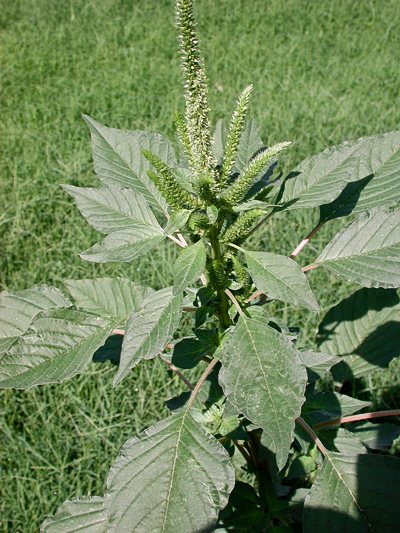 Palmer AmaranthAmaranthus palmeri
-
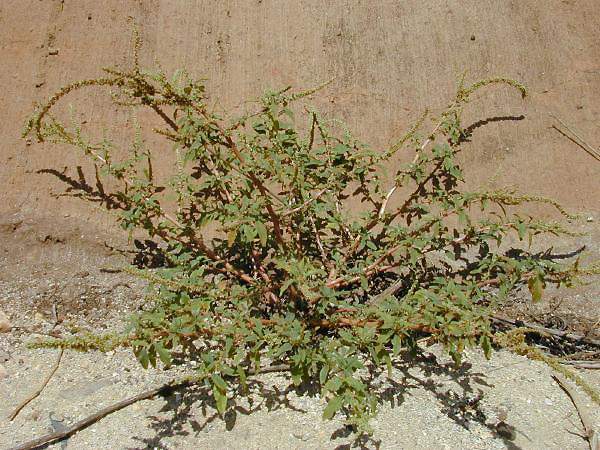 Spiny AmaranthAmaranthus spinosus
-
 Prince-of-Wales FeatherAmaranthus hypochondriacus
Compare
Questions and answers
What is the scientific name of the Low Amaranth?
The scientific name of the Low Amaranth is Amaranthus deflexus. Written with its author, the full name is Amaranthus deflexus L..
Which family does the Low Amaranth belong to?
Amaranthus deflexus belongs to the family Amaranthaceae, in the order Caryophyllales and the class Magnoliopsida.
Where is the Low Amaranth found?
Checklists and occurrence records place Amaranthus deflexus in 55 countries, including The Netherlands, Argentina, Chile, Uruguay, Peru and Bolivia.
What other names does the Low Amaranth have?
Amaranthus deflexus is also known in English as Argentine Amaranth, Perennial Pigweed, Prostrate Amaranth, Deflexed Amaranth, Large-fruit Amaranth and Largefruit Amaranth.
Where does amaranth grow naturally?
Low amaranth is native to South America.[8]
Sources
Passages the profile rests on
- The plant has a prostrate or spreading growth habit. Source passage: “Low amaranth is a prostrate or spreading summer annual, biennial, or short-lived perennial.” — ipm.ucanr.edu
- The plant can reach a height of 0.5 m. Source passage: “The plant can grow up to 1.5 ft (0.5 m) in height.” — English Wikipedia
- The plant grows best in weedy areas and disturbed habitats. Source passage: “It grows best in weedy areas or in disturbed habitats.” — English Wikipedia
- The plant flowers from summer through fall. Source passage: “It flowers in the summer to fall.” — English Wikipedia
- The plant can grow as an annual or short-lived perennial. Source passage: “It is a short-lived perennial or annual plant.” — English Wikipedia
- The plant can have an annual, biennial, or short-lived perennial life cycle. Source passage: “Low amaranth is a prostrate or spreading summer annual, biennial, or short-lived perennial.” — ipm.ucanr.edu
- A natural hybrid between this species and Amaranthus muricatus has been described in Europe under the name Amaranthus × tarraconensis. Source passage: “A natural hybrid of Amaranthus deflexus and Amaranthus muricatus has been described in Europe, and is known as Amaranthus × tarraconensis.” — English Wikipedia
- The species is native to South America. Source passage: “It is native to South America” — English Wikipedia
Data
- Catalogue of Life, 2026-10-16 XR cc by
- Global Biodiversity Information Facility CC BY 4.0
- Wikidata CC0
- GeoNames CC BY 4.0
- Wikimedia Commons per image; credit shown with each image
- Within the Catalogue of Life, this name comes from Synonymic Checklists of the Vascular Plants of the World cc by
References
- L. Mant. Pl. Altera [Linnaeus] 295 (1771). where the name was published
This species in other databases
Page built on 27 November 2026. See how the catalog is made and all sources and licences.
Cite this page
ScientificNames.org. (2026). Amaranthus deflexus (Low Amaranth). Retrieved November 27, 2026, from https://scientificnames.org/species/amaranthus-deflexus
“Amaranthus deflexus (Low Amaranth).” ScientificNames.org, 2026, scientificnames.org/species/amaranthus-deflexus. Accessed 27 Nov. 2026.
ScientificNames.org. “Amaranthus deflexus (Low Amaranth).” Accessed November 27, 2026. https://scientificnames.org/species/amaranthus-deflexus.
@misc{scientificnames_amaranthus_deflexus_low_amaranth,
  author = {{ScientificNames.org}},
  title = {Amaranthus deflexus (Low Amaranth)},
  year = {2026},
  url = {https://scientificnames.org/species/amaranthus-deflexus},
  note = {Accessed 2026-11-27}
}