Species · Flowering plants
Powell's Smooth Amaranth Amaranthus powellii
The scientific name of the Powell's Smooth Amaranth is Amaranthus powellii. It is a species of flowering plant in the family Amaranthaceae (amaranth family), order Caryophyllales.
- Scientific name
- Amaranthus powellii S.Watson
- Common name
- Powell's Smooth Amaranth
- Genus
- Amaranthus
- Family
- Amaranthaceae (Amaranth Family)
- Order
- Caryophyllales
- Class
- Magnoliopsida
- Recorded in
- 31 countries
- Name status
- accepted in the Catalogue of Life

Overview
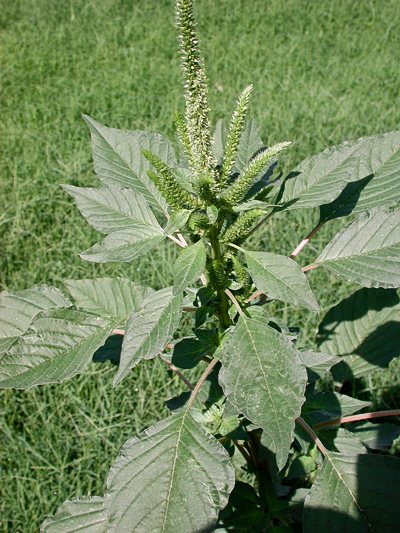
Powell's smooth amaranth is native to Pennsylvania. It has thicker, less-branched flower stalks than smooth pigweed and produces small, inconspicuous greenish flowers.
Written 28 November 2026 from the sources listed below. Each statement was checked against the passage it cites; statements that could not be supported were removed.
Appearance
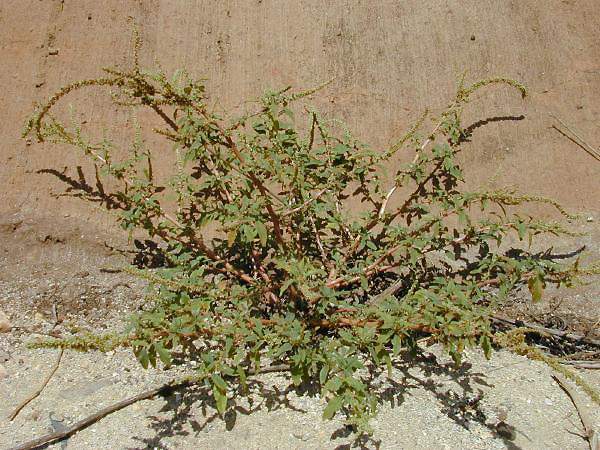
Powell's smooth amaranth has thicker flower stalks and less branching than smooth pigweed. Its leaves are arranged alternately along the stems, and its taproot can be red.[1][2][3]
It produces small, inconspicuous greenish flowers.[4]
Habitat
Powell's smooth amaranth grows in full-sun conditions and can grow in clay, loam, and sandy soils.[5][6]
Behaviour
Seedlings emerge over a period of several weeks. The plant undergoes particularly aggressive growth during May and June.[7][8]
Reproduction and life cycle
Powell's smooth amaranth flowers between July and September and produces seeds between August and October. A plant can produce between 13,000 and 35,000 seeds on average.[9][10][11]
Seeds can germinate at different times over several years after production. They generally germinate within the upper inch of soil.[12][13]
Seeds can persist in the soil seed bank, with the seed population taking up to three years to decline to half its initial level. Reducing the seed population in the soil to 99 percent below its initial level can take up to 20 years.[14][15]
Conservation
Powell's smooth amaranth is listed among the Amaranthus species considered invasive and noxious weeds in the United States and Canada.[16]
Similar species
Powell's smooth amaranth can grow in the same locations as smooth pigweed and redroot pigweed. It is difficult to distinguish from other common pigweed species at the seedling stage.[17][18]
Powell's smooth amaranth can hybridize with other Amaranthus species.[19]
Classification of the Powell's Smooth Amaranth
| Kingdom | Plantae |
|---|---|
| Subkingdom | Pteridobiotina |
| Phylum | Tracheophyta |
| Class | Magnoliopsida |
| Order | Caryophyllales |
| Family | Amaranthaceae (Amaranth Family) |
| Subfamily | Amaranthoideae |
| Tribe | Amarantheae |
| Genus | Amaranthus (Amaranth) |
| Species | Amaranthus powellii S.Watson |
Where the Powell's Smooth Amaranth is found
Checklists and occurrence records place Amaranthus powellii in 31 countries across Africa, Asia, Europe, North America, Oceania and South America. GBIF holds 14,754 georeferenced records of it.
Countries where it is native or its origin is not stated
Countries where it has been introduced
- Albania
- Algeria
- Argentina 67
- Australia 525
- Belarus 6
- Belgium 89
- Bolivia 47
- Canada 455
- Croatia 7
- Czechia 430
- Ecuador 20
- France 1,127
- Georgia 3
- Germany 3,436
- Greece 83
- Hungary 49
- Luxembourg 6
- Moldova 2
- Morocco 11
- New Zealand 233
- Portugal 125
- Slovakia 259
- Spain 551
- Switzerland 912
- Tunisia
- Ukraine 184
Regions and cities with the most records
- Bavaria, Germany 2,039
- Regensburg, Germany 482
- Upper Austria, Austria 478
- Bourgogne-Franche-Comté, France 374
- Quebec, Canada 297
- Vaud, Switzerland 279
- Karlsfeld, Germany 253
- New South Wales, Australia 248
- Munich, Germany 245
- Iași County, Romania 244
- Zurich, Switzerland 243
- California, United States 240
- Unterschleißheim, Germany 239
- Kelheim, Germany 230
- Garching, Germany 226
- Baden-Wurttemberg, Germany 222
- Dachau, Germany 222
- Gröbenzell, Germany 218
- Germering, Germany 216
- Unterhaching, Germany 216
- Opfikon, Switzerland 207
- Kloten, Switzerland 206
- Puchheim, Germany 204
- Salzburg, Austria 204
- Dübendorf, Switzerland 199
- Gauting, Germany 199
- Taufkirchen, Germany 199
- Olching, Germany 198
- Zürich, Switzerland 198
- Adliswil, Switzerland 186
- Kalmar, Sweden 184
- Rheinland-Pfalz, Germany 181
- Schweinfurt, Germany 180
- North Rhine-Westphalia, Germany 179
- Freilassing, Germany 176
- Skåne, Sweden 176
21 more countries have a few records outside this range
These countries hold a few records of Amaranthus powellii but lie outside the range the checklists give for it. Such records are often zoo or garden specimens, museum material or vagrants, so the species is not counted as occurring there.
Range as the checklists state it
Belgium [I]; Luxembourg [I]; Germany [I]; Switzerland [I]; Czech Republic [I]; Slovakia [I]; Hungary [I]; Portugal [I]; Spain [I]; France [I]; Croatia [I]; Albania [I]; Greece [I]; Crete [I]; Belarus [I]; Moldova [I]; Ukraine [I]; Siberia [I]; Morocco [I]; Algeria [I]; ?Tunisia [I]; East Aegaean Isl. [I] (Karpathos [I]); Georgia [Caucasus] [I]; Australia [I] (Western Australia [I], South Australia [I], Queensland [I], New South Wales [I], Victoria [I], Tasmania [I]); New Zealand [I]; Canada (Alberta, British Columbia, Ontario, Prince Edward Isl., Quebec, Saskatchewan); USA (Arizona, Arkansas, California, Colorado, Connecticut, Florida, Idaho, Illinois, Indiana, Kansas, Kentucky, Louisiana, Maine, Massachusetts, Michigan, Minnesota, Mississippi, Missouri, Montana, Nevada, New Hampshire, New Jersey, New Mexico, New York, North Carolina, Ohio, Oklahoma, Oregon, Pennsylvania, Rhode Island, South Carolina, South Dakota, Tennessee, Texas, Utah, Vermont, Virginia, Washington State, West Virginia, Wisconsin, Wyoming); Mexico (Baja California Norte, Chihuahua, Coahuila, Durango, Guerrero, Hidalgo, Jalisco, Mexico State, Michoacán, Morelos, Nuevo León, Oaxaca, Puebla, Sonora, Zacatecas); Ecuador [I]; Bolivia [I]; Argentina [I] (Salta [I], San Juan [I])
A number beside a place is its count of GBIF occurrence records. A place without a number comes from a checklist alone. Records show where a species has been observed or collected, which can include escapes and vagrants.
Common names
English
- Powell's Smooth Amaranth
- Green Pigweed
Names in 19 other languages
- Chinese
- 直穗苋, 鮑氏莧, 鲍氏苋
- Czech
- laskavec zelenoklasý
- Dutch
- Powellamarant
- Finnish
- tummarevonhäntä
- French
- amarante de Powell
- German
- Grünähriger Amarant, grünähriger Fuchsschwanz
- Hungarian
- karcsú disznóparéj
- Italian
- Amaranto di Powell
- Japanese
- イガホビユ, ホナガアオゲイトウ
- Polish
- szarlat zielonokłosy
- Portuguese
- bredo-bicudo
- Romanian
- Stir de ogoare
- Russian
- Щирица Пауэлла
- Slovak
- láskavec zelenoklasý
- Slovenian
- vitkocvetni ščir
- Spanish
- quintonil
- Ukrainian
- Щириця Пауелла
- Welsh
- Blodyn Amor Powell
- hsb
- Zeleny šćěrjenc
Synonyms
15 other scientific names have been used for this species and are now treated as synonyms of Amaranthus powellii.
- Amaranthus bracteosus Uline & W.L.Bray
- Amaranthus chlorostachys subsp. pseudoretroflexus (Thell.) Aellen
- Amaranthus chlorostachys var. powellii (S.Watson) Priszter
- Amaranthus chlorostachys var. pseudoretroflexus Thell.
- Amaranthus hybridus f. pseudoretroflexus (Thell.) Thell.
- Amaranthus hybridus subsp. powellii (S.Watson) Karlsson
- Amaranthus hybridus subsp. pseudoretroflexus (Thell.) Carretero
- Amaranthus hybridus subvar. pseudoretroflexus (Thell.) Thell.
- Amaranthus hybridus var. pseudoretroflexus (Thell.) Carretero
- Amaranthus hypochondriacus var. powellii (S.Watson) Pedersen
- Amaranthus obovatus S.Watson
- Amaranthus pseudoretroflexus (Thell.) Almq.
- Amaranthus retroflexus var. powellii (S.Watson) B.Boivin
- Amaranthus retroflexus var. pseudoretroflexus (Thell.) B.Boivin
- Amaranthus chlorostachys subvar. aristulatus (Thell.) Thell. ex Probst ambiguous synonym
Subspecies and varieties
- Amaranthus powellii subsp. powellii (Green Pigweed) subspecies
Related species
-
 Love Lies BleedingAmaranthus caudatus
-
 Green AmaranthAmaranthus viridis
-
 Redroot PigweedAmaranthus retroflexus
-
 AmaranthAmaranthus cruentus
-
 Chinese AmaranthAmaranthus tricolor
-
 Palmer AmaranthAmaranthus palmeri
-
 Spiny AmaranthAmaranthus spinosus
-
 Prince-of-Wales FeatherAmaranthus hypochondriacus
Compare
Questions and answers
What is the scientific name of the Powell's Smooth Amaranth?
The scientific name of the Powell's Smooth Amaranth is Amaranthus powellii. Written with its author, the full name is Amaranthus powellii S.Watson.
Which family does the Powell's Smooth Amaranth belong to?
Amaranthus powellii belongs to the family Amaranthaceae, in the order Caryophyllales and the class Magnoliopsida.
Where is the Powell's Smooth Amaranth found?
Checklists and occurrence records place Amaranthus powellii in 31 countries, including United States, Romania, Sweden, Austria and Mexico.
What other names does the Powell's Smooth Amaranth have?
Amaranthus powellii is also known in English as Green Pigweed.
Why is pigweed a problem?
Powell's smooth amaranth is listed among the Amaranthus species considered invasive and noxious weeds in the United States and Canada. Its seeds can persist in the soil seed bank, and reducing their population to 99 percent below its initial level can take up to 20 years.[16][14][15]
Where does pigweed grow naturally?
Powell's smooth amaranth is native to Pennsylvania.[20]
Sources
Passages the profile rests on
- Powell amaranth has thicker flower stalks than smooth pigweed, with less branching. Source passage: “in Powell pigweed, the flower stalks are not as branched and are thicker.” — extension.psu.edu
- The leaves of Powell amaranth are arranged alternately along the stems. Source passage: “Leaves are alternate on the stems” — extension.psu.edu
- Powell amaranth can have a red taproot. Source passage: “other species, including smooth pigweed and Powell amaranth, can also have a red taproot.” — extension.psu.edu
- Powell amaranth produces small, inconspicuous greenish flowers. Source passage: “Small and inconspicuous, the greenish flowers are formed on the ends of the main stems and branches.” — extension.psu.edu
- Powell amaranth grows in full-sun conditions. Source passage: “Growing in full sun, pigweeds tolerate a variety of soils” — extension.psu.edu
- Powell amaranth can grow in clay, loam, and sandy soils. Source passage: “growing in clay, loam, or sand.” — extension.psu.edu
- Powell amaranth seedlings emerge over a period of several weeks. Source passage: “Germination and emergence occur over weeks” — extension.psu.edu
- Powell amaranth undergoes particularly aggressive growth during May and June. Source passage: “with an aggressive spurt of growth in May through June.” — extension.psu.edu
- Powell amaranth flowers between July and September. Source passage: “Flowers are present from July to September.” — extension.psu.edu
- Powell amaranth produces seeds between August and October. Source passage: “Seeds are formed from August to October.” — extension.psu.edu
- A Powell amaranth plant can produce between 13,000 and 35,000 seeds on average. Source passage: “One plant can produce an average of 13,000 to 35,000 seeds.” — extension.psu.edu
- Powell amaranth seeds can germinate at different times over several years after production. Source passage: “Pigweeds have evolved multiple processes that allow seeds produced in a given season to germinate at different times over the next several years.” — extension.psu.edu
- Powell amaranth seeds generally germinate within the upper inch of soil. Source passage: “Germination takes place in the top 1 inch of the soil” — extension.psu.edu
- Powell amaranth seeds can persist in the soil seed bank, with the seed population taking up to three years to decline to half its initial level. Source passage: “taking three years to reduce the seeds in the soil to 50 percent” — extension.psu.edu
- Reducing Powell amaranth seeds in the soil to 99 percent below their initial level can take up to 20 years. Source passage: “up to 20 years to reduce them to 99 percent.” — extension.psu.edu
- Powell amaranth is listed among the Amaranthus species considered invasive and noxious weeds in the United States and Canada. Source passage: “In the United States and Canada, nine species of Amaranthus are considered invasive and noxious weeds: A. albus, A. blitoides, A. hybridus, A. palmeri, A. powellii,” — English Wikipedia
- Powell amaranth can grow in the same locations as smooth pigweed and redroot pigweed. Source passage: “Smooth, Palmer, and redroot amaranths can be found growing together in the same location” — extension.psu.edu
- Powell amaranth is difficult to distinguish from other common pigweed species at the seedling stage. Source passage: “Seedlings of the three common pigweeds are difficult to identify and can be confused with other weeds.” — extension.psu.edu
- Powell amaranth can hybridize with other Amaranthus species. Source passage: “they are difficult to identify to species and are known to hybridize.” — extension.psu.edu
- Powell amaranth is native to Pennsylvania. Source passage: “Pigweeds include annual weed species native to Pennsylvania: smooth pigweed (Amaranthus hybridus), Powell amaranth (A. powellii), and redroot pigweed (A. retroflexus).” — extension.psu.edu
Data
- Catalogue of Life, 2026-10-16 XR cc by
- Global Biodiversity Information Facility CC BY 4.0
- Wikidata CC0
- GeoNames CC BY 4.0
- Wikimedia Commons per image; credit shown with each image
- Within the Catalogue of Life, this name comes from Synonymic Checklists of the Vascular Plants of the World cc by
References
- Watson, S. (1875). Proc. Amer. Acad. Arts 10: 347 (1875). where the name was published
This species in other databases
Page built on 29 November 2026. See how the catalog is made and all sources and licences.
Cite this page
ScientificNames.org. (2026). Amaranthus powellii (Powell's Smooth Amaranth). Retrieved November 29, 2026, from https://scientificnames.org/species/amaranthus-powellii
“Amaranthus powellii (Powell's Smooth Amaranth).” ScientificNames.org, 2026, scientificnames.org/species/amaranthus-powellii. Accessed 29 Nov. 2026.
ScientificNames.org. “Amaranthus powellii (Powell's Smooth Amaranth).” Accessed November 29, 2026. https://scientificnames.org/species/amaranthus-powellii.
@misc{scientificnames_amaranthus_powellii_powells_smooth_amaranth,
  author = {{ScientificNames.org}},
  title = {Amaranthus powellii (Powell's Smooth Amaranth)},
  year = {2026},
  url = {https://scientificnames.org/species/amaranthus-powellii},
  note = {Accessed 2026-11-29}
}