Species · Flowering plants
Seabeach Amaranth Amaranthus pumilus
The scientific name of the Seabeach Amaranth is Amaranthus pumilus. It is a species of flowering plant in the family Amaranthaceae (amaranth family), order Caryophyllales.
- Scientific name
- Amaranthus pumilus Raf.
- Common name
- Seabeach Amaranth
- Genus
- Amaranthus
- Family
- Amaranthaceae (Amaranth Family)
- Order
- Caryophyllales
- Class
- Magnoliopsida
- Recorded in
- 1 country
- Name status
- accepted in the Catalogue of Life

Overview
Amaranthus pumilus grows on sandy beaches, particularly on barrier islands, at the bases of dunes above the high-water mark. It has numerous low-growing, prostrate stems, fleshy leaves, inconspicuous yellow flowers, and unusually large seeds.
Written 26 November 2026 from the sources listed below. Each statement was checked against the passage it cites; statements that could not be supported were removed.
Appearance
Seabeach Amaranth has numerous low-growing, prostrate stems and fleshy leaves. It produces inconspicuous yellow flowers.[1][2]
Large individuals can have hundreds of stems covering approximately one square meter. Its seeds are unusually large compared with those of other members of its genus.[3][4]
Habitat
Seabeach Amaranth grows on sandy beaches, particularly on barrier islands. It flourishes at the bases of dunes above the high-water mark.[5][6]
The species occurs more frequently in lower-elevation locations on barrier islands where periodic overwash by high-water conditions occurs. It requires a barrier-island setting with periodic overwash disturbances that remove competing vegetation.[7][8][9]
The species tolerates American sea rocket but is intolerant of other neighboring beach plants.[10]
Behaviour
Seabeach Amaranth accumulates sand around itself, contributing to dune formation.[11]
Reproduction and life cycle
Seabeach Amaranth produces numerous seeds in July. The seeds remain viable for an extended period, potentially explaining the plant's reappearance in previously unoccupied locations.[12][13]
In a reported cultivation experiment, keeping the seeds in cool, moist conditions for three months produced approximately 90 percent synchronized germination.[14]
Conservation
Seabeach Amaranth historically occurred along the eastern United States coast from South Carolina to Massachusetts. It has disappeared from approximately two-thirds of its original geographic range.[15][16]
The species was first identified in New Jersey and had disappeared from that state by 1913. Few plants were observed between the early 1920s and the late 1990s, and the species was rediscovered at Assateague Island Seashore in 1997.[17][18][19]
Seabeach Amaranth was listed as threatened under United States federal conservation status in 1993. Approximately 50 populations may remain.[20][21]
The species is classified as a special concern in Connecticut, where it is believed to be extirpated, and as threatened in North Carolina. It is classified as endangered in Maryland, New Jersey, New York, and Rhode Island.[22][23][24]
Coastal development, seawall construction, and off-road vehicle activity are identified threats to the species. It serves as an indicator of a healthy beach ecosystem and contributes to coastal resiliency.[25][26][27]
Approximately 5,000 cultivated plants were planted on Assateague Island between 2000 and 2002 to re-establish the species. The population reached approximately 2,200 plants in 2007, declined to approximately 1,000 plants between 2008 and 2010, and subsequently declined to only a few hundred plants.[28][29][30][31]
Drought during the growing season and storms coincided with the largest population changes observed at Assateague Island. Large storms may remove seeds from the habitat or bury them too deeply for germination in the following season.[32][33]
Six distinct populations were collected from ocean beaches along the North Carolina and South Carolina coasts for germplasm conservation.[34]
Uses
Seabeach Amaranth seeds are of agricultural research interest as a possible source of crop-improving genes for cultivated amaranths.[35]
Classification of the Seabeach Amaranth
| Kingdom | Plantae |
|---|---|
| Subkingdom | Pteridobiotina |
| Phylum | Tracheophyta |
| Class | Magnoliopsida |
| Order | Caryophyllales |
| Family | Amaranthaceae (Amaranth Family) |
| Subfamily | Amaranthoideae |
| Tribe | Amarantheae |
| Genus | Amaranthus (Amaranth) |
| Species | Amaranthus pumilus Raf. |
Where the Seabeach Amaranth is found
Checklists and occurrence records place Amaranthus pumilus in 1 country across North America. GBIF holds 597 georeferenced records of it.
Countries
Regions and cities with the most records
- Long Beach, United States 56
- Woodmere, United States 44
- Seaford, United States 43
- Bellmore, United States 39
- Massapequa, United States 39
- Oceanside, United States 39
- Wantagh, United States 39
- Massapequa Park, United States 37
- Merrick, United States 37
- Baldwin, United States 36
- East Massapequa, United States 36
- Freeport, United States 36
- North Bellmore, United States 35
- Lynbrook, United States 34
- New York, United States 32
- Roosevelt, United States 32
- Valley Stream, United States 32
- Copiague, United States 31
- Rockville Centre, United States 31
- Lindenhurst, United States 30
- North Amityville, United States 30
- North Massapequa, United States 30
- Queens, United States 29
- Brooklyn, United States 28
- Islip, United States 26
- North Valley Stream, United States 26
- Uniondale, United States 26
- West Islip, United States 26
- Bay Shore, United States 25
- East Meadow, United States 25
- Long Branch, United States 25
- North Babylon, United States 25
- West Babylon, United States 25
- Levittown, United States 24
- North Bay Shore, United States 23
- Brentwood, United States 20
1 more country has a few records outside this range
These countries hold a few records of Amaranthus pumilus but lie outside the range the checklists give for it. Such records are often zoo or garden specimens, museum material or vagrants, so the species is not counted as occurring there.
Range as the checklists state it
USA (Connecticut, Delaware, Maryland, Massachusetts, New Jersey, New York, North Carolina, Pennsylvania, Rhode Island, South Carolina, Virginia)
A number beside a place is its count of GBIF occurrence records. A place without a number comes from a checklist alone. Records show where a species has been observed or collected, which can include escapes and vagrants.
Common names
English
- Seabeach Amaranth
- Coast Amaranth
- Seabeach Amaranthus
- Seabeach Pigweed
Names in 1 other language
- Chinese
- 海濱莧, 矮苋
Synonyms
One other scientific name has been used for this species and is now treated as a synonym of Amaranthus pumilus.
- Euxolus pumilus (Raf.) Chapm.
Related species
-
 Love Lies BleedingAmaranthus caudatus
-
 Green AmaranthAmaranthus viridis
-
 Redroot PigweedAmaranthus retroflexus
-
 AmaranthAmaranthus cruentus
-
 Chinese AmaranthAmaranthus tricolor
-
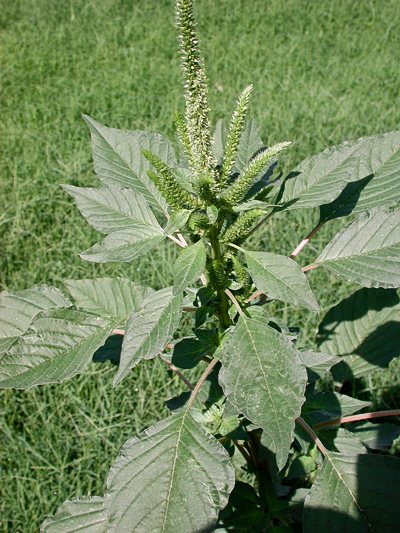 Palmer AmaranthAmaranthus palmeri
-
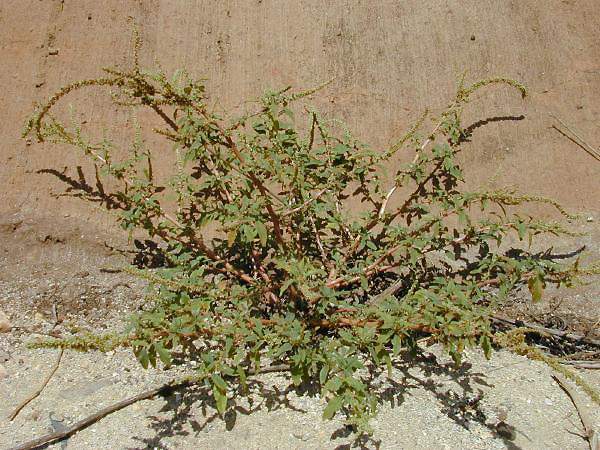 Spiny AmaranthAmaranthus spinosus
-
 Prince-of-Wales FeatherAmaranthus hypochondriacus
Compare
Questions and answers
What is the scientific name of the Seabeach Amaranth?
The scientific name of the Seabeach Amaranth is Amaranthus pumilus. Written with its author, the full name is Amaranthus pumilus Raf..
Which family does the Seabeach Amaranth belong to?
Amaranthus pumilus belongs to the family Amaranthaceae, in the order Caryophyllales and the class Magnoliopsida.
Where is the Seabeach Amaranth found?
Checklists and occurrence records place Amaranthus pumilus in 1 country: United States.
What other names does the Seabeach Amaranth have?
Amaranthus pumilus is also known in English as Coast Amaranth, Seabeach Amaranthus and Seabeach Pigweed.
Sources
Passages the profile rests on
- The plant has numerous low-growing, prostrate stems and fleshy leaves. Source passage: “The plant consists of many low and prostrate stems with fleshy leaves.” — English Wikipedia
- The plant produces inconspicuous yellow flowers. Source passage: “Yellow flowers are obscure” — English Wikipedia
- Large individuals can have hundreds of stems covering approximately one square meter. Source passage: “Larger plants with hundreds of stems may cover an area of about a meter.” — English Wikipedia
- The species has unusually large seeds compared with other members of its genus. Source passage: “because it has atypically large seeds for the genus” — ars.usda.gov
- The species grows on sandy beaches, particularly on barrier islands. Source passage: “This plant is found on sandy beaches, especially on barrier islands.” — English Wikipedia
- The species flourishes at the bases of dunes above the high-water mark. Source passage: “It flourishes at the base of dunes above the high water mark.” — English Wikipedia
- The species occurs more frequently in lower-elevation locations on barrier islands. Source passage: “The study found that seabeach amaranth tended to occur more frequently in lower-elevation locations” — usgs.gov
- Periodic overwash by high-water conditions is associated with locations where the species occurs more frequently. Source passage: “presumably where periodic washover by high-water conditions was more likely.” — usgs.gov
- The species requires a barrier-island setting with periodic overwash disturbances that remove competing vegetation. Source passage: “seabeach amaranth requires a barrier island setting where periodic disturbances such as washovers naturally occur, which serves to remove vegetation that may outcompete seabeach amaranth.” — usgs.gov
- The species tolerates American sea rocket but is intolerant of other neighboring beach plants. Source passage: “Although the seaside amaranth is found in the neighborhood of other beach plants, it is intolerant of all but American sea rocket (Cakile edentula).” — English Wikipedia
- The species accumulates sand around itself, contributing to dune formation. Source passage: “The plant is important in the sandy beach ecosystem, accumulating sand around itself to form dunes.” — English Wikipedia
- The plant produces numerous seeds in July. Source passage: “many seeds are produced in July.” — English Wikipedia
- The seeds remain viable for an extended period, potentially explaining the plant's reappearance in previously unoccupied locations. Source passage: “The lengthy viability of these seeds may account for the reappearance of Amaranthus pumilus in places where it had formerly vanished.” — English Wikipedia
- Keeping the seeds in cool, moist conditions for three months produced approximately 90 percent synchronized germination in a reported cultivation experiment. Source passage: “By keeping the seeds for three months in cool, moist surroundings, Brenner obtained about 90 percent synchronized germination.” — ars.usda.gov
- The species historically occurred along the eastern United States coast from South Carolina to Massachusetts. Source passage: “The seaside amaranth once ranged widely from South Carolina to Massachusetts.” — English Wikipedia
- The species has disappeared from approximately two-thirds of its original geographic range. Source passage: “It is now gone from two thirds of its original range.” — English Wikipedia
- The species was first identified in New Jersey and had disappeared from that state by 1913. Source passage: “It was first identified in New Jersey, but disappeared in that state by 1913.” — English Wikipedia
- Few plants were observed between the early 1920s and the late 1990s. Source passage: “However, few seabeach amaranth plants were observed from the early 1920s through the late 1990s” — usgs.gov
- The species was rediscovered at Assateague Island Seashore in 1997. Source passage: “Following the discovery of seabeach amaranth at ASIS in 1997” — usgs.gov
- The species was listed as threatened under United States federal conservation status in 1993. Source passage: “The plant was listed as a threatened species of the United States in 1993.” — English Wikipedia
- Approximately 50 populations of the species may remain. Source passage: “There are perhaps 50 populations remaining.” — English Wikipedia
- The species is classified as a special concern in Connecticut, where it is believed to be extirpated. Source passage: “It is listed as a special concern and believed extirpated in Connecticut” — English Wikipedia
- The species is classified as threatened in North Carolina. Source passage: “as threatened in North Carolina” — English Wikipedia
- The species is classified as endangered in Maryland, New Jersey, New York, and Rhode Island. Source passage: “as endangered in Maryland, New Jersey, New York, and Rhode Island.” — English Wikipedia
- Coastal development, seawall construction, and off-road vehicle activity are identified threats to the species. Source passage: “Threats include disturbance of its beach habitat through development, construction of seawalls, off-road vehicle activity, and other forces.” — English Wikipedia
- The species serves as an indicator of a healthy beach ecosystem. Source passage: “serves as an indicator of a healthy beach ecosystem” — usgs.gov
- The species contributes to coastal resiliency. Source passage: “and contributes to coastal resiliency.” — usgs.gov
- Approximately 5,000 cultivated plants were planted on Assateague Island between 2000 and 2002 to re-establish the species. Source passage: “Between 2000 and 2002, National Park Service biologists planted approximately 5,000 cultivated plants on ASIS” — usgs.gov
- The Assateague Island population reached approximately 2,200 plants in 2007. Source passage: “Although the population reached a high of 2,200 plants in 2007” — usgs.gov
- The Assateague Island population declined to approximately 1,000 plants between 2008 and 2010. Source passage: “with the largest drop occurring between 2008 and 2010 to approximately 1,000 plants” — usgs.gov
- The Assateague Island population declined to only a few hundred plants in subsequent years. Source passage: “and then to only a few hundred in subsequent years” — usgs.gov
- Drought during the growing season and storms coincided with the largest population changes observed at Assateague Island. Source passage: “The authors determined the largest changes in population coincided with a multi-year period where drought conditions persisted during the growing season and a combination of in-season storms and large storms out-of-season caused significant impacts to the island’s landscape” — usgs.gov
- Large storms may remove seeds from the habitat or bury them too deeply for germination in the following season. Source passage: “seed stock (seed bank) may have been effectively removed from the system during large storms or buried too deeply to germinate the following season.” — usgs.gov
- Six distinct populations were collected from ocean beaches along the North Carolina and South Carolina coasts for germplasm conservation. Source passage: “collected six distinct populations with large seed samples representing many individual plants on ocean beaches along the North and South Carolina coastlines.” — ars.usda.gov
- The species' seeds are of agricultural research interest as a possible source of crop-improving genes for cultivated amaranths. Source passage: “could perhaps be the source of crop-improving genes for cultivated amaranths.” — ars.usda.gov
Data
- Catalogue of Life, 2026-10-16 XR cc by
- Global Biodiversity Information Facility CC BY 4.0
- Wikidata CC0
- GeoNames CC BY 4.0
- Wikimedia Commons per image; credit shown with each image
- Within the Catalogue of Life, this name comes from Synonymic Checklists of the Vascular Plants of the World cc by
References
- Raf. (1808). Med. Repos. 5: 360 (1808). where the name was published
This species in other databases
- Catalogue of Life 5TYXK
- Wikidata Q4740174
- iNaturalist 158252
- World Flora Online wfo-0000530438
- GRIN 315346
Page built on 28 November 2026. See how the catalog is made and all sources and licences.
Cite this page
ScientificNames.org. (2026). Amaranthus pumilus (Seabeach Amaranth). Retrieved November 28, 2026, from https://scientificnames.org/species/amaranthus-pumilus
“Amaranthus pumilus (Seabeach Amaranth).” ScientificNames.org, 2026, scientificnames.org/species/amaranthus-pumilus. Accessed 28 Nov. 2026.
ScientificNames.org. “Amaranthus pumilus (Seabeach Amaranth).” Accessed November 28, 2026. https://scientificnames.org/species/amaranthus-pumilus.
@misc{scientificnames_amaranthus_pumilus_seabeach_amaranth,
  author = {{ScientificNames.org}},
  title = {Amaranthus pumilus (Seabeach Amaranth)},
  year = {2026},
  url = {https://scientificnames.org/species/amaranthus-pumilus},
  note = {Accessed 2026-11-28}
}