Species · Fishes
White Bullhead Ameiurus catus
The scientific name of the White Bullhead is Ameiurus catus. It is a species of fish in the family Ictaluridae (bullhead catfishes), order Siluriformes. The name dates from 1758.
- Scientific name
- Ameiurus catus (Linnaeus, 1758)
- Common name
- White Bullhead
- Genus
- Ameiurus
- Family
- Ictaluridae (Bullhead Catfishes)
- Order
- Siluriformes
- Class
- Teleostei
- Red List category
- LC Least Concern
- Environment
- brackish, freshwater
- Recorded in
- 4 countries
- Name status
- accepted in the Catalogue of Life

Overview
The White Bullhead is an omnivorous fish. It is native to eastern United States river systems extending from the Hudson River in New York to the Peace River in Florida and west to the Apalachicola River in Florida. It has eight barbels, light-colored chin barbels, and a forked tail.
Written 26 November 2026 from the sources listed below. Each statement was checked against the passage it cites; statements that could not be supported were removed.
Appearance
The White Bullhead has eight barbels: two nasal, two maxillary, and four chin barbels. Its chin barbels are light-colored, and it has a forked tail.[1][2][3]
It has a spine along the anterior edge of both the dorsal and pectoral fins and usually has six soft dorsal-fin rays. It lacks palatine teeth and has an anal fin with 22 to 24 rays.[4][5][6][7]
At maturity, it typically has a larger head relative to body width than the channel catfish.[8]
Habitat
The White Bullhead prefers sluggish pools with muddy bottoms in rivers and streams. It also inhabits lakes and large impoundments.[9][10]
Diet
The White Bullhead is omnivorous and feeds primarily near the bottom of aquatic habitats. Its diet includes other fish, aquatic insects, bottom-dwelling insects, worms, amphipods, and other small invertebrates.[11][12][13][14]
Behaviour
The White Bullhead feeds most actively at dusk and during the night.[15][16]
Reproduction and life cycle
The White Bullhead reproduces between April and July when water temperatures range from 65 to 75 °F (18 to 24 °C). It deposits its eggs in gelatinous masses inside cavities formed by hollow logs or beneath undercut banks.[17][18][19]
The male guards the nest and incubates the eggs by fanning fresh water over them.[20][21]
Conservation
Predation by introduced White Bullheads contributed to the disappearance of Sacramento perch from Thurston Lake by 1970. The species is not currently considered invasive by the state of California.[22][23]
Uses
The White Bullhead has been introduced into locations outside its native range for use as a food and game fish. The commercial fishery for this species in California was closed in 1953 because of concerns about overfishing.[24][25]
Similar species
The yellow bullhead also has light-colored chin barbels, but its tail is rounded or truncate rather than forked.[26]
Compared with the channel catfish, the White Bullhead typically has a larger head relative to body width at maturity and a shorter anal fin relative to body length.[27]
Classification of the White Bullhead
| Kingdom | Animalia |
|---|---|
| Phylum | Chordata |
| Subphylum | Vertebrata |
| Infraphylum | Gnathostomata |
| Parvphylum | Osteichthyes |
| Gigaclass | Actinopterygii |
| Superclass | Actinopteri |
| Class | Teleostei (Teleost) |
| Order | Siluriformes (Catfish) |
| Family | Ictaluridae (Bullhead Catfishes) |
| Genus | Ameiurus (Bullheads) |
| Species | Ameiurus catus (Linnaeus, 1758) |
Where the White Bullhead is found
Checklists and occurrence records place Ameiurus catus in 4 countries. GBIF holds 5,134 georeferenced records of it.
Countries
Regions and cities with the most records
- Georgia, United States 1,667
- Florida, United States 870
- North Carolina, United States 374
- New Jersey, United States 355
- California, United States 302
- South Carolina, United States 242
- Milledgeville, United States 218
- Pennsylvania, United States 210
- Woodland, United States 134
- Rio Linda, United States 130
- LaGrange, United States 124
- Maryland, United States 124
- Virginia, United States 97
- Alabama, United States 88
- Hopatcong Hills, United States 84
- Dover, United States 73
- Randolph, United States 73
- DeBary, United States 63
- Deltona, United States 63
- Maple Shade, United States 62
- Gainesville, United States 61
- Sanford, United States 59
- Camden, United States 56
- Pennsauken, United States 56
- Cherry Hill, United States 55
- Phenix City, United States 55
- Ewing, United States 54
- Sewell, United States 52
- Philadelphia, United States 51
- Fruit Cove, United States 50
- Trenton, United States 50
- DeLand, United States 49
- Fleming Island, United States 49
- Glassboro, United States 48
- Nevada, United States 48
- Gainesville, United States 47
A number beside a place is its count of GBIF occurrence records. A place without a number comes from a checklist alone. Records show where a species has been observed or collected, which can include escapes and vagrants.
Common names
English
- White Bullhead
- White Catfish
Names in 7 other languages
- Chinese
- 犀目鮰
- Czech
- sumeček namodralý
- Danish
- Hvid dværgmalle
- French
- Poisson-chat blanc
- German
- Weißer Katzenwels
- Portuguese
- Peixe-gato-branco
- Russian
- Американский сомик
Synonyms
10 other scientific names have been used for this species and are now treated as synonyms of Ameiurus catus.
- Amiurus catus (Linnaeus, 1758)
- Amiurus lophius Cope, 1870
- Amiurus niveiventris Cope, 1870
- Ichthaelurus kevinskii Stauffer, 1869
- Ichthyaelurus mccaskei Stauffer, 1869
- Ictalurus catus (Linnaeus, 1758)
- Pimelodus albidus Lesueur, 1819
- Pimelodus catus (Linnaeus, 1758)
- Pimelodus lynx Girard, 1859
- Silurus catus Linnaeus, 1758
Related species
-
 Brown BullheadAmeiurus nebulosus
-
 Black BullheadAmeiurus melas
-
 Yellow BullheadAmeiurus natalis
-
 Flat BullheadAmeiurus platycephalus
- Snail BullheadAmeiurus brunneus
-
 Spotted BullheadAmeiurus serracanthus
-
 Channel CatfishIctalurus punctatus
-
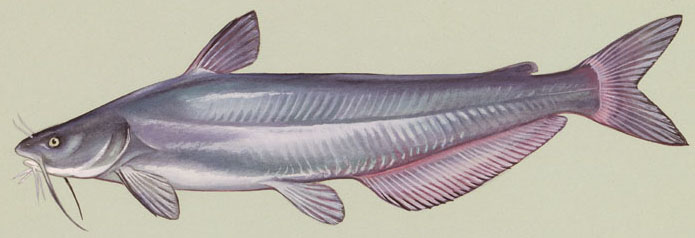 Blue CatfishIctalurus furcatus
Compare
Questions and answers
What is the scientific name of the White Bullhead?
The scientific name of the White Bullhead is Ameiurus catus. Written with its author, the full name is Ameiurus catus (Linnaeus, 1758).
Which family does the White Bullhead belong to?
Ameiurus catus belongs to the family Ictaluridae, in the order Siluriformes and the class Teleostei.
Where is the White Bullhead found?
Checklists and occurrence records place Ameiurus catus in 4 countries: United States, Mexico, Belize and Puerto Rico.
What is the conservation status of the White Bullhead?
The IUCN Red List category recorded for Ameiurus catus is Least Concern (LC).
What other names does the White Bullhead have?
Ameiurus catus is also known in English as White Catfish.
Sources
Passages the profile rests on
- The species has eight barbels, comprising two nasal, two maxillary, and four chin barbels. Source passage: “Ameiurus catus has a head with eight barbels, two nasal, two maxillary and four chin.” — English Wikipedia
- The species has light-colored chin barbels. Source passage: “Like the yellow bullhead (Ameiurus natalis), white catfish have light-colored chin barbels.” — English Wikipedia
- The species has a forked tail. Source passage: “In A. catus the tail is forked, while it is rounded or truncate in A. natalis.” — English Wikipedia
- The species has a spine along the anterior edge of both its dorsal and pectoral fins. Source passage: “It has a spine on the anterior edge of its dorsal and pectoral fins.” — English Wikipedia
- The species usually has six soft dorsal-fin rays. Source passage: “It usually has six dorsal soft rays.” — English Wikipedia
- The species lacks palatine teeth. Source passage: “It does not have palatine teeth.” — English Wikipedia
- The species has an anal fin with 22 to 24 rays. Source passage: “bearing 22 to 24 rays.” — English Wikipedia
- At maturity, the species typically has a larger head relative to body width than the channel catfish. Source passage: “In comparison to channel catfish (Ictalurus punctatus), A. catus typically has a larger head relative to its body width at maturity” — English Wikipedia
- The species prefers sluggish pools with muddy bottoms in rivers and streams. Source passage: “prefers sluggish, mud-bottom pools and backwaters of rivers and streams” — English Wikipedia
- The species also inhabits lakes and large impoundments. Source passage: “and does well in lakes and large impoundments.” — English Wikipedia
- The species feeds primarily near the bottom of aquatic habitats. Source passage: “White catfish feed mostly on the bottom” — English Wikipedia
- The species eats other fish and aquatic insects. Source passage: “where they eat other fish and aquatic insects.” — English Wikipedia
- The species consumes bottom-dwelling insects, worms, amphipods, and other small invertebrates. Source passage: “mostly on bottom-dwelling insects, worms, amphipods, and other small invertebrates.” — English Wikipedia
- The species is omnivorous. Source passage: “Like other catfish species the White Catfish is omnivorous” — dwr.virginia.gov
- The species feeds most actively at dusk and during the night. Source passage: “They feed most actively at dusk and through the night” — English Wikipedia
- The species feeds most actively during dusk and nighttime. Source passage: “They feed most actively at dusk and through the night” — English Wikipedia
- The species reproduces between April and July. Source passage: “Reproduction occurs from April to July” — English Wikipedia
- Reproduction occurs when water temperatures range from 65 to 75 °F (18 to 24 °C). Source passage: “when the water temperature ranges between 65 and 75 °F (18 and 24 °C).” — English Wikipedia
- The species deposits its eggs in gelatinous masses inside cavities formed by hollow logs or beneath undercut banks. Source passage: “A gelatinous mass of eggs is deposited in a cavity created by hollow logs or undercut banks.” — English Wikipedia
- The male guards the nest and incubates the eggs by fanning fresh water over them. Source passage: “The male guards the nest and incubates the eggs by continually fanning fresh water over them.” — English Wikipedia
- Male individuals guard nests and fan fresh water over the eggs during incubation. Source passage: “The male guards the nest and incubates the eggs by continually fanning fresh water over them.” — English Wikipedia
- Predation by introduced individuals of this species contributed to the disappearance of Sacramento perch from Thurston Lake by 1970. Source passage: “Predation by introduced white bullheads contributed to the extirpation of Sacramento perch (Archoplites interruptus) from Thurston Lake by 1970.” — English Wikipedia
- The species is not currently considered invasive by the state of California. Source passage: “and it is not currently considered to be an invasive species by the state.” — English Wikipedia
- The species has been introduced into locations outside its native range for use as a food and game fish. Source passage: “Elsewhere, the white bullhead has been widely introduced as a food and game fish” — English Wikipedia
- The commercial fishery for this species in California was closed in 1953 because of concerns about overfishing. Source passage: “The white bullhead commercial fishery in California was closed in 1953 due to concern of overfishing” — English Wikipedia
- The yellow bullhead also has light-colored chin barbels, but its tail is rounded or truncate rather than forked. Source passage: “Like the yellow bullhead (Ameiurus natalis), white catfish have light-colored chin barbels. In A. catus the tail is forked, while it is rounded or truncate in A. natalis.” — English Wikipedia
- Compared with the channel catfish, the white catfish typically has a larger head relative to body width at maturity and a shorter anal fin relative to body length. Source passage: “In comparison to channel catfish (Ictalurus punctatus), A. catus typically has a larger head relative to its body width at maturity and a shorter anal fin relative to its body length” — English Wikipedia
Data
- Catalogue of Life, 2026-10-16 XR cc by
- Global Biodiversity Information Facility CC BY 4.0
- Wikidata CC0
- GeoNames CC BY 4.0
- Wikimedia Commons per image; credit shown with each image
- Within the Catalogue of Life, this name comes from World Register of Marine Species cc by
This species in other databases
- Catalogue of Life CQKB
- Wikidata Q1813930
- iNaturalist 93844
- WoRMS urn:lsid:marinespecies.org:taxname:1023048
- ITIS 164037
Page built on 26 November 2026. See how the catalog is made and all sources and licences.
Cite this page
ScientificNames.org. (2026). Ameiurus catus (White Bullhead). Retrieved November 26, 2026, from https://scientificnames.org/species/ameiurus-catus
“Ameiurus catus (White Bullhead).” ScientificNames.org, 2026, scientificnames.org/species/ameiurus-catus. Accessed 26 Nov. 2026.
ScientificNames.org. “Ameiurus catus (White Bullhead).” Accessed November 26, 2026. https://scientificnames.org/species/ameiurus-catus.
@misc{scientificnames_ameiurus_catus_white_bullhead,
  author = {{ScientificNames.org}},
  title = {Ameiurus catus (White Bullhead)},
  year = {2026},
  url = {https://scientificnames.org/species/ameiurus-catus},
  note = {Accessed 2026-11-26}
}