Species · Fishes
Yellow Bullhead Ameiurus natalis
The scientific name of the Yellow Bullhead is Ameiurus natalis. It is a species of fish in the family Ictaluridae (bullhead catfishes), order Siluriformes. The name dates from 1819.
- Scientific name
- Ameiurus natalis (Lesueur, 1819)
- Common name
- Yellow Bullhead
- Genus
- Ameiurus
- Family
- Ictaluridae (Bullhead Catfishes)
- Order
- Siluriformes
- Class
- Teleostei
- Red List category
- LC Least Concern
- Environment
- freshwater
- Recorded in
- 3 countries
- Name status
- accepted in the Catalogue of Life

Overview
The species occurs in creeks, rivers, lakes, and ponds, inhabiting river pools, backwaters, and slow-flowing waters. White barbels beneath the chin distinguish the Yellow Bullhead from brown and black bullheads.
Written 26 November 2026 from the sources listed below. Each statement was checked against the passage it cites; statements that could not be supported were removed.
Appearance
The Yellow Bullhead lacks scales. Its back ranges in color from yellow-olive to slate black, while the underside of its head and body is yellow, yellow-white, or bright white.[1][2][3]
The rear edge of the caudal fin is rounded, and the anal fin has between 24 and 27 rays. Its pectoral spines have backward-facing barbs.[4][5][6]
Habitat
Yellow Bullheads inhabit river pools, backwaters, and slow-flowing waters. They occur in creeks, rivers, lakes, and ponds and prefer slow-current backwaters in rivers and streams.[7][8][9]
They occupy bottom habitats with mud, rock, sand, or clay substrates.[10]
Diet
Yellow Bullheads commonly consume worms, insects, snails, minnows, clams, and crayfish. They also consume living and dead plant and animal material.[11][12]
They consume more aquatic vegetation than black and brown bullheads. Young Yellow Bullheads feed on aquatic invertebrates.[13][14]
Behaviour
Yellow Bullheads typically feed during nighttime. They locate food by sweeping their barbels along the bottom of streams.[15][16]
Yellow Bullheads are highly social fish. They can recognize other individuals and their social status through smell.[17][18]
Reproduction and life cycle
Yellow Bullheads spawn from April through June, generally beginning in mid-May or early June. Spawning begins when water temperatures reach between 23 and 28 degrees Celsius.[19][20][21]
Males dig nests ranging from shallow muddy depressions to deep stream-bank burrows. Nest sites are commonly located near rocks and stumps with dense vegetation, and both sexes participate in building the nest.[22][23][24]
Females deposit between 300 and 700 eggs in each spawning act, and a nest can contain up to 4,300 eggs. After fertilization, the male guards and continuously fans the eggs.[25][26][27]
Eggs generally hatch within five to seven days. The male herds newly hatched fry into compact schools, and both parents protect the young until they reach approximately two inches in length.[28][29][30]
Sexual maturity is reached between two and three years of age.[31]
Uses
Yellow Bullheads are considered a minor game fish. They are widely sought after as food, and their meat is regarded as sweet and flavorful.[32][33][34]
Yellow Bullheads can be introduced into highly polluted streams because of their pollution tolerance.[35]
Similar species
Yellow Bullheads resemble black bullheads and brown bullheads in their fins and coloration. White barbels beneath the chin distinguish them from these species.[36][37]
Conservation
Yellow Bullheads are not known to have a specific conservation status.[38]
Classification of the Yellow Bullhead
| Kingdom | Animalia |
|---|---|
| Phylum | Chordata |
| Subphylum | Vertebrata |
| Infraphylum | Gnathostomata |
| Parvphylum | Osteichthyes |
| Gigaclass | Actinopterygii |
| Superclass | Actinopteri |
| Class | Teleostei (Teleost) |
| Order | Siluriformes (Catfish) |
| Family | Ictaluridae (Bullhead Catfishes) |
| Genus | Ameiurus (Bullheads) |
| Species | Ameiurus natalis (Lesueur, 1819) |
Where the Yellow Bullhead is found
Checklists and occurrence records place Ameiurus natalis in 3 countries. GBIF holds 37,364 georeferenced records of it.
Countries
Regions and cities with the most records
- Minnesota, United States 7,965
- Pennsylvania, United States 5,595
- Texas, United States 3,763
- Oklahoma, United States 2,024
- Florida, United States 1,937
- Illinois, United States 1,613
- Wisconsin, United States 1,180
- Ohio, United States 972
- Alabama, United States 953
- New Mexico, United States 812
- Iowa, United States 750
- North Carolina, United States 741
- Carlisle, United States 666
- Georgia, United States 662
- Arkansas, United States 601
- New York, United States 571
- New Jersey, United States 538
- Kansas, United States 526
- Kentucky, United States 487
- Michigan, United States 460
- Mississippi, United States 446
- Missouri, United States 408
- Roseville, United States 347
- Saint Paul, United States 336
- Scranton, United States 336
- Maryland, United States 332
- New Brighton, United States 326
- Chanhassen, United States 313
- White Bear Lake, United States 313
- Shoreview, United States 311
- Hopkins, United States 310
- Columbia Heights, United States 308
- Fridley, United States 298
- Louisiana, United States 297
- West Saint Paul, United States 295
- Minnetonka Mills, United States 289
2 more countries have a few records outside this range
These countries hold a few records of Ameiurus natalis but lie outside the range the checklists give for it. Such records are often zoo or garden specimens, museum material or vagrants, so the species is not counted as occurring there.
A number beside a place is its count of GBIF occurrence records. A place without a number comes from a checklist alone. Records show where a species has been observed or collected, which can include escapes and vagrants.
Common names
English
- Yellow Bullhead
- White-whiskered Bullhead
- Yellow Cat
Names in 13 other languages
- Chinese
- 黃鮰
- Czech
- sumeček žlutý
- Danish
- Gul dværgmalle
- Dutch
- gele dwergmeerval
- Finnish
- Keltapiikkimonni
- French
- barbotte jaune
- German
- Gelber Katzenwels
- Italian
- Pesce gatto
- Korean
- 황색찬넬동자개
- Latvian
- Dzeltenais buļļugalvis
- Portuguese
- Bagre-touro-amarelo
- Russian
- Жёлтый сомик
- Spanish
- bagre torito amarillo
Synonyms
12 other scientific names have been used for this species and are now treated as synonyms of Ameiurus natalis.
- Amiurus bolli Cope, 1880
- Amiurus erebennus Jordan, 1877
- Amiurus prosthistius Cope, 1883
- Ictalurus natalis (Lesueur, 1819)
- Pimelodus ailurus Girard, 1858
- Pimelodus antoniensis Girard, 1858
- Pimelodus felinus Girard, 1858
- Pimelodus natalis Lesueur, 1819
- Pimelodus puma Girard, 1859
- Silurus lividus Rafinesque, 1820
- Silurus lividus fuscatus Rafinesque, 1820
- Silurus xanthocephalus Rafinesque, 1820
Related species
-
 Brown BullheadAmeiurus nebulosus
-
 Black BullheadAmeiurus melas
-
 White BullheadAmeiurus catus
-
 Flat BullheadAmeiurus platycephalus
- Snail BullheadAmeiurus brunneus
-
 Spotted BullheadAmeiurus serracanthus
-
 Channel CatfishIctalurus punctatus
-
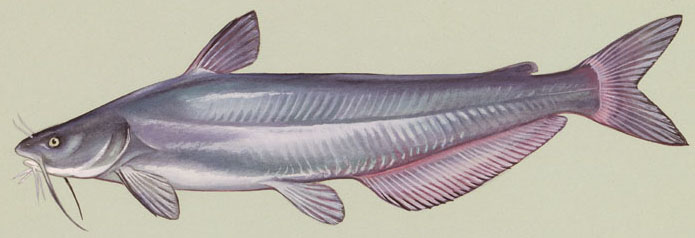 Blue CatfishIctalurus furcatus
Compare
Questions and answers
What is the scientific name of the Yellow Bullhead?
The scientific name of the Yellow Bullhead is Ameiurus natalis. Written with its author, the full name is Ameiurus natalis (Lesueur, 1819).
Which family does the Yellow Bullhead belong to?
Ameiurus natalis belongs to the family Ictaluridae, in the order Siluriformes and the class Teleostei.
Where is the Yellow Bullhead found?
Checklists and occurrence records place Ameiurus natalis in 3 countries: United States, Canada and Mexico.
What is the conservation status of the Yellow Bullhead?
The IUCN Red List category recorded for Ameiurus natalis is Least Concern (LC).
What other names does the Yellow Bullhead have?
Ameiurus natalis is also known in English as White-whiskered Bullhead and Yellow Cat.
Are yellow bullheads poisonous?
Yellow Bullheads can inflict venomous stings using their pectoral spines.[39]
How big do yellow bullheads get?
Yellow Bullheads commonly reach approximately 22.5 centimetres in total length. They can reach a maximum total length of 60 centimetres and a weight of 3.2 kilograms.[40][41][42]
What do yellow bullheads eat?
They commonly consume worms, insects, snails, minnows, clams, and crayfish. They also eat living and dead plant and animal material, including aquatic vegetation.[11][12][13]
Are yellow bullhead catfish good eating?
Yellow Bullheads are widely sought after as food. Their meat is regarded as sweet and flavorful.[33][34]
What do baby bullhead fish eat?
Young Yellow Bullheads feed on aquatic invertebrates.[14]
Are yellow bullheads venomous?
Yes. Yellow Bullheads can inflict venomous stings using their pectoral spines.[39]
Sources
Passages the profile rests on
- The yellow bullhead lacks scales. Source passage: “a ray-finned fish that lacks scales.” — English Wikipedia
- The back ranges in color from yellow-olive to slate black. Source passage: “typically yellow-olive to slate black on the back” — English Wikipedia
- The underside of the head and body is yellow, yellow-white, or bright white. Source passage: “the underside of the head and body are bright yellow, yellow white, or bright white.” — English Wikipedia
- The rear edge of the caudal fin is rounded. Source passage: “The rear edge of its caudal fin is rounded.” — English Wikipedia
- The anal fin has between 24 and 27 rays. Source passage: “The anal fin has anywhere between 24 and 27 constituent rays” — English Wikipedia
- The pectoral spines have backward-facing barbs. Source passage: “The pectoral spines are barbed posteriorly like those of the brown bullhead.” — English Wikipedia
- Yellow bullheads inhabit river pools, backwaters, and slow-flowing waters. Source passage: “Its habitat includes river pools, backwaters, and sluggish current” — English Wikipedia
- The species occurs in creeks, rivers, lakes, and ponds. Source passage: “in creeks, small to larger rivers, and shallow portions of lakes and ponds.” — English Wikipedia
- Yellow bullheads prefer slow-current backwaters in rivers and streams. Source passage: “Yellow bullhead prefer backwaters with slow current in rivers and streams.” — animaldiversity.org
- Yellow bullheads occupy bottom habitats with mud, rock, sand, or clay substrates. Source passage: “living in areas with muck, rock, sand, or clay substrates.” — English Wikipedia
- Yellow bullheads commonly consume worms, insects, snails, minnows, clams, and crayfish. Source passage: “most commonly consisting of worms, insects, snails, minnows, clams, crayfish” — English Wikipedia
- The species consumes both living and dead plant and animal material. Source passage: “a variety of plant and animal material, both live and dead” — English Wikipedia
- Yellow bullheads consume more aquatic vegetation than black and brown bullheads. Source passage: “Compared to black and brown bullheads, yellow bullheads consume more aquatic vegetation.” — English Wikipedia
- Young yellow bullheads feed on aquatic invertebrates. Source passage: “The young will feed on aquatic invertebrates.” — animaldiversity.org
- Yellow bullheads typically feed during nighttime. Source passage: “They typically feed at night” — English Wikipedia
- Yellow bullheads locate food by sweeping their barbels along the bottom of streams. Source passage: “It locates prey by brushing the stream bottom with its barbels.” — English Wikipedia
- Yellow bullheads are highly social fish. Source passage: “They are highly social” — animaldiversity.org
- Yellow bullheads can recognize other individuals and their social status through smell. Source passage: “yellow bullheads are a very social fish and can recognize other individuals and their social status by their smell.” — animaldiversity.org
- Yellow bullheads generally begin spawning in mid-May or early June. Source passage: “with spawning beginning in mid-May or early-June” — English Wikipedia
- Yellow bullheads spawn from April through June. Source passage: “Yellow bullhead spawn from April until June” — animaldiversity.org
- Spawning begins when water temperatures reach between 23 and 28 degrees Celsius. Source passage: “beginning when water temperatures reach 23 to 28 degrees Celsius.” — animaldiversity.org
- Both sexes participate in building the nest. Source passage: “with both sexes participating in nest-building.” — English Wikipedia
- Yellow bullhead males dig nests ranging from shallow muddy depressions to deep stream-bank burrows. Source passage: “Yellow bullhead males dig nests, which may range from a shallow depression in muddy sediment to a deep burrow in the stream bank.” — animaldiversity.org
- Yellow bullhead nest sites are commonly located near rocks and stumps with dense vegetation. Source passage: “Protected nest sites near rocks and stumps with dense vegetation are preferred.” — animaldiversity.org
- Females deposit between 300 and 700 eggs in each spawning act. Source passage: “The female will lay anywhere from 300 to 700 eggs at a time” — English Wikipedia
- A nest can contain up to 4,300 eggs. Source passage: “with up to 4300 eggs deposited into the nest in total.” — English Wikipedia
- The male guards and continuously fans the eggs after fertilization. Source passage: “the male protects and continually fans the nest of eggs.” — English Wikipedia
- Eggs generally hatch within five to seven days. Source passage: “The eggs hatch in 5 to 7 days on average.” — English Wikipedia
- The male herds newly hatched fry into compact schools. Source passage: “Young fry are herded into tight schools by the male” — English Wikipedia
- Both parents protect the young until they reach approximately two inches in length. Source passage: “are protected by both parents until they are approximately two inches long.” — English Wikipedia
- Sexual maturity is reached between two and three years of age. Source passage: “Sexual maturity is achieved after two to three years” — English Wikipedia
- Yellow bullheads are considered a minor game fish. Source passage: “Yellow bullheads are considered a minor game fish” — English Wikipedia
- The meat is regarded as sweet and flavorful. Source passage: “their meat is considered sweet and has a good flavor” — English Wikipedia
- Yellow bullheads are widely sought after as food. Source passage: “they are widely sought after for food.” — animaldiversity.org
- Yellow bullheads can be introduced into highly polluted streams because of their pollution tolerance. Source passage: “Yellow bullheads also can be introduced into streams with high pollution because of their high tolerance to pollution.” — animaldiversity.org
- Yellow bullheads resemble black bullheads and brown bullheads in their fins and coloration. Source passage: “Fins and colorations are similar among the three species.” — animaldiversity.org
- White barbels beneath the chin distinguish this species from the brown and black bullheads. Source passage: “distinguished from A. nebulosus and the black bullhead (A. melas) by the group of white barbels or "whiskers" under its chin.” — English Wikipedia
- Yellow bullheads are not known to have a specific conservation status. Source passage: “Yellow bullheads are not known to have any specific conservation status.” — animaldiversity.org
- Yellow bullheads can inflict venomous stings using their pectoral spines. Source passage: “They can inflict venomous stings with their pectoral spines” — animaldiversity.org
- Yellow bullheads commonly reach approximately 22.5 centimetres in total length. Source passage: “they are more commonly 22.5 centimetres (8.9 in) TL” — English Wikipedia
- The species can reach a maximum total length of 60 centimetres. Source passage: “may grow to a maximum total length (TL) of 60 centimetres (24 in)” — English Wikipedia
- The species can reach a weight of 3.2 kilograms. Source passage: “weigh up to 3.2 kilograms.” — animaldiversity.org
Data
- Catalogue of Life, 2026-10-16 XR cc by
- Global Biodiversity Information Facility CC BY 4.0
- Wikidata CC0
- GeoNames CC BY 4.0
- Wikimedia Commons per image; credit shown with each image
- Within the Catalogue of Life, this name comes from World Register of Marine Species cc by
References
- Lesueur, C. A. (1819). Notice de quelques poissons découverts dans les lacs du Haut-Canada, durant l’été de 1816. Mem. Mus. Natl. Hist. Nat., 5: 148–161. 2 pls. where the name was published
This species in other databases
- Catalogue of Life CQKF
- Wikidata Q536070
- iNaturalist 58657
- WoRMS urn:lsid:marinespecies.org:taxname:154201
- ITIS 164041
Page built on 27 November 2026. See how the catalog is made and all sources and licences.
Cite this page
ScientificNames.org. (2026). Ameiurus natalis (Yellow Bullhead). Retrieved November 27, 2026, from https://scientificnames.org/species/ameiurus-natalis
“Ameiurus natalis (Yellow Bullhead).” ScientificNames.org, 2026, scientificnames.org/species/ameiurus-natalis. Accessed 27 Nov. 2026.
ScientificNames.org. “Ameiurus natalis (Yellow Bullhead).” Accessed November 27, 2026. https://scientificnames.org/species/ameiurus-natalis.
@misc{scientificnames_ameiurus_natalis_yellow_bullhead,
  author = {{ScientificNames.org}},
  title = {Ameiurus natalis (Yellow Bullhead)},
  year = {2026},
  url = {https://scientificnames.org/species/ameiurus-natalis},
  note = {Accessed 2026-11-27}
}