Species · Fishes
Red Sea Clownfish Amphiprion bicinctus
The scientific name of the Red Sea Clownfish is Amphiprion bicinctus. It is a species of fish in the family Pomacentridae (damselfishes), order Perciformes. The name dates from 1830.
- Scientific name
- Amphiprion bicinctus Rüppell, 1830
- Common name
- Red Sea Clownfish
- Genus
- Amphiprion
- Family
- Pomacentridae (Damselfishes)
- Order
- Perciformes
- Class
- Teleostei
- Red List category
- LC Least Concern
- Environment
- marine
- Recorded in
- 19 countries
- Name status
- accepted in the Catalogue of Life

Overview
Amphiprion bicinctus occurs in the Western Indian Ocean, the Red Sea, around Socotra and in the Chagos Archipelago. It has two white body bands edged in black, with the band across the head considerably wider than the other.
Written 26 November 2026 from the sources listed below. Each statement was checked against the passage it cites; statements that could not be supported were removed.
Appearance
Body coloration ranges from yellow-orange to dark brown. The fish has two white body bands edged in black, and the band across the head is considerably wider than the other.[1][2][3]
The caudal fin is yellow. The species has 9–10 dorsal spines, 2 anal spines, 15–17 dorsal soft rays and 13–14 anal soft rays.[4][5][6]
Males grow to approximately 10 centimetres in length, while females grow to approximately 14 centimetres.[7][8]
Habitat
The Red Sea Clownfish lives in association with sea anemones and participates in a mutualistic relationship with its host.[9][10]
Its hosts include the bubble-tip anemone (Entacmaea quadricolor), the white beaded anemone (Heteractis aurora), the Sebae anemone (Heteractis crispa), the magnificent sea anemone (Heteractis magnifica) and the giant carpet anemone (Stichodactyla gigantea).[11][12][13][14][15]
The species shows a preference for Entacmaea quadricolor over Heteractis crispa.[16]
Diet
In the wild, the Red Sea Clownfish feeds on algae and zooplankton.[17][18]
Behaviour
The species is a generalist in its selection of host anemones. Sexually mature individuals are rarely hosted by Heteractis crispa.[19][20]
Reproduction and life cycle
The Red Sea Clownfish is a sequential hermaphrodite, developing first as a male and later becoming female.[21]
Reproduction in clownfish groups involves a male and a female. Fertilization occurs externally.[22][23]
Conservation
The species has a reported low to moderate vulnerability score of 25 out of 100.[24]
Its reported minimum population doubling time is less than 15 months.[25]
Uses
The reported protein content is 18.2% by wet weight. The reported calcium content is 93.7 mg per 100 g, and the iron content is 0.71 mg per 100 g.[26][27][28]
The reported omega-3 content is 0.109 g per 100 g, selenium content is 25.1 micrograms per 100 g, vitamin A content is 80.2 micrograms per 100 g and zinc content is 1.63 mg per 100 g.[29][30][31][32]
Classification of the Red Sea Clownfish
| Kingdom | Animalia |
|---|---|
| Phylum | Chordata |
| Subphylum | Vertebrata |
| Infraphylum | Gnathostomata |
| Parvphylum | Osteichthyes |
| Gigaclass | Actinopterygii |
| Superclass | Actinopteri |
| Class | Teleostei (Teleost) |
| Order | Perciformes |
| Family | Pomacentridae (Damselfishes) |
| Subfamily | Amphiprioninae |
| Genus | Amphiprion (Clownfish) |
| Species | Amphiprion bicinctus Rüppell, 1830 |
Where the Red Sea Clownfish is found
Checklists and occurrence records place Amphiprion bicinctus in 19 countries. GBIF holds 2,472 georeferenced records of it.
Countries
- British Indian Ocean Territory 7
- Djibouti 34
- Egypt 1,823
- Eritrea 5
- Indonesia 6
- Israel 191
- Japan 4
- Jordan 98
- Malaysia 4
- Maldives 5
- Mauritius 4
- Mayotte 3
- Philippines 15
- Reunion 9
- Saudi Arabia 223
- Somalia 4
- Sudan 19
- Tanzania 7
- Yemen 11
Regions and cities with the most records
- Eilat, Israel 274
- Aqaba, Jordan 273
- Hurghada, Egypt 264
- Safaga, Egypt 209
- Sharm el-Sheikh, Egypt 173
- Al Quşayr, Egypt 81
- Ḩaql, Saudi Arabia 79
- Southern District, Israel 64
- Djibouti, Djibouti 26
- Tabuk Region, Saudi Arabia 24
- Yanbu, Saudi Arabia 21
- Aqaba, Jordan 19
- Balbala, Djibouti 15
- Saint-Leu, Reunion 8
- La Possession, Reunion 7
- Le Port, Reunion 7
- Saint-Paul, Reunion 7
- Amlapura, Indonesia 4
- Amlapura city, Indonesia 4
- Bedugul, Indonesia 4
- Goodlands, Mauritius 4
- Port Sudan, Sudan 4
- Thuwal, Saudi Arabia 4
- Triolet, Mauritius 4
- Baie du Tombeau, Mauritius 3
- Danao, Philippines 3
- Le Hochet, Mauritius 3
- Northern Red Sea, Eritrea 3
- Nungwi, Tanzania 3
- Port Louis, Mauritius 3
2 more countries have a few records outside this range
These countries hold a few records of Amphiprion bicinctus but lie outside the range the checklists give for it. Such records are often zoo or garden specimens, museum material or vagrants, so the species is not counted as occurring there.
A number beside a place is its count of GBIF occurrence records. A place without a number comes from a checklist alone. Records show where a species has been observed or collected, which can include escapes and vagrants.
Common names
English
- Red Sea Clownfish
- Red Sea Anemonefish
- Two-banded Anemonefish
- Twoband Anemonefish (FB)
- Threebanded Anemonefish
- Twoband Anemonefish
- Twobar Anemonefish
Names in 12 other languages
- Catalan
- Peix pallasso del Mar Roja
- Czech
- klaun špičatopruhý
- Danish
- Tobåndet klovnfisk
- Dutch
- Rode Zee-anemoonvis
- French
- Poisson-clown à deux bandes
- German
- Rotmeer-Anemonenfisch
- Hebrew
- שושנון אילתי
- Italian
- Pesce pagliaccio del Mar Rosso
- Lithuanian
- Dvijuostis jūrų klounas
- Polish
- Błazenek Dwupręgi
- Portuguese
- Peixe-palhaço-do-Mar-Vermelho
- Spanish
- Pez payaso de dos cintas
Related species
-
 Ocellaris ClownfishAmphiprion ocellaris
-
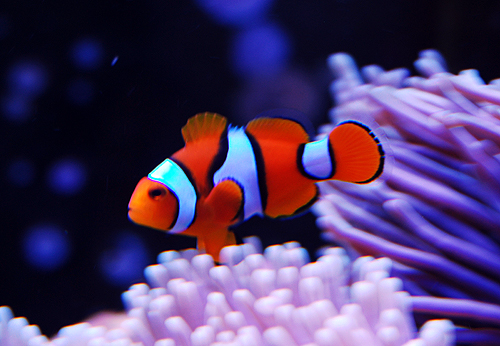 Orange ClownfishAmphiprion percula
-
 Clark's AnemonefishAmphiprion clarkii
-
 Tomato ClownfishAmphiprion frenatus
-
 Pink Skunk ClownfishAmphiprion perideraion
-
 Barrier Reef AnemonefishAmphiprion akindynos
-
 Saddleback ClownfishAmphiprion polymnus
-
 Wide-band AnemonefishAmphiprion latezonatus
Compare
Questions and answers
What is the scientific name of the Red Sea Clownfish?
The scientific name of the Red Sea Clownfish is Amphiprion bicinctus. Written with its author, the full name is Amphiprion bicinctus Rüppell, 1830.
Which family does the Red Sea Clownfish belong to?
Amphiprion bicinctus belongs to the family Pomacentridae, in the order Perciformes and the class Teleostei.
Where is the Red Sea Clownfish found?
Checklists and occurrence records place Amphiprion bicinctus in 19 countries, including Egypt, Saudi Arabia, Israel, Jordan, Djibouti and Sudan.
What is the conservation status of the Red Sea Clownfish?
The IUCN Red List category recorded for Amphiprion bicinctus is Least Concern (LC).
What other names does the Red Sea Clownfish have?
Amphiprion bicinctus is also known in English as Red Sea Anemonefish, Two-banded Anemonefish, Twoband Anemonefish (FB), Threebanded Anemonefish, Twoband Anemonefish and Twobar Anemonefish.
What kind of habitat do clownfish live in?
The Red Sea Clownfish lives in association with sea anemones, including Entacmaea quadricolor, Heteractis aurora, Heteractis crispa, Heteractis magnifica and Stichodactyla gigantea.[9][11][12][13][14][15]
Sources
Passages the profile rests on
- The body coloration ranges from yellow-orange to dark brown. Source passage: “The fish's body is yellow-orange to dark brown.” — English Wikipedia
- The fish has two white body bands edged in black. Source passage: “the two-banded anemonefish has two white bands or bars, with black edges.” — English Wikipedia
- The white band across the head is considerably wider than the other band. Source passage: “The head-bar considerably wider.” — English Wikipedia
- The species has a yellow caudal fin. Source passage: “The yellow caudal fin of A. bicinctus distinguishes it from all but A. latifasciatus and some variations of A. clarkii” — English Wikipedia
- The species has 9–10 dorsal spines and 2 anal spines. Source passage: “They have 9-10 dorsal spines, 2 anal spines” — English Wikipedia
- The species has 15–17 dorsal soft rays and 13–14 anal soft rays. Source passage: “15-17 dorsal soft rays and 13-14 anal soft rays.” — English Wikipedia
- Males grow to approximately 10 centimetres in length. Source passage: “Males grow to a length of 10 centimetres (3.9 in)” — English Wikipedia
- Females grow to approximately 14 centimetres in length. Source passage: “females grow to a length of 14 centimetres (5.5 in).” — English Wikipedia
- The species lives in association with sea anemones. Source passage: “A. bicinctus is generalist, being hosted by the following 5 species of anemones:” — English Wikipedia
- The species participates in a mutualistic relationship with its host sea anemone. Source passage: “Clownfish or anemonefish are fishes that, in the wild, form symbiotic mutualisms with sea anemones” — English Wikipedia
- The species uses the bubble-tip anemone (Entacmaea quadricolor) as a host. Source passage: “Entacmaea quadricolor Bubble-tip anemone” — English Wikipedia
- The species uses the white beaded anemone (Heteractis aurora) as a host. Source passage: “Heteractis aurora white beaded anemone” — English Wikipedia
- The species uses the Sebae anemone (Heteractis crispa) as a host. Source passage: “Heteractis crispa Sebae anemone” — English Wikipedia
- The species uses the magnificent sea anemone (Heteractis magnifica) as a host. Source passage: “Heteractis magnifica magnificent sea anemone” — English Wikipedia
- The species uses the giant carpet anemone (Stichodactyla gigantea) as a host. Source passage: “Stichodactyla gigantea giant carpet anemone” — English Wikipedia
- The species shows a preference for Entacmaea quadricolor over Heteractis crispa. Source passage: “A. bicinctus has a preference for E. quadricolor over H. crispa” — English Wikipedia
- The species feeds on algae in the wild. Source passage: “the fish feeds on algae and zooplankton in the wild.” — English Wikipedia
- The species feeds on zooplankton in the wild. Source passage: “the fish feeds on algae and zooplankton in the wild.” — English Wikipedia
- The species is described as a generalist in its selection of host anemones. Source passage: “A. bicinctus is generalist, being hosted by the following 5 species of anemones:” — English Wikipedia
- Sexually mature individuals are rarely hosted by Heteractis crispa. Source passage: “sexually mature fish are rarely hosted by H. crispa.” — English Wikipedia
- The species is a sequential hermaphrodite, developing first as a male and later becoming female. Source passage: “Clownfish are sequential hermaphrodites, meaning that they develop into males first, and when they mature, they become females.” — English Wikipedia
- Reproduction in clownfish groups involves a male and a female. Source passage: “Only two clownfish, a male and a female, in a group reproduce through external fertilization.” — English Wikipedia
- Fertilization occurs externally. Source passage: “reproduce through external fertilization.” — English Wikipedia
- The species has a reported low to moderate vulnerability score of 25 out of 100. Source passage: “Low to moderate vulnerability (25 of 100).” — fishbase.se
- The species has a reported minimum population doubling time of less than 15 months. Source passage: “High, minimum population doubling time less than 15 months (Preliminary K or Fecundity.).” — fishbase.se
- The reported protein content is 18.2% by wet weight. Source passage: “Protein = 18.2 [17.1, 19.4] %” — fishbase.se
- The reported calcium content is 93.7 mg per 100 g. Source passage: “Calcium = 93.7 [47.6, 145.6] mg/100g;” — fishbase.se
- The reported iron content is 0.71 mg per 100 g. Source passage: “Iron = 0.71 [0.44, 1.15] mg/100g;” — fishbase.se
- The reported omega-3 content is 0.109 g per 100 g. Source passage: “Omega3 = 0.109 [0.069, 0.174] g/100g;” — fishbase.se
- The reported selenium content is 25.1 micrograms per 100 g. Source passage: “Selenium = 25.1 [14.3, 45.9] μg/100g;” — fishbase.se
- The reported vitamin A content is 80.2 micrograms per 100 g. Source passage: “VitaminA = 80.2 [22.4, 269.2] μg/100g;” — fishbase.se
- The reported zinc content is 1.63 mg per 100 g. Source passage: “Zinc = 1.63 [1.12, 2.34] mg/100g (wet weight);” — fishbase.se
Data
- Catalogue of Life, 2026-10-16 XR cc by
- Global Biodiversity Information Facility CC BY 4.0
- Wikidata CC0
- GeoNames CC BY 4.0
- Wikimedia Commons per image; credit shown with each image
- Within the Catalogue of Life, this name comes from World Register of Marine Species cc by
References
- Rüppell, W. P. E. S. (1828). Atlas zu der Reise im nördlichen Afrika. Fische des Rothen Meers. Frankfurt Am Main (Heinrich Ludwig Brönner)., 1–141 + 3 pp., Pls. 1–35. [Part 1 (1828): 1–26, Pls. 1–6; part 2 (1829): 27–94, Pls. 7–24; part 3 (1830):95–141, Pls. 25–35.]. where the name was published
This species in other databases
- Catalogue of Life D54W
- Wikidata Q74400
- iNaturalist 343249
- WoRMS urn:lsid:marinespecies.org:taxname:212778
- ITIS 170142
Page built on 28 November 2026. See how the catalog is made and all sources and licences.
Cite this page
ScientificNames.org. (2026). Amphiprion bicinctus (Red Sea Clownfish). Retrieved November 28, 2026, from https://scientificnames.org/species/amphiprion-bicinctus
“Amphiprion bicinctus (Red Sea Clownfish).” ScientificNames.org, 2026, scientificnames.org/species/amphiprion-bicinctus. Accessed 28 Nov. 2026.
ScientificNames.org. “Amphiprion bicinctus (Red Sea Clownfish).” Accessed November 28, 2026. https://scientificnames.org/species/amphiprion-bicinctus.
@misc{scientificnames_amphiprion_bicinctus_red_sea_clownfish,
  author = {{ScientificNames.org}},
  title = {Amphiprion bicinctus (Red Sea Clownfish)},
  year = {2026},
  url = {https://scientificnames.org/species/amphiprion-bicinctus},
  note = {Accessed 2026-11-28}
}