Species · Mammals
Madras Treeshrew Anathana ellioti
The scientific name of the Madras Treeshrew is Anathana ellioti. It is a species of mammal in the family Tupaiidae (treeshrews), order Scandentia. The name dates from 1850.
- Scientific name
- Anathana ellioti (Waterhouse, 1850)
- Common name
- Madras Treeshrew
- Genus
- Anathana
- Family
- Tupaiidae (Treeshrews)
- Order
- Scandentia
- Class
- Mammalia
- Red List category
- LC Least Concern
- Recorded in
- 1 country
- Name status
- accepted in the Catalogue of Life

Overview
Anathana ellioti inhabits hill forests of central and southern India and is restricted to peninsular India. It spends much of its time on the ground and moving over rocky terrain rather than living primarily in trees.
Written 26 November 2026 from the sources listed below. Each statement was checked against the passage it cites; statements that could not be supported were removed.
Similar species
The Madras Treeshrew has larger ears and thicker ear hair than Tupaia.[1]
Appearance
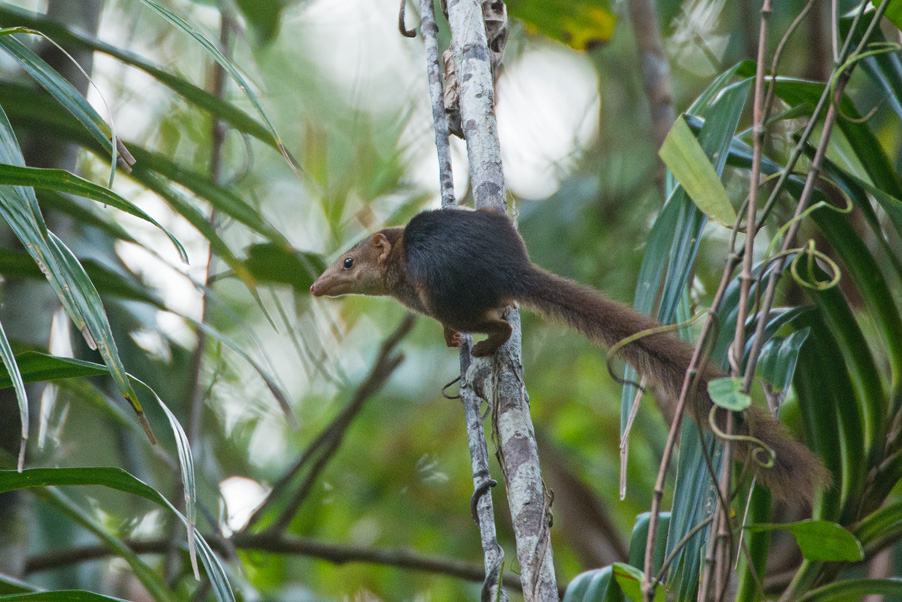
The upper body is speckled with brown, yellow, and black, often with a reddish tinge. The ventral body surface and an oblique shoulder stripe are nearly white.[2][3]
The nominate subspecies has a reddish-brown upper body, buff or ochraceous feet and hind legs, and a tail matching the back in colour. A. e. pallida has reddish-brown upper body coloration and grizzled buffy feet and hind legs.[4][5]
A. e. wroughtoni has dull grizzled brownish upper body coloration and grizzled greyish feet and hind legs.[6]
The body and head length ranges from 16.0 to 18.5 cm. The tail measures between 16.5 and 19.5 cm in length.[7][8]
Habitat
The species inhabits moist to semi-moist deciduous forests within predominantly dry deciduous landscapes. It occurs in hill forests of central and southern India.[9][10]
It has been observed on stone-covered slopes and ravines, including locations near cultivated fields and pastures. It has occasionally been recorded in the Sunderban mangrove forests.[11][12]
The species constructs night shelters between soft ground and stones. These shelters range from simple depressions to corridors with multiple entrances.[13][14]
The species occurs on the Indian subcontinent south of the Ganges River and is restricted to peninsular India. Garhwa district of Bihar represents its northernmost documented record in document 1.[15][16][17]
The subspecies A. e. ellioti occurs in the Eastern Ghats and Shevaroy Hills of southern India. A. e. pallida occurs primarily in Madhya Pradesh and Raipur in central India.[18][19]
The subspecies A. e. wroughtoni occurs in the Satpura Range and the Dangs near Bombay. The species has also been recorded in the Western Ghats at Wayanad and Mahabaleshwar.[20][21]
Diet
The Madras Treeshrew is omnivorous and has dentition adapted to an omnivorous diet.[22][23]
Its recorded insect prey includes caterpillars, flying ants, and butterflies. It also consumes earthworms and wild berries.[24][25]
The species has been observed eating fruit from Lantana camara.[26]
Behaviour
The species spends much of its time on the ground or moving over rocky terrain rather than living primarily in trees. It usually does not climb trees despite being a capable climber of rocks.[27][28]
It has been observed climbing trees when frightened, playing, or cleaning itself. It can climb trees rapidly when alarmed or frightened.[29][30]
The species is largely solitary and does not engage in mutual grooming. Individuals groom themselves using tree trunks and their paws.[31][32]
During grooming, individuals climb approximately 2 metres up tree trunks before stretching and sliding down headfirst. They also climb low, slanting tree trunks and slide down them headfirst, possibly for scent marking.[33][34]
The species spends much of the morning and evening foraging for food. Foraging takes place individually rather than in groups.[35][36]
The species generally uses its hands only occasionally when eating insects and fruit.[37]
Reproduction and life cycle
Male testes are located inside the abdomen rather than in a scrotum.[38]
Conservation
The distribution of the species is patchy, and the status of its populations is poorly known. S. M. Mohnot considered the species common in 1975.[39][40]
The Crested Hawk-eagle has been recorded preying on the species. Individuals are sometimes killed by vehicle traffic on roads within protected reserves in India.[41][42]
Classification of the Madras Treeshrew
| Kingdom | Animalia |
|---|---|
| Phylum | Chordata |
| Subphylum | Vertebrata |
| Infraphylum | Gnathostomata |
| Parvphylum | Osteichthyes |
| Megaclass | Tetrapoda |
| Class | Mammalia (Mammal) |
| Subclass | Theria |
| Infraclass | Eutheria |
| Order | Scandentia (Treeshrews) |
| Family | Tupaiidae (Treeshrews) |
| Genus | Anathana |
| Species | Anathana ellioti (Waterhouse, 1850) |
Where the Madras Treeshrew is found
Checklists and occurrence records place Anathana ellioti in 1 country across Asia. GBIF holds 68 georeferenced records of it.
Countries
Regions and cities with the most records
- Maharashtra, India 22
- Madhya Pradesh, India 10
- Andhra Pradesh, India 6
- Badlapur, India 6
- Karjat, India 6
- Neral, India 6
- Panvel, India 6
- Tamil Nadu, India 5
- Denkanikota, India 4
- Karnataka, India 4
- Bhayandar, India 3
- Kondapalle, India 3
- Sopāra, India 3
- Virār, India 3
Range as the checklists state it
Southern Asia
A number beside a place is its count of GBIF occurrence records. A place without a number comes from a checklist alone. Records show where a species has been observed or collected, which can include escapes and vagrants.
Common names
English
- Madras Treeshrew
- Elliot's Treeshrew
- Indian Tree Shrew
- Madras Scandentian
- Madras Tree Shrew
Names in 14 other languages
- Czech
- tana indická
- Dutch
- Elliottoepaja, Indische Toepaja
- Finnish
- intiantupaija
- French
- Toupaye d'Elliot
- German
- Elliots Tupaia, Indisches Spitzhörnchen
- Italian
- Tupaia di Madras, Tupaia indiana
- Japanese
- マドラスツパイ
- Marathi
- Zadchichundri
- Norwegian Bokmål
- Indiatrespissmus, Madrastrespissmus
- Polish
- Anatana indyjska
- Russian
- Индийская тупайя
- Spanish
- ardilla bambú
- Tamil
- Munghil Anathana, மூங்கணத்தான்
- ori
- Ban Chuchundriya
Synonyms
3 other scientific names have been used for this species and are now treated as synonyms of Anathana ellioti.
- Anathana pallida Lyon, 1913
- Anathana wroughtoni Lyon, 1913
- Tupaia ellioti Waterhouse, 1850
Related species
-
 Northern TreeshrewTupaia belangeri
-
 Common TreeshrewTupaia glis
-
 Large TreeshrewTupaia tana
-
 Horsfield's TreeshrewTupaia javanica
-
 Mountain TreeshrewTupaia montana
-
 Nicobar TreeshrewTupaia nicobarica
-
 Pygmy TreeshrewTupaia minor
-
 Northern Smooth-tailed TreeshrewDendrogale murina
Compare
Questions and answers
What is the scientific name of the Madras Treeshrew?
The scientific name of the Madras Treeshrew is Anathana ellioti. Written with its author, the full name is Anathana ellioti (Waterhouse, 1850).
Which family does the Madras Treeshrew belong to?
Anathana ellioti belongs to the family Tupaiidae, in the order Scandentia and the class Mammalia.
Where is the Madras Treeshrew found?
Checklists and occurrence records place Anathana ellioti in 1 country: India.
What is the conservation status of the Madras Treeshrew?
The IUCN Red List category recorded for Anathana ellioti is Least Concern (LC).
What other names does the Madras Treeshrew have?
Anathana ellioti is also known in English as Elliot's Treeshrew, Indian Tree Shrew, Madras Scandentian and Madras Tree Shrew.
Are shrews found in India?
The Madras Treeshrew occurs on the Indian subcontinent south of the Ganges River and is restricted to peninsular India.[15][17]
Sources
Passages the profile rests on
- The species has larger ears and thicker ear hair than Tupaia. Source passage: “has larger ears with thicker hair than does Tupaia” — animaldiversity.org
- The upper body of this species is speckled with brown, yellow, and black, often with a reddish tinge. Source passage: “Indian tree shrews' upper parts are speckled with brown, yellow, and black often with a reddish tinge” — animaldiversity.org
- The ventral body surface and an oblique shoulder stripe are nearly white. Source passage: “The ventral portion is nearly white as is an oblique shoulder stripe” — animaldiversity.org
- The nominate subspecies has a reddish-brown upper body, buff or ochraceous feet and hind legs, and a tail matching the back in colour. Source passage: “The nominate race (type locality: Eastern Ghats, Madras. British Museum 50.1.21.5) has the tail coloured like the back, the ground colour above being reddish-brown while the feet and hind legs are buff or ochraceous.” — English Wikipedia
- The subspecies A. e. pallida has reddish-brown upper body coloration and grizzled buffy feet and hind legs. Source passage: “has the colour of body above reddish-brown and the feet and hind legs grizzled buffy.” — English Wikipedia
- The subspecies A. e. wroughtoni has dull grizzled brownish upper body coloration and grizzled greyish feet and hind legs. Source passage: “has the colour of body above dull grizzled brownish and the feet and hind legs grizzled greyish.” — English Wikipedia
- The body and head length ranges from 16.0 to 18.5 cm. Source passage: “Body and head length range from 16.0cm to 18.5cm” — animaldiversity.org
- The tail measures between 16.5 and 19.5 cm in length. Source passage: “tail of 16.5 to 19.5 cm.” — English Wikipedia
- The species inhabits moist to semi-moist deciduous forests within predominantly dry deciduous landscapes. Source passage: “sighted in moist to semi-moist deciduous forests in an overall dry deciduous area” — animaldiversity.org
- The species is found in hill forests of central and southern India. Source passage: “found in the hill forests of central and southern India” — English Wikipedia
- The species has been observed on stone-covered slopes and ravines, including locations near cultivated fields and pastures. Source passage: “observed on stone covered slopes and ravines, some near cultivated fields and pastures” — animaldiversity.org
- The species has occasionally been recorded in the Sunderban mangrove forests. Source passage: “occasionally found as far east as the Sunderban mangrove forests.” — English Wikipedia
- The species constructs night shelters between soft ground and stones. Source passage: “builds night shelters between soft ground and stones” — animaldiversity.org
- Its night shelters range from simple depressions to corridors with multiple entrances. Source passage: “vary in complexity from depressions to corridors with multiple entries.” — animaldiversity.org
- The species occurs on the Indian subcontinent south of the Ganges River. Source passage: “Indian or Madras tree shrews are found on the Indian subcontinent south of the Ganges River” — animaldiversity.org
- Garhwa district of Bihar represents the northernmost documented record of the species in document 1. Source passage: “The northernmost record is from Garhwa district of Bihar.” — English Wikipedia
- The species is restricted to peninsular India. Source passage: “Anathana ellioti is restricted to peninsular India” — pmc.ncbi.nlm.nih.gov
- The subspecies A. e. ellioti occurs in the Eastern Ghats and Shevaroy Hills of southern India. Source passage: “Anathana ellioti ellioti inhabits the Eastern Ghats and the Shevaroy Hills of Southern India” — animaldiversity.org
- The subspecies A. e. pallida occurs primarily in Madhya Pradesh and Raipur in central India. Source passage: “Anathana ellioti pallida is found in Central India primarily in Madhya Pradesh and Raipur” — animaldiversity.org
- The subspecies A. e. wroughtoni occurs in the Satpura Range and the Dangs near Bombay. Source passage: “Anathana ellioti wroughtoni lives in Western India in the Satpura Range and the Dangs near Bombay” — animaldiversity.org
- The species has been recorded in the Western Ghats at Wayanad and Mahabaleshwar. Source passage: “They have been reported within the Western Ghats ranges of Wayanad (Periya) and Mahabaleshwar.” — English Wikipedia
- The species is omnivorous. Source passage: “Indian tree shrews are omnivorous.” — animaldiversity.org
- The species has dentition adapted to an omnivorous diet. Source passage: “The dentition is suited for an omnivorous diet.” — English Wikipedia
- Its recorded insect prey includes caterpillars, flying ants, and butterflies. Source passage: “They eat insects such as caterpillars, flying ants, and butterflies” — animaldiversity.org
- The species also consumes earthworms and wild berries. Source passage: “as well as earthworms and fruit (such as wild berries).” — animaldiversity.org
- The species has been observed eating fruit from Lantana camara. Source passage: “They have also been observed eating the fruit of Lantana camara” — animaldiversity.org
- The species spends much of its time on the ground or moving over rocky terrain rather than living primarily in trees. Source passage: “spends much of its time on the ground or clambering about on rocky terrain” — English Wikipedia
- The species usually does not climb trees despite being a capable climber of rocks. Source passage: “A. ellioti usually does not climb trees.” — animaldiversity.org
- The species has been observed climbing trees when frightened, playing, or cleaning itself. Source passage: “observed climbing trees only when frightened, when playing, or when self-cleaning.” — animaldiversity.org
- The species can climb trees rapidly when alarmed or frightened. Source passage: “Indian tree shrews have been known to climb trees rapidly when alarmed or frightened” — animaldiversity.org
- The species is largely solitary and does not engage in mutual grooming. Source passage: “Since they are largely solitary animals, A. ellioti do not mutual groom.” — animaldiversity.org
- Individuals groom themselves using tree trunks and their paws. Source passage: “they use tree trunks to groom in addition to using their paws to comb and smooth their fur.” — animaldiversity.org
- Individuals climb approximately 2 metres up tree trunks before stretching and sliding down headfirst as part of grooming. Source passage: “An Indian tree shrew will climb about 2m on a tree trunk, stretch to full length, and slide down head first” — animaldiversity.org
- The species climbs low, slanting tree trunks and slides down them headfirst, possibly for scent marking. Source passage: “They have a behaviour of climbing up low, slanting trunks and sliding down headfirst. This may be associated with scent marking” — English Wikipedia
- The species spends much of the morning and evening foraging for food. Source passage: “Indian tree shrews spend much of their morning and evening hours foraging for food.” — animaldiversity.org
- Foraging takes place individually rather than in groups. Source passage: “Foraging is always solitary” — animaldiversity.org
- The species generally uses its hands only occasionally when eating insects and fruit. Source passage: “Anathana ellioti only occasionally uses its hands when eating insects and fruit.” — animaldiversity.org
- Male testes are located inside the abdomen rather than in a scrotum. Source passage: “the testes are abdominal in A. ellioti” — animaldiversity.org
- The distribution of the species is patchy, and the status of its populations is poorly known. Source passage: “Little is known about the status of these populations as the distribution is patchy” — English Wikipedia
- The species was considered common by S. M. Mohnot in 1975. Source passage: “S. M. Mohnot considered them as "common" in 1975.” — English Wikipedia
- The Crested Hawk-eagle has been recorded preying on this species. Source passage: “The Crested Hawk-eagle (Nisaetus cirrhatus) has been known to prey on this tree shrew.” — English Wikipedia
- The species is sometimes killed by vehicle traffic on roads within protected reserves in India. Source passage: “The Madras Treeshrew is sometimes killed by vehicular traffic on roads inside protected reserves in India.” — English Wikipedia
Data
- Catalogue of Life, 2026-10-16 XR cc by
- Global Biodiversity Information Facility CC BY 4.0
- Wikidata CC0
- GeoNames CC BY 4.0
- Wikimedia Commons per image; credit shown with each image
- Within the Catalogue of Life, this name comes from The Integrated Taxonomic Information System cc0
References
- Proc. Zool. Soc. Lond. vol.1849 p.107 where the name was published
- Wilson, Don E., and DeeAnn M. Reeder, eds. (1993). Mammal Species of the World: A Taxonomic and Geographic Reference, 2nd Ed., 3rd Printing.
- Wilson, Don E., and F. Russell Cole. (2000). Common Names of Mammals of the World.
- Wilson, Don E., and DeeAnn M. Reeder, eds. (2005). Mammal Species of the World: A Taxonomic and Geographic Reference, 3rd Ed., Vols. 1 & 2.
- Hawkins, M. T. R. / Don E. Wilson and Russell A. Mittermeier, eds. (2018). Family Tupaiidae (Treeshrews). Handbook of the Mammals of the World. Vol. 8: Insectivores, Sloths and Colugos.
This species in other databases
Page built on 29 November 2026. See how the catalog is made and all sources and licences.
Cite this page
ScientificNames.org. (2026). Anathana ellioti (Madras Treeshrew). Retrieved November 29, 2026, from https://scientificnames.org/species/anathana-ellioti
“Anathana ellioti (Madras Treeshrew).” ScientificNames.org, 2026, scientificnames.org/species/anathana-ellioti. Accessed 29 Nov. 2026.
ScientificNames.org. “Anathana ellioti (Madras Treeshrew).” Accessed November 29, 2026. https://scientificnames.org/species/anathana-ellioti.
@misc{scientificnames_anathana_ellioti_madras_treeshrew,
  author = {{ScientificNames.org}},
  title = {Anathana ellioti (Madras Treeshrew)},
  year = {2026},
  url = {https://scientificnames.org/species/anathana-ellioti},
  note = {Accessed 2026-11-29}
}