Species · Fishes
Banded Lampeye Aplocheilichthys spilauchen
The scientific name of the Banded Lampeye is Aplocheilichthys spilauchen. It is a species of fish in the family Poeciliidae (topminnows), order Cyprinodontiformes. The name dates from 1861.
- Scientific name
- Aplocheilichthys spilauchen (Duméril, 1861)
- Common name
- Banded Lampeye
- Genus
- Aplocheilichthys
- Family
- Poeciliidae (Topminnows)
- Order
- Cyprinodontiformes
- Class
- Teleostei
- Red List category
- LC Least Concern
- Environment
- brackish, freshwater
- Recorded in
- 16 countries
- Name status
- accepted in the Catalogue of Life

Overview
Aplocheilichthys spilauchen primarily inhabits coastal brackish-water environments, including river mouths, lagoons, and mangrove swamps. It has a pale cream body with an iridescent silvery-blue lateral band and a bright spot above the eye.
Written 27 November 2026 from the sources listed below. Each statement was checked against the passage it cites; statements that could not be supported were removed.
Appearance
The species has a somewhat cylindrical body, short rounded fins, round scales, and a dorsally flattened head. Its body is pale cream with an iridescent silvery-blue band along the flanks that becomes more prominent toward the tail.[1][2]
Males have vertical bars near the tail that match the colour of the lateral band. Male fins are more intensely coloured than female fins, and the species has a bright spot above the eye.[3][4][5]
The species reaches a maximum total length of 7 cm.[6]
Habitat
The species primarily inhabits coastal brackish-water environments. Documented habitats include river mouths, lagoons, and mangrove swamps.[7][8]
It is rarely recorded in pure freshwater or pure marine water, although it has occasionally been collected from inland freshwater habitats. It is a dominant fish in mangrove habitats along tropical and subtropical sections of the Atlantic coast.[9][10][11]
Diet
The species is carnivorous. Its recorded foods include insect larvae, small aquatic insects, small crustaceans, and worms.[12][13]
Reproduction and life cycle
The species is not live-bearing. Females scatter their eggs over plants during spawning, and the eggs adhere to the plants.[14][15]
Classification of the Banded Lampeye
| Kingdom | Animalia |
|---|---|
| Phylum | Chordata |
| Subphylum | Vertebrata |
| Infraphylum | Gnathostomata |
| Parvphylum | Osteichthyes |
| Gigaclass | Actinopterygii |
| Superclass | Actinopteri |
| Class | Teleostei (Teleost) |
| Order | Cyprinodontiformes |
| Family | Poeciliidae (Topminnows) |
| Subfamily | Aplocheilichthyinae |
| Genus | Aplocheilichthys |
| Species | Aplocheilichthys spilauchen (Duméril, 1861) |
Where the Banded Lampeye is found
Checklists and occurrence records place Aplocheilichthys spilauchen in 16 countries. GBIF holds 916 georeferenced records of it.
Countries
- Angola 19
- Benin 44
- Cameroon 37
- Democratic Republic of the Congo 13
- Equatorial Guinea 40
- Gabon 131
- Gambia 42
- Ghana 32
- Guinea 8
- Ivory Coast 115
- Liberia 3
- Nigeria 32
- Republic of the Congo 37
- Senegal 346
- Sierra Leone 13
- Togo 4
Regions and cities with the most records
- Fatick, Senegal 289
- Ogooué-Maritime, Gabon 50
- Banjul, Gambia 33
- Lamin, Gambia 30
- Abuko, Gambia 29
- Faji Kunda, Gambia 28
- Latri Sabiji, Gambia 28
- New Jeshwang, Gambia 28
- Serekunda, Gambia 28
- Talinding, Gambia 28
- Abidjan, Ivory Coast 27
- Bakau, Gambia 27
- Dippa Kunda, Gambia 27
- Kanifing, Gambia 27
- Koumassi, Ivory Coast 27
- Kunkujang, Gambia 27
- Marcory, Ivory Coast 27
- Welingara, Gambia 27
- Bakoti, Gambia 26
- Busumbala, Gambia 26
- Kotu, Gambia 26
- Manjai Kunda, Gambia 26
- Sinchu Alagi, Gambia 26
- Sukuta, Gambia 26
- Brikama, Gambia 25
- Brufut, Gambia 25
- Sanchaba, Gambia 25
- Abobo, Ivory Coast 23
- Bingerville, Ivory Coast 19
- South, Cameroon 19
- Ziguinchor, Senegal 17
- Moyen-Ogooué, Gabon 16
- Kouilou, Republic of the Congo 15
- Ziguinchor, Senegal 13
- Anyama, Ivory Coast 12
- North Bank, Gambia 11
A number beside a place is its count of GBIF occurrence records. A place without a number comes from a checklist alone. Records show where a species has been observed or collected, which can include escapes and vagrants.
Common names
English
- Banded Lampeye
Names in 3 other languages
- Czech
- zářnoočko příčnopruhé
- German
- Nackenfleck-Leuchtaugenfisch, Nackenfleckenbärbling
- Polish
- błyskotek Spilauchena
Synonyms
14 other scientific names have been used for this species and are now treated as synonyms of Aplocheilichthys spilauchen.
- Aplocheilichthys bensonii (Peters, 1864)
- Aplocheilichthys spilauchena (Duméril, 1861)
- Aplocheilichthys tschiloangensis Ahl, 1928
- Aplocheilichthys typus Bleeker, 1863
- Aplocheilus spilauchen (Duméril, 1861)
- Epiplatys spilauchen (Duméril, 1861)
- Haplochilichthys spilauchen (Duméril, 1861)
- Haplochilichthys spilauchena (Duméril, 1861)
- Haplochilus spilauchen (Duméril, 1861)
- Haplochilus spilauchena (Duméril, 1861)
- Haplochilus spilauchenus (Duméril, 1861)
- Panchax spilauchen (Duméril, 1861)
- Poecilia bensonii Peters, 1864
- Poecilia spilauchena Duméril, 1861
Related species
-
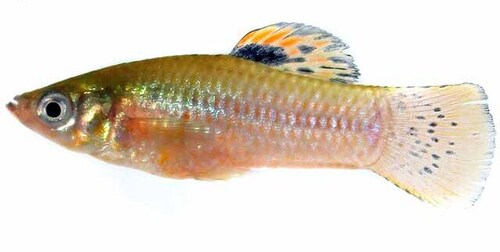 Island MollyPoecilia vandepolli
-
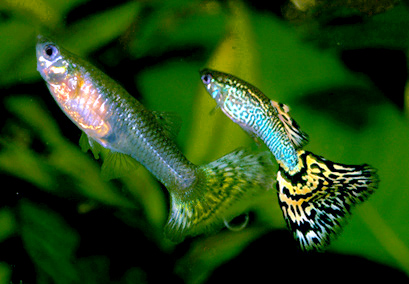 GuppyPoecilia reticulata
-
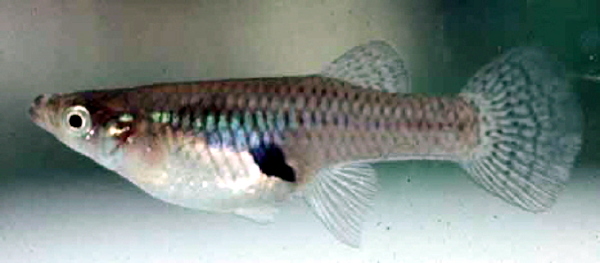 MosquitofishGambusia affinis
-
 Common MollyPoecilia sphenops
-
 Endler's LivebearerPoecilia wingei
-
 Green SwordtailXiphophorus hellerii
-
 Amazon MollyPoecilia formosa
-
 Sailfin MollyPoecilia latipinna
Compare
Questions and answers
What is the scientific name of the Banded Lampeye?
The scientific name of the Banded Lampeye is Aplocheilichthys spilauchen. Written with its author, the full name is Aplocheilichthys spilauchen (Duméril, 1861).
Which family does the Banded Lampeye belong to?
Aplocheilichthys spilauchen belongs to the family Poeciliidae, in the order Cyprinodontiformes and the class Teleostei.
Where is the Banded Lampeye found?
Checklists and occurrence records place Aplocheilichthys spilauchen in 16 countries, including Senegal, Gabon, Ivory Coast, Benin, Gambia and Equatorial Guinea.
What is the conservation status of the Banded Lampeye?
The IUCN Red List category recorded for Aplocheilichthys spilauchen is Least Concern (LC).
Where is the Banded Lampeye native to?
The species is native to Africa, with a broad coastal distribution extending from Senegal to Angola. Its coastal distribution closely follows Atlantic African mangrove forests from the Senegal River to the Kwanza River in Angola.[16][17]
Where does the Banded Lampeye occur in West Africa?
In West Africa, the species occurs from the Senegal River to Nigeria.[18]
Where does the second population occur?
A second population occurs around the Congo River mouth and nearby estuaries and deltas, extending from Cameroon to Angola.[19]
What are the southernmost documented records?
The southernmost documented records include the Chiloango River in Cabinda and the Lower Cuanza River near Luanda.[20]
How long can the Banded Lampeye live in captivity?
The species can live for up to five years in captivity.[21]
Which genus does the Banded Lampeye belong to?
The species is currently recognized as the sole member of the genus Aplocheilichthys.[22]
What was the species originally described as?
The species was originally described as Poecilia spilauchen from specimens collected in the Ogowe River in Gabon.[23]
What is known about the diversification of its lineage?
Genetic analyses recognized six to seven operational taxonomic units. The estimated onset of diversification occurred during the middle Miocene, with both dispersal and vicariance contributing to diversification and distribution.[24][25][26]
How does the lineage's diversification relate to mangrove forests?
The diversification pattern of this brackish-water fish lineage corresponds with the historical distribution of coastal mangrove forests.[27]
Sources
Passages the profile rests on
- The species has a somewhat cylindrical body with short, rounded fins, round scales, and a dorsally flattened head. Source passage: “with a somewhat cylindrical body and short, rounded fins. It has round scales and a dorsally flattened head” — English Wikipedia
- Its body is pale cream with an iridescent silvery-blue band along the flanks that becomes more prominent toward the tail. Source passage: “They are a pale cream in colour with an iridescent silvery blue band running along the flanks, this band is more marked towards the tail.” — English Wikipedia
- Males have vertical bars near the tail that match the colour of the lateral band. Source passage: “Males have the rear of the body, close to the tail, marked with vertical bars which are the same colour as the band along the flanks” — English Wikipedia
- Male fins are more intensely coloured than female fins. Source passage: “their fins will be more intensively coloured than those of the females.” — English Wikipedia
- The species has a bright spot above the eye. Source passage: “There is a bright spot above the, which gives rise to the common name lampeye.” — English Wikipedia
- The species reaches a maximum total length of 7 cm. Source passage: “It reaches up to 7 cm (2.8 in) in total length.” — English Wikipedia
- The species primarily inhabits coastal brackish-water environments. Source passage: “It is mainly found in coastal brackish habitats” — English Wikipedia
- Its documented habitats include river mouths, lagoons, and mangrove swamps. Source passage: “such as river mouths, lagoons and mangrove swamps.” — English Wikipedia
- The species is rarely recorded in pure freshwater or pure marine water. Source passage: “is rarely recorded in either pure freshwater or pur marine water.” — English Wikipedia
- The species is a dominant fish in mangrove habitats along tropical and subtropical sections of the Atlantic coast. Source passage: “is a dominant species in mangrove habitats along the tropical and subtropical zones of the Atlantic coast” — pmc.ncbi.nlm.nih.gov
- Although primarily coastal, the species has occasionally been collected from inland freshwater habitats. Source passage: “Although A. spilauchen has also occasionally been collected from inland freshwater habitats” — pmc.ncbi.nlm.nih.gov
- The species is carnivorous. Source passage: “It is a carnivorous species” — English Wikipedia
- Its recorded foods include insect larvae, small aquatic insects, small crustaceans, and worms. Source passage: “feeds on insect larvae, small aquatic insects, small crustaceans, and worms.” — English Wikipedia
- The species is not live-bearing. Source passage: “This species is not a live bearer” — English Wikipedia
- Females scatter their eggs over plants during spawning, and the eggs adhere to the plants. Source passage: “the females scatter their eggs over plants when spawning, the eggs sticking to the plants.” — English Wikipedia
- The species is native to Africa and has a broad coastal distribution extending from Senegal to Angola. Source passage: “is native to Africa, ranging from Senegal to Angola.” — English Wikipedia
- Its coastal distribution closely follows Atlantic African mangrove forests from the Senegal River to the Kwanza River in Angola. Source passage: “it primarily has a coastal distributional range, which closely mirrors the area covered by Atlantic coast mangrove forests, from the Senegal River to the Kwanza River in Angola” — pmc.ncbi.nlm.nih.gov
- In West Africa, the species occurs from the Senegal River to Nigeria. Source passage: “In West Africa this species occurs from the Senegal River to Nigeria;” — English Wikipedia
- A second population occurs around the Congo River mouth and nearby estuaries and deltas, extending from Cameroon to Angola. Source passage: “a second population is found around the mouth of the Congo River and nearby estuaries and deltas from Cameroon to Angola.” — English Wikipedia
- The southernmost documented records include the Chiloango River in Cabinda and the Lower Cuanza River near Luanda. Source passage: “The southernmost records are from the Chiloango River in Cabinda and the Lower Cuanza River near Luanda.” — English Wikipedia
- The species can live for up to five years in captivity. Source passage: “They can live for up to five years in captivity.” — English Wikipedia
- The species is currently recognized as the sole member of the genus Aplocheilichthys. Source passage: “Aplocheilichthys spilauchen is currently recognized as the sole member of Aplocheilichthys” — pmc.ncbi.nlm.nih.gov
- The species was originally described as Poecilia spilauchen from specimens collected in the Ogowe River in Gabon. Source passage: “was the first African lampeye to be described (as Poecilia spilauchen), based on specimens from the Ogowe River in Gabon by Duméril (1861).” — pmc.ncbi.nlm.nih.gov
- Genetic analyses of the species lineage recognized six to seven operational taxonomic units. Source passage: “recognizing 6–7 OTUs with absolute pairwise genetic distances ranging between 8 and 22%.” — pmc.ncbi.nlm.nih.gov
- The estimated onset of diversification within the species lineage occurred during the middle Miocene. Source passage: “The onset of diversification is estimated to be within the middle Miocene” — pmc.ncbi.nlm.nih.gov
- Both dispersal and vicariance contributed to the diversification and distribution of the species lineage. Source passage: “both dispersal and vicariance-shaped A. spilauchen diversity and distribution” — pmc.ncbi.nlm.nih.gov
- The diversification pattern of this brackish-water fish lineage corresponds with the historical distribution of coastal mangrove forests. Source passage: “a pattern of diversification within a lineage of brackish water fish that is concordant with the historical distribution of coastal mangroves forests” — pmc.ncbi.nlm.nih.gov
Data
- Catalogue of Life, 2026-10-16 XR cc by
- Global Biodiversity Information Facility CC BY 4.0
- Wikidata CC0
- GeoNames CC BY 4.0
- Wikimedia Commons per image; credit shown with each image
- Within the Catalogue of Life, this name comes from World Register of Marine Species cc by
This species in other databases
- Catalogue of Life FP9N
- Wikidata Q739103
- iNaturalist 94385
- WoRMS urn:lsid:marinespecies.org:taxname:279648
- ITIS 165732
Page built on 29 November 2026. See how the catalog is made and all sources and licences.
Cite this page
ScientificNames.org. (2026). Aplocheilichthys spilauchen (Banded Lampeye). Retrieved November 29, 2026, from https://scientificnames.org/species/aplocheilichthys-spilauchen
“Aplocheilichthys spilauchen (Banded Lampeye).” ScientificNames.org, 2026, scientificnames.org/species/aplocheilichthys-spilauchen. Accessed 29 Nov. 2026.
ScientificNames.org. “Aplocheilichthys spilauchen (Banded Lampeye).” Accessed November 29, 2026. https://scientificnames.org/species/aplocheilichthys-spilauchen.
@misc{scientificnames_aplocheilichthys_spilauchen_banded_lampeye,
  author = {{ScientificNames.org}},
  title = {Aplocheilichthys spilauchen (Banded Lampeye)},
  year = {2026},
  url = {https://scientificnames.org/species/aplocheilichthys-spilauchen},
  note = {Accessed 2026-11-29}
}