Species · Other invertebrates
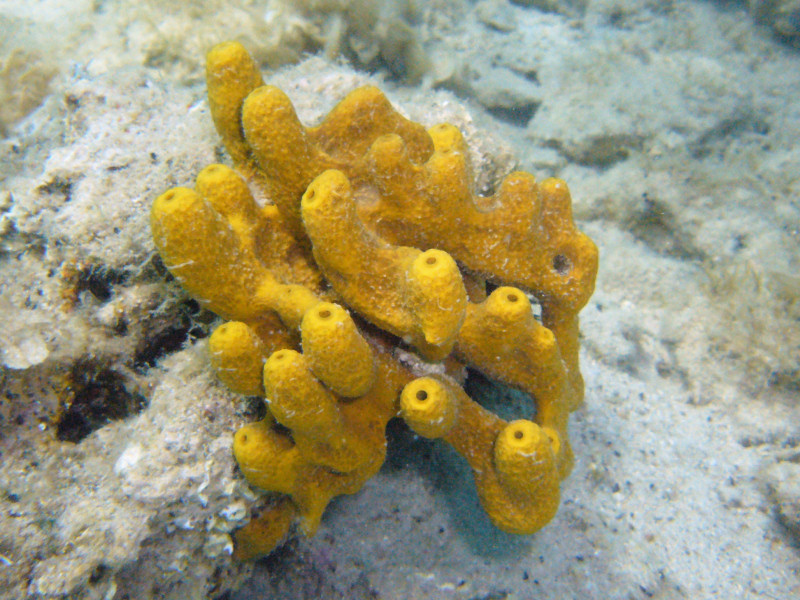
Yellow Cave Sponge Aplysina cavernicola
The scientific name of the Yellow Cave Sponge is Aplysina cavernicola. It is a species of animal in the family Aplysinidae, order Verongiida. The name dates from 1959.
- Scientific name
- Aplysina cavernicola (Vacelet, 1959)
- Common name
- Yellow Cave Sponge
- Genus
- Aplysina
- Family
- Aplysinidae
- Order
- Verongiida
- Class
- Demospongiae
- Environment
- marine
- Recorded in
- 4 countries
- Name status
- accepted in the Catalogue of Life

Overview
The species inhabits marine caves and areas beneath overhangs and is native to the Mediterranean Sea. It forms yellowish clumps with projecting finger-like processes and produces brominated isoxazoline alkaloids that accumulate in its tissues.
Written 27 November 2026 from the sources listed below. Each statement was checked against the passage it cites; statements that could not be supported were removed.
Appearance
The sponge lacks spicules and is structurally supported by a mesh of spongin fibres. Water enters through ostia at its base and exits through oscula in slight depressions at the tips of its processes.[1][2]
Clumps can reach 30 cm in diameter. The finger-like processes can reach 6 cm in length and 2 cm in diameter.[3][4]
Habitat
The Yellow Cave Sponge inhabits marine caves and areas beneath overhangs. Its native distribution is the Mediterranean Sea.[5][6]
Reproduction and life cycle
The species is hermaphroditic and releases ciliated parenchymella larvae into the water. The larvae settle in suitable locations and subsequently transform into juvenile sponges.[7][8][9]
Uses
The species has been used as a model organism for studying isotopes such as americium-241 in seawater.[10]
Classification of the Yellow Cave Sponge
| Kingdom | Animalia |
|---|---|
| Phylum | Porifera |
| Class | Demospongiae (Demosponge) |
| Subclass | Verongimorpha |
| Order | Verongiida |
| Family | Aplysinidae |
| Genus | Aplysina |
| Species | Aplysina cavernicola (Vacelet, 1959) |
Where the Yellow Cave Sponge is found
Checklists and occurrence records place Aplysina cavernicola in 4 countries. GBIF holds 1,544 georeferenced records of it.
Countries
Regions and cities with the most records
- Marseille 09, France 441
- Marseille 11, France 420
- Marseille 10, France 419
- Marseille 08, France 416
- Marseille 12, France 411
- Marseille 06, France 410
- Marseille 07, France 410
- Marseille 04, France 409
- Marseille 05, France 409
- Marseille, France 408
- Marseille 01, France 408
- Marseille 02, France 408
- Marseille 03, France 408
- Marseille 13, France 406
- Marseille 14, France 380
- Allauch, France 329
- Marseille 16, France 315
- La Ciotat, France 265
- Aubagne, France 256
- Marseille 15, France 224
- Ajaccio, France 200
- Marignane, France 188
- Provence-Alpes-Côte d'Azur, France 188
- Les Pennes-Mirabeau, France 183
- Agde, France 168
- Mandelieu-la-Napoule, France 164
- Martigues, France 142
- Vitrolles, France 142
- Cannes, France 137
- Le Cannet, France 130
- Mougins, France 123
- Vallauris, France 123
- Cagnes-sur-Mer, France 119
- Antibes, France 118
- Juan-les-Pins, France 117
- Sanary-sur-Mer, France 108
1 more country has a few records outside this range
These countries hold a few records of Aplysina cavernicola but lie outside the range the checklists give for it. Such records are often zoo or garden specimens, museum material or vagrants, so the species is not counted as occurring there.
A number beside a place is its count of GBIF occurrence records. A place without a number comes from a checklist alone. Records show where a species has been observed or collected, which can include escapes and vagrants.
Common names
English
- Yellow Cave Sponge
- Yellow Cave-sponge
Names in 5 other languages
- Catalan
- verongia cavernícola
- French
- Eponge cavernicole jaune, éponge cavernicole jaune
- Hungarian
- sárga barlangi szivacs
- Italian
- Verongia cavernicola, spugna cavernicola gialla
- Spanish
- verongia cavernícola
Synonyms
One other scientific name has been used for this species and is now treated as a synonym of Aplysina cavernicola.
- Verongia cavernicola Vacelet, 1959
Related species
-
 Yellow Tube SpongeAplysina fistularis
-
 Stove-pipe SpongeAplysina archeri
-
 Gold SpongeAplysina aerophoba
-
 Row Pore Rope SpongeAplysina cauliformis
-
 Scattered Pore Rope SpongeAplysina fulva
- Yellow Tube SpongeAplysina insularis
- Giant Tube SpongeAplysina lacunosa
- Aplysina chiriquiensis
Compare
Questions and answers
What is the scientific name of the Yellow Cave Sponge?
The scientific name of the Yellow Cave Sponge is Aplysina cavernicola. Written with its author, the full name is Aplysina cavernicola (Vacelet, 1959).
Which family does the Yellow Cave Sponge belong to?
Aplysina cavernicola belongs to the family Aplysinidae, in the order Verongiida and the class Demospongiae.
Where is the Yellow Cave Sponge found?
Checklists and occurrence records place Aplysina cavernicola in 4 countries: France, Spain, Croatia and Italy.
What other names does the Yellow Cave Sponge have?
Aplysina cavernicola is also known in English as Yellow Cave-sponge.
How do yellow tube sponges reproduce?
The Yellow Cave Sponge is hermaphroditic and releases ciliated parenchymella larvae into the water. The larvae settle in suitable locations and transform into juvenile sponges.[7][8][9]
What is the habitat for sponges?
The Yellow Cave Sponge inhabits marine caves and areas beneath overhangs.[5]
Sources
Passages the profile rests on
- The sponge lacks spicules and has structural support provided by a mesh of spongin fibres. Source passage: “There are no spicules, structural support being provided by a mesh of spongin fibres.” — English Wikipedia
- Water enters the sponge through ostia at its base and exits through oscula located in slight depressions at the tips of its processes. Source passage: “Water is drawn in through pores known as ostia at the base of the sponge and ejected from the oscuili which are situated in slight depressions at the tips of the processes.” — English Wikipedia
- The sponge forms clumps that can reach 30 cm in diameter. Source passage: “Aplysina cavernicola forms clumps that may be up to 30 cm (12 in) across.” — English Wikipedia
- Its finger-like processes can reach 6 cm in length and 2 cm in diameter. Source passage: “finger-like processes up to 6 cm (2.4 in) long and 2 cm (0.8 in) in diameter.” — English Wikipedia
- The species inhabits marine caves and areas beneath overhangs. Source passage: “where it grows in caves and under overhangs.” — English Wikipedia
- The species is native to the Mediterranean Sea. Source passage: “It is native to the Mediterranean Sea” — English Wikipedia
- The species is hermaphroditic. Source passage: “This sponge is a hermaphrodite;” — English Wikipedia
- The species releases ciliated parenchymella larvae into the water. Source passage: “ciliated larvae known as parenchymella larvae are released into the water” — English Wikipedia
- Its larvae settle in suitable locations and subsequently transform into juvenile sponges. Source passage: “soon settle in a suitable location and undergo metamorphosis into juvenile sponges.” — English Wikipedia
- The species has been used as a model organism for studying isotopes such as americium-241 in seawater. Source passage: “has been used as a model organism to study the presence of isotopes such as americium-241 in seawater.” — English Wikipedia
Data
- Catalogue of Life, 2026-10-16 XR cc by
- Global Biodiversity Information Facility CC BY 4.0
- Wikidata CC0
- GeoNames CC BY 4.0
- Wikimedia Commons per image; credit shown with each image
- Within the Catalogue of Life, this name comes from World Porifera Database cc by
This species in other databases
- Catalogue of Life FQ7Q
- Wikidata Q1891651
- iNaturalist 359504
- WoRMS urn:lsid:marinespecies.org:taxname:133913
Page built on 28 November 2026. See how the catalog is made and all sources and licences.
Cite this page
ScientificNames.org. (2026). Aplysina cavernicola (Yellow Cave Sponge). Retrieved November 28, 2026, from https://scientificnames.org/species/aplysina-cavernicola
“Aplysina cavernicola (Yellow Cave Sponge).” ScientificNames.org, 2026, scientificnames.org/species/aplysina-cavernicola. Accessed 28 Nov. 2026.
ScientificNames.org. “Aplysina cavernicola (Yellow Cave Sponge).” Accessed November 28, 2026. https://scientificnames.org/species/aplysina-cavernicola.
@misc{scientificnames_aplysina_cavernicola_yellow_cave_sponge,
  author = {{ScientificNames.org}},
  title = {Aplysina cavernicola (Yellow Cave Sponge)},
  year = {2026},
  url = {https://scientificnames.org/species/aplysina-cavernicola},
  note = {Accessed 2026-11-28}
}