Species · Other invertebrates
Yellow Tube Sponge Aplysina insularis
The scientific name of the Yellow Tube Sponge is Aplysina insularis. It is a species of animal in the family Aplysinidae, order Verongiida. The name dates from 1864.
- Scientific name
- Aplysina insularis (Duchassaing & Michelotti, 1864)
- Common name
- Yellow Tube Sponge
- Genus
- Aplysina
- Family
- Aplysinidae
- Order
- Verongiida
- Class
- Demospongiae
- Environment
- marine
- Recorded in
- 16 countries
- Name status
- accepted in the Catalogue of Life
Overview
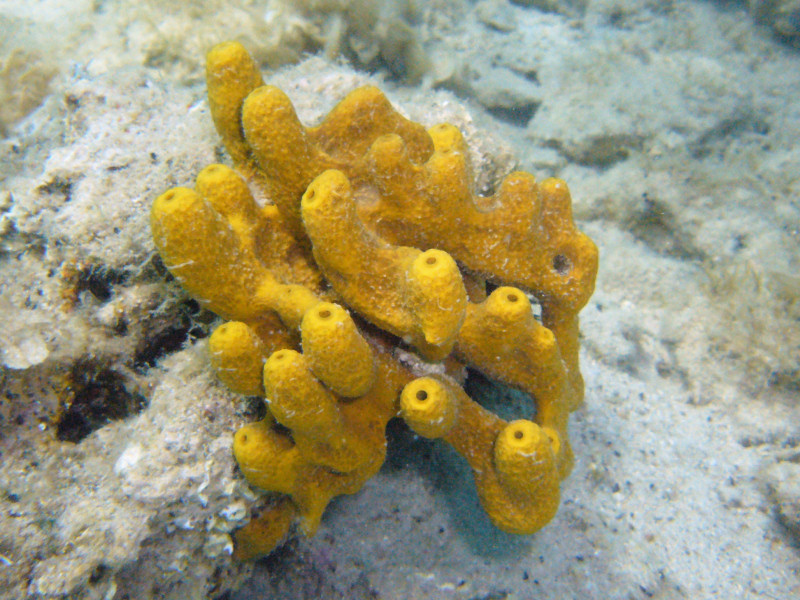
The yellow tube sponge inhabits reefs in the Caribbean Sea, particularly outer reef slopes and vertical walls, at depths of approximately 40 metres. The sponge consists of cylindrical tubes and turns dark purple or black when bruised or removed from the water.
Written 27 November 2026 from the sources listed below. Each statement was checked against the passage it cites; statements that could not be supported were removed.
Appearance
The yellow tube sponge consists of one or more cylindrical tubes joined at their base. Each tube narrows towards its apex, forming a large osculum that may be surrounded by small, finger-shaped projections.[1][2][3]
The sponge may develop slender tendrils and larger rope-like projections. In areas with substantial sedimentation, these projections may grow larger than its tubes.[4][5]
The sponge can reach a length of 50 centimetres, and its tubes can reach a diameter of 8 centimetres. Its texture is both soft and tough.[6][7][8]
Its outer surface may be smooth or covered with fine conical projections. Its wall lacks silicaceous spicules and is reinforced by a network of fibres arranged in hexagonal or circular mesh patterns.[9][10][11]
Its usual colour is yellowish brown. In deeper water, it changes to an intense greenish-yellow colour because of fluorescence in the blue light that reaches it.[12][13][14]
Habitat
The yellow tube sponge inhabits reefs in the Caribbean Sea at depths of approximately 40 metres. It particularly occurs on outer reef slopes and vertical walls.[15][16][17][18]
Several animal species use the sponge's internal cavity as a protected living space. The sponge provides an internal habitat for the sponge cardinal fish (Phaeoptyx xenus) and several species of neon goby (Elacatinus spp.).[19][20][21]
Behaviour
The yellow tube sponge turns dark purple or black when bruised or taken out of the water. It releases a substance capable of staining human skin, and the stain can be difficult to remove.[22][23][24]
Classification of the Yellow Tube Sponge
| Kingdom | Animalia |
|---|---|
| Phylum | Porifera |
| Class | Demospongiae (Demosponge) |
| Subclass | Verongimorpha |
| Order | Verongiida |
| Family | Aplysinidae |
| Genus | Aplysina |
| Species | Aplysina insularis (Duchassaing & Michelotti, 1864) |
Where the Yellow Tube Sponge is found
Checklists and occurrence records place Aplysina insularis in 16 countries. GBIF holds 405 georeferenced records of it.
Countries
- Antigua and Barbuda 3
- Bahamas 40
- Bermuda 5
- British Virgin Islands 6
- Cayman Islands 80
- Cuba 15
- Dominican Republic 4
- Martinique 7
- Mexico 97
- Panama 5
- Puerto Rico 28
- Saint Barthelemy 8
- Saint Martin 7
- Sint Maarten 5
- U.S. Virgin Islands 11
- United States 84
Regions and cities with the most records
- George Town, Cayman Islands 62
- West Bay, Cayman Islands 62
- Dania Beach, United States 23
- Davie, United States 23
- Fort Lauderdale, United States 23
- Lauderdale Lakes, United States 23
- Lauderhill, United States 23
- Oakland Park, United States 23
- Plantation, United States 23
- Sunrise, United States 23
- Pompano Beach, United States 22
- Coconut Creek, United States 20
- Margate, United States 20
- North Lauderdale, United States 20
- Tamarac, United States 20
- Hollywood, United States 16
- Cooper City, United States 14
- Hallandale Beach, United States 14
- Pembroke Pines, United States 14
- West Park, United States 14
- Aventura, United States 13
- Marigot, Saint Martin 12
- Philipsburg, Sint Maarten 12
- Sunny Isles Beach, United States 12
- Nassau, Bahamas 11
- Aguadilla, Puerto Rico 10
- Deerfield Beach, United States 9
- Killarney, Bahamas 9
- Gustavia, Saint Barthelemy 8
- Ives Estates, United States 8
- Boca Del Mar, United States 7
- Boca Raton, United States 7
- Ojus, United States 7
- Parkland, United States 7
- Saint Croix, U.S. Virgin Islands 7
- Sandalfoot Cove, United States 7
2 more countries have a few records outside this range
These countries hold a few records of Aplysina insularis but lie outside the range the checklists give for it. Such records are often zoo or garden specimens, museum material or vagrants, so the species is not counted as occurring there.
A number beside a place is its count of GBIF occurrence records. A place without a number comes from a checklist alone. Records show where a species has been observed or collected, which can include escapes and vagrants.
Common names
English
- Yellow Tube Sponge
- Yellow-green Candle Sponge
Synonyms
9 other scientific names have been used for this species and are now treated as synonyms of Aplysina insularis.
- Aplysina anomala Wilson, 1902
- Aplysina fistularis f. ansa (Laubenfels, 1950)
- Aplysina fistularis f. insularis (Duchassaing & Michelotti, 1864)
- Aplysina flagelliformis var. anomala Wilson, 1902
- Aplysina tenuissima (Hyatt, 1875)
- Luffaria insularis Duchassaing & Michelotti, 1864
- Verongia ansa Laubenfels, 1950
- Verongia fistularis var. ansa de Laubenfels, 1950
- Verongia tenuissima Hyatt, 1875
Related species
-
 Yellow Tube SpongeAplysina fistularis
-
 Stove-pipe SpongeAplysina archeri
-
 Gold SpongeAplysina aerophoba
-
 Row Pore Rope SpongeAplysina cauliformis
-
 Scattered Pore Rope SpongeAplysina fulva
-
 Yellow Cave SpongeAplysina cavernicola
- Giant Tube SpongeAplysina lacunosa
- Aplysina chiriquiensis
Compare
Questions and answers
What is the scientific name of the Yellow Tube Sponge?
The scientific name of the Yellow Tube Sponge is Aplysina insularis. Written with its author, the full name is Aplysina insularis (Duchassaing & Michelotti, 1864).
Which family does the Yellow Tube Sponge belong to?
Aplysina insularis belongs to the family Aplysinidae, in the order Verongiida and the class Demospongiae.
Where is the Yellow Tube Sponge found?
Checklists and occurrence records place Aplysina insularis in 16 countries, including Mexico, United States, Cayman Islands, Bahamas, Puerto Rico and Cuba.
What other names does the Yellow Tube Sponge have?
Aplysina insularis is also known in English as Yellow-green Candle Sponge.
What is the habitat of sponges?
The yellow tube sponge inhabits reefs in the Caribbean Sea, particularly outer reef slopes and vertical walls, at depths of approximately 40 metres.[15][16][17][18]
What are some interesting facts about yellow tube sponges?
The yellow tube sponge can reach a length of 50 centimetres, and its tubes can reach a diameter of 8 centimetres. It may develop slender tendrils and larger rope-like projections. When bruised or removed from water, it turns dark purple or black and releases a substance that can stain human skin.[4][5][6][7][22][23][24]
Sources
Passages the profile rests on
- The sponge consists of one or more cylindrical tubes joined together at their base. Source passage: “consists of one or more cylindrical tubes united at the base.” — English Wikipedia
- Each tube narrows towards its apex, forming a large osculum. Source passage: “Each one narrows at the apex into a large osculum” — English Wikipedia
- The large osculum may be surrounded by small, finger-shaped projections. Source passage: “this may be surrounded by small, finger-like projections.” — English Wikipedia
- The sponge may develop slender tendrils and larger rope-like projections. Source passage: “Slender tendrils and larger rope-like projections may also occur” — English Wikipedia
- In areas with substantial sedimentation, its tendrils and rope-like projections may grow larger than its tubes. Source passage: “in areas with high levels of sedimentation, these may exceed the tubes in size.” — English Wikipedia
- The sponge can reach a length of 50 centimetres. Source passage: “This sponge can grow to a length of 50 centimetres (20 in)” — English Wikipedia
- Its tubes can reach a diameter of 8 centimetres. Source passage: “with a tube diameter of 8 centimetres (3.1 in)” — English Wikipedia
- Its texture is both soft and tough. Source passage: “the texture is soft yet tough.” — English Wikipedia
- The outer surface may be smooth or covered with fine conical projections. Source passage: “The outer surface is either smooth or covered with fine conical projections.” — English Wikipedia
- The sponge lacks silicaceous spicules in its wall. Source passage: “There are no silicaceous spicules in the wall” — English Wikipedia
- Its wall is reinforced by a network of fibres arranged in hexagonal or circular mesh patterns. Source passage: “it is strengthened with a network of fibres forming a hexagonal or circular mesh pattern.” — English Wikipedia
- Its usual colour is yellowish brown. Source passage: “The colour is yellowish brown” — English Wikipedia
- In deeper water, the sponge changes to an intense greenish-yellow colour. Source passage: “in deeper water changes to an intense greenish yellow” — English Wikipedia
- Its deeper-water greenish-yellow coloration results from fluorescence in the blue light that reaches it. Source passage: “the surface layers of the sponge fluoresce in the blue (only) light that penetrates this far into the water.” — English Wikipedia
- The species inhabits reefs in the Caribbean Sea. Source passage: “found on reefs in the Caribbean Sea and the Gulf of Mexico.” — English Wikipedia
- The species occurs at depths of approximately 40 metres. Source passage: “occurs down to about 40 metres (130 ft) on reefs” — English Wikipedia
- The sponge particularly inhabits outer reef slopes and vertical walls. Source passage: “particularly the outer reef slopes and on vertical walls.” — English Wikipedia
- The species is found on reefs in the Caribbean Sea. Source passage: “is a species of demosponge that is found on reefs in the Caribbean Sea” — inaturalist.org
- Several animal species use the sponge's internal cavity as a protected living space. Source passage: “A number of animals live inside the protective lumen of this sponge.” — English Wikipedia
- The sponge provides an internal habitat for the sponge cardinal fish (Phaeoptyx xenus). Source passage: “These include the sponge cardinal fish (Phaeoptyx xenus)” — English Wikipedia
- Several species of neon goby (Elacatinus spp.) live inside the sponge. Source passage: “and several species of neon goby (Elacatinus spp.).” — English Wikipedia
- The sponge turns dark purple or black when bruised or taken out of the water. Source passage: “If bruised or removed from the water, this sponge turns dark purple or black” — English Wikipedia
- When bruised or removed from water, the sponge releases a substance capable of staining human skin. Source passage: “exuding a substance that can stain a person's skin” — English Wikipedia
- The stain produced by the sponge can be difficult to remove. Source passage: “leaving a mark that is difficult to eradicate.” — English Wikipedia
Data
- Catalogue of Life, 2026-10-16 XR cc by
- Global Biodiversity Information Facility CC BY 4.0
- Wikidata CC0
- GeoNames CC BY 4.0
- Within the Catalogue of Life, this name comes from World Porifera Database cc by
This species in other databases
- Catalogue of Life FQ8N
- Wikidata Q3375794
- iNaturalist 131704
- WoRMS urn:lsid:marinespecies.org:taxname:169655
Page built on 29 November 2026. See how the catalog is made and all sources and licences.
Cite this page
ScientificNames.org. (2026). Aplysina insularis (Yellow Tube Sponge). Retrieved November 29, 2026, from https://scientificnames.org/species/aplysina-insularis
“Aplysina insularis (Yellow Tube Sponge).” ScientificNames.org, 2026, scientificnames.org/species/aplysina-insularis. Accessed 29 Nov. 2026.
ScientificNames.org. “Aplysina insularis (Yellow Tube Sponge).” Accessed November 29, 2026. https://scientificnames.org/species/aplysina-insularis.
@misc{scientificnames_aplysina_insularis_yellow_tube_sponge,
  author = {{ScientificNames.org}},
  title = {Aplysina insularis (Yellow Tube Sponge)},
  year = {2026},
  url = {https://scientificnames.org/species/aplysina-insularis},
  note = {Accessed 2026-11-29}
}