Species · Birds
Bar-backed Partridge Arborophila brunneopectus
The scientific name of the Bar-backed Partridge is Arborophila brunneopectus. It is a species of bird in the family Phasianidae (quail), order Galliformes. The name dates from 1855.
- Scientific name
- Arborophila brunneopectus (Blyth, 1855)
- Common name
- Bar-backed Partridge
- Genus
- Arborophila
- Family
- Phasianidae (Quail)
- Order
- Galliformes
- Class
- Aves
- Red List category
- LC Least Concern
- Recorded in
- 8 countries
- Name status
- accepted in the Catalogue of Life

Overview
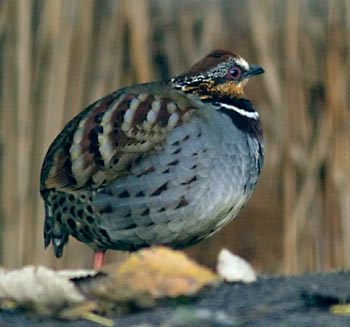
The Bar-backed Partridge (Arborophila brunneopectus) is a bird in the family Phasianidae. It occurs in Cambodia, China, Laos, Myanmar, Thailand, and Vietnam. It is predominantly buff-colored, with a black crown, black throat markings, and white cheeks.
Written 26 November 2026 from the sources listed below. Each statement was checked against the passage it cites; statements that could not be supported were removed.
Appearance
Males and females have similar coloration. The species is predominantly buff-colored, with black markings extending from the beak around the eyes to the throat, a black crown, and black feather tips along its back.[1][2][3][4]
Its wing feathers are white with black tips and brown coloration near the back. It is also described as earth-colored, with a black throat and white cheeks.[5][6]
Three subspecies are recognized. They differ in the coloration and patterns of their underparts and heads.[7][8]
Similar species
The White-cheeked Partridge is identified as the Bar-backed Partridge's closest visual comparison.[9]
Habitat
The Bar-backed Partridge inhabits subtropical or tropical moist lowland forests and subtropical or tropical moist montane forests.[10][11]
It is typically found below 910 metres in elevation, although it has also been recorded at elevations of 1,500 metres and above.[12][13]
Diet
The Bar-backed Partridge feeds on seeds and small shells. It also eats insects found in leaves on the forest floor.[14][15][16]
Behaviour
The species forms flocks containing approximately four to nine individuals. These usually consist of two parents and their latest offspring, or occasionally two families.[17][18]
When disturbed by humans, the species rapidly disperses into the underbrush.[19]
In captivity, males attract mates by displaying red throat feathers and calling.[20]
Reproduction and life cycle
The Bar-backed Partridge breeds around May and June. Its eggs measure approximately 37 by 28 mm.[21][22]
It lays its eggs in holes covered with bamboo and grass.[23]
Conservation
The Bar-backed Partridge was assessed as Least Concern by the IUCN. Its most recent IUCN Red List assessment was in 2016.[24][25]
Its population is slowly declining. Habitat loss and hunting are identified as causes of the decline, which is not sufficiently steep to warrant Vulnerable status.[26][27][28]
Classification of the Bar-backed Partridge
| Kingdom | Animalia |
|---|---|
| Phylum | Chordata |
| Subphylum | Vertebrata |
| Infraphylum | Gnathostomata |
| Parvphylum | Osteichthyes |
| Megaclass | Tetrapoda |
| Class | Aves (Bird) |
| Order | Galliformes (Fowls) |
| Family | Phasianidae (Quail) |
| Genus | Arborophila (Hill-Partridges) |
| Species | Arborophila brunneopectus (Blyth, 1855) |
Where the Bar-backed Partridge is found
Checklists and occurrence records place Arborophila brunneopectus in 8 countries across Asia. GBIF holds 3,326 georeferenced records of it.
Countries
Regions and cities with the most records
- Phetchaburi, Thailand 1,416
- Lam Dong, Vietnam 335
- Chiang Mai, Thailand 156
- Guangxi, China 156
- Ðà Lạt, Vietnam 151
- Phetchabun, Thailand 132
- Yunnan, China 67
- Chaiyaphum, Thailand 58
- Xékong, Laos 54
- Đưc Trọng, Vietnam 52
- Mondolkiri, Cambodia 49
- Thừa Thiên Huế Province, Vietnam 45
- Tak, Thailand 33
- Loei, Thailand 32
- Thị Trấn Đại Từ, Vietnam 31
- Vĩnh Yên, Vietnam 31
- Chiang Mai, Thailand 28
- Bolikhamsai, Laos 27
- Hang Dong, Thailand 26
- Kamphaeng Phet, Thailand 23
- Kanchanaburi, Thailand 23
- Thanh Hóa Province, Vietnam 21
- Ninh Binh, Vietnam 20
- San Kamphaeng, Thailand 20
- Shan State, Myanmar 20
- Xiangkhoang, Laos 19
- Bokeo, Laos 18
- Điện Biên Province, Vietnam 16
- Quang Tri, Vietnam 15
- Khammouane Province, Laos 14
- Lao Cai, Vietnam 14
- Bắc Kạn, Vietnam 13
- Savannakhet Province, Laos 13
- Thị Trấn Vân Du, Vietnam 13
- Houaphan, Laos 12
- Champasak Province, Laos 11
1 more country has a few records outside this range
These countries hold a few records of Arborophila brunneopectus but lie outside the range the checklists give for it. Such records are often zoo or garden specimens, museum material or vagrants, so the species is not counted as occurring there.
Range as the checklists state it
Southern Asia
A number beside a place is its count of GBIF occurrence records. A place without a number comes from a checklist alone. Records show where a species has been observed or collected, which can include escapes and vagrants.
Common names
English
- Bar-backed Partridge
- Bar-backed Hill Partridge
Names in 27 other languages
- Arabic
- حجل التل شريطي الظهر, حجل شريطي الظهر
- Catalan
- perdiu forestal de pit daurat
- Chinese
- 斑背山鷓鴣, 褐胸山鷓鴣, 褐胸山鹧鸪
- Croatian
- smeđoprsa trčka
- Czech
- koroptev pruhokřídlá
- Danish
- Brunbrystet Skovhøne
- Dutch
- Bruinborstbospatrijs
- Esperanto
- stridorsa perdriko
- Estonian
- helmes-künkakana
- Finnish
- ruskorintapyy
- French
- Torquéole à poitrine brune
- German
- Braunbrust-Buschwachtel, Braunbrust-Waldrebhuhn, Braunbrustbuschwachtel
- Italian
- Pernice dorsobarrato
- Japanese
- チャムネミヤマテッケイ
- Lithuanian
- rudakrūtė krūmyninė kurapka
- Norwegian
- laohøne
- Polish
- pstropiór płowy
- Portuguese
- perdiz-de-dorso-barrado, perdiz-de-peito-castanho, perdiz-montesa-de-peito-marrom
- Russian
- Пестробокая лесная куропатка, Рыжебрюхая кустарниковая куропатка
- Serbian
- Jarebica prugastih leđa
- Slovak
- kurička plavá
- Spanish
- Arborófila pechiparda
- Swedish
- brunbröstad sånghöna
- Thai
- นกกระทาดงอกสีน้ำตาล
- Turkish
- Sarı Göğüslü Dağ Kekliği
- Ukrainian
- куріпка буровола
- Welsh
- petrisen fynydd fronfrown
Synonyms
One other scientific name has been used for this species and is now treated as a synonym of Arborophila brunneopectus.
- Arborophila brunneipectus Blyth, E, 1855
Subspecies and varieties
- Arborophila brunneopectus albigula subspecies
- Arborophila brunneopectus brunneopectus subspecies
- Arborophila brunneopectus henrici subspecies
Related species
-
 Hill PartridgeArborophila torqueola
-
 Red-billed PartridgeArborophila rubrirostris
-
 Rufous-throated PartridgeArborophila rufogularis
-
 Taiwan PartridgeArborophila crudigularis
-
 White-necklaced PartridgeArborophila gingica
-
 Chestnut-breasted PartridgeArborophila mandellii
-
 Chestnut-bellied PartridgeArborophila javanica
-
 Hainan PartridgeArborophila ardens
Compare
Questions and answers
What is the scientific name of the Bar-backed Partridge?
The scientific name of the Bar-backed Partridge is Arborophila brunneopectus. Written with its author, the full name is Arborophila brunneopectus (Blyth, 1855).
Which family does the Bar-backed Partridge belong to?
Arborophila brunneopectus belongs to the family Phasianidae, in the order Galliformes and the class Aves.
Where is the Bar-backed Partridge found?
Checklists and occurrence records place Arborophila brunneopectus in 8 countries, including Thailand, Vietnam, Laos, China, Myanmar and Cambodia.
What is the conservation status of the Bar-backed Partridge?
The IUCN Red List category recorded for Arborophila brunneopectus is Least Concern (LC).
What other names does the Bar-backed Partridge have?
Arborophila brunneopectus is also known in English as Bar-backed Hill Partridge.
Sources
Passages the profile rests on
- Males and females have similar coloration. Source passage: “The males are similar in color to females.” — English Wikipedia
- The species is predominantly buff-colored. Source passage: “It is mostly buff in color” — English Wikipedia
- Black markings extend from the beak around the eyes to the throat. Source passage: “with black running from the beak, around the eyes, and to the throat” — English Wikipedia
- The species has a black crown and black feather tips along its back. Source passage: “as well as a black crown and feather tips along its back.” — English Wikipedia
- Its wing feathers are white with black tips and brown coloration near the back. Source passage: “its wing feathers are white with black tips, adding brown near the back of the bird.” — English Wikipedia
- The species is described as earth-colored with a black throat and white cheeks. Source passage: “An earth-colored partridge with a black throat and white cheeks.” — ebird.org
- Three subspecies are recognized within the species. Source passage: “The bar-backed partridge has three recognized subspecies:” — English Wikipedia
- The recognized subspecies differ in the coloration and patterns of their underparts and heads. Source passage: “These subspecies differ in colouration and patterns of their underparts and head, respectively.” — English Wikipedia
- The White-cheeked Partridge is identified as the species' closest visual comparison. Source passage: “Most similar in appearance to White-cheeked Partridge” — ebird.org
- The species inhabits subtropical or tropical moist lowland forests. Source passage: “Its natural habitats are subtropical or tropical moist lowland forests” — English Wikipedia
- The species inhabits subtropical or tropical moist montane forests. Source passage: “and subtropical or tropical moist montane forests.” — English Wikipedia
- The species is typically found below 910 metres in elevation. Source passage: “It is typically found at relatively low elevations, under 3,000 feet (910 m)” — English Wikipedia
- The species has also been recorded at elevations of 1,500 metres and above. Source passage: “but have been seen at 5,000 feet (1,500 m) and above.” — English Wikipedia
- The species feeds on seeds. Source passage: “They feed on seeds, small shells, and insects found in leaves on the forest floor.” — English Wikipedia
- The species consumes small shells. Source passage: “They feed on seeds, small shells, and insects found in leaves on the forest floor.” — English Wikipedia
- The species eats insects found in leaves on the forest floor. Source passage: “They feed on seeds, small shells, and insects found in leaves on the forest floor.” — English Wikipedia
- The species forms flocks containing approximately four to nine individuals. Source passage: “They flock in groups of about 4–9” — English Wikipedia
- Its flocks usually consist of two parents and their latest offspring or occasionally two families. Source passage: “usually consisting of two parents and their latest offspring or sometimes two families.” — English Wikipedia
- When disturbed by humans, the species rapidly disperses into the underbrush. Source passage: “When disturbed by humans, they quickly scatter into the underbrush.” — English Wikipedia
- Captive males attract mates by displaying red throat feathers and calling. Source passage: “Captive male bar-backed partridges attract a mate by exposing the red feathers around their throat and calling.” — English Wikipedia
- The species breeds around May and June. Source passage: “They breed around May to June” — English Wikipedia
- The eggs measure approximately 37 by 28 mm. Source passage: “their 37 by 28 mm (1.5 by 1.1 in) eggs” — English Wikipedia
- The species lays its eggs in holes covered with bamboo and grass. Source passage: “eggs are usually laid in a hole covered with bamboo and grass.” — English Wikipedia
- The species has been assessed as Least Concern by the IUCN. Source passage: “The bar-backed partridge has been evaluated as Least Concern by the IUCN” — English Wikipedia
- The species was most recently assessed for the IUCN Red List in 2016. Source passage: “Bar-backed Partridge Arborophila brunneopectus has most recently been assessed for The IUCN Red List of Threatened Species in 2016.” — iucnredlist.org
- The species has a slowly declining population. Source passage: “its population is slowly declining” — English Wikipedia
- Habitat loss and hunting are identified as causes of population decline. Source passage: “because of habitat loss and hunting” — English Wikipedia
- The population decline is not sufficiently steep to warrant Vulnerable status. Source passage: “although this decline is not steep enough to make it Vulnerable.” — English Wikipedia
Data
- Catalogue of Life, 2026-10-16 XR cc by
- Global Biodiversity Information Facility CC BY 4.0
- Wikidata CC0
- GeoNames CC BY 4.0
- Wikimedia Commons per image; credit shown with each image
- Within the Catalogue of Life, this name comes from The Integrated Taxonomic Information System cc0
References
- Dickinson, Edward C., ed. (2003). The Howard and Moore Complete Checklist of the Birds of the World, 3rd Edition.
- Gill, Frank, & and Minturn Wright. (2006). Birds of the World: Recommended English Names.
- Dickinson, E. C., and J. V. Remsen Jr., eds. (2013). The Howard and Moore Complete Checklist of the Birds of the World, 4th Edition, Vol. 1 Non-Passerines.
This species in other databases
Page built on 29 November 2026. See how the catalog is made and all sources and licences.
Cite this page
ScientificNames.org. (2026). Arborophila brunneopectus (Bar-backed Partridge). Retrieved November 29, 2026, from https://scientificnames.org/species/arborophila-brunneopectus
“Arborophila brunneopectus (Bar-backed Partridge).” ScientificNames.org, 2026, scientificnames.org/species/arborophila-brunneopectus. Accessed 29 Nov. 2026.
ScientificNames.org. “Arborophila brunneopectus (Bar-backed Partridge).” Accessed November 29, 2026. https://scientificnames.org/species/arborophila-brunneopectus.
@misc{scientificnames_arborophila_brunneopectus_bar_backed_partridge,
  author = {{ScientificNames.org}},
  title = {Arborophila brunneopectus (Bar-backed Partridge)},
  year = {2026},
  url = {https://scientificnames.org/species/arborophila-brunneopectus},
  note = {Accessed 2026-11-29}
}