Species · Birds
Hill Partridge Arborophila torqueola
The scientific name of the Hill Partridge is Arborophila torqueola. It is a species of bird in the family Phasianidae (quail), order Galliformes. The name dates from 1825.
- Scientific name
- Arborophila torqueola (Valenciennes, 1825)
- Common name
- Hill Partridge
- Genus
- Arborophila
- Family
- Phasianidae (Quail)
- Order
- Galliformes
- Class
- Aves
- Red List category
- LC Least Concern
- Recorded in
- 6 countries
- Name status
- accepted in the Catalogue of Life

Overview
Arborophila torqueola inhabits subtropical or tropical moist lowland and montane forests. It is brightly coloured, with an intricate head pattern and a football-shaped body.
Written 26 November 2026 from the sources listed below. Each statement was checked against the passage it cites; statements that could not be supported were removed.
Appearance
Males have an orange crown and face contrasting with a black head and streaked throat. They also have a grey chest and upper belly.[1][2]
Females lack the distinctive head markings and grey chest and upper belly found in males. Their ginger-brown flank feathers have white streaks and extend across more of the belly.[2][3]
The species measures approximately 27–30 cm in length. Body weight ranges from approximately 230 g in small females to 390 g in large males.[4][5]
Diet
The Hill Partridge feeds on seeds and various invertebrates.[6]
Behaviour
Individuals are usually observed in pairs or small groups containing up to ten birds. Groups may consist of members of the same family.[7][8]
The species collects food by scratching through leaf litter. It regularly gives a hen-like contact call while feeding.[9][10]
Reproduction and life cycle
Indian populations generally breed between April and June. Breeding has also been recorded earlier in the year at lower elevations.[11][12]
The average clutch contains three to five eggs, although clutches of up to nine eggs have been observed.[13][14]
Incubation lasts approximately 24 days in captive birds. The nest consists of a shallow lined scrape forming a central cup within a ball of nearby nesting materials.[15][16]
Habitat
The Hill Partridge inhabits subtropical or tropical moist lowland forests and subtropical or tropical moist montane forests.[17][18]
Conservation
The Hill Partridge is described as not globally threatened and common across most of its range. Its geographic range is very large and does not meet the Vulnerable threshold based on range size.[19][20]
The species was most recently assessed for the IUCN Red List in 2018.[21]
Classification of the Hill Partridge
| Kingdom | Animalia |
|---|---|
| Phylum | Chordata |
| Subphylum | Vertebrata |
| Infraphylum | Gnathostomata |
| Parvphylum | Osteichthyes |
| Megaclass | Tetrapoda |
| Class | Aves (Bird) |
| Order | Galliformes (Fowls) |
| Family | Phasianidae (Quail) |
| Genus | Arborophila (Hill-Partridges) |
| Species | Arborophila torqueola (Valenciennes, 1825) |
Where the Hill Partridge is found
Checklists and occurrence records place Arborophila torqueola in 6 countries across Asia. GBIF holds 16,220 georeferenced records of it.
Countries
Regions and cities with the most records
- Uttarakhand, India 5,142
- West Bengal, India 1,492
- Mussoorie, India 1,290
- Rāipur, India 1,086
- Naini Tāl, India 1,079
- Dehradun, India 1,057
- Dārjiling, India 1,052
- Kurseong, India 1,016
- Himachal Pradesh, India 609
- Sikkim, India 569
- Kathmandu, Nepal 550
- Madhyapur Thimi, Nepal 548
- Pātan, Nepal 537
- Ki̇̄rtipur, Nepal 525
- Nagaland, India 459
- Arunachal Pradesh, India 419
- Mongar, Bhutan 386
- Thimphu, Bhutan 367
- Yunnan, China 357
- Banepā, Nepal 340
- Panauti, Nepal 338
- Panauti̇̄, Nepal 338
- Dhulikhel, Nepal 337
- Punākha, Bhutan 335
- Kālimpong, India 334
- Punakha, Bhutan 314
- Almora, India 299
- Gangtok, India 277
- Ilām, Nepal 253
- Wangdi Phodrang, Bhutan 218
- Rānikhet, India 195
- Pokhara, Nepal 181
- Thimphu District, Bhutan 131
- Bumthang District, Bhutan 122
- Tongsa, Bhutan 121
- Paro, Bhutan 110
1 more country has a few records outside this range
These countries hold a few records of Arborophila torqueola but lie outside the range the checklists give for it. Such records are often zoo or garden specimens, museum material or vagrants, so the species is not counted as occurring there.
Range as the checklists state it
Southern Asia
A number beside a place is its count of GBIF occurrence records. A place without a number comes from a checklist alone. Records show where a species has been observed or collected, which can include escapes and vagrants.
Common names
English
- Hill Partridge
- Common Hill Partridge
Names in 31 other languages
- Arabic
- حجل التل الشائع
- Catalan
- Perdiu boscana de collar, perdiu forestal de collar
- Chinese
- 环颈山鹧鸪, 環頸山鷓鴣
- Croatian
- sivoprsa trčka
- Czech
- koroptev himálajská, koroptev rudohlavá
- Danish
- Himalaya Skovhøne
- Dutch
- Gewone Bospatrijs
- Esperanto
- rufkrona perdriko
- Estonian
- himaalaja künkakana
- Finnish
- viidakkopyy
- French
- Torquéole à collier
- German
- Hügelbuschwachtel, Hügelhuhn
- Hindi
- पियोरा
- Italian
- Pernice di collina
- Japanese
- チャガシラミヤマテッケイ
- Latvian
- pakalnu irbīte
- Lithuanian
- paprastoji krūmyninė kurapka
- Nepali
- पिउरा
- Norwegian
- rustkronehøne
- Persian
- کبک تپه
- Polish
- pstropiór obrożny
- Portuguese
- perdiz-mascarada, perdiz-montesa-mascarada, perdiz-montês
- Russian
- Воротничковая лесная куропатка, Обыкновенная кустарниковая куропатка
- Serbian
- Brdska jarebica
- Slovak
- kurička himalájska
- Spanish
- Arborófila común
- Swedish
- brunkronad sånghöna
- Turkish
- Dağ Kekliği
- Ukrainian
- куріпка чагарникова
- Vietnamese
- Gà so họng đen
- Welsh
- petrisen fynydd
Synonyms
3 other scientific names have been used for this species and are now treated as synonyms of Arborophila torqueola.
- Aborophila torqueola Valenciennes, A, 1825
- Arborophila olivacea Hodgson, BH, 1837
- Perdix olivacea Latham, J
Subspecies and varieties
- Arborophila torqueola batemani subspecies
- Arborophila torqueola griseata subspecies
- Arborophila torqueola interstincta subspecies
- Arborophila torqueola millardi subspecies
- Arborophila torqueola torqueola subspecies
Related species
-
 Red-billed PartridgeArborophila rubrirostris
-
 Rufous-throated PartridgeArborophila rufogularis
-
 Taiwan PartridgeArborophila crudigularis
-
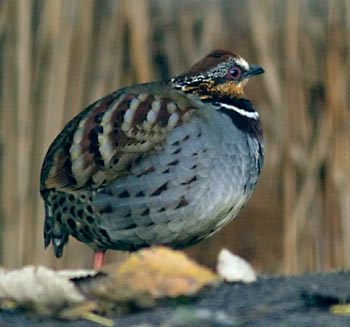 White-necklaced PartridgeArborophila gingica
-
 Bar-backed PartridgeArborophila brunneopectus
-
 Chestnut-breasted PartridgeArborophila mandellii
-
 Chestnut-bellied PartridgeArborophila javanica
-
 Hainan PartridgeArborophila ardens
Compare
Questions and answers
What is the scientific name of the Hill Partridge?
The scientific name of the Hill Partridge is Arborophila torqueola. Written with its author, the full name is Arborophila torqueola (Valenciennes, 1825).
Which family does the Hill Partridge belong to?
Arborophila torqueola belongs to the family Phasianidae, in the order Galliformes and the class Aves.
Where is the Hill Partridge found?
Checklists and occurrence records place Arborophila torqueola in 6 countries: India, Bhutan, Nepal, China, Myanmar and Vietnam.
What is the conservation status of the Hill Partridge?
The IUCN Red List category recorded for Arborophila torqueola is Least Concern (LC).
What other names does the Hill Partridge have?
Arborophila torqueola is also known in English as Common Hill Partridge.
What does a partridge eat?
The Hill Partridge feeds on seeds and various invertebrates.[6]
Sources
Passages the profile rests on
- Males have an orange crown and face contrasting with a black head and streaked throat. Source passage: “a combination of an orange crown and face set against a black head and streaked throat.” — English Wikipedia
- Females lack the distinctive head markings and grey chest and upper belly found in males. Source passage: “Females lack the distinctive head markings and the grey chest and upper belly of the male” — English Wikipedia
- Females have white-streaked ginger-brown flank feathers extending across more of the belly. Source passage: “the flank colouration of white streaked ginger-brown feathers extending further up and across the belly of the hen.” — English Wikipedia
- The species measures approximately 27–30 cm in length. Source passage: “The length of this species is roughly 27–30 cm (11–12 in)” — English Wikipedia
- Body weight ranges from approximately 230 g in small females to 390 g in large males. Source passage: “weight can vary between 230 g (8 oz) for a small female to 390 g (14 oz) for a large fat male.” — English Wikipedia
- The species feeds on seeds and various invertebrates. Source passage: “The food of the common hill-partridge comprises seeds and various invertebrates” — English Wikipedia
- Individuals are usually observed in pairs or small groups containing up to ten birds. Source passage: “Common hill-partridges are mostly seen in pairs or small coveys of up to 10 individuals” — English Wikipedia
- Groups may consist of members of the same family. Source passage: “that may be made up of family groups.” — English Wikipedia
- The species collects food by scratching through leaf litter. Source passage: “which it collects by scratching in leaf litter.” — English Wikipedia
- The species regularly gives a hen-like contact call while feeding. Source passage: “It has a hen-like contact call that is constantly uttered when it is feeding.” — English Wikipedia
- Indian populations generally breed between April and June. Source passage: “Indian populations of common hill-partridges breed between April and June” — English Wikipedia
- Breeding has also been recorded earlier in the year at lower elevations. Source passage: “although earlier breeding has been recorded at lower altitudes.” — English Wikipedia
- The average clutch contains three to five eggs. Source passage: “The average clutch size is 3-5 eggs” — English Wikipedia
- Clutches of up to nine eggs have been observed. Source passage: “but up to nine eggs have also been observed” — English Wikipedia
- Incubation lasts approximately 24 days in captive birds. Source passage: “are reported to be 24 days for captive birds.” — English Wikipedia
- The nest consists of a shallow lined scrape forming a central cup within a ball of nearby nesting materials. Source passage: “The nest is a ball of whatever manageable materials are within a few feet of the nest site with a lined shallow scrape at the centre to form the cup of the nest.” — English Wikipedia
- The species inhabits subtropical or tropical moist lowland forests. Source passage: “Its natural habitats are subtropical or tropical moist lowland forest” — English Wikipedia
- The species inhabits subtropical or tropical moist montane forests. Source passage: “and subtropical or tropical moist montane forest.” — English Wikipedia
- The species is described as not globally threatened and common across most of its range. Source passage: “The species is not globally threatened and is common in most parts of its range.” — English Wikipedia
- The species has a very large geographic range and does not meet the Vulnerable threshold based on range size. Source passage: “This species has a very large range, and hence does not approach the thresholds for Vulnerable under the range size criterion” — datazone.birdlife.org
- The species was most recently assessed for the IUCN Red List in 2018. Source passage: “Hill Partridge Arborophila torqueola has most recently been assessed for The IUCN Red List of Threatened Species in 2018.” — iucnredlist.org
Data
- Catalogue of Life, 2026-10-16 XR cc by
- Global Biodiversity Information Facility CC BY 4.0
- Wikidata CC0
- GeoNames CC BY 4.0
- Wikimedia Commons per image; credit shown with each image
- Within the Catalogue of Life, this name comes from The Integrated Taxonomic Information System cc0
References
- Dickinson, Edward C., ed. (2003). The Howard and Moore Complete Checklist of the Birds of the World, 3rd Edition.
- Gill, Frank, & and Minturn Wright. (2006). Birds of the World: Recommended English Names.
- Dickinson, E. C., and J. V. Remsen Jr., eds. (2013). The Howard and Moore Complete Checklist of the Birds of the World, 4th Edition, Vol. 1 Non-Passerines.
This species in other databases
Page built on 28 November 2026. See how the catalog is made and all sources and licences.
Cite this page
ScientificNames.org. (2026). Arborophila torqueola (Hill Partridge). Retrieved November 28, 2026, from https://scientificnames.org/species/arborophila-torqueola
“Arborophila torqueola (Hill Partridge).” ScientificNames.org, 2026, scientificnames.org/species/arborophila-torqueola. Accessed 28 Nov. 2026.
ScientificNames.org. “Arborophila torqueola (Hill Partridge).” Accessed November 28, 2026. https://scientificnames.org/species/arborophila-torqueola.
@misc{scientificnames_arborophila_torqueola_hill_partridge,
  author = {{ScientificNames.org}},
  title = {Arborophila torqueola (Hill Partridge)},
  year = {2026},
  url = {https://scientificnames.org/species/arborophila-torqueola},
  note = {Accessed 2026-11-28}
}