Species · Birds
Rufous-throated Partridge Arborophila rufogularis
The scientific name of the Rufous-throated Partridge is Arborophila rufogularis. It is a species of bird in the family Phasianidae (quail), order Galliformes. The name dates from 1849.
- Scientific name
- Arborophila rufogularis (Blyth, 1849)
- Common name
- Rufous-throated Partridge
- Genus
- Arborophila
- Family
- Phasianidae (Quail)
- Order
- Galliformes
- Class
- Aves
- Red List category
- LC Least Concern
- Recorded in
- 9 countries
- Name status
- accepted in the Catalogue of Life

Overview
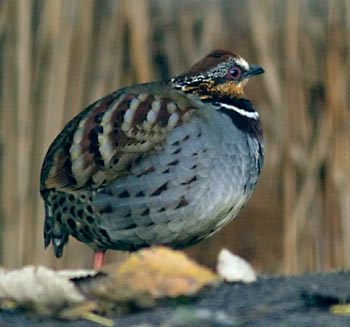
The Rufous-throated Partridge (Arborophila rufogularis) is a bird in the family Phasianidae, order Galliformes and class Aves. It inhabits montane forests at elevations of 1,800–3,000 metres. It is distinguished by its orange-rufous throat and sides of the neck, marked with black speckles.
Written 26 November 2026 from the sources listed below. Each statement was checked against the passage it cites; statements that could not be supported were removed.
Appearance
Adult males have a grey forehead and an olive-brown crown and nape marked with black mottles. The species has a whitish supercilium and whitish moustachial curves.[1][2]
The throat and sides of the neck are orange-rufous with black speckles. The breast and flanks are blue-grey, and the upper belly is blue-grey while the central belly is whitish.[3][4][5]
The vent is buffy-brown, while the mantle, back and rump are olive-brown. The scapulars and wing coverts have chestnut, black and greyish bands.[6][7][8]
Females have plumage similar to males. Juveniles have duller underparts and brown and black vermiculations on the crown and flanks.[9][10]
The throat pattern differs among the recognized subspecies.[11]
Adults measure 26–29 cm in length. Adult males weigh between 325 and 430 g, while adult females weigh between 261 and 386 g.[12][13][14]
Habitat
The Rufous-throated Partridge inhabits montane forests, principally at elevations of 1,800–3,000 metres. Oak forests containing laurels and rhododendrons are preferred habitats.[15][16][17]
Diet
The Rufous-throated Partridge eats seeds, plant shoots, berries, insects and snails.[18]
Behaviour
The species forages in groups of five to ten birds. When startled, individuals escape by running or flying, and some fly onto branches.[19][20][21]
Birds belonging to the same covey roost and huddle together in trees.[22]
The species produces a rising series of hu-hu whistles. During duets, the partner responds with a kew-kew-kew call.[23][24]
Reproduction and life cycle
Breeding has been recorded in India between April and July and in China between February and May.[25][26]
The male constructs a scrape in bamboo, forest undergrowth or beside water. The nest is lined or padded with grass.[27][28]
Clutches contain three to five white eggs.[29]
Conservation
The IUCN classifies the Rufous-throated Partridge as Least Concern. Its population is declining because of habitat destruction and unsustainable hunting.[30][31]
The IUCN assessment published in 2016 is the most recent assessment identified in the supplied IUCN document.[32]
Classification of the Rufous-throated Partridge
| Kingdom | Animalia |
|---|---|
| Phylum | Chordata |
| Subphylum | Vertebrata |
| Infraphylum | Gnathostomata |
| Parvphylum | Osteichthyes |
| Megaclass | Tetrapoda |
| Class | Aves (Bird) |
| Order | Galliformes (Fowls) |
| Family | Phasianidae (Quail) |
| Genus | Arborophila (Hill-Partridges) |
| Species | Arborophila rufogularis (Blyth, 1849) |
Where the Rufous-throated Partridge is found
Checklists and occurrence records place Arborophila rufogularis in 9 countries across Asia. GBIF holds 8,794 georeferenced records of it.
Countries
- Bangladesh 18
- Bhutan 642
- China 1,042
- India 3,705
- Laos 68
- Myanmar 185
- Nepal 118
- Thailand 2,243
- Vietnam 773
Regions and cities with the most records
- Chiang Mai, Thailand 1,826
- Uttarakhand, India 1,306
- Naini Tāl, India 1,268
- Haldwani, India 1,194
- Yunnan, China 992
- Lam Dong, Vietnam 492
- Ðà Lạt, Vietnam 419
- Nagaland, India 337
- Jietou, China 222
- Mizoram, India 213
- Kohima, India 202
- Kamphaeng Phet, Thailand 192
- Arunachal Pradesh, India 182
- Mongar, Bhutan 181
- West Bengal, India 174
- Zhemgang District, Bhutan 148
- Manipur, India 116
- Shan State, Myanmar 110
- Kurseong, India 99
- Samdrup Jongkhar, Bhutan 82
- Meghalaya, India 81
- Thừa Thiên Huế Province, Vietnam 81
- Sikkim, India 78
- Dārjiling, India 71
- Serchhīp, India 68
- Kālimpong, India 62
- Tak, Thailand 59
- Lao Cai, Vietnam 53
- Tongsa, Bhutan 51
- Qushi, China 50
- Kathmandu, Nepal 46
- Madhyapur Thimi, Nepal 46
- Pātan, Nepal 46
- Ki̇̄rtipur, Nepal 45
- Banepā, Nepal 42
- Beihai, China 42
Range as the checklists state it
Southern Asia
A number beside a place is its count of GBIF occurrence records. A place without a number comes from a checklist alone. Records show where a species has been observed or collected, which can include escapes and vagrants.
Common names
English
- Rufous-throated Partridge
- Rufous-throated Hill Partridge
Names in 29 other languages
- Arabic
- حجل أصهب الحنجرة, حجل التل أصهب الحنجرة
- Bengali
- পাহাড়ি তিতির
- Catalan
- perdiu forestal gola-rogenca
- Chinese
- 紅喉山鷓鴣, 红喉山鹧鸪
- Croatian
- riđogrla trčka
- Czech
- koroptev oranžovohrdlá
- Danish
- Gyldenstrubet Buskhøne, Gyldenstrubet Skovhøne
- Dutch
- Roodkeelbospatrijs
- Esperanto
- rufgorĝa perdriko
- Estonian
- punakael-künkakana
- Finnish
- ruskokurkkupyy
- French
- Torquéole à gorge rousse
- German
- Rotkehl-Buschwachtel, Rotkehl-Waldrebhuhn, Rotkehlbuschwachtel, Rotkehlwaldrebhuhn
- Italian
- Pernice golarossiccia
- Japanese
- ノドアカミヤマテッケイ
- Latvian
- rudrīkles irbīte
- Lithuanian
- raudongurklė krūmyninė kurapka
- Norwegian
- ruststrupehøne
- Polish
- pstropiór rdzawogardły
- Portuguese
- perdiz-de-garganta-ruiva, perdiz-de-papo-ruivo, perdiz-montesa-de-papo-ruivo
- Russian
- Красногорлая кустарниковая куропатка, Красногорлая лесная куропатка
- Serbian
- Riđogrla jarebica
- Slovak
- kurička hrdzavokrká
- Spanish
- Arborófila golirrufa
- Swedish
- roststrupig sånghöna
- Thai
- นกกระทาดงคอสีแสด
- Turkish
- Kızıl Boğazlı Dağ Kekliği
- Ukrainian
- куріпка непальська
- Welsh
- petrisen fynydd yddfgoch
Subspecies and varieties
- Arborophila rufogularis annamensis subspecies
- Arborophila rufogularis euroa subspecies
- Arborophila rufogularis guttata subspecies
- Arborophila rufogularis intermedia subspecies
- Arborophila rufogularis rufogularis subspecies
- Arborophila rufogularis tickelli subspecies
Related species
-
 Hill PartridgeArborophila torqueola
-
 Red-billed PartridgeArborophila rubrirostris
-
 Taiwan PartridgeArborophila crudigularis
-
 White-necklaced PartridgeArborophila gingica
-
 Bar-backed PartridgeArborophila brunneopectus
-
 Chestnut-breasted PartridgeArborophila mandellii
-
 Chestnut-bellied PartridgeArborophila javanica
-
 Hainan PartridgeArborophila ardens
Compare
Questions and answers
What is the scientific name of the Rufous-throated Partridge?
The scientific name of the Rufous-throated Partridge is Arborophila rufogularis. Written with its author, the full name is Arborophila rufogularis (Blyth, 1849).
Which family does the Rufous-throated Partridge belong to?
Arborophila rufogularis belongs to the family Phasianidae, in the order Galliformes and the class Aves.
Where is the Rufous-throated Partridge found?
Checklists and occurrence records place Arborophila rufogularis in 9 countries, including India, Thailand, China, Vietnam, Bhutan and Myanmar.
What is the conservation status of the Rufous-throated Partridge?
The IUCN Red List category recorded for Arborophila rufogularis is Least Concern (LC).
What other names does the Rufous-throated Partridge have?
Arborophila rufogularis is also known in English as Rufous-throated Hill Partridge.
What do partridges eat?
The Rufous-throated Partridge eats seeds, plant shoots, berries, insects and snails.[18]
Sources
Passages the profile rests on
- Adult males have a grey forehead and an olive-brown crown and nape marked with black mottles. Source passage: “The male has a grey forehead. The olive-brown crown and nape have black mottles.” — English Wikipedia
- The species has a whitish supercilium and whitish moustachial curves. Source passage: “There are a whitish supercilium and moustachial curves.” — English Wikipedia
- The throat and sides of the neck are orange-rufous with black speckles. Source passage: “The throat and neck-sides are orange-rufous, with black speckles.” — English Wikipedia
- The breast and flanks are blue-grey. Source passage: “The breast and flanks are blue-grey.” — English Wikipedia
- The upper belly is blue-grey, while the central belly is whitish. Source passage: “The upper belly is blue-grey and the central belly is whitish.” — English Wikipedia
- The vent is buffy-brown. Source passage: “The vent is buffy-brown.” — English Wikipedia
- The mantle, back and rump are olive-brown. Source passage: “The mantle, back and rump are olive-brown.” — English Wikipedia
- The scapulars and wing coverts have chestnut, black and greyish bands. Source passage: “The scapulars and wing coverts have chestnut, black and greyish bands.” — English Wikipedia
- Females have plumage similar to males. Source passage: “The female is similar to the male.” — English Wikipedia
- Juveniles have duller underparts and brown and black vermiculations on the crown and flanks. Source passage: “The juvenile bird is duller below, and its crown and flanks have brown and black vermiculations.” — English Wikipedia
- The throat pattern differs among the recognized subspecies. Source passage: “The subspecies have different patterns on their throats.” — English Wikipedia
- Adults measure 26–29 cm in length. Source passage: “The rufous-throated partridge is 26–29 cm (10–11 in) long.” — English Wikipedia
- Adult males weigh between 325 and 430 g. Source passage: “The male weighs 325–430 g (11.5–15.2 oz)” — English Wikipedia
- Adult females weigh between 261 and 386 g. Source passage: “the female weighs 261–386 g (9.2–13.6 oz).” — English Wikipedia
- The species inhabits montane forests. Source passage: “Its natural habitat is montane forests” — English Wikipedia
- Its principal habitat elevation range is 1,800–3,000 metres. Source passage: “mainly at elevations of 1,800–3,000 metres (5,900–9,800 ft).” — English Wikipedia
- Oak forests containing laurels and rhododendrons are preferred habitats. Source passage: “Oak forests containing laurels and rhododendrons are preferred.” — English Wikipedia
- The species eats seeds, plant shoots, berries, insects and snails. Source passage: “It eats seeds, plant shoots, berries, insects and snails.” — English Wikipedia
- The species forages in groups of five to ten birds. Source passage: “This partridge feeds in groups of five to ten birds.” — English Wikipedia
- When startled, individuals escape by running or flying. Source passage: “Surprised birds run or fly” — English Wikipedia
- Some startled individuals fly onto branches. Source passage: “sometimes flying to branches like some thrushes.” — English Wikipedia
- Birds belonging to the same covey roost and huddle together in trees. Source passage: “Birds in a covey roost and huddle together in trees, similar to babblers.” — English Wikipedia
- The species produces a rising series of hu-hu whistles. Source passage: “The rufous-throated partridge gives a rising series of hu-hu whistles.” — English Wikipedia
- During duets, the partner responds with a kew-kew-kew call. Source passage: “In a duet, the partner's call is kew-kew-kew.” — English Wikipedia
- Breeding has been recorded in India between April and July. Source passage: “Breeding has been recorded from April to July in India” — English Wikipedia
- Breeding has been recorded in China between February and May. Source passage: “and from February to May in China.” — English Wikipedia
- The male constructs a scrape in bamboo, forest undergrowth or beside water. Source passage: “The male builds a scrape in bamboo, forest undergrowth or along water.” — English Wikipedia
- The nest is lined or padded with grass. Source passage: “The nest is lined or padded with grass.” — English Wikipedia
- Clutches contain three to five white eggs. Source passage: “Three to five white eggs are laid.” — English Wikipedia
- The IUCN classifies the species as Least Concern. Source passage: “the IUCN has assessed it as a least-concern species.” — English Wikipedia
- The species population is declining because of habitat destruction and unsustainable hunting. Source passage: “the species's population is declining because of habitat destruction and unsustainable hunting” — English Wikipedia
- The IUCN assessment published in 2016 is the most recent assessment identified in the supplied IUCN document. Source passage: “has most recently been assessed for The IUCN Red List of Threatened Species in 2016.” — iucnredlist.org
Data
- Catalogue of Life, 2026-10-16 XR cc by
- Global Biodiversity Information Facility CC BY 4.0
- Wikidata CC0
- GeoNames CC BY 4.0
- Wikimedia Commons per image; credit shown with each image
- Within the Catalogue of Life, this name comes from The Integrated Taxonomic Information System cc0
References
- Dickinson, Edward C., ed. (2003). The Howard and Moore Complete Checklist of the Birds of the World, 3rd Edition.
- Gill, Frank, & and Minturn Wright. (2006). Birds of the World: Recommended English Names.
- Dickinson, E. C., and J. V. Remsen Jr., eds. (2013). The Howard and Moore Complete Checklist of the Birds of the World, 4th Edition, Vol. 1 Non-Passerines.
This species in other databases
Page built on 29 November 2026. See how the catalog is made and all sources and licences.
Cite this page
ScientificNames.org. (2026). Arborophila rufogularis (Rufous-throated Partridge). Retrieved November 29, 2026, from https://scientificnames.org/species/arborophila-rufogularis
“Arborophila rufogularis (Rufous-throated Partridge).” ScientificNames.org, 2026, scientificnames.org/species/arborophila-rufogularis. Accessed 29 Nov. 2026.
ScientificNames.org. “Arborophila rufogularis (Rufous-throated Partridge).” Accessed November 29, 2026. https://scientificnames.org/species/arborophila-rufogularis.
@misc{scientificnames_arborophila_rufogularis_rufous_throated_partridge,
  author = {{ScientificNames.org}},
  title = {Arborophila rufogularis (Rufous-throated Partridge)},
  year = {2026},
  url = {https://scientificnames.org/species/arborophila-rufogularis},
  note = {Accessed 2026-11-29}
}