Species · Birds
Kori Bustard Ardeotis kori
The scientific name of the Kori Bustard is Ardeotis kori. It is a species of bird in the family Otididae (bustard), order Otidiformes. The name dates from 1822.
- Scientific name
- Ardeotis kori (Burchell, 1822)
- Common name
- Kori Bustard
- Genus
- Ardeotis
- Family
- Otididae (Bustard)
- Order
- Otidiformes
- Class
- Aves
- Red List category
- NT Near Threatened
- Recorded in
- 11 countries
- Name status
- accepted in the Catalogue of Life

Overview
The Kori Bustard (Ardeotis kori) is a bird in the family Otididae and the order Otidiformes. It occurs in eastern and southern Africa.
Written 26 November 2026 from the sources listed below. Each statement was checked against the passage it cites; statements that could not be supported were removed.
Appearance
It has relatively long legs, a large head and feet with three forward-facing toes. Females have slimmer necks and thinner legs than males.[1][2][3]
Juveniles resemble females but have browner plumage, more mantle spotting, and shorter crest and neck feathers.[4]
Adult males measure approximately 105–135 cm in body length and have wingspans of approximately 230–275 cm. They typically weigh between 7 and 18 kg.[5][6][7]
Adult females weigh approximately 3–7 kg and are approximately 20–30% smaller than males in linear measurements. Adult males are more than twice as heavy as females in some cases.[8][9][10]
Habitat
The Kori Bustard inhabits open grassy areas, particularly those with sandy soil and short grass. Its habitats include plains, arid plateaus, highveld grasslands, scrub, savannas and semi-deserts.[11][12]
The species generally avoids densely wooded and forested habitats. It may use cultivated areas, particularly wheat fields containing scattered trees.[13][14]
In arid grasslands, the species occurs along dry watercourses where trees provide shade.[15]
In the Serengeti ecosystem, males prefer open grasslands during the non-breeding season and closed or shrubbed grasslands during the breeding season. Females prefer more woody vegetation during the non-breeding season.[16][17]
Diet
The Kori Bustard is an opportunistic omnivore. Its insect prey includes locusts, grasshoppers, dung beetles and caterpillars.[18][19]
The species also consumes lizards, chameleons, small snakes, rodents and other small mammals.[20]
Its plant diet includes grasses, seeds, berries, roots, bulbs, flowers, wild melons and green leaves. It particularly favors Acacia gum.[21][22]
Kori Bustards regularly drink water when it is accessible and can travel as far as 40 km from water sources.[23]
Behaviour
Kori Bustards spend approximately 70% of their time walking on the ground. When threatened, they commonly run or crouch before resorting to flight.[24][25]
The species generally avoids flying because of its large body size and weight. It is generally residential but sometimes makes nomadic movements associated with rainfall.[26][27]
Male Kori Bustards tracked in the Serengeti were 21.5% more mobile than females.[28]
Reproduction and life cycle
Male Kori Bustards do not participate in incubating eggs or caring for offspring.[29]
The nominate subspecies generally breeds between September and February. Ardeotis kori struthiunculus generally breeds between December and August.[30][31]
Conservation
The Kori Bustard is classified as Near Threatened. The distribution of its subspecies has declined because of anthropogenic pressures, including altered land use and illegal harvesting.[32][33]
The subspecies Ardeotis kori struthiunculus is listed as Near Threatened and included in Appendix II of CITES.[34]
Classification of the Kori Bustard
| Kingdom | Animalia |
|---|---|
| Phylum | Chordata |
| Subphylum | Vertebrata |
| Infraphylum | Gnathostomata |
| Parvphylum | Osteichthyes |
| Megaclass | Tetrapoda |
| Class | Aves (Bird) |
| Order | Otidiformes (Bustards) |
| Family | Otididae (Bustard) |
| Genus | Ardeotis (Large Bustards) |
| Species | Ardeotis kori (Burchell, 1822) |
Where the Kori Bustard is found
Checklists and occurrence records place Ardeotis kori in 11 countries across Africa. GBIF holds 51,470 georeferenced records of it.
Countries
- Botswana 4,613
- Ethiopia 899
- Kenya 8,728
- Mozambique 21
- Namibia 8,021
- Somalia 21
- South Africa 20,774
- Tanzania 7,342
- Uganda 6
- Zambia 3
- Zimbabwe 1,042
Regions and cities with the most records
- Northern Cape, South Africa 5,701
- Mpumalanga, South Africa 5,519
- Limpopo, South Africa 4,845
- Oshikoto Region, Namibia 4,535
- Arusha, Tanzania 4,332
- Kajiado County, Kenya 2,066
- North West, South Africa 1,816
- Chobe, Botswana 1,605
- Simiyu, Tanzania 1,483
- Narok County, Kenya 1,420
- Laikipia, Kenya 1,312
- Kgalagadi, Botswana 1,283
- North-West, Botswana 1,161
- Mara, Tanzania 1,153
- Taita Taveta, Kenya 970
- Oshana Region, Namibia 958
- Matabeleland North, Zimbabwe 904
- Central, Botswana 844
- Eastern Cape, South Africa 831
- Western Cape, South Africa 751
- Otjozondjupa Region, Namibia 695
- Mlolongo, Kenya 687
- Ongata Rongai, Kenya 620
- Imara Daima Estate, Kenya 617
- Komatipoort, South Africa 611
- Nairobi, Kenya 596
- Isiolo County, Kenya 594
- Nairobi County, Kenya 570
- Githunguri, Kenya 543
- Ressano Garcia, Mozambique 525
- Meru County, Kenya 507
- Kiserian, Kenya 504
- Oromiya, Ethiopia 496
- Ngong, Kenya 485
- Samburu County, Kenya 465
- Ghanzi, Botswana 424
2 more countries have a few records outside this range
These countries hold a few records of Ardeotis kori but lie outside the range the checklists give for it. Such records are often zoo or garden specimens, museum material or vagrants, so the species is not counted as occurring there.
Range as the checklists state it
Africa
A number beside a place is its count of GBIF occurrence records. A place without a number comes from a checklist alone. Records show where a species has been observed or collected, which can include escapes and vagrants.
Common names
English
- Kori Bustard
- Giant Bustard
- KOBU
Names in 32 other languages
- Afrikaans
- Gompou
- Arabic
- حبارى كوري
- Bulgarian
- Африканска голяма дропла
- Catalan
- pioc salvatge kori
- Chinese
- 灰頸鷺鴇, 灰颈鹭鸨
- Croatian
- sivovrata droplja
- Danish
- Koritrappe
- Dutch
- Koritrap
- Esperanto
- giganta otido
- Estonian
- hiidtrapp
- Finnish
- kuningastrappi
- French
- Outarde kori
- German
- Riesentrappe
- Greek
- Ωτίδα του Κόρι
- Hebrew
- חובת קורי
- Hungarian
- óriástúzok
- Italian
- Otarda di Kori, Otarda kori
- Japanese
- アフリカオオノガン
- Lithuanian
- afrikinis didysis einis
- Polish
- drop olbrzymi
- Portuguese
- abetarda-gigante
- Russian
- Африканская большая дрофа, Дрофа-кори
- Serbian
- Kori droplja
- Slovak
- drop kori
- Spanish
- Avutarda kori
- Swedish
- koritrapp
- Tswana
- Kgori
- Turkish
- Kori Toyu
- Ukrainian
- дрохва африканська
- Welsh
- ceiliog gwaun Kori
- Xhosa
- Iseme
- her
- Etwangema
Synonyms
2 other scientific names have been used for this species and are now treated as synonyms of Ardeotis kori.
- Choriotis kori Burchell, WJ, 1822
- Otis kori Burchell, 1822
Subspecies and varieties
- Ardeotis kori kori (Southern Kori) subspecies
- Ardeotis kori struthiunculus (Somali Kori) subspecies
Related species
-
 Great Indian BustardArdeotis nigriceps
-
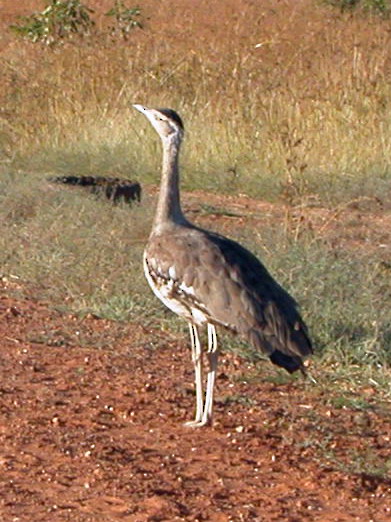 Australian BustardArdeotis australis
-
 Arabian BustardArdeotis arabs
-
 Great BustardOtis tarda
-
 Little BustardTetrax tetrax
-
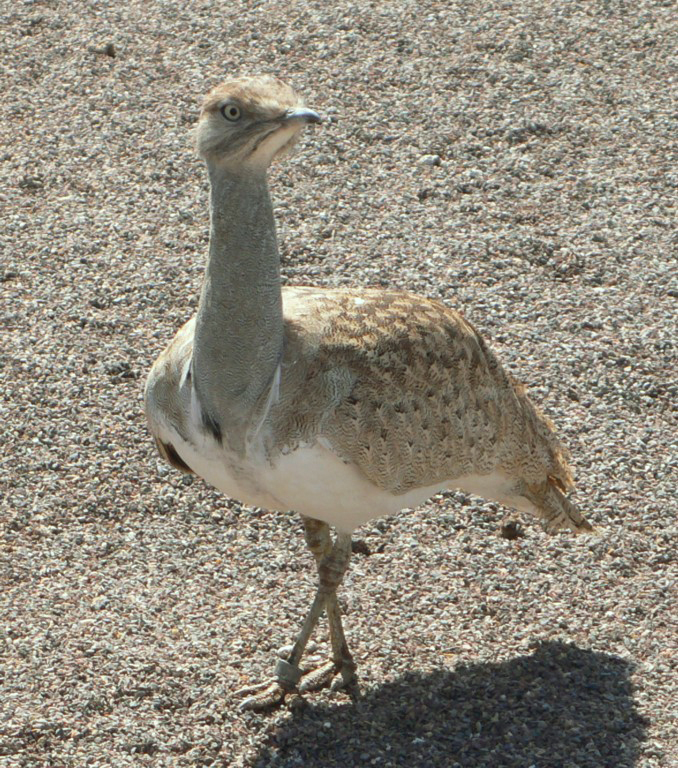 African HoubaraChlamydotis undulata
-
 Bengal FloricanHoubaropsis bengalensis
-
 Lesser FloricanSypheotides indicus
Compare
Questions and answers
What is the scientific name of the Kori Bustard?
The scientific name of the Kori Bustard is Ardeotis kori. Written with its author, the full name is Ardeotis kori (Burchell, 1822).
Which family does the Kori Bustard belong to?
Ardeotis kori belongs to the family Otididae, in the order Otidiformes and the class Aves.
Where is the Kori Bustard found?
Checklists and occurrence records place Ardeotis kori in 11 countries, including South Africa, Kenya, Namibia, Tanzania, Botswana and Zimbabwe.
What is the conservation status of the Kori Bustard?
The IUCN Red List category recorded for Ardeotis kori is Near Threatened (NT).
What other names does the Kori Bustard have?
Ardeotis kori is also known in English as Giant Bustard and KOBU.
Why is it called kori bustard?
The specific epithet kori originates from the Tswana name Kgori.[35]
Sources
Passages the profile rests on
- The Kori bustard has relatively long legs and a large head. Source passage: “The head is large and the legs are relatively long.” — English Wikipedia
- Its feet have three forward-facing toes. Source passage: “The feet have three forward facing toes.” — English Wikipedia
- Female Kori bustards have slimmer necks and thinner legs than males. Source passage: “The female is visibly thinner legged and slimmer necked.” — English Wikipedia
- Juveniles resemble females but have browner plumage, more mantle spotting, and shorter crest and neck feathers. Source passage: “The juvenile is similar in appearance to the female, but is browner with more spotting on the mantle, with shorter crest and neck plumes.” — English Wikipedia
- Adult males measure approximately 105–135 cm in body length. Source passage: “The male kori bustard has a length of 105 to 135 cm (3 ft 5 in to 4 ft 5 in)” — English Wikipedia
- Adult males have wingspans of approximately 230–275 cm. Source passage: “and a wingspan of 230 to 275 cm (7 ft 7 in to 9 ft 0 in).” — English Wikipedia
- Male Kori bustards typically weigh between 7 and 18 kg. Source passage: “Male birds may typically weigh between 7 and 18 kg (15 and 40 lb).” — English Wikipedia
- Adult females weigh approximately 3–7 kg. Source passage: “The female kori bustard weighs an average of 4.8 to 6.1 kg (11 to 13 lb), with a full range of 3 to 7 kg (6.6 to 15.4 lb).” — English Wikipedia
- Females are approximately 20–30% smaller than males in linear measurements. Source passage: “Females are similar in plumage but are much smaller, measuring about 20–30% less in linear measurements” — English Wikipedia
- Adult males are more than twice as heavy as females in some cases. Source passage: “Male kori bustards, which can be more than twice as heavy as the female” — English Wikipedia
- The species inhabits open grassy areas, particularly those with sandy soil and short grass. Source passage: “This species occurs in open grassy areas, often characterized by sandy soil, especially Kalahari sands, and short grass” — English Wikipedia
- Its habitats include plains, arid plateaus, highveld grasslands, scrub, savannas, and semi-deserts. Source passage: “It may be found in plains, arid plateaus, highveld grassland, arid scrub, lightly wooded savanna, open dry bushveld and semi-desert.” — English Wikipedia
- The species generally avoids densely wooded and forested habitats. Source passage: “This bustard is not found in well-wooded and forested areas due to the fact that it needs a lot of open space in which to take off.” — English Wikipedia
- Kori bustards may use cultivated areas, particularly wheat fields containing scattered trees. Source passage: “They may also be found in cultivated areas, especially wheat fields with a few scattered trees.” — English Wikipedia
- In arid grasslands, the species occurs along dry watercourses where trees provide shade. Source passage: “In arid grassland areas it is found along dry watercourses where patches of trees offer shade during the heat of the day.” — English Wikipedia
- In the Serengeti ecosystem, males prefer open grasslands during the non-breeding season and closed or shrubbed grasslands during the breeding season. Source passage: “males preferred more open grasslands during the non-breeding period and also preferred closed and shrubbed grassland during the breeding period.” — pmc.ncbi.nlm.nih.gov
- In the Serengeti ecosystem, females prefer more woody vegetation during the non-breeding season. Source passage: “Females preferred more woody vegetation during the non-breeding season compared to the breeding season.” — pmc.ncbi.nlm.nih.gov
- The Kori bustard is an opportunistic omnivore. Source passage: “This species, like most bustards, is a ground-dwelling bird and an opportunistic omnivore.” — English Wikipedia
- Its insect prey includes locusts, grasshoppers, dung beetles, and caterpillars. Source passage: “Insects are an important food source, with common species such as locusts, grasshoppers, dung beetles (Scarabaeus ssp.) and caterpillars being most often taken.” — English Wikipedia
- The species also consumes lizards, chameleons, small snakes, rodents, and other small mammals. Source passage: “Small vertebrates may also be taken regularly, including lizards, chameleons, small snakes, small mammals (especially rodents)” — English Wikipedia
- Its plant diet includes grasses, seeds, berries, roots, bulbs, flowers, wild melons, and green leaves. Source passage: “Grasses and their seeds are perhaps the most prominent plant foods, but they may also eat seeds, berries, roots, bulbs, flowers, wild melons and green leaves.” — English Wikipedia
- The species particularly favors Acacia gum. Source passage: “This bustard is very partial to Acacia gum.” — English Wikipedia
- Kori bustards regularly drink water when it is accessible and can travel as far as 40 km from water sources. Source passage: “They drink regularly when they can access water but they can be found as far as 40 km (25 mi) from water sources.” — English Wikipedia
- Kori bustards spend approximately 70% of their time walking on the ground. Source passage: “with up to 70% of their time being on foot” — English Wikipedia
- When threatened, the species commonly runs or crouches before resorting to flight. Source passage: “Their behavior varies however, and they are usually very shy, running or crouching at the first sign of danger” — English Wikipedia
- Kori bustards generally avoid flying because of their large body size and weight. Source passage: “Being a large and heavy bird, it avoids flying if possible.” — English Wikipedia
- The species is generally residential but sometimes makes nomadic movements associated with rainfall. Source passage: “They are usually residential in their range, with some random, nomadic movement following rainfall.” — English Wikipedia
- Male Kori bustards tracked in the Serengeti were 21.5% more mobile than females. Source passage: “The results indicated that males were 21.5% more mobile than females” — pmc.ncbi.nlm.nih.gov
- Male Kori bustards do not participate in incubating eggs or caring for offspring. Source passage: “Similar to other bustards, the male Kori bustards do not participate in parental care, including incubation of the eggs and care of the young” — pmc.ncbi.nlm.nih.gov
- The nominate subspecies generally breeds between September and February. Source passage: “A. k. kori breeds from September to February.” — English Wikipedia
- The subspecies Ardeotis kori struthiunculus generally breeds between December and August. Source passage: “A. k. struthiunculus breeds from December to August” — English Wikipedia
- The Kori bustard is classified as Near Threatened. Source passage: “Otididae Kori Bustard Ardeotis kori NT Near Threatened” — ebird.org
- The distribution of Kori bustard subspecies has declined because of anthropogenic pressures, including altered land use and illegal harvesting. Source passage: “The distribution of these sub species has recently decreased due to various anthropogenic factors, including altered land use practices [14] and illegal harvests [15–19].” — pmc.ncbi.nlm.nih.gov
- The subspecies Ardeotis kori struthiunculus is listed as Near Threatened and included in Appendix II of CITES. Source passage: “Ardeotis kori struthiunculus is listed as near threatened by the IUCN and is included in Appendix II of the list of CITES species [20].” — pmc.ncbi.nlm.nih.gov
- The specific epithet kori originates from the Tswana name Kgori. Source passage: “The specific epithet kori is derived from the Tswana name for this bird – Kgori.” — English Wikipedia
Data
- Catalogue of Life, 2026-10-16 XR cc by
- Global Biodiversity Information Facility CC BY 4.0
- Wikidata CC0
- GeoNames CC BY 4.0
- Wikimedia Commons per image; credit shown with each image
- Within the Catalogue of Life, this name comes from The Integrated Taxonomic Information System cc0
References
- Gill, Frank, & and Minturn Wright. (2006). Birds of the World: Recommended English Names.
- Dickinson, E. C., and J. V. Remsen Jr., eds. (2013). The Howard and Moore Complete Checklist of the Birds of the World, 4th Edition, Vol. 1 Non-Passerines.
This species in other databases
Page built on 28 November 2026. See how the catalog is made and all sources and licences.
Cite this page
ScientificNames.org. (2026). Ardeotis kori (Kori Bustard). Retrieved November 28, 2026, from https://scientificnames.org/species/ardeotis-kori
“Ardeotis kori (Kori Bustard).” ScientificNames.org, 2026, scientificnames.org/species/ardeotis-kori. Accessed 28 Nov. 2026.
ScientificNames.org. “Ardeotis kori (Kori Bustard).” Accessed November 28, 2026. https://scientificnames.org/species/ardeotis-kori.
@misc{scientificnames_ardeotis_kori_kori_bustard,
  author = {{ScientificNames.org}},
  title = {Ardeotis kori (Kori Bustard)},
  year = {2026},
  url = {https://scientificnames.org/species/ardeotis-kori},
  note = {Accessed 2026-11-28}
}