Species · Birds
African Houbara Chlamydotis undulata
The scientific name of the African Houbara is Chlamydotis undulata. It is a species of bird in the family Otididae (bustard), order Otidiformes. The name dates from 1784.
- Scientific name
- Chlamydotis undulata (Jacquin, 1784)
- Common name
- African Houbara
- Genus
- Chlamydotis
- Family
- Otididae (Bustard)
- Order
- Otidiformes
- Class
- Aves
- Red List category
- VU Vulnerable
- Recorded in
- 7 countries
- Name status
- accepted in the Catalogue of Life
Overview
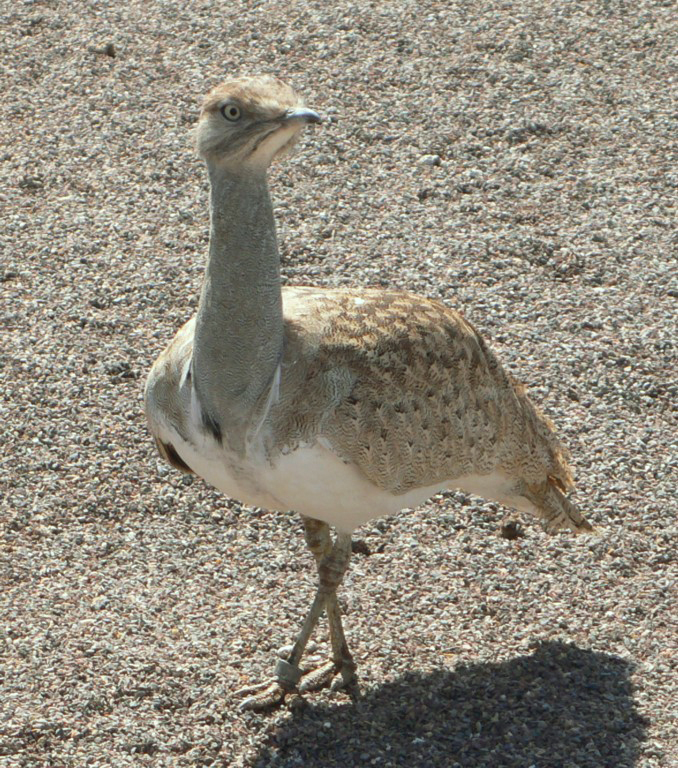
Chlamydotis undulata inhabits arid desert and semi-desert environments in North Africa, mainly in the western Sahara desert region. It is distinguished by its long neck and tail, greyish neck, black neck ruff and long wings with conspicuous black and brown flight feathers.
Written 26 November 2026 from the sources listed below. Each statement was checked against the passage it cites; statements that could not be supported were removed.
Appearance
The African Houbara has brown upperparts, white underparts and a black stripe running along each side of its neck. Its neck is greyish, with a black ruff along the sides.[1][2]
It has long wings with conspicuous black and brown areas on its flight feathers, as well as a long neck and tail. Females are generally greyer above and smaller than males.[3][4][5]
The African Houbara measures approximately 55–75 cm in length and has a wingspan of approximately 135–170 cm. Adult males measure approximately 65–75 cm in height, while adult females measure approximately 55–65 cm.[6][7][8][9]
Males weigh approximately 1.8–3.2 kg, while females weigh approximately 1.2–1.7 kg.[10][11]
Habitat
The African Houbara inhabits arid environments in North Africa. It occurs in desert and semi-desert habitats with low scattered bushes, mainly in the western Sahara desert region.[12][13][14]
Diet
The African Houbara is omnivorous and consumes seeds, insects and other small creatures.[15]
Behaviour
During its elaborate display, the African Houbara raises the white feathers of its head and neck while withdrawing its head. Males produce three to five low booming notes during breeding displays.[16][17]
North African populations are sedentary rather than migratory.[18]
Reproduction and life cycle
Female African Houbaras lay between two and four eggs per clutch. The eggs are laid directly on the ground.[19][20]
Breeding-performance differences between wild-born and released females have been investigated in reinforced North African populations of the African Houbara subspecies.[21]
Conservation
The global population of the African Houbara has been classified as Vulnerable on the IUCN Red List since 2014. The Canary Islands population was assessed as Near Threatened in 2015 before subsequently being assessed as Vulnerable.[22][23]
African Houbara populations declined during the two decades preceding 2004 but subsequently increased. The species is hunted in North Africa by falconers and firearm hunters.[24][25]
Classification of the African Houbara
| Kingdom | Animalia |
|---|---|
| Phylum | Chordata |
| Subphylum | Vertebrata |
| Infraphylum | Gnathostomata |
| Parvphylum | Osteichthyes |
| Megaclass | Tetrapoda |
| Class | Aves (Bird) |
| Order | Otidiformes (Bustards) |
| Family | Otididae (Bustard) |
| Genus | Chlamydotis (Houbaras) |
| Species | Chlamydotis undulata (Jacquin, 1784) |
Where the African Houbara is found
Checklists and occurrence records place Chlamydotis undulata in 7 countries across Africa. GBIF holds 5,505 georeferenced records of it.
Countries
Regions and cities with the most records
- Canary Islands, Spain 4,141
- La Oliva, Spain 2,708
- Puerto del Rosario, Spain 1,834
- Tías, Spain 1,713
- Teguise, Spain 1,707
- San Bartolomé, Spain 1,701
- Arrecife, Spain 1,622
- Puerto del Carmen, Spain 1,475
- Yaiza, Spain 780
- Pájara, Spain 263
- Boumia, Morocco 30
- Oriental, Morocco 24
- Missour, Morocco 22
- Ar Rudayyif, Tunisia 14
- Gafsa, Tunisia 14
- Moularès, Tunisia 14
- Naama, Algeria 13
- Arfoud, Morocco 8
- Mecheria, Algeria 7
- Moulay Ali Cherif, Morocco 6
- Reçani, Morocco 6
- Biskra, Algeria 5
- Biskra, Algeria 5
- Sidi Okba, Algeria 5
- Midelt, Morocco 4
- Arucas, Spain 3
- Gabès Governorate, Tunisia 3
- Las Palmas de Gran Canaria, Spain 3
- Santa Brígida, Spain 3
- Telde, Spain 3
3 more countries have a few records outside this range
These countries hold a few records of Chlamydotis undulata but lie outside the range the checklists give for it. Such records are often zoo or garden specimens, museum material or vagrants, so the species is not counted as occurring there.
Range as the checklists state it
Africa
A number beside a place is its count of GBIF occurrence records. A place without a number comes from a checklist alone. Records show where a species has been observed or collected, which can include escapes and vagrants.
Common names
English
- African Houbara
- African Houbara Bustard
- HOBU
- Houbara Bustard
Names in 49 other languages
- Arabic
- حبارى أفريقي
- Armenian
- Գեղանի արոս
- Azerbaijani
- Gözəl baladoydaq
- Basque
- Houbara basoilo
- Breton
- Otiz houbara
- Bulgarian
- Африканска хубара, Хубара
- Catalan
- Pioc hubara, hubara africana
- Chinese
- 波斑鴇, 翎頜鴇, 非洲波斑鸨
- Croatian
- ogrličasta droplja
- Czech
- drop hřívnatý, drop obojkový
- Danish
- Kravetrappe
- Dutch
- Kraagtrap, Westelijke Kraagtrap
- Esperanto
- koluma otido
- Estonian
- kraetrapp
- Finnish
- lännenkaulustrappi
- French
- Outarde houbara
- German
- Kragentrappe, Saharakragentrappe
- Greek
- Χλαμυδωτίδα της Σαχάρας
- Gujarati
- ટિલોર
- Hebrew
- חוברה מדברית, חוברה מערבית
- Hungarian
- galléros túzok
- Icelandic
- Auðnadoðra
- Irish
- bustard Houbara
- Italian
- Ubara, Ubara africana
- Japanese
- フサエリショウノガン
- Kannada
- ಹೌಬರ ಕಾಡುಕೋಳಿ
- Kazakh
- Жорға дуадақ
- Latvian
- Sahāras sīga
- Lithuanian
- puošnusis einis
- Mongolian
- Жороо тоодог
- Nepali
- मोती चरा
- Northern Sami
- Čehportráhppe
- Norwegian
- kragetrappe
- Persian
- هوبره آفریقایی
- Polish
- hubara saharyjska
- Portuguese
- Hubara-comum, abetarda-hubara, hubara, hubara-moura
- Russian
- Вихляй, Дрофа-красотка, джек-вихляй
- Slovak
- drop orientálny
- Spanish
- Avutarda hubara africana
- Swedish
- ökentrapp
- Turkish
- Afrika Yakalı Toyu
- Ukrainian
- Джек, джек західний
- Uzbek
- Yoʻrgʻa tuvaloq
- Vietnamese
- Ô tác Houbara
- Welsh
- ceiliog gwaun copog
- kbd
- КӀупхъжэр
- kir
- Жорго тоодак
- pnb
- ہوبارا بسٹارڈ
- snd
- تلور
Synonyms
4 other scientific names have been used for this species and are now treated as synonyms of Chlamydotis undulata.
- Otis houbara Desfontaines, RL, 1787
- Otis oubara Boubée, N, 1834
- Otis undulata Jacquin, JF, 1784
- Psophia undulata Jacquin, 1784
Subspecies and varieties
- Chlamydotis undulata fuertaventurae (Canarian Houbara) subspecies
- Chlamydotis undulata undulata (North African Houbara) subspecies
Related species
-
 Asian HoubaraChlamydotis macqueenii
-
 Great Indian BustardArdeotis nigriceps
-
 Kori BustardArdeotis kori
-
 Great BustardOtis tarda
-
 Australian BustardArdeotis australis
-
 Little BustardTetrax tetrax
-
 Bengal FloricanHoubaropsis bengalensis
-
 Lesser FloricanSypheotides indicus
Compare
Questions and answers
What is the scientific name of the African Houbara?
The scientific name of the African Houbara is Chlamydotis undulata. Written with its author, the full name is Chlamydotis undulata (Jacquin, 1784).
Which family does the African Houbara belong to?
Chlamydotis undulata belongs to the family Otididae, in the order Otidiformes and the class Aves.
Where is the African Houbara found?
Checklists and occurrence records place Chlamydotis undulata in 7 countries, including Spain, Morocco, Algeria, Tunisia, Egypt and Western Sahara.
What is the conservation status of the African Houbara?
The IUCN Red List category recorded for Chlamydotis undulata is Vulnerable (VU).
What other names does the African Houbara have?
Chlamydotis undulata is also known in English as African Houbara Bustard, HOBU and Houbara Bustard.
What is a houbara?
A houbara is a bustard. The African Houbara is an omnivorous bird in the family Otididae.[15][26]
What do houbara bustards eat?
African Houbaras are omnivorous and consume seeds, insects and other small creatures.[15]
Sources
Passages the profile rests on
- The African Houbara has brown upperparts, white underparts, and a black stripe running along each side of its neck. Source passage: “It is brown above and white below, with a black stripe down the sides of its neck.” — English Wikipedia
- The African Houbara has a greyish neck and a black ruff along the sides of its neck. Source passage: “It is dull brown with black markings on the wings, a greyish neck and a black ruff along the side of the neck.” — English Wikipedia
- The African Houbara has long wings with conspicuous black and brown areas on its flight feathers. Source passage: “In flight, the long wings show large areas of black and brown on the flight feathers.” — English Wikipedia
- Female African Houbaras are generally greyer above and smaller than males. Source passage: “The sexes are similar, but the female, between 55–65 cm (22–26 in) tall, is rather smaller and greyer above than the male” — English Wikipedia
- The African Houbara is described as an elegant bustard with a long neck and tail. Source passage: “Elegant bustard with a long neck and tail.” — ebird.org
- The African Houbara measures approximately 55–75 cm in length. Source passage: “It measures 55–75 cm (22–30 in) in length” — English Wikipedia
- The African Houbara has a wingspan of approximately 135–170 cm. Source passage: “spans 135–170 cm (53–67 in) across the wings.” — English Wikipedia
- Adult male African Houbaras measure approximately 65–75 cm in height. Source passage: “than the male, at 65–75 cm (26–30 in) tall.” — English Wikipedia
- Adult female African Houbaras measure approximately 55–65 cm in height. Source passage: “the female, between 55–65 cm (22–26 in) tall” — English Wikipedia
- Male African Houbaras weigh approximately 1.8–3.2 kg. Source passage: “The body mass is 1.8–3.2 kg (4.0–7.1 lb) in males” — English Wikipedia
- Female African Houbaras weigh approximately 1.2–1.7 kg. Source passage: “and 1.2–1.7 kg (2.6–3.7 lb) in females.” — English Wikipedia
- The African Houbara inhabits arid environments in North Africa. Source passage: “native to North Africa, where it lives in arid habitats.” — English Wikipedia
- The African Houbara occurs in desert and semi-desert habitats with low scattered bushes. Source passage: “Found in desert and semi-desert with low scattered bushes.” — ebird.org
- The species occurs mainly in the western Sahara desert region. Source passage: “mainly in the western part of the Sahara desert region” — English Wikipedia
- The African Houbara is omnivorous and consumes seeds, insects, and other small creatures. Source passage: “It is omnivorous, eating seeds, insects and other small creatures.” — English Wikipedia
- The African Houbara performs an elaborate display in which it raises the white feathers of its head and neck while withdrawing its head. Source passage: “The African houbara has a flamboyant display raising the white feathers of the head and neck and withdrawing the head.” — English Wikipedia
- Male African Houbaras produce three to five low booming notes during breeding displays. Source passage: “males make 3–5 low booming notes during breeding displays.” — English Wikipedia
- The North African populations of the African Houbara are sedentary rather than migratory. Source passage: “The North African species is sedentary unlike the migratory northern populations of MacQueen's bustards.” — English Wikipedia
- Female African Houbaras lay between two and four eggs per clutch. Source passage: “Females lay two to four eggs on the ground.” — English Wikipedia
- African Houbaras lay their eggs directly on the ground. Source passage: “Females lay two to four eggs on the ground.” — English Wikipedia
- Breeding-performance differences between wild-born and released females have been investigated in reinforced North African populations of the African Houbara subspecies. Source passage: “Long lasting breeding performance diferences between wild‑born and released females in a reinforced North African Houbara bustard (Chlamydotis undulata undulata)” — datazone.birdlife.org
- The global population of the African Houbara has been classified as Vulnerable on the IUCN Red List since 2014. Source passage: “The global population is listed as Vulnerable on the IUCN Red List since 2014.” — English Wikipedia
- The Canary Islands population was assessed as Near Threatened in 2015 before subsequently being assessed as Vulnerable. Source passage: “There is a population in the Canary Islands which was assessed as Near Threatened in 2015, but has since also been assessed as Vulnerable.” — English Wikipedia
- The African Houbara is hunted in North Africa by falconers and firearm hunters. Source passage: “In North Africa, the houbara bustard is hunted by falconers and by hunters with guns.” — English Wikipedia
- African Houbara populations declined during the two decades preceding 2004 but subsequently increased. Source passage: “The populations declined in the two decades before 2004, but have been increasing since.” — English Wikipedia
- The common name Houbara derives from the Arabic word ḥubārā, which refers generally to bustards. Source passage: “houbara from Arabic: حُبَارَى, romanized: ḥubārā for bustards in general” — English Wikipedia
Data
- Catalogue of Life, 2026-10-16 XR cc by
- Global Biodiversity Information Facility CC BY 4.0
- Wikidata CC0
- GeoNames CC BY 4.0
- Wikimedia Commons per image; credit shown with each image
- Within the Catalogue of Life, this name comes from The Integrated Taxonomic Information System cc0
References
- Gill, Frank, & and Minturn Wright. (2006). Birds of the World: Recommended English Names.
- Dickinson, E. C., and J. V. Remsen Jr., eds. (2013). The Howard and Moore Complete Checklist of the Birds of the World, 4th Edition, Vol. 1 Non-Passerines.
This species in other databases
Page built on 29 November 2026. See how the catalog is made and all sources and licences.
Cite this page
ScientificNames.org. (2026). Chlamydotis undulata (African Houbara). Retrieved November 29, 2026, from https://scientificnames.org/species/chlamydotis-undulata
“Chlamydotis undulata (African Houbara).” ScientificNames.org, 2026, scientificnames.org/species/chlamydotis-undulata. Accessed 29 Nov. 2026.
ScientificNames.org. “Chlamydotis undulata (African Houbara).” Accessed November 29, 2026. https://scientificnames.org/species/chlamydotis-undulata.
@misc{scientificnames_chlamydotis_undulata_african_houbara,
  author = {{ScientificNames.org}},
  title = {Chlamydotis undulata (African Houbara)},
  year = {2026},
  url = {https://scientificnames.org/species/chlamydotis-undulata},
  note = {Accessed 2026-11-29}
}