Species · Birds
Little Bustard Tetrax tetrax
The scientific name of the Little Bustard is Tetrax tetrax. It is a species of bird in the family Otididae (bustard), order Otidiformes. The name dates from 1758.
- Scientific name
- Tetrax tetrax (Linnaeus, 1758)
- Common name
- Little Bustard
- Genus
- Tetrax
- Family
- Otididae (Bustard)
- Order
- Otidiformes
- Class
- Aves
- Red List category
- NT Near Threatened
- Recorded in
- 43 countries
- Name status
- accepted in the Catalogue of Life

Overview
Tetrax tetrax inhabits open grasslands, pastureland, and cultivated land with vegetation tall enough to provide cover. The breeding male is distinguished by a black neck bordered by white, while females and non-breeding males lack this pattern.
Written 26 November 2026 from the sources listed below. Each statement was checked against the passage it cites; statements that could not be supported were removed.
Appearance
The breeding male has brown upperparts, white underparts, a grey head, and a black neck bordered by white. Females and non-breeding males lack the distinctive neck pattern, and females have darker underparts than males.[1][2]
Both sexes have predominantly brown dorsal plumage with white streaks and occasional black spots. Females have brown dorsal plumage with black tips extending from the head to the tail, while immature individuals have plumage resembling that of females.[3][4][5]
The legs and bills are light brown. The species measures 42–45 cm in length, has a reported wingspan of 90–110 cm, and a reported body weight of 830 g.[6][7][8][9]
Habitat
The Little Bustard inhabits open grasslands and undisturbed cultivated land with vegetation tall enough to provide cover. Dry, open grassland is a preferred habitat.[10][11]
The species also inhabits pastureland resembling its original steppe-like habitat. In agricultural areas, it prefers vegetation of medium height and density.[12][13]
Diet
The Little Bustard is omnivorous and consumes seeds, insects, rodents, and reptiles. Its diet also includes green plants and invertebrates.[14][15]
Populations inhabiting agricultural land show a preference for alfalfa. Insects are particularly important during mating and chick-rearing periods.[16][17]
Behaviour
Individuals generally walk slowly and tend to run rather than fly when disturbed. The species is particularly gregarious during winter, when individuals form flocks.[18][19][20]
Males attract females through snort-like calls, foot stamping, wing beating, and aerial leaps. Their display leaps range from 20 to 100 cm, and their distinctive call is described as a raspberry-blowing sound.[21][22][23]
Males migrate nocturnally and make frequent stopovers in irrigated and non-irrigated croplands. The species commonly uses a polygynous mating system, and males may also congregate at display sites in a lek mating system.[24][25][26]
Reproduction and life cycle
Females typically lay three to five eggs directly on the ground. The average clutch contains three to four eggs, although observed clutch sizes range from one to six.[27][28]
Nests consist of shallow depressions in the ground covered with grass. Females incubate the eggs for approximately three weeks.[29][30]
Chicks can fly approximately 20 days after hatching, and fledging occurs approximately 45–50 days after hatching. Females provide all parental care received by chicks.[31][32][33]
Females reach sexual maturity at one year, whereas males mature at two years.[34]
Conservation
The species has been reported to collide frequently with vehicles, power lines, and aircraft.[35]
Similar species
The Little Bustard is the sole member of the genus Tetrax. No subspecies are currently recognised.[36][37]
Classification of the Little Bustard
| Kingdom | Animalia |
|---|---|
| Phylum | Chordata |
| Subphylum | Vertebrata |
| Infraphylum | Gnathostomata |
| Parvphylum | Osteichthyes |
| Megaclass | Tetrapoda |
| Class | Aves (Bird) |
| Order | Otidiformes (Bustards) |
| Family | Otididae (Bustard) |
| Genus | Tetrax |
| Species | Tetrax tetrax (Linnaeus, 1758) |
Where the Little Bustard is found
Checklists and occurrence records place Tetrax tetrax in 43 countries across Africa and Asia. GBIF holds 99,575 georeferenced records of it.
Countries
- Albania 3
- Algeria 17
- Austria 13
- Azerbaijan 782
- Belgium 246
- Bulgaria 24
- China 34
- Cyprus 4
- Czechia 8
- Denmark 53
- Estonia 18
- Finland 36
- France 57,796
- Georgia 107
- Germany 42
- Greece 131
- Hungary 6
- India 6
- Iran 46
- Israel 208
- Italy 62
- Kazakhstan 643
- Kyrgyzstan 115
- Moldova 3
- Morocco 28
- Norway 93
- Oman 4
- Pakistan 15
- Palestinian Territory 4
- Poland 10
- Portugal 8,434
- Romania 26
- Russia 1,180
- Spain 24,434
- Sweden 1,259
- Switzerland 25
- The Netherlands 3,048
- Tunisia 3
- Turkey 164
- Ukraine 156
- United Arab Emirates 19
- United Kingdom 227
- Uzbekistan 43
Regions and cities with the most records
- Occitanie, France 29,605
- Provence-Alpes-Côte d'Azur, France 18,155
- Nîmes, France 15,345
- Miramas, France 13,955
- Istres, France 13,470
- Lunel, France 9,353
- Fos-sur-Mer, France 9,074
- Extremadura, Spain 7,827
- Salon-de-Provence, France 7,197
- Arles, France 5,886
- Port-de-Bouc, France 5,846
- Beja, Portugal 5,714
- Mauguio, France 4,688
- Béziers, France 4,182
- Martigues, France 4,037
- Centre-Val de Loire, France 3,998
- Agde, France 3,219
- Avignon, France 2,371
- Castelnau-le-Lez, France 2,306
- Catalonia, Spain 2,277
- Sorgues, France 2,122
- Montpellier, France 2,025
- Orange, France 2,024
- Narbonne, France 1,994
- Lattes, France 1,847
- Le Pontet, France 1,842
- Cavaillon, France 1,656
- Madrid, Spain 1,524
- Aragon, Spain 1,450
- Beja, Portugal 1,407
- Pays de la Loire, France 1,179
- Manosque, France 1,073
- Cáceres, Spain 1,055
- Saumur, France 1,025
- Hillegom, The Netherlands 1,016
- Katwijk aan Zee, The Netherlands 1,016
Range as the checklists state it
Europe & Northern Asia (excluding China)
Southern Asia
Africa
A number beside a place is its count of GBIF occurrence records. A place without a number comes from a checklist alone. Records show where a species has been observed or collected, which can include escapes and vagrants.
Common names
English
- Little Bustard
Names in 58 other languages
- Arabic
- حبارى صغيرة, حباري صغيرة
- Armenian
- Արոս
- Azerbaijani
- Bəzgək
- Basque
- Basoilo txiki
- Belarusian
- Стрэпет, Стрэпет (або хахатва)
- Breton
- Otiz bihan
- Catalan
- Sisó, sisó comú
- Chinese
- 小鴇, 小鸨
- Czech
- drop malý
- Danish
- Dværgtrappe
- Dutch
- Kleine Trap
- Esperanto
- Malgranda otido, eta otido
- Estonian
- väiketrapp
- Finnish
- pikkutrappi
- French
- Outarde canepetière, Petite outarde
- Georgian
- სარსარაკი
- German
- Grieltrappe, Trieltrappe, Zwergtrappe
- Greek
- Χαμωτίδα
- Hebrew
- חובה קטנה
- Hungarian
- reznek
- Icelandic
- Dvergdoðra
- Irish
- Bustard beag, Bústard beag
- Italian
- Gallina prataiola, Otarda minore
- Japanese
- ヒメノガン
- Kazakh
- Безгелдек
- Latvian
- mazā sīga
- Lithuanian
- Mažasis einis, strepetas
- Luxembourgish
- Kleng Trapp
- Macedonian
- Мала дропла, мала дропља
- Northern Sami
- Uhcatráhppe, ruoššaláful
- Norwegian
- dvergtrappe
- Persian
- زنگوله بال
- Polish
- strepet
- Portuguese
- sisão, sisão-europeu
- Romanian
- Spârcaci
- Russian
- Стрепет
- Scottish Gaelic
- Coileach Frangach
- Serbian
- Mala droplja
- Spanish
- Sisón, Sisón común, Sisón común español
- Swedish
- småtrapp
- Turkish
- Mezgeldek
- Ukrainian
- хохітва
- Uzbek
- Bizgʻaldoq
- Vietnamese
- Ô tác châu Âu nhỏ
- Welsh
- Ceiliog y Waun Lleiaf, Ceiliogod y Waun Lleiaf, ceiliog gwaun bychan
- arg
- Sisote
- azb
- بزگک
- bak
- Биҙгәләк
- cor
- Gwernyar lyha
- glv
- Bustart beg
- kbd
- КӀупхъ
- kir
- Кадимки безбелдек
- kur
- Berçirik
- myv
- Паксясараз
- oss
- Сунсунæг
- pnb
- نکا بسٹرڈ
- tat
- Дала кошы
- tuk
- Bezbeltek
Synonyms
5 other scientific names have been used for this species and are now treated as synonyms of Tetrax tetrax.
- Otis tetrax Linnaeus, 1758
- Otis tetrax orientalis Hartet, 1916
- Tetrax tetrax orientalis (Hartet, 1916)
- Tetrax tetrax tetrax Linnaeus, C, 1758
- Thalassarche campestris Forster, T, 1817
Related species
-
 Great Indian BustardArdeotis nigriceps
-
 Kori BustardArdeotis kori
-
 Great BustardOtis tarda
-
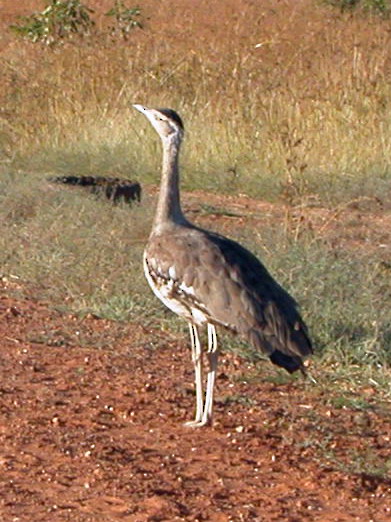 Australian BustardArdeotis australis
-
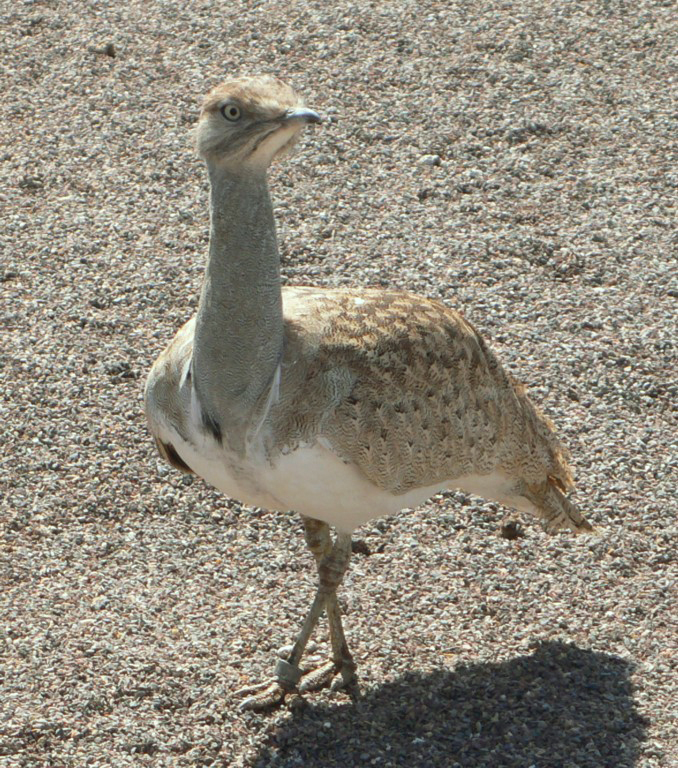 African HoubaraChlamydotis undulata
-
 Bengal FloricanHoubaropsis bengalensis
-
 Lesser FloricanSypheotides indicus
-
 Asian HoubaraChlamydotis macqueenii
Compare
Questions and answers
What is the scientific name of the Little Bustard?
The scientific name of the Little Bustard is Tetrax tetrax. Written with its author, the full name is Tetrax tetrax (Linnaeus, 1758).
Which family does the Little Bustard belong to?
Tetrax tetrax belongs to the family Otididae, in the order Otidiformes and the class Aves.
Where is the Little Bustard found?
Checklists and occurrence records place Tetrax tetrax in 43 countries, including France, Spain, Portugal, The Netherlands, Sweden and Russia.
What is the conservation status of the Little Bustard?
The IUCN Red List category recorded for Tetrax tetrax is Near Threatened (NT).
Sources
Passages the profile rests on
- The breeding male has brown upperparts, white underparts, a grey head, and a black neck bordered by white. Source passage: “The breeding male is brown above and white below, with a grey head and a black neck bordered above and below by white.” — English Wikipedia
- Females and non-breeding males lack the distinctive neck pattern, and females have darker underparts than males. Source passage: “The female and non-breeding male lack the dramatic neck pattern, and the female is marked darker below than the male.” — English Wikipedia
- Immature individuals have plumage resembling that of females. Source passage: “Immature bustards resemble females.” — English Wikipedia
- Both sexes have predominantly brown dorsal plumage with white streaks and occasional black spots. Source passage: “Dorsal side is brown with white streaks and occasionally black spots” — animaldiversity.org
- Females have brown dorsal plumage with black tips extending from the head to the tail. Source passage: “On the dorsal side, from head to tail, they are brown with black tips.” — animaldiversity.org
- The legs and bills are light brown. Source passage: “Legs and bills are light brown in color.” — animaldiversity.org
- The species measures 42–45 cm in length. Source passage: “42–45 cm (17–18 in) long” — English Wikipedia
- Its wingspan is reported as 90–110 cm. Source passage: “90–110 cm (35–43 in) wingspan” — English Wikipedia
- Its body weight is reported as 830 g. Source passage: “a weight of 830 g (29 oz).” — English Wikipedia
- The species inhabits open grasslands and undisturbed cultivated land with vegetation tall enough to provide cover. Source passage: “The bird's habitat is open grassland and undisturbed cultivation, with plants tall enough for cover.” — English Wikipedia
- Dry, open grassland is a preferred habitat. Source passage: “Little bustard preferred habitat is dry, open grassland.” — animaldiversity.org
- The species also inhabits pastureland resembling its original steppe-like habitat. Source passage: “Tetrax tetrax will also inhabit pasture lands due to its similarity of the original steppe-like habitat.” — animaldiversity.org
- In agricultural areas, the species prefers vegetation of medium height and density. Source passage: “In agriculture areas, there is a preference towards mid-height vegetation with medium density” — animaldiversity.org
- The species is omnivorous and consumes seeds, insects, rodents, and reptiles. Source passage: “This species is omnivorous, taking seeds, insects, rodents and reptiles.” — English Wikipedia
- Its diet includes green plants, seeds, invertebrates, and insects. Source passage: “Little bustards are omnivorous feeding on green plants, seeds, invertebrates, and insects.” — animaldiversity.org
- Populations inhabiting agricultural land show a preference for alfalfa. Source passage: “Populations in agricultural lands show preference towards alfalfa.” — animaldiversity.org
- Insects are particularly important in the diet during mating and chick-rearing periods. Source passage: “Insects are of particular importance during the mating season and rearing of chicks.” — animaldiversity.org
- Individuals generally walk slowly and tend to run rather than fly when disturbed. Source passage: “It has a stately slow walk, and tends to run when disturbed rather than fly.” — English Wikipedia
- The species is particularly gregarious during winter. Source passage: “It is gregarious, especially in winter.” — English Wikipedia
- Individuals form flocks particularly during winter. Source passage: “Little bustards are a social species, particularly in the winter when they gather in flocks.” — animaldiversity.org
- Males attract females through snort-like calls, foot stamping, wing beating, and aerial leaps. Source passage: “During mating season, males attempt to attract mates through snort-like calls, foot stamping, beating of wings, and leaping in the air.” — animaldiversity.org
- Male display leaps range from 20 to 100 cm. Source passage: “Leaps range from 20-100cm.” — animaldiversity.org
- Males produce a distinctive call described as a raspberry-blowing sound. Source passage: “the male has a distinctive "raspberry-blowing" call: prrt.” — English Wikipedia
- Male individuals migrate nocturnally and make frequent stopovers in irrigated and non-irrigated croplands. Source passage: “they are nocturnal migrants that make frequent stopovers in non-irrigated and irrigated croplands” — English Wikipedia
- The species commonly uses a polygynous mating system. Source passage: “Little bustards most commonly utilize a polygynous mating system.” — animaldiversity.org
- Males may also congregate at display sites in a lek mating system. Source passage: “they may also utilize a lek mating system where there is no male parental care and males congregate at sites for display.” — animaldiversity.org
- Females typically lay three to five eggs directly on the ground. Source passage: “Females lay 3 to 5 eggs on the ground.” — English Wikipedia
- The average clutch contains three to four eggs, although observed clutch sizes range from one to six. Source passage: “the average size clutch 3 to 4 eggs, although clutch sizes of 1 to 6 eggs have been observed.” — animaldiversity.org
- Females incubate the eggs for approximately three weeks. Source passage: “Eggs are incubated by the female for three weeks.” — animaldiversity.org
- Nests consist of shallow depressions in the ground covered with grass. Source passage: “Nests are formed in shallow ground depressions with grassy cover.” — animaldiversity.org
- Fledging occurs approximately 45–50 days after hatching. Source passage: “Fledging occurs after about 45-50 days.” — animaldiversity.org
- Chicks can fly approximately 20 days after hatching. Source passage: “Chicks are able to fly after about 20 days after hatching” — animaldiversity.org
- Females provide all parental care received by chicks. Source passage: “All care that is provided for the chicks is done by the females.” — animaldiversity.org
- Females reach sexual maturity at one year, whereas males mature at two years. Source passage: “Females become sexually mature at 1 year of age whereas males become sexually mature at 2 years of age.” — animaldiversity.org
- The species has been reported to collide frequently with vehicles, power lines, and aircraft. Source passage: “They have also been known to frequently collide with vehicles, power lines, and aircraft.” — animaldiversity.org
- The species is the sole member of the genus Tetrax. Source passage: “the only member of the genus Tetrax.” — English Wikipedia
- No subspecies are currently recognised. Source passage: “The species is considered to be monotypic: no subspecies are recognised.” — English Wikipedia
Data
- Catalogue of Life, 2026-10-16 XR cc by
- Global Biodiversity Information Facility CC BY 4.0
- Wikidata CC0
- GeoNames CC BY 4.0
- Wikimedia Commons per image; credit shown with each image
- Within the Catalogue of Life, this name comes from The Integrated Taxonomic Information System cc0
References
- Syst. Nat. ed. 10 p. 154 where the name was published
- Peters, & James Lee. (1934). Check-List of Birds of the World, Vol. 2.
- Gill, Frank, & and Minturn Wright. (2006). Birds of the World: Recommended English Names.
- Dickinson, E. C., and J. V. Remsen Jr., eds. (2013). The Howard and Moore Complete Checklist of the Birds of the World, 4th Edition, Vol. 1 Non-Passerines.
This species in other databases
Page built on 28 November 2026. See how the catalog is made and all sources and licences.
Cite this page
ScientificNames.org. (2026). Tetrax tetrax (Little Bustard). Retrieved November 28, 2026, from https://scientificnames.org/species/tetrax-tetrax
“Tetrax tetrax (Little Bustard).” ScientificNames.org, 2026, scientificnames.org/species/tetrax-tetrax. Accessed 28 Nov. 2026.
ScientificNames.org. “Tetrax tetrax (Little Bustard).” Accessed November 28, 2026. https://scientificnames.org/species/tetrax-tetrax.
@misc{scientificnames_tetrax_tetrax_little_bustard,
  author = {{ScientificNames.org}},
  title = {Tetrax tetrax (Little Bustard)},
  year = {2026},
  url = {https://scientificnames.org/species/tetrax-tetrax},
  note = {Accessed 2026-11-28}
}