Species · Flowering plants
Field Wormwood Artemisia campestris
The scientific name of the Field Wormwood is Artemisia campestris. It is a species of flowering plant in the family Asteraceae (composite), order Asterales.
- Scientific name
- Artemisia campestris L.
- Common name
- Field Wormwood
- Genus
- Artemisia
- Family
- Asteraceae (Composite)
- Order
- Asterales
- Class
- Magnoliopsida
- Recorded in
- 57 countries
- Name status
- accepted in the Catalogue of Life

Overview
Artemisia campestris grows in open sites with dry sandy soils, steppes, rocky slopes and waste areas. It is a branching, aromatic plant that can reach a height of 150 cm (5 ft).
Written 26 November 2026 from the sources listed below. Each statement was checked against the passage it cites; statements that could not be supported were removed.
Appearance
Field wormwood is a branching, aromatic plant. It can reach a height of 150 cm (5 ft).[1][2]
Habitat
Field wormwood grows in open sites with dry sandy soils, steppes and rocky slopes. It also grows in waste areas.[3][4][5][6]
Classification of the Field Wormwood
| Kingdom | Plantae |
|---|---|
| Subkingdom | Pteridobiotina |
| Phylum | Tracheophyta |
| Class | Magnoliopsida |
| Order | Asterales |
| Family | Asteraceae (Composite) |
| Subfamily | Asteroideae |
| Tribe | Anthemideae |
| Subtribe | Artemisiinae |
| Genus | Artemisia (Sagewort) |
| Species | Artemisia campestris L. |
Where the Field Wormwood is found
Checklists and occurrence records place Artemisia campestris in 57 countries across Africa, Asia and Europe. GBIF holds 119,574 georeferenced records of it.
Countries where it is native or its origin is not stated
- Afghanistan 3
- Aland Islands 166
- Albania 4
- Algeria 65
- Andorra 27
- Armenia 8
- Austria 944
- Azerbaijan 10
- Belarus 295
- Belgium 221
- Bosnia and Herzegovina 3
- Bulgaria 21
- Canada 542
- China 43
- Croatia 9
- Czechia 3,005
- Denmark 11,354
- Estonia 2,766
- Finland 2,877
- France 27,625
- Georgia 5
- Germany 16,457
- Greece 47
- Hungary 112
- Iran 4
- Iraq 2
- Italy 993
- Japan 19
- Kazakhstan 92
- Kosovo
- Latvia 113
- Libya 9
- Lithuania 159
- Moldova 4
- Mongolia 3
- Morocco 13
- North Korea 9
- North Macedonia
- Norway 4,046
- Poland 10,746
- Portugal 94
- Romania 39
- Russia 2,893
- Serbia 5
- Slovakia 1,302
- Slovenia 3
- Spain 10,652
- Sweden 10,806
- Switzerland 6,049
- The Netherlands 1,410
- Tunisia 34
- Turkey 42
- Turkmenistan 5
- Ukraine 1,176
- United Kingdom 989
- United States 1,219
Countries where it has been introduced
Regions and cities with the most records
- Auvergne-Rhône-Alpes, France 14,070
- Bavaria, Germany 8,032
- Provence-Alpes-Côte d'Azur, France 4,673
- Zealand, Denmark 3,932
- Catalonia, Spain 3,909
- Valais, Switzerland 3,826
- Valencia, Spain 3,391
- Occitanie, France 3,047
- Central Jutland, Denmark 2,390
- Skåne, Sweden 2,271
- Capital Region, Denmark 1,974
- Mecklenburg-Vorpommern, Germany 1,875
- Centre-Val de Loire, France 1,855
- Asker, Norway 1,789
- Oslo, Norway 1,758
- Kalmar, Sweden 1,730
- Brandenburg, Germany 1,430
- Sierre, Switzerland 1,423
- Romans-sur-Isère, France 1,395
- Kujawsko-Pomorskie, Poland 1,358
- Sitten, Switzerland 1,323
- Östergötland, Sweden 1,242
- Martigny-Ville, Switzerland 1,158
- Frederikssund, Denmark 956
- Kalundborg, Denmark 935
- Île-de-France, France 930
- Akershus, Norway 844
- Västra Götaland, Sweden 844
- Rheinland-Pfalz, Germany 838
- Uppsala, Sweden 824
- Regensburg, Germany 822
- Lower Saxony, Germany 807
- Sulzbach-Rosenberg, Germany 806
- Kalmar, Sweden 783
- Kelheim, Germany 768
- Bourg-lès-Valence, France 767
3 more countries have a few records outside this range
These countries hold a few records of Artemisia campestris but lie outside the range the checklists give for it. Such records are often zoo or garden specimens, museum material or vagrants, so the species is not counted as occurring there.
A number beside a place is its count of GBIF occurrence records. A place without a number comes from a checklist alone. Records show where a species has been observed or collected, which can include escapes and vagrants.
Common names
English
- Field Wormwood
- Breckland Mugwort
- Field Mugwort
- Field Sagewort
- Sagewort Wormwood
- Sand Wormwood
Names in 8 other languages
- Danish
- Mark-bynke
- Dutch
- Averuit, Wilde averuit en duinaveruit, Wilde en Duinaveruit
- Finnish
- ketomaruna
- French
- armoise champêtre, armoise des champs
- German
- Artengruppe Feld-Beifuß, Feld-Beifuß
- Norwegian Nynorsk
- markmalurt
- Swedish
- fältbynke, fältmalört
- Welsh
- Brytan, Brytwn, Henwr, Llys y Corff, Llysiau'r Corff, Llysiau'r Cyrff, Sidwrmot, Siligabwd
Synonyms
9 other scientific names have been used for this species and are now treated as synonyms of Artemisia campestris.
- Artemisia campestris
- Artemisia campestris f. campestris
- Artemisia campestris subsp. canescens Le Houér.
- Artemisia campestris subsp. typica H.M.Hall & Clem.
- Artemisia campestris var. campestris
- Artemisia caudata f. typica J.Rousseau
- Artemisia forwoodii var. forwoodii
- Artemisia variabilis Vinson, 1863
- Oligosporus campestris subsp. campestris
Subspecies and varieties
- Artemisia campestris subsp. campestris (Field Sagewort) subspecies
- Artemisia campestris subsp. cinerea subspecies
- Artemisia campestris subsp. lednicensis subspecies
- Artemisia campestris subsp. lempergii subspecies
- Artemisia campestris subsp. sericea subspecies
- Artemisia campestris subsp. variabilis subspecies
Related species
-
 Absinthe WormwoodArtemisia absinthium
-
 TarragonArtemisia dracunculus
-
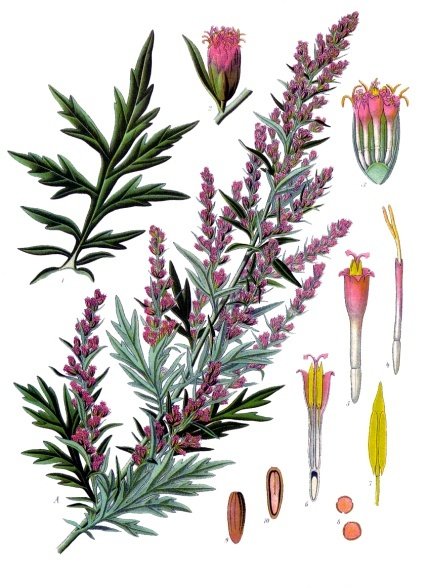 MugwortArtemisia vulgaris
-
 Annual WormwoodArtemisia annua
-
 Big SagebrushArtemisia tridentata
-
 Chinese MugwortArtemisia argyi
-
 Japanese MugwortArtemisia princeps
-
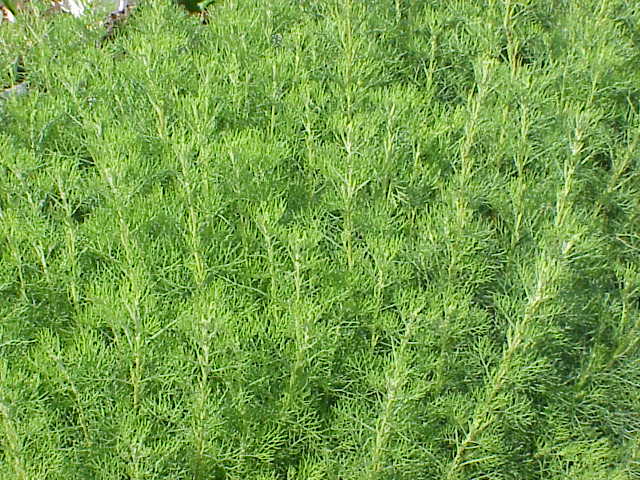 Lad's-loveArtemisia abrotanum
Compare
Questions and answers
What is the scientific name of the Field Wormwood?
The scientific name of the Field Wormwood is Artemisia campestris. Written with its author, the full name is Artemisia campestris L..
Which family does the Field Wormwood belong to?
Artemisia campestris belongs to the family Asteraceae, in the order Asterales and the class Magnoliopsida.
Where is the Field Wormwood found?
Checklists and occurrence records place Artemisia campestris in 57 countries, including France, Germany, Denmark, Sweden, Poland and Spain.
What other names does the Field Wormwood have?
Artemisia campestris is also known in English as Breckland Mugwort, Field Mugwort, Field Sagewort, Sagewort Wormwood and Sand Wormwood.
Sources
Passages the profile rests on
- Artemisia campestris is a branching, aromatic plant. Source passage: “Artemisia campestris is a branching, aromatic plant up to 150 cm (5 ft) tall.” — English Wikipedia
- The plant can reach a height of 150 cm (5 ft). Source passage: “Artemisia campestris is a branching, aromatic plant up to 150 cm (5 ft) tall.” — English Wikipedia
- The species grows in open sites with dry sandy soils. Source passage: “It grows in open sites on dry sandy soils, in steppes, rocky slopes, and waste areas.” — English Wikipedia
- The species occurs in steppes. Source passage: “It grows in open sites on dry sandy soils, in steppes, rocky slopes, and waste areas.” — English Wikipedia
- The species grows on rocky slopes. Source passage: “It grows in open sites on dry sandy soils, in steppes, rocky slopes, and waste areas.” — English Wikipedia
- The species also grows in waste areas. Source passage: “It grows in open sites on dry sandy soils, in steppes, rocky slopes, and waste areas.” — English Wikipedia
- Artemisia campestris is native to a broad region of Eurasia and North America. Source passage: “It is native to a wide region of Eurasia and North America.” — English Wikipedia
Data
- Catalogue of Life, 2026-10-16 XR cc by
- Global Biodiversity Information Facility CC BY 4.0
- Wikidata CC0
- GeoNames CC BY 4.0
- Wikimedia Commons per image; credit shown with each image
- Within the Catalogue of Life, this name comes from Synonymic Checklists of the Vascular Plants of the World cc by
References
- L. where the name was published
This species in other databases
Page built on 29 November 2026. See how the catalog is made and all sources and licences.
Cite this page
ScientificNames.org. (2026). Artemisia campestris (Field Wormwood). Retrieved November 29, 2026, from https://scientificnames.org/species/artemisia-campestris
“Artemisia campestris (Field Wormwood).” ScientificNames.org, 2026, scientificnames.org/species/artemisia-campestris. Accessed 29 Nov. 2026.
ScientificNames.org. “Artemisia campestris (Field Wormwood).” Accessed November 29, 2026. https://scientificnames.org/species/artemisia-campestris.
@misc{scientificnames_artemisia_campestris_field_wormwood,
  author = {{ScientificNames.org}},
  title = {Artemisia campestris (Field Wormwood)},
  year = {2026},
  url = {https://scientificnames.org/species/artemisia-campestris},
  note = {Accessed 2026-11-29}
}