Species · Flowering plants
Levant Wormseed Artemisia cina
The scientific name of the Levant Wormseed is Artemisia cina. It is a species of flowering plant in the family Asteraceae (composite), order Asterales.
- Scientific name
- Artemisia cina O.Berg
- Common name
- Levant Wormseed
- Genus
- Artemisia
- Family
- Asteraceae (Composite)
- Order
- Asterales
- Class
- Magnoliopsida
- Recorded in
- 7 countries
- Name status
- accepted in the Catalogue of Life

Overview
The species is native to China, Pakistan, Russia, Turkestan, Kazakhstan, and Kyrgyzstan. Its dried flowerheads have historically been used as the source of the vermifugic drug santonin.
Written 26 November 2026 from the sources listed below. Each statement was checked against the passage it cites; statements that could not be supported were removed.
Appearance
The plant has spherical pollen grains characteristic of the Asteraceae family. Its anthers possess a fibrous layer, and its tissues contain lignified, elongated hypodermal sclereids and clusters of calcium oxalate crystals.[1][2][3][4]
The powder obtained from the plant is grayish-green, aromatic, and bitter-tasting.[5]
Habitat
The plant has been successfully grown under conditions of 80% humidity, a temperature of 24°C, and soil pH 6.3.[6]
Uses
The dried flowerheads have historically been used as the source of the vermifugic drug santonin. The species has traditionally been used to expel intestinal worms.[7][8]
The n-hexane extract has demonstrated larvicidal activity against transitional L3-L4 larvae of Haemonchus contortus. It achieved 75% larvicidal activity at a concentration of 1 mg/mL and 82.6% at 2 mg/mL.[9][10][11]
The ethyl acetate extract exhibits anthelmintic activity against infective L3 larvae of Haemonchus contortus.[12]
Classification of the Levant Wormseed
| Kingdom | Plantae |
|---|---|
| Subkingdom | Pteridobiotina |
| Phylum | Tracheophyta |
| Class | Magnoliopsida |
| Order | Asterales |
| Family | Asteraceae (Composite) |
| Subfamily | Asteroideae |
| Tribe | Anthemideae |
| Subtribe | Artemisiinae |
| Genus | Artemisia (Sagewort) |
| Species | Artemisia cina O.Berg |
Where the Levant Wormseed is found
Checklists and occurrence records place Artemisia cina in 7 countries across Asia. GBIF holds 79 georeferenced records of it.
Countries where it is native or its origin is not stated
Countries where it has been introduced
Regions and cities with the most records
1 more country has a few records outside this range
These countries hold a few records of Artemisia cina but lie outside the range the checklists give for it. Such records are often zoo or garden specimens, museum material or vagrants, so the species is not counted as occurring there.
Range as the checklists state it
Uzbekistan; Kazakhstan; Iran (EC-Iran, SW-Iran); China [I] (Gansu [I], Shaanxi [I], Xinjiang [I])
A number beside a place is its count of GBIF occurrence records. A place without a number comes from a checklist alone. Records show where a species has been observed or collected, which can include escapes and vagrants.
Common names
English
- Levant Wormseed
- Levant Wormwood
- Santonica
- Santonica Wormwood
- Wormseed
Names in 22 other languages
- Arabic
- الشيح
- Azerbaijani
- Çin yovşanı
- Chinese
- 蛔蒿
- Czech
- pelyněk cicvárový
- Estonian
- ussipuju
- Finnish
- matomaruna
- French
- Semen contra
- Georgian
- ხოროსანი
- German
- Wurmsamen, Zitwer
- Japanese
- シナヨモギ
- Kazakh
- Дәрмене
- Pashto
- درمنه
- Persian
- درمنه سانتونیکا
- Polish
- Bylica cytwarowa
- Russian
- Полынь цитварная
- Slovak
- palina cicvárová
- Spanish
- Santónica, tomillo blanco
- Swedish
- maskfrö
- Turkish
- horasani
- Uzbek
- Darmana
- arz
- شيح السينا
- oss
- Хоросан
Synonyms
One other scientific name has been used for this species and is now treated as a synonym of Artemisia cina.
- Seriphidium cinum (O.Berg) Poljakov
Related species
-
 Absinthe WormwoodArtemisia absinthium
-
 TarragonArtemisia dracunculus
-
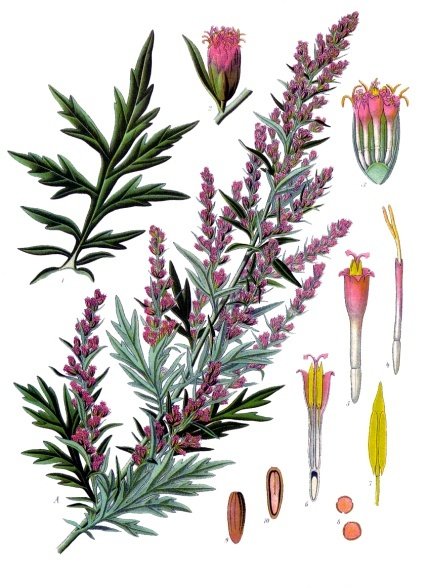 MugwortArtemisia vulgaris
-
 Annual WormwoodArtemisia annua
-
 Big SagebrushArtemisia tridentata
-
 Chinese MugwortArtemisia argyi
-
 Japanese MugwortArtemisia princeps
-
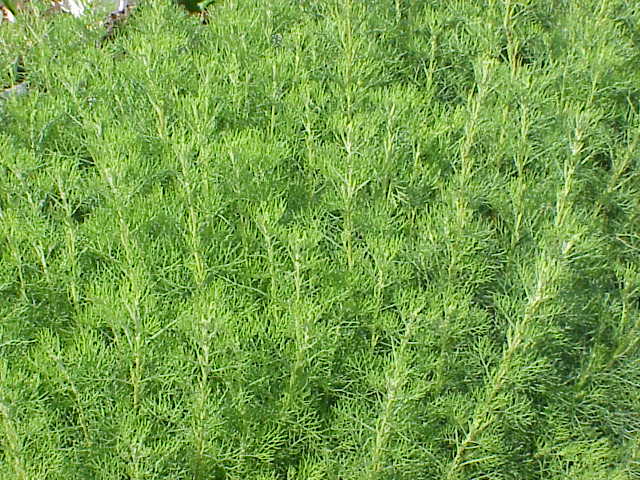 Lad's-loveArtemisia abrotanum
Compare
Questions and answers
What is the scientific name of the Levant Wormseed?
The scientific name of the Levant Wormseed is Artemisia cina. Written with its author, the full name is Artemisia cina O.Berg.
Which family does the Levant Wormseed belong to?
Artemisia cina belongs to the family Asteraceae, in the order Asterales and the class Magnoliopsida.
Where is the Levant Wormseed found?
Checklists and occurrence records place Artemisia cina in 7 countries, including Kazakhstan, Iran, Uzbekistan, Pakistan, Turkmenistan and Japan.
What other names does the Levant Wormseed have?
Artemisia cina is also known in English as Levant Wormwood, Santonica, Santonica Wormwood and Wormseed.
Sources
Passages the profile rests on
- The plant has spherical pollen grains characteristic of the Asteraceae family. Source passage: “The plant is characterised by its spherical pollen grains, which are typical in the Asteraceae” — English Wikipedia
- The anthers possess a fibrous layer. Source passage: “a fibrous layer on anthers” — English Wikipedia
- The plant has lignified, elongated hypodermal sclereids. Source passage: “lignified, elongated, hypodermal sclerids” — English Wikipedia
- The plant contains clusters of calcium oxalate crystals. Source passage: “clusters of calcium oxalate crystals.” — English Wikipedia
- The powder obtained from the plant is grayish-green, aromatic, and bitter-tasting. Source passage: “The powder is grayish-green in colour with an aromatic odour and a bitter taste.” — English Wikipedia
- The plant was successfully grown under conditions of 80% humidity, a temperature of 24°C, and soil pH 6.3. Source passage: “The plant was grown at 80% humidity, 24°C, and soil with pH = 6.3.” — pmc.ncbi.nlm.nih.gov
- The dried flowerheads of the species have historically been used as the source of the vermifugic drug santonin. Source passage: “Its dried flowerheads are the source of the vermifugic drug santonin since ancient times.” — English Wikipedia
- The species has traditionally been used to expel intestinal worms. Source passage: “Artemisia cina, also known as santonica or Levant wormseed, has been traditionally used as a vermifuge to expel intestinal worms” — pmc.ncbi.nlm.nih.gov
- The n-hexane extract of the species has demonstrated larvicidal activity against transitional L3-L4 larvae of Haemonchus contortus. Source passage: “the n-hexane (n-HE) extract of A. cina exhibited the highest larvicidal activity against transitional larvae L3-L4 of H. contortus” — pmc.ncbi.nlm.nih.gov
- The n-hexane extract achieved 75% larvicidal activity against Haemonchus contortus at a concentration of 1 mg/mL. Source passage: “achieving percentages of 75% and 82.6% of larvicidal activity at concentrations of 1 mg/mL and 2 mg/mL, respectively” — pmc.ncbi.nlm.nih.gov
- The n-hexane extract achieved 82.6% larvicidal activity against Haemonchus contortus at a concentration of 2 mg/mL. Source passage: “achieving percentages of 75% and 82.6% of larvicidal activity at concentrations of 1 mg/mL and 2 mg/mL, respectively” — pmc.ncbi.nlm.nih.gov
- The ethyl acetate extract of the species exhibits anthelmintic activity against infective L3 larvae of Haemonchus contortus. Source passage: “the EAE presents anthelmintic activity against H. contortus L3 infective larvae” — pmc.ncbi.nlm.nih.gov
Data
- Catalogue of Life, 2026-10-16 XR cc by
- Global Biodiversity Information Facility CC BY 4.0
- Wikidata CC0
- GeoNames CC BY 4.0
- Wikimedia Commons per image; credit shown with each image
- Within the Catalogue of Life, this name comes from Synonymic Checklists of the Vascular Plants of the World cc by
References
- Berg, O. (1863). Darstell. Beschr. Off. Gew. 4: t. 29c (1863) ex Poljakov, Act. Inst. Chem. Acad. Sci. Caucasus 4: 69 (1959). where the name was published
This species in other databases
Page built on 27 November 2026. See how the catalog is made and all sources and licences.
Cite this page
ScientificNames.org. (2026). Artemisia cina (Levant Wormseed). Retrieved November 27, 2026, from https://scientificnames.org/species/artemisia-cina
“Artemisia cina (Levant Wormseed).” ScientificNames.org, 2026, scientificnames.org/species/artemisia-cina. Accessed 27 Nov. 2026.
ScientificNames.org. “Artemisia cina (Levant Wormseed).” Accessed November 27, 2026. https://scientificnames.org/species/artemisia-cina.
@misc{scientificnames_artemisia_cina_levant_wormseed,
  author = {{ScientificNames.org}},
  title = {Artemisia cina (Levant Wormseed)},
  year = {2026},
  url = {https://scientificnames.org/species/artemisia-cina},
  note = {Accessed 2026-11-27}
}