Species · Flowering plants
Estafiata Artemisia frigida
The scientific name of the Estafiata is Artemisia frigida. It is a species of flowering plant in the family Asteraceae (composite), order Asterales.
- Scientific name
- Artemisia frigida Willd.
- Common name
- Estafiata
- Genus
- Artemisia
- Family
- Asteraceae (Composite)
- Order
- Asterales
- Class
- Magnoliopsida
- Recorded in
- 11 countries
- Name status
- accepted in the Catalogue of Life

Overview
Estafiata is a perennial flowering plant with a woody base, belonging to the family Asteraceae, order Asterales, and class Magnoliopsida. It is native to Europe, Asia, and much of North America. It is distinguished by its spreading stems, silvery-haired gray-green leaves, spherical flower heads, and strong aromatic scent.
Written 26 November 2026 from the sources listed below. Each statement was checked against the passage it cites; statements that could not be supported were removed.
Appearance
Estafiata is a perennial plant with a woody base. Its stems spread outward and generally form a mat or clump, with lobed gray-green leaves covered in silvery hairs.[1][2][3]
Its inflorescence consists of numerous spherical flower heads with woolly-haired gray-green or brownish phyllaries. Each flower head contains several pistillate ray florets and numerous bisexual disc florets.[4][5][6]
The plant has a strong aromatic scent. Its stems generally form mats or clumps reaching up to 40 centimetres in height, and its flower heads are approximately half a centimeter wide.[7][8][9]
Habitat
Estafiata commonly occurs in dry and disturbed habitats. It grows in grasslands, shrublands, and woodlands in North America and is common in the Rocky Mountains and Great Plains of North America.[10][11][12]
Diet
White-tailed jackrabbits and sage grouse consume estafiata.[13][14]
Reproduction and life cycle
Estafiata can produce a large number of seeds and can spread through layering. Seed production can be very low in some years.[15][16][17]
Behaviour
Estafiata tends to increase in areas that have experienced heavy livestock grazing. Excessive growth can indicate overgrazing on rangeland.[18][19]
The species can sometimes become an aggressive weed. Ranchers have regarded it both as adequate forage and as a nuisance.[20][21]
Conservation
Estafiata is described as common and dominant or codominant in many areas.[22]
Uses
Estafiata is cultivated for the ornamental effects of its foliage and is used in landscaping. It has received the Royal Horticultural Society's Award of Garden Merit.[23][24][25]
The plant is used for erosion control and rangeland revegetation. It is drought-resistant.[26][27]
The Blackfoot use estafiata medicinally to treat coughs, colds, wounds, and heartburn. The Cree use it to treat headaches and fever, while the Tewa people have used it to treat gastritis and indigestion.[28][29][30]
The Zuni prepare an infusion from the whole plant to treat colds. Blackfoot people reportedly used crushed leaves in a veterinary practice involving gophers.[31][32]
Similar species
Estafiata is not closely related to the true sages of the genus Salvia.[33]
Classification of the Estafiata
| Kingdom | Plantae |
|---|---|
| Subkingdom | Pteridobiotina |
| Phylum | Tracheophyta |
| Class | Magnoliopsida |
| Order | Asterales |
| Family | Asteraceae (Composite) |
| Subfamily | Asteroideae |
| Tribe | Anthemideae |
| Subtribe | Artemisiinae |
| Genus | Artemisia (Sagewort) |
| Species | Artemisia frigida Willd. |
Where the Estafiata is found
Checklists and occurrence records place Artemisia frigida in 11 countries across Asia and North America. GBIF holds 21,543 georeferenced records of it.
Countries
- Canada 8,223
- China 839
- Kazakhstan 115
- Kyrgyzstan 4
- Mexico 3
- Mongolia 603
- Pakistan 3
- Russia 2,402
- Tajikistan
- Turkey 3
- United States 9,348
Regions and cities with the most records
- Alberta, Canada 3,794
- Colorado, United States 3,572
- British Columbia, Canada 1,976
- Saskatchewan, Canada 1,144
- Calgary, Canada 923
- Irkutsk Oblast, Russia 708
- Montana, United States 678
- Wyoming, United States 521
- Yukon, Canada 515
- New Mexico, United States 512
- Boulder, United States 508
- Chestermere, Canada 469
- South Dakota, United States 446
- Louisville, United States 384
- Golden, United States 359
- Saskatoon, Canada 357
- Nebraska, United States 352
- Lafayette, United States 324
- Dakota Ridge, United States 322
- Colorado Springs, United States 312
- Buryatiya Republic, Russia 294
- Okotoks, Canada 287
- Lakewood, United States 282
- Wheat Ridge, United States 273
- Arvada, United States 266
- North Dakota, United States 253
- Columbine, United States 237
- Centennial, United States 236
- Parker, United States 235
- Manitoba, Canada 232
- Greenwood Village, United States 226
- Ken Caryl, United States 226
- Utah, United States 223
- Longmont, United States 220
- Minnesota, United States 211
- Fort Collins, United States 210
1 more country has a few records outside this range
These countries hold a few records of Artemisia frigida but lie outside the range the checklists give for it. Such records are often zoo or garden specimens, museum material or vagrants, so the species is not counted as occurring there.
Range as the checklists state it
E-European Russia; Siberia (Altay, Buryatia, Chita, Irkutsk, Krasnoyarsk, W-Siberia, Yakutia); Russian Far East (Magadan); Kazakhstan; Tajikistan; China (Gansu, W-Heilongjiang, N-Hubei, W-Jilin, NW-Liaoning, Nei Mongol, Ningxia, Qinghai, N-Shaanxi, Xinjiang); Tibet; Mongolia; Alaska; Canada (Alberta, British Columbia, Manitoba, New Brunswick, N. W. T., Nunavut, Ontario, Québec, Saskatchewan, Yukon); USA (Arizona, Colorado, Idaho, Illinois, Iowa, Kansas, Minnesota, Montana, Nebraska, New Mexico, North Dakota, South Dakota, Texas, Utah, Washington, Wisconsin, Wyoming)
A number beside a place is its count of GBIF occurrence records. A place without a number comes from a checklist alone. Records show where a species has been observed or collected, which can include escapes and vagrants.
Common names
English
- Estafiata
- Fringed Sagewort
- Fringed-sage
- Pasture Sage
- Prairie Sagebrush
- Wormwood-sage
Names in 2 other languages
- French
- armoise douce
- Swedish
- ismalört
Synonyms
24 other scientific names have been used for this species and are now treated as synonyms of Artemisia frigida.
- Absinthium candidum M.Bieb. ex DC.
- Absinthium frigidum (Willd.) Besser
- Absinthium frigidum var. fischerianum Besser
- Absinthium frigidum var. willdenowianum Besser
- Artemisia aprica Gebl. ex DC.
- Artemisia biebersteinii Voss
- Artemisia frigida subsp. frigida
- Artemisia frigida var. fischeriana (Besser) DC.
- Artemisia frigida var. frigida
- Artemisia frigida var. intermedia Trautv.
- Artemisia frigida var. mongolica Kitam.
- Artemisia frigida var. willdenowiana (Besser) DC.
- Artemisia frigida var. williamsiae S.L.Welsh
- Artemisia involucrata Turcz. ex Ledeb.
- Artemisia jeniscensis Willd. ex Spreng.
- Artemisia jenisea Willd. ex Ledeb.
- Artemisia maritima var. willdenowiana Besser
- Artemisia petraea Turcz. ex Ledeb.
- Artemisia procumbens Schrad. ex DC.
- Artemisia virgata Richardson
- Bidens chrysantha DC.
- Coreopsis chrysantha L.
- Artemisia chrysantha Fisch. ex DC. ambiguous synonym
- Artemisia pumila Link ambiguous synonym
Subspecies and varieties
Related species
-
 Absinthe WormwoodArtemisia absinthium
-
 TarragonArtemisia dracunculus
-
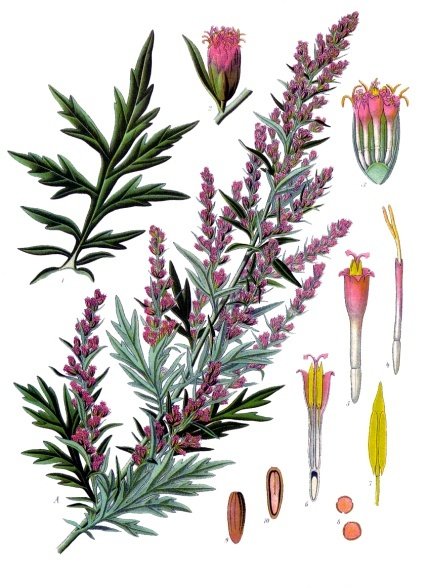 MugwortArtemisia vulgaris
-
 Annual WormwoodArtemisia annua
-
 Big SagebrushArtemisia tridentata
-
 Chinese MugwortArtemisia argyi
-
 Japanese MugwortArtemisia princeps
-
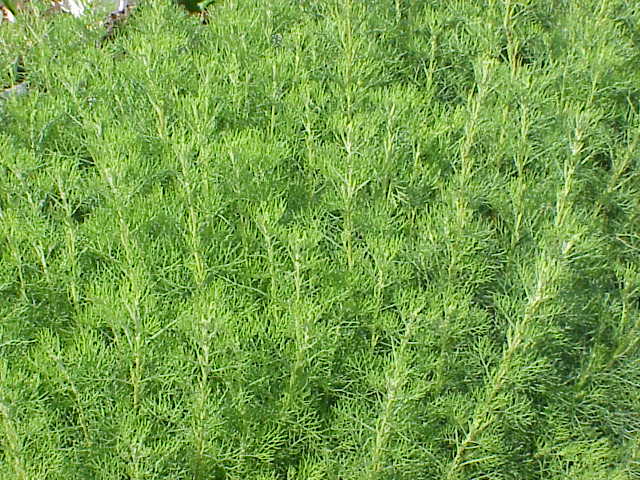 Lad's-loveArtemisia abrotanum
Compare
Questions and answers
What is the scientific name of the Estafiata?
The scientific name of the Estafiata is Artemisia frigida. Written with its author, the full name is Artemisia frigida Willd..
Which family does the Estafiata belong to?
Artemisia frigida belongs to the family Asteraceae, in the order Asterales and the class Magnoliopsida.
Where is the Estafiata found?
Checklists and occurrence records place Artemisia frigida in 11 countries, including United States, Canada, Russia, China, Mongolia and Kazakhstan.
What other names does the Estafiata have?
Artemisia frigida is also known in English as Fringed Sagewort, Fringed-sage, Pasture Sage, Prairie Sagebrush and Wormwood-sage.
What are the benefits of estafiate Tea?
The Zuni prepare an infusion from the whole plant to treat colds.[31]
Sources
Passages the profile rests on
- Artemisia frigida is a perennial plant with a woody base. Source passage: “Artemisia frigida is a perennial plant with a woody base.” — English Wikipedia
- Its stems spread outward and generally form a mat or clump. Source passage: “The stems spread out, generally forming a mat or clump up to 40 centimetres (1.3 ft) tall.” — English Wikipedia
- Its stems bear lobed gray-green leaves covered with silvery hairs. Source passage: “The stems are covered in lobed gray-green leaves which are coated in silvery hairs.” — English Wikipedia
- Its inflorescence consists of numerous spherical flower heads. Source passage: “The inflorescence contains many spherical flower heads each about half a centimeter wide” — English Wikipedia
- Its flower heads have woolly-haired gray-green or brownish phyllaries. Source passage: “lined with woolly-haired, gray-green or brownish phyllaries.” — English Wikipedia
- Its flower heads contain several pistillate ray florets and numerous bisexual disc florets. Source passage: “The flower heads contain several pistillate ray florets and many bisexual disc florets.” — English Wikipedia
- The plant has a strong aromatic scent. Source passage: “The plant is aromatic, with a strong scent.” — English Wikipedia
- Its stems generally form mats or clumps reaching up to 40 centimetres in height. Source passage: “The stems spread out, generally forming a mat or clump up to 40 centimetres (1.3 ft) tall.” — English Wikipedia
- Its spherical flower heads are approximately half a centimeter wide. Source passage: “each about half a centimeter wide” — English Wikipedia
- The species commonly occurs in dry and disturbed habitats. Source passage: “especially in dry and disturbed habitat types.” — English Wikipedia
- It occurs in grasslands, shrublands, and woodlands in North America. Source passage: “where it occurs in grasslands, shrublands, and woodlands, among others.” — English Wikipedia
- It is common in the Rocky Mountains and Great Plains of North America. Source passage: “It is common in the Rocky Mountains and Great Plains in North America” — English Wikipedia
- White-tailed jackrabbits consume this plant. Source passage: “including white-tailed jackrabbits and sage grouse.” — English Wikipedia
- Sage grouse consume this plant. Source passage: “including white-tailed jackrabbits and sage grouse.” — English Wikipedia
- The species can produce a large number of seeds. Source passage: “This plant can make a great many seeds.” — English Wikipedia
- The species can spread through layering. Source passage: “It can also spread by layering” — English Wikipedia
- Seed production can be very low in some years. Source passage: “in some years it produces very few seeds.” — English Wikipedia
- The species tends to increase in areas that have experienced heavy livestock grazing. Source passage: “It has a tendency to increase in areas that have been heavily grazed by livestock.” — English Wikipedia
- Excessive growth of this plant can indicate overgrazing on rangeland. Source passage: “Overgrowth of the plant is sometimes an indicator of overgrazing on rangeland.” — English Wikipedia
- The species can sometimes become an aggressive weed. Source passage: “It sometimes becomes an aggressive weed.” — English Wikipedia
- Ranchers have regarded the species both as adequate forage and as a nuisance. Source passage: “Ranchers have considered the plant to be both an adequate forage species and a worthless nuisance species.” — English Wikipedia
- The species is described as common and dominant or codominant in many areas. Source passage: “Artemisia frigida is common and dominant or codominant in many areas” — English Wikipedia
- The species is cultivated for the ornamental effects of its foliage. Source passage: “Artemisia frigida is cultivated for its foliage effects” — English Wikipedia
- The species has received the Royal Horticultural Society's Award of Garden Merit. Source passage: “has gained the Royal Horticultural Society's Award of Garden Merit.” — English Wikipedia
- The plant is used in landscaping. Source passage: “Artemisia frigida is also used in landscaping” — English Wikipedia
- The plant is used for erosion control and rangeland revegetation. Source passage: “used in landscaping and for erosion control and revegetation of rangeland.” — English Wikipedia
- The species is drought-resistant. Source passage: “It is drought-resistant.” — English Wikipedia
- The Blackfoot use the plant medicinally to treat coughs, colds, wounds, and heartburn. Source passage: “It is used medicinally for coughs, colds, wounds, and heartburn by the Blackfoot.” — English Wikipedia
- The Cree use the plant to treat headaches and fever. Source passage: “The Cree people use it for headache and fever” — English Wikipedia
- The Tewa people have used the plant to treat gastritis and indigestion. Source passage: “the Tewa people took it for gastritis and indigestion.” — English Wikipedia
- The Zuni prepare an infusion from the whole plant to treat colds. Source passage: “Among the Zuni, the whole plant is made into an infusion for colds.” — English Wikipedia
- Blackfoot people reportedly used crushed leaves of the plant in a veterinary practice involving gophers. Source passage: “used the crushed leaves to "revive gophers after children clubbed them while playing a game".” — English Wikipedia
- The plant is not closely related to the true sages of the genus Salvia. Source passage: “The plant is not, however, closely related to the true sages Salvia.” — English Wikipedia
Data
- Catalogue of Life, 2026-10-16 XR cc by
- Global Biodiversity Information Facility CC BY 4.0
- Wikidata CC0
- GeoNames CC BY 4.0
- Wikimedia Commons per image; credit shown with each image
- Within the Catalogue of Life, this name comes from Synonymic Checklists of the Vascular Plants of the World cc by
References
- Willd. (1803). Sp. Pl., ed. 4 [Willdenow] 3(3): 1838 (1803). where the name was published
This species in other databases
Page built on 29 November 2026. See how the catalog is made and all sources and licences.
Cite this page
ScientificNames.org. (2026). Artemisia frigida (Estafiata). Retrieved November 29, 2026, from https://scientificnames.org/species/artemisia-frigida
“Artemisia frigida (Estafiata).” ScientificNames.org, 2026, scientificnames.org/species/artemisia-frigida. Accessed 29 Nov. 2026.
ScientificNames.org. “Artemisia frigida (Estafiata).” Accessed November 29, 2026. https://scientificnames.org/species/artemisia-frigida.
@misc{scientificnames_artemisia_frigida_estafiata,
  author = {{ScientificNames.org}},
  title = {Artemisia frigida (Estafiata)},
  year = {2026},
  url = {https://scientificnames.org/species/artemisia-frigida},
  note = {Accessed 2026-11-29}
}