Species · Flowering plants
White Mugwort Artemisia lactiflora
The scientific name of the White Mugwort is Artemisia lactiflora. It is a species of flowering plant in the family Asteraceae (composite), order Asterales.
- Scientific name
- Artemisia lactiflora Wall. ex DC.
- Common name
- White Mugwort
- Genus
- Artemisia
- Family
- Asteraceae (Composite)
- Order
- Asterales
- Class
- Magnoliopsida
- Recorded in
- 11 countries
- Name status
- accepted in the Catalogue of Life

Overview
White mugwort is a clump-forming herbaceous perennial flowering plant. White mugwort is native to western China. It produces creamy-white flower heads arranged in plumes above dark green leaves.
Written 26 November 2026 from the sources listed below. Each statement was checked against the passage it cites; statements that could not be supported were removed.
Appearance
White mugwort is a vigorous, clump-forming herbaceous perennial. It can grow to a height of 1.5 metres.[1][2]
Its creamy-white flower heads are arranged in plumes above dark green leaves.[3]
Habitat
White mugwort is native to western China. Plants grown in poor, dry soil are hardier and last longer than those grown in heavy, damp soil.[4][5]
Reproduction and life cycle
White mugwort produces flower heads during summer and autumn.[6]
Uses
White mugwort is cultivated for both its flowers and its foliage.[7]
It has received the Royal Horticultural Society's Award of Garden Merit.[8]
Classification of the White Mugwort
| Kingdom | Plantae |
|---|---|
| Subkingdom | Pteridobiotina |
| Phylum | Tracheophyta |
| Class | Magnoliopsida |
| Order | Asterales |
| Family | Asteraceae (Composite) |
| Subfamily | Asteroideae |
| Tribe | Anthemideae |
| Subtribe | Artemisiinae |
| Genus | Artemisia (Sagewort) |
| Species | Artemisia lactiflora Wall. ex DC. |
Where the White Mugwort is found
Checklists and occurrence records place Artemisia lactiflora in 11 countries across Asia and Europe. GBIF holds 1,573 georeferenced records of it.
Countries where it is native or its origin is not stated
Countries where it has been introduced
Regions and cities with the most records
- Sichuan, China 363
- Chongqing, China 193
- Gecheng, China 143
- Hubei, China 130
- Guangdong, China 105
- Hunan, China 83
- Jiangxi, China 78
- Guangxi, China 70
- Zhejiang, China 39
- Fujian, China 35
- Jingling, China 33
- Guizhou, China 28
- Yunnan, China 26
- Songbai, China 24
- Hebei, China 22
- Anping, China 19
- Baidi, China 19
- Conglin, China 19
- Daguan, China 19
- Fenhe, China 19
- Kangle, China 19
- Nanchuan, China 19
- Nanping, China 19
- Shigang, China 19
- Xinglong, China 19
- Xinmin, China 19
- Yongle, China 19
- Yong’an, China 19
- Zhuyi, China 19
- Caotang, China 18
- Gansu, China 17
- Shaanxi, China 17
- Jiujiang, China 15
- Lecheng, China 14
- Liancheng, China 13
- Wenheng, China 13
2 more countries have a few records outside this range
These countries hold a few records of Artemisia lactiflora but lie outside the range the checklists give for it. Such records are often zoo or garden specimens, museum material or vagrants, so the species is not counted as occurring there.
Range as the checklists state it
Germany [I]; China (Anhui, Fujian, S-Gansu, Guangdong, Guangxi, Guizhou, S-Henan, Hubei, Hunan, Jiangsu, Jiangxi, S-Shaanxi, Sichuan, Yunnan, Zhejiang); Taiwan; NE-India (Nagaland, Manipur, Mizoram); Thailand; Laos; Cambodia; Vietnam; Jawa
A number beside a place is its count of GBIF occurrence records. A place without a number comes from a checklist alone. Records show where a species has been observed or collected, which can include escapes and vagrants.
Common names
English
- White Mugwort
- Guizhou Mugwort
Names in 9 other languages
- Chinese
- 甜菜子, 白苞蒿, 角菜, 鴨腳艾(中藥名)
- Dutch
- Witte bijvoet
- Estonian
- valgeõieline puju
- Finnish
- kiinanmaruna
- French
- armoise à fleurs blanches, armoise à fleurs laiteuses
- German
- weißer China-Beifuß
- Japanese
- ヨモギナ
- Russian
- Полынь молочноцветковая
- Swedish
- pärlmalört
Synonyms
6 other scientific names have been used for this species and are now treated as synonyms of Artemisia lactiflora.
- Artemisia lactiflora f. henryana Pamp.
- Artemisia lactiflora f. lactiflora
- Artemisia lactiflora f. septemlobata (H.Lév. & Vaniot) Pamp.
- Artemisia lactiflora var. lactiflora
- Artemisia septemlobata H.Lév. & Vaniot
- Artemisia septemlobata var. septemlobata
Subspecies and varieties
Related species
-
 Absinthe WormwoodArtemisia absinthium
-
 TarragonArtemisia dracunculus
-
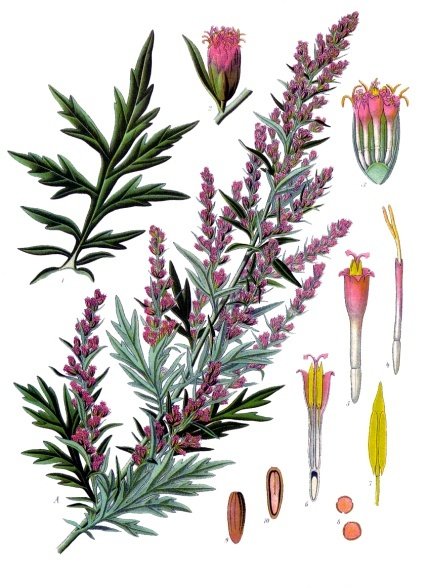 MugwortArtemisia vulgaris
-
 Annual WormwoodArtemisia annua
-
 Big SagebrushArtemisia tridentata
-
 Chinese MugwortArtemisia argyi
-
 Japanese MugwortArtemisia princeps
-
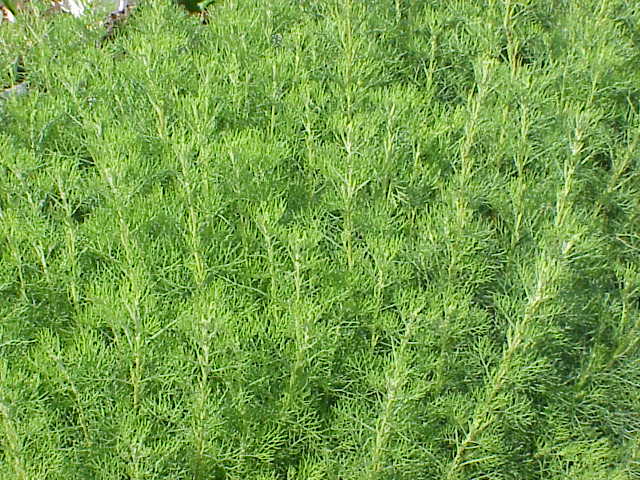 Lad's-loveArtemisia abrotanum
Compare
Questions and answers
What is the scientific name of the White Mugwort?
The scientific name of the White Mugwort is Artemisia lactiflora. Written with its author, the full name is Artemisia lactiflora Wall. ex DC..
Which family does the White Mugwort belong to?
Artemisia lactiflora belongs to the family Asteraceae, in the order Asterales and the class Magnoliopsida.
Where is the White Mugwort found?
Checklists and occurrence records place Artemisia lactiflora in 11 countries, including China, Taiwan, Hong Kong, Indonesia, Thailand and Japan.
What other names does the White Mugwort have?
Artemisia lactiflora is also known in English as Guizhou Mugwort.
Where does mugwort grow naturally?
White mugwort is native to western China.[4]
Sources
Passages the profile rests on
- Artemisia lactiflora is a vigorous, clump-forming herbaceous perennial. Source passage: “is a vigorous clump-forming herbaceous perennial” — English Wikipedia
- Artemisia lactiflora can grow to a height of 1.5 metres. Source passage: “growing to 1.5 m (4 ft 11 in)” — English Wikipedia
- Artemisia lactiflora produces creamy-white flower heads arranged in plumes above dark green leaves. Source passage: “with plumes of creamy-white flower heads appearing in summer and autumn above dark green leaves.” — English Wikipedia
- Artemisia lactiflora is native to western China. Source passage: “native to western China.” — English Wikipedia
- Plants grown in poor, dry soil are hardier and last longer than those grown in heavy, damp soil. Source passage: “Plants grown in poor dry soil are hardier and last longer than those grown in heavy, damp soil.” — English Wikipedia
- Artemisia lactiflora produces flower heads during summer and autumn. Source passage: “flower heads appearing in summer and autumn” — English Wikipedia
- Artemisia lactiflora is cultivated for both its flowers and its foliage. Source passage: “This is the only artemisia which is cultivated as much for its flowers as for its foliage.” — English Wikipedia
- Artemisia lactiflora has received the Royal Horticultural Society's Award of Garden Merit. Source passage: “This plant has gained the Royal Horticultural Society's Award of Garden Merit.” — English Wikipedia
Data
- Catalogue of Life, 2026-10-16 XR cc by
- Global Biodiversity Information Facility CC BY 4.0
- Wikidata CC0
- GeoNames CC BY 4.0
- Wikimedia Commons per image; credit shown with each image
- Within the Catalogue of Life, this name comes from Synonymic Checklists of the Vascular Plants of the World cc by
References
- Wall. ex DC. (1837). Prodr. [A.P. de Candolle] 6: 115 (1837). where the name was published
This species in other databases
Page built on 26 November 2026. See how the catalog is made and all sources and licences.
Cite this page
ScientificNames.org. (2026). Artemisia lactiflora (White Mugwort). Retrieved November 26, 2026, from https://scientificnames.org/species/artemisia-lactiflora
“Artemisia lactiflora (White Mugwort).” ScientificNames.org, 2026, scientificnames.org/species/artemisia-lactiflora. Accessed 26 Nov. 2026.
ScientificNames.org. “Artemisia lactiflora (White Mugwort).” Accessed November 26, 2026. https://scientificnames.org/species/artemisia-lactiflora.
@misc{scientificnames_artemisia_lactiflora_white_mugwort,
  author = {{ScientificNames.org}},
  title = {Artemisia lactiflora (White Mugwort)},
  year = {2026},
  url = {https://scientificnames.org/species/artemisia-lactiflora},
  note = {Accessed 2026-11-26}
}