Species · Flowering plants
Antispasmodic Herb Artemisia monosperma
The scientific name of the Antispasmodic Herb is Artemisia monosperma. It is a species of flowering plant in the family Asteraceae (composite), order Asterales.
- Scientific name
- Artemisia monosperma Delile
- Common name
- Antispasmodic Herb
- Genus
- Artemisia
- Family
- Asteraceae (Composite)
- Order
- Asterales
- Class
- Magnoliopsida
- Recorded in
- 12 countries
- Name status
- accepted in the Catalogue of Life

Overview
The antispasmodic herb is a perennial, woody, low-growing shrub with fleshy leaves. It grows in arid coastal environments along the Mediterranean coast of Egypt, including desert plains and inland and coastal wadis. It plays an important role in ecological succession by stabilizing sand dunes.
Written 27 November 2026 from the sources listed below. Each statement was checked against the passage it cites; statements that could not be supported were removed.
Appearance
The antispasmodic herb has fleshy leaves and a thick epidermal cuticle on its leaves and stems. Its leaves contain glandular trichomes, while its stems contain sclerenchymatous pericycle fibers.[1][2][3][4]
Habitat
In Egypt, it grows in desert plains and in inland and coastal wadis within the Mediterranean coastal sector.[5][6]
Uses
The species has reported anticancer, antimalarial, antispasmodic, antihypertensive, and antioxidant activities.[7][8][9][10][11]
It also has reported insecticidal, larvicidal, and antimicrobial properties.[12][13][14]
Classification of the Antispasmodic Herb
| Kingdom | Plantae |
|---|---|
| Subkingdom | Pteridobiotina |
| Phylum | Tracheophyta |
| Class | Magnoliopsida |
| Order | Asterales |
| Family | Asteraceae (Composite) |
| Subfamily | Asteroideae |
| Tribe | Anthemideae |
| Subtribe | Artemisiinae |
| Genus | Artemisia (Sagewort) |
| Species | Artemisia monosperma Delile |
Where the Antispasmodic Herb is found
Checklists and occurrence records place Artemisia monosperma in 12 countries across Africa and Asia. GBIF holds 2,148 georeferenced records of it.
Countries
- Bahrain 1
- Egypt 99
- Iraq 6
- Israel 1,975
- Kuwait 1
- Lebanon 5
- Libya 1
- Oman
- Palestinian Territory 16
- Saudi Arabia 36
- Syria 8
- United Arab Emirates
Regions and cities with the most records
- Southern District, Israel 1,081
- Ashdod, Israel 604
- Yavné, Israel 597
- Gedera, Israel 592
- Ashkelon, Israel 569
- Gan Yavne, Israel 568
- Central District, Israel 484
- Qiryat Mal’akhi, Israel 461
- Reẖovot, Israel 407
- Rishon LeTsiyyon, Israel 405
- Mazkeret Batya, Israel 391
- Ness Ziona, Israel 391
- Be’er Ya‘aqov, Israel 388
- Hadera, Israel 380
- Ramla, Israel 379
- Netanya, Israel 378
- Bat Yam, Israel 366
- Kfar Yona, Israel 357
- H̱olon, Israel 355
- Pardés H̱anna Karkur, Israel 343
- Or Akiva, Israel 341
- Bāqa el Gharbīya, Israel 339
- Binyamina-Giv'at Ada, Israel 338
- Binyamina-Giv‘at ‘Ada, Israel 337
- Jisr ez Zarqā, Israel 332
- Bayt Ḩānūn, Palestinian Territory 328
- Bayt Lāhyā, Palestinian Territory 321
- Ramat Gan, Israel 320
- Sderot, Israel 319
- Gaza, Palestinian Territory 317
- Jabālyā, Palestinian Territory 315
- Tel Aviv, Israel 310
- Bnei Brak, Israel 309
- Haifa, Israel 305
- Givatayim, Israel 303
- Kafr Qari‘, Israel 303
Range as the checklists state it
Libya; Egypt (Eastern Desert, Great Southwestern Desert, NE-Egypt, NW-coastal Egypt); Lebanon (coastal W-Lebanon); Israel (C-Israel, coastal W-Israel, Rift Valley, N-Negev Desert); Sinai peninsula (C-Sinai, N-Sinai, S-Sinai); Jordania (S-Jordania); Saudi Arabia (C-Saudi Arabia, Dahana, NE-Saudi Arabia, N-Saudi Arabia, Nafud Desert, Hejaz, S-Saudi Arabia: Rub to Khali, Asir, Nejd Desert); Kuwait; Bahrain; United Arab Emirates; Oman (Mascat & Oman)
A number beside a place is its count of GBIF occurrence records. A place without a number comes from a checklist alone. Records show where a species has been observed or collected, which can include escapes and vagrants.
Common names
English
- Antispasmodic Herb
Names in 2 other languages
- Hebrew
- לענה חד-זרעית
- Russian
- Полынь односемянная
Synonyms
7 other scientific names have been used for this species and are now treated as synonyms of Artemisia monosperma.
- Artemisia delileana Besser
- Artemisia deliliana Besser
- Artemisia inculta var. inculta
- Artemisia monosperma var. libyca Chiov.
- Artemisia monosperma var. monosperma
- Oligosporus monospermus (Delile) Poljakov
- Oligosporus monospermus DC.
Related species
-
 Absinthe WormwoodArtemisia absinthium
-
 TarragonArtemisia dracunculus
-
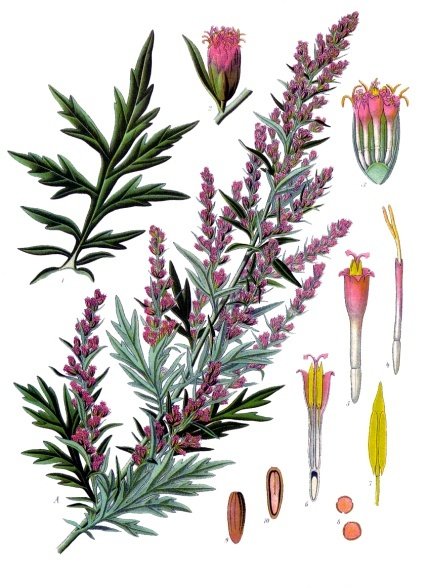 MugwortArtemisia vulgaris
-
 Annual WormwoodArtemisia annua
-
 Big SagebrushArtemisia tridentata
-
 Chinese MugwortArtemisia argyi
-
 Japanese MugwortArtemisia princeps
-
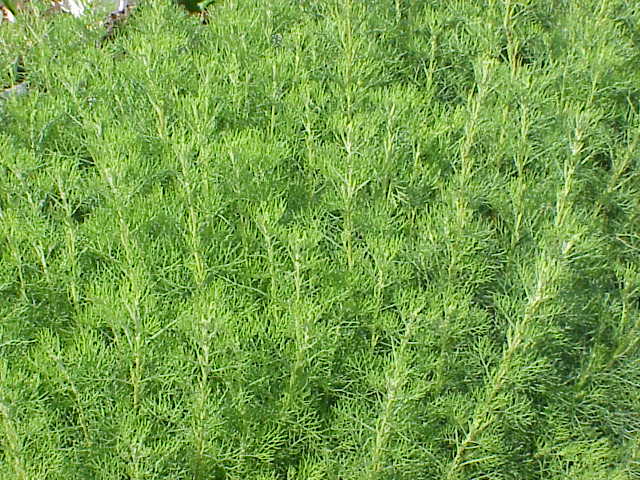 Lad's-loveArtemisia abrotanum
Compare
Questions and answers
What is the scientific name of the Antispasmodic Herb?
The scientific name of the Antispasmodic Herb is Artemisia monosperma. Written with its author, the full name is Artemisia monosperma Delile.
Which family does the Antispasmodic Herb belong to?
Artemisia monosperma belongs to the family Asteraceae, in the order Asterales and the class Magnoliopsida.
Where is the Antispasmodic Herb found?
Checklists and occurrence records place Artemisia monosperma in 12 countries, including Israel, Egypt, Saudi Arabia, Palestinian Territory, Syria and Iraq.
What herbs are antispasmodic?
Artemisia monosperma, known as the antispasmodic herb, has reported antispasmodic activity.[9]
Sources
Passages the profile rests on
- Artemisia monosperma is a woody, low-growing shrub with fleshy leaves. Source passage: “The morphology of both species appeared woody low shrub with fleshy leaves.” — pmc.ncbi.nlm.nih.gov
- Its leaves and stems have a thick epidermal cuticle. Source passage: “The most marked anatomical attributes were the thick cuticle of the epidermal layer in leaves and stems” — pmc.ncbi.nlm.nih.gov
- Its leaves contain glandular trichomes. Source passage: “and glandular trichomes on the leaf had appeared in A. monosperma.” — pmc.ncbi.nlm.nih.gov
- Its stems contain sclerenchymatous pericycle fibers. Source passage: “Also, sclerenchymatous pericycle fibers in stem” — pmc.ncbi.nlm.nih.gov
- In Egypt, the species grows in desert plains. Source passage: “In Egypt, it grows in desert plains,” — pmc.ncbi.nlm.nih.gov
- In Egypt, the species also grows in inland and coastal wadis within the Mediterranean coastal sector. Source passage: “and inland or coastal wadis within the Mediterranean coastal sector.” — pmc.ncbi.nlm.nih.gov
- The species has reported anticancer activity. Source passage: “its anticancer, antimalarial, antispasmodic, antihypertensive and antioxidant activities [17,18,19].” — pmc.ncbi.nlm.nih.gov
- The species has reported antimalarial activity. Source passage: “its anticancer, antimalarial, antispasmodic, antihypertensive and antioxidant activities [17,18,19].” — pmc.ncbi.nlm.nih.gov
- The species has reported antispasmodic activity. Source passage: “its anticancer, antimalarial, antispasmodic, antihypertensive and antioxidant activities [17,18,19].” — pmc.ncbi.nlm.nih.gov
- The species has reported antihypertensive activity. Source passage: “its anticancer, antimalarial, antispasmodic, antihypertensive and antioxidant activities [17,18,19].” — pmc.ncbi.nlm.nih.gov
- The species has reported antioxidant activity. Source passage: “its anticancer, antimalarial, antispasmodic, antihypertensive and antioxidant activities [17,18,19].” — pmc.ncbi.nlm.nih.gov
- The species has reported insecticidal properties. Source passage: “the insecticidal, larvacidal and antimicrobial properties of A. monosperma are due to the bioactive compounds and essential oils (EOs) [20,21,22].” — pmc.ncbi.nlm.nih.gov
- The species has reported larvicidal properties. Source passage: “the insecticidal, larvacidal and antimicrobial properties of A. monosperma are due to the bioactive compounds and essential oils (EOs) [20,21,22].” — pmc.ncbi.nlm.nih.gov
- The species has reported antimicrobial properties. Source passage: “the insecticidal, larvacidal and antimicrobial properties of A. monosperma are due to the bioactive compounds and essential oils (EOs) [20,21,22].” — pmc.ncbi.nlm.nih.gov
Data
- Catalogue of Life, 2026-10-16 XR cc by
- Global Biodiversity Information Facility CC BY 4.0
- Wikidata CC0
- GeoNames CC BY 4.0
- Wikimedia Commons per image; credit shown with each image
- Within the Catalogue of Life, this name comes from Synonymic Checklists of the Vascular Plants of the World cc by
References
- Delile. Descr. Égypte, Hist. Nat. 263, t. 4, f. 1 (1813-1814). where the name was published
This species in other databases
- Catalogue of Life GWMY
- Wikidata Q6709633
- iNaturalist 868108
- World Flora Online wfo-0000025868
- GRIN 417480
Page built on 28 November 2026. See how the catalog is made and all sources and licences.
Cite this page
ScientificNames.org. (2026). Artemisia monosperma (Antispasmodic Herb). Retrieved November 28, 2026, from https://scientificnames.org/species/artemisia-monosperma
“Artemisia monosperma (Antispasmodic Herb).” ScientificNames.org, 2026, scientificnames.org/species/artemisia-monosperma. Accessed 28 Nov. 2026.
ScientificNames.org. “Artemisia monosperma (Antispasmodic Herb).” Accessed November 28, 2026. https://scientificnames.org/species/artemisia-monosperma.
@misc{scientificnames_artemisia_monosperma_antispasmodic_herb,
  author = {{ScientificNames.org}},
  title = {Artemisia monosperma (Antispasmodic Herb)},
  year = {2026},
  url = {https://scientificnames.org/species/artemisia-monosperma},
  note = {Accessed 2026-11-28}
}