Species · Flowering plants
Owyhee Sagebrush Artemisia papposa
The scientific name of the Owyhee Sagebrush is Artemisia papposa. It is a species of flowering plant in the family Asteraceae (composite), order Asterales.
- Scientific name
- Artemisia papposa S.F.Blake & Cronquist
- Common name
- Owyhee Sagebrush
- Genus
- Artemisia
- Family
- Asteraceae (Composite)
- Order
- Asterales
- Class
- Magnoliopsida
- Recorded in
- 1 country
- Name status
- accepted in the Catalogue of Life
Overview
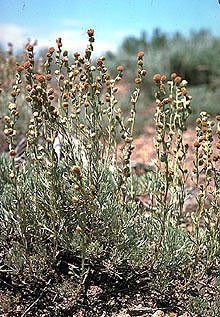
Owyhee Sagebrush is a small aromatic shrub with several grayish stems. It is native to the Snake River Plain and surrounding areas of the northwestern United States. Its achenes are topped with pappi, unlike those of most other Artemisia species.
Written 27 November 2026 from the sources listed below. Each statement was checked against the passage it cites; statements that could not be supported were removed.
Appearance
Owyhee Sagebrush reaches a maximum height of approximately 15–20 centimeters. Its small leaves are gray-green and usually lobed.[1][2]
Its inflorescence consists of several flower heads containing yellow ray and disc florets. The species produces achenes as its fruit, topped with pappi.[3][4][5]
Habitat
Owyhee Sagebrush grows in sagebrush steppe habitats, meadows, and sagebrush-juniper associations. It occurs in mid-elevation habitats and often grows in shallow, rocky, poorly drained soils.[6][7][8][9][10]
It occurs alongside thymeleaf buckwheat (Eriogonum thymoides), mat buckwheat (Eriogonum caespitosum), lava aster (Ionactis alpina), whip pussytoes (Antennaria flagellaris), and onespike danthonia (Danthonia unispicata).[11][12][13][14][15]
Other associated plants include western needlegrass (Achnatherum occidentale ssp. occidentale), barestem biscuitroot (Lomatium nudicaule), and Sandberg bluegrass (Poa secunda).[16][17][18]
The species occurs in southern Idaho, eastern Oregon, and northern Nevada.[19][20][21]
Conservation
Owyhee Sagebrush has a state conservation rank of S4 in Idaho.[22]
Classification of the Owyhee Sagebrush
| Kingdom | Plantae |
|---|---|
| Subkingdom | Pteridobiotina |
| Phylum | Tracheophyta |
| Class | Magnoliopsida |
| Order | Asterales |
| Family | Asteraceae (Composite) |
| Subfamily | Asteroideae |
| Tribe | Anthemideae |
| Subtribe | Artemisiinae |
| Genus | Artemisia (Sagewort) |
| Species | Artemisia papposa S.F.Blake & Cronquist |
Where the Owyhee Sagebrush is found
Checklists and occurrence records place Artemisia papposa in 1 country across North America. GBIF holds 277 georeferenced records of it.
Countries
Regions and cities with the most records
Range as the checklists state it
USA (Idaho, Nevada, Oregon)
A number beside a place is its count of GBIF occurrence records. A place without a number comes from a checklist alone. Records show where a species has been observed or collected, which can include escapes and vagrants.
Common names
English
- Owyhee Sagebrush
- Owyhee-sage
Related species
-
 Absinthe WormwoodArtemisia absinthium
-
 TarragonArtemisia dracunculus
-
 MugwortArtemisia vulgaris
-
 Annual WormwoodArtemisia annua
-
 Big SagebrushArtemisia tridentata
-
 Chinese MugwortArtemisia argyi
-
 Japanese MugwortArtemisia princeps
-
 Lad's-loveArtemisia abrotanum
Compare
Questions and answers
What is the scientific name of the Owyhee Sagebrush?
The scientific name of the Owyhee Sagebrush is Artemisia papposa. Written with its author, the full name is Artemisia papposa S.F.Blake & Cronquist.
Which family does the Owyhee Sagebrush belong to?
Artemisia papposa belongs to the family Asteraceae, in the order Asterales and the class Magnoliopsida.
Where is the Owyhee Sagebrush found?
Checklists and occurrence records place Artemisia papposa in 1 country: United States.
What other names does the Owyhee Sagebrush have?
Artemisia papposa is also known in English as Owyhee-sage.
Sources
Passages the profile rests on
- The shrub reaches a maximum height of approximately 15–20 centimeters. Source passage: “This small aromatic shrub grows up to 15 or 20 centimeters tall” — English Wikipedia
- Its leaves are small, gray-green, and usually lobed. Source passage: “The small gray-green leaves are usually lobed.” — English Wikipedia
- Its inflorescence consists of several flower heads containing yellow ray and disc florets. Source passage: “The inflorescence is an array of several flower heads containing yellow ray and disc florets.” — English Wikipedia
- The species produces achenes as its fruit. Source passage: “The fruit is an achene.” — English Wikipedia
- Its achenes are topped with pappi, unlike those of most other Artemisia species. Source passage: “Unlike those of most other Artemisia, the achenes of this species are topped with pappi.” — English Wikipedia
- The species grows in sagebrush steppe habitats. Source passage: “Artemisia papposa grows on sagebrush steppe” — English Wikipedia
- The species occurs in meadows. Source passage: “and in meadows, alkali flats, and sagebrush-juniper associations.” — English Wikipedia
- The species grows in sagebrush-juniper associations. Source passage: “sagebrush-juniper associations.” — English Wikipedia
- The species occurs in mid-elevation habitats. Source passage: “It occurs in mid-elevation habitat” — English Wikipedia
- The species often grows in shallow, rocky, poorly drained soils. Source passage: “often in shallow, rocky, poorly drained soils.” — English Wikipedia
- The species occurs alongside thymeleaf buckwheat (Eriogonum thymoides). Source passage: “thymeleaf and mat buckwheats (Eriogonum thymoides and E. caespitosum, respectively)” — English Wikipedia
- The species occurs alongside mat buckwheat (Eriogonum caespitosum). Source passage: “thymeleaf and mat buckwheats (Eriogonum thymoides and E. caespitosum, respectively)” — English Wikipedia
- The species occurs alongside lava aster (Ionactis alpina). Source passage: “lava aster (Ionactis alpina)” — English Wikipedia
- The species occurs alongside whip pussytoes (Antennaria flagellaris). Source passage: “whip pussytoes (Antennaria flagellaris)” — English Wikipedia
- The species occurs alongside onespike danthonia (Danthonia unispicata). Source passage: “onespike danthonia (Danthonia unispicata)” — English Wikipedia
- The species occurs alongside western needlegrass (Achnatherum occidentale ssp. occidentale). Source passage: “western needlegrass (Achnatherum occidentale ssp. occidentale)” — English Wikipedia
- The species occurs alongside barestem biscuitroot (Lomatium nudicaule). Source passage: “barestem biscuitroot (Lomatium nudicaule)” — English Wikipedia
- The species occurs alongside Sandberg bluegrass (Poa secunda). Source passage: “Sandberg bluegrass (Poa secunda).” — English Wikipedia
- The species occurs in southern Idaho. Source passage: “occurring in southern Idaho, eastern Oregon, and northern Nevada.” — English Wikipedia
- The species occurs in eastern Oregon. Source passage: “occurring in southern Idaho, eastern Oregon, and northern Nevada.” — English Wikipedia
- The species occurs in northern Nevada. Source passage: “occurring in southern Idaho, eastern Oregon, and northern Nevada.” — English Wikipedia
- The species has a state conservation rank of S4 in Idaho. Source passage: “Artemisia papposa (Owyhee Sagebrush) Plantae/Anthophyta/Dicotyledoneae/Asterales/Asteraceae/Artemisia papposa State Rank: S4” — idfg.idaho.gov
Data
- Catalogue of Life, 2026-10-16 XR cc by
- Global Biodiversity Information Facility CC BY 4.0
- Wikidata CC0
- GeoNames CC BY 4.0
- Wikimedia Commons per image; credit shown with each image
- Within the Catalogue of Life, this name comes from Synonymic Checklists of the Vascular Plants of the World cc by
References
- Blake, S. F., & Cronquist. (1950). Leafl. W. Bot. 6: 43 (1950). where the name was published
This species in other databases
- Catalogue of Life GWRD
- Wikidata Q604711
- iNaturalist 158713
- World Flora Online wfo-0000013852
- GRIN 448081
Page built on 28 November 2026. See how the catalog is made and all sources and licences.
Cite this page
ScientificNames.org. (2026). Artemisia papposa (Owyhee Sagebrush). Retrieved November 28, 2026, from https://scientificnames.org/species/artemisia-papposa
“Artemisia papposa (Owyhee Sagebrush).” ScientificNames.org, 2026, scientificnames.org/species/artemisia-papposa. Accessed 28 Nov. 2026.
ScientificNames.org. “Artemisia papposa (Owyhee Sagebrush).” Accessed November 28, 2026. https://scientificnames.org/species/artemisia-papposa.
@misc{scientificnames_artemisia_papposa_owyhee_sagebrush,
  author = {{ScientificNames.org}},
  title = {Artemisia papposa (Owyhee Sagebrush)},
  year = {2026},
  url = {https://scientificnames.org/species/artemisia-papposa},
  note = {Accessed 2026-11-28}
}