Species · Flowering plants
Breadfruit Artocarpus altilis
The scientific name of the Breadfruit is Artocarpus altilis. It is a species of flowering plant in the family Moraceae (mulberry family), order Rosales.
- Scientific name
- Artocarpus altilis (Parkinson) Fosberg
- Common name
- Breadfruit
- Genus
- Artocarpus
- Family
- Moraceae (Mulberry Family)
- Order
- Rosales
- Class
- Magnoliopsida
- Recorded in
- 112 countries
- Name status
- accepted in the Catalogue of Life

Overview
Breadfruit is an equatorial lowland species widely cultivated in tropical regions of South Asia, Southeast Asia, the Pacific, the Caribbean, Central America, northern South America, and Africa. Breadfruit has large, deeply divided leaves and ovoid compound fruits with rough surfaces and numerous achenes surrounded by fleshy tissue.
Written 26 November 2026 from the sources listed below. Each statement was checked against the passage it cites; statements that could not be supported were removed.
Appearance
Breadfruit has large, thick leaves that are deeply divided into pinnate lobes. Its fruit is an ovoid compound structure with a rough surface and numerous achenes surrounded by fleshy tissue.[1][2]
The fruit surface displays hexagon-like disks corresponding to the flowers from which it develops.[3]
Habitat
Breadfruit is an equatorial lowland species. It grows best below elevations of 650 metres but can occur up to 1,550 metres.[4][5]
Breadfruit grows in soils ranging from sand to sandy clay loam, with a preferred pH of 6.1–7.4. It can also grow in coral sands and saline soils.[6][7]
Breadfruit requires temperatures of approximately 16–38 °C and annual rainfall of 2,000–2,500 mm.[8]
Diet
Breadfruit is a carbohydrate-rich staple food. Its fruit can be consumed ripe or unripe, although unripe fruit requires cooking.[9][10]
Breadfruit can be roasted, baked, fried, or boiled before consumption. Its seeds can also be cooked and eaten.[11][12]
Breadfruit can be dried and ground into flour.[13]
Behaviour
Breadfruit trees produce male and female flowers on the same individual. Male flowers emerge before female flowers.[14][15]
Reproduction and life cycle
Breadfruit female flowers develop into capitula that become capable of pollination approximately three days later. Fruit bats are the main pollinators of breadfruit.[16][17]
Cultivated breadfruit varieties can produce fruit without pollination.[18]
Breadfruit is commonly propagated using root cuttings. Seedless cultivars can also be propagated by transplanting suckers arising from surface roots.[19][20]
Root cuttings used for large-scale propagation are approximately 10 centimetres thick and 20 centimetres long. Breadfruit roots may require up to five months to develop during propagation.[21][22]
Trees propagated from root cuttings are ready for orchard planting when they reach approximately 60 centimetres in height.[23]
Conservation
Breadfruit suitability is projected to increase in both area and quality under the climate projections examined for 2070. Existing breadfruit-producing regions are projected to retain relatively stable production potential under the examined climate scenarios.[24][25]
Uses
Breadfruit fruit serves as a staple food in many tropical cultures.[26]
Breadfruit timber is used to manufacture furniture, houses, and surfboards. Its lightweight wood, which is resistant to termites and shipworms, is also used to construct structures and outrigger canoes.[27][28]
Breadfruit wood pulp can be processed into paper known as breadfruit tapa. Its latex has been used as glue, caulk, and chewing gum.[29][30]
Discarded breadfruit parts can be used as livestock feed, and cattle can browse its leaves.[31]
Breadfruit trees can provide shade, stabilize soil, benefit watersheds, and sequester carbon. They also provide habitat and food for pollinators.[32][33]
Similar species
Artocarpus camansi differs from breadfruit by having spiny fruits containing numerous seeds.[34]
Artocarpus mariannensis differs from breadfruit by having dark green elongated fruits, darker yellow flesh, and entire or shallowly lobed leaves.[35]
Classification of the Breadfruit
| Kingdom | Plantae |
|---|---|
| Subkingdom | Pteridobiotina |
| Phylum | Tracheophyta |
| Class | Magnoliopsida |
| Order | Rosales |
| Family | Moraceae (Mulberry Family) |
| Tribe | Artocarpeae |
| Genus | Artocarpus (Bread Fruit) |
| Species | Artocarpus altilis (Parkinson) Fosberg |
Where the Breadfruit is found
Checklists and occurrence records place Artocarpus altilis in 112 countries across Africa, Asia, North America, Oceania and South America. GBIF holds 9,393 georeferenced records of it.
Countries
- Afghanistan 16
- American Samoa 31
- Antigua and Barbuda 15
- Australia 27
- Bahamas 12
- Bangladesh 2
- Barbados 36
- Belize 38
- Benin 98
- Bhutan
- Bolivia 15
- Bonaire, Saint Eustatius and Saba 16
- Brazil 337
- British Virgin Islands 14
- Brunei
- Cabo Verde 13
- Cambodia 3
- Cameroon 29
- Cayman Islands 15
- Central African Republic 2
- China 3
- Christmas Island 7
- Colombia 560
- Cook Islands 76
- Costa Rica 259
- Cuba 36
- Democratic Republic of the Congo 24
- Dominica 20
- Dominican Republic 95
- Ecuador 160
- El Salvador 7
- Equatorial Guinea 24
- Fiji 223
- French Guiana 66
- French Polynesia 903
- Gabon 7
- Gambia
- Ghana 3
- Grenada 11
- Guadeloupe 451
- Guam 130
- Guatemala 12
- Guinea 3
- Guinea-Bissau 4
- Guyana 9
- Haiti 42
- Honduras 21
- Hong Kong 15
- India 219
- Indonesia 641
- Ivory Coast 25
- Jamaica 111
- Japan 5
- Kiribati 24
- Laos 2
- Liberia 3
- Macao 8
- Madagascar 22
- Malaysia 68
- Maldives 90
- Marshall Islands 157
- Martinique 377
- Mauritius 18
- Mayotte 72
- Mexico 108
- Micronesia 230
- Montserrat 11
- Mozambique 1
- Myanmar
- Nauru 4
- Nepal
- New Caledonia 25
- Nicaragua 25
- Nigeria 30
- Niue 16
- Northern Mariana Islands 102
- Palau 65
- Panama 75
- Papua New Guinea 177
- Peru 83
- Philippines 272
- Pitcairn 4
- Puerto Rico 665
- Reunion 87
- Saint Barthelemy 3
- Saint Kitts and Nevis 14
- Saint Lucia 35
- Saint Martin 8
- Saint Vincent and the Grenadines 18
- Samoa 189
- Sao Tome and Principe 79
- Seychelles 173
- Singapore 58
- Solomon Islands 39
- South Africa 7
- Sri Lanka 90
- Suriname 33
- Taiwan 76
- Tanzania 13
- Thailand 51
- Timor Leste 5
- Tokelau 23
- Tonga 59
- Trinidad and Tobago 60
- Tuvalu 29
- U.S. Virgin Islands 30
- United States 409
- United States Minor Outlying Islands 4
- Vanuatu 57
- Venezuela 24
- Vietnam 76
- Wallis and Futuna 19
Regions and cities with the most records
- Antioquia, Colombia 355
- Ducos, Martinique 286
- Hawaii, United States 282
- Le Lamentin, Martinique 273
- Fort-de-France, Martinique 265
- Saint-Joseph, Martinique 232
- Pointe-à-Pitre, Guadeloupe 215
- Les Abymes, Guadeloupe 213
- Le Gosier, Guadeloupe 207
- Fajardo, Puerto Rico 204
- Baie-Mahault, Guadeloupe 202
- Le Robert, Martinique 166
- Le Moule, Guadeloupe 162
- Trujillo Alto, Puerto Rico 162
- Le François, Martinique 161
- Caguas, Puerto Rico 156
- Carolina, Puerto Rico 156
- Guaynabo, Puerto Rico 156
- Petit-Bourg, Guadeloupe 155
- Sainte-Anne, Guadeloupe 146
- Bayamón, Puerto Rico 138
- Río Grande, Puerto Rico 137
- La Trinité, Martinique 135
- Sainte-Rose, Guadeloupe 131
- Cataño, Puerto Rico 129
- Îles du Vent, French Polynesia 127
- Candelaria, Puerto Rico 126
- Levittown, Puerto Rico 126
- San Juan, Puerto Rico 126
- Capesterre-Belle-Eau, Guadeloupe 114
- Western, Fiji 111
- Sainte-Marie, Martinique 107
- Basse-Terre, Guadeloupe 96
- La Digue and Inner Islands, Seychelles 82
- San Juan, Puerto Rico 80
- Dededo Village, Guam 75
1 more country has a few records outside this range
These countries hold a few records of Artocarpus altilis but lie outside the range the checklists give for it. Such records are often zoo or garden specimens, museum material or vagrants, so the species is not counted as occurring there.
Range as the checklists state it
native area uncertain; Gambia [c]; Guinea [c]; Benin [c]; Cameroon [c]; Bioko Isl. [Fernando Poo] [c]; Principe Isl. [c]; São Tomé [c]; Annobon Isl. [c]; Gabon [c]; Central African Republic [c]; Mozambique [c]; Mauritius [c]; La Réunion [c]; Seychelles [c]; Chagos Arch. [c] (Diego Garcia [c]); China [c] (Guangdong [c], Guangxi [c], Hainan [c], S-Yunnan [c]); Ryukyu Isl. [c]; Taiwan [c]; Nepal [c]; Bhutan [c]; India [c]; Lakshadweep Isl. [Laccadives] [c]; Maldives [c]; Sri Lanka [c]; Bangladesh [c]; Andaman Isl. [c]; Nicobar Isl. [c]; Myanmar [c]; Thailand [c]; Laos [c]; Cambodia [c]; Vietnam [c]; Singapore [c]; Borneo [c]; Brunei [c]; Sulawesi [c]; Philippines [c] (Luzon [c], Mindanao [c]); Jawa [c]; Lesser Sunda Isl. [c] (Bali [c], Flores [c]); Moluccas [c]; New Guinea [c]; Bismarck Arch. [c]; Solomon Isl. [c]; Australia [c]; New Caledonia [c]; Rotuma Isl. [c]; Santa Cruz Isl. [c]; Vanuatu [c]; Tonga [c] (Late Isl. [c], Vava'u [c]); Niue [c]; American Samoa [c] (Ofu [c]); [Western] Samoa [c] ('Upolu [c], Savai'i [c]); Tuvalu [c] (Nui Atoll [c]); Tokelau [c] (Swains Isl. [c]); Gilbert Isl. [c] (Butaritari [c], Marakei [c], Abaiang [c], Tarawa [c], Kuria [c], Abemama [c], Tabiteuea [c], Onotoa [c], Beru [c], Nikunau [c], Arorae [c]); Gilbert Isl. [c] (Tabiteuea [c]); Nauru [c]; N-Line Isl. [c] (Teraina [c], Tabueran [c], Kiritimati [c]); Cook Isl. [c] (widespread, incl. Rarotonga [c]); Marquesas Isl. [c] (Nuku Hiva [c], Ua Huka [c], Ua Pou [c], Hiva Oa [c], Tahuata [c], Fatu Hiva [c]); Society Isl. [c] (Mopelia Atoll [c]); Society Isl. [c] (Tahiti [c], Raiatea [c]); Society Isl. [c] (Tetiaroa Atoll [c]); Tuamotu Arch. [c] (Makatea Isl. [c], Rangiroa Atoll [c], Takapoto Atoll [c], etc. [c]); Austral Isl. [c] (Tubuai [c]); Pitcairn Isl. [c]; Palau [c] (Koror [c], Sonsorol [c], Pulu Anna [c], Tobi [c], Malakal [c], Ulebsechel [c], Ngeanges [c], Sonsorol [c]); Northern Marianas [c] (Agrihan [c], Pagan [c], Alamagan [c], Sarigan [c], Saipan [c], Tinian [c], Rota [c]); Guam [c]; Fed. States of Micronesia [c] (Yap [c], Ulithi [c], Fais [c], Eauripik [c], Woleai [c], Ifalik [c], Lamotrek [c], Satawal [c], Puluwat [c], Namonuito [c], Murilo [c], Nomwin [c], Truk [c], Moen [c], Piis [c], Nama [c], Losap [c], Namoluk [c], Etal [c], Lukunor [c], Satawan [c], Nukuoro [c], Kapingamarangi [c], Ant [c], Ngatik [c], Pohnpei [c], Mokil [c], Kosrae [c]); Marshall Isl. [c] (Enewetok [c], Bikini [c], Rongelap [c], Utirik [c], Ujelang [c], Ujae [c], Wotho [c], Lae [c], Kwajalein [c], Ailuk [c], Jemo [c], Likiep [c], Mejit [c], Aur [c], Ailinglapalap [c], Maloelap [c], Majuro [c], Arno [c], Mili [c], Namorik [c], Kili [c], Jaluit [c], Ebon [c]); Mexico [c]; Guatemala [c]; Belize [c]; El Salvador [c]; Honduras [c]; Nicaragua [c]; Nicaragua [c]; Costa Rica [c]; Panama [c]; Cuba [c]; Jamaica [c]; Dominican Republic [c]; Haiti [c]; Puerto Rico [c]; Virgin Isl. [c]; Antigua [c]; Montserrat [c]; Guadeloupe [c]; Marie-Galante [c]; Dominica [c]; Martinique [c]; St. Lucia [c]; St. Vincent [c]; Tobago [c]; Trinidad [c]; Colombia [c]; Venezuela [c]; Guyana [c]; Ecuador [c]; Peru [c]; Peru [c]; Bolivia [c]; Brazil [c]
A number beside a place is its count of GBIF occurrence records. A place without a number comes from a checklist alone. Records show where a species has been observed or collected, which can include escapes and vagrants.
Common names
English
- Breadfruit
- Breadfruit Tree
- Dugdug
Names in 40 other languages
- Afrikaans
- broodvrugboom
- Arabic
- فاكهة الخبز
- Belarusian
- Хлебнае дрэва
- Catalan
- Arbre del pa
- Cebuano
- Dalungyan
- Chinese
- 太平洋麵包樹, 麵包樹
- Croatian
- Kruhovac (biljna vrsta)
- Czech
- Chlebovník obecný
- Danish
- Brødfrugttræ
- Dutch
- Broodboom, Broodvrucht
- Esperanto
- Panarbo
- Finnish
- Leipäpuu, malaijienleipäpuu
- French
- arbre à pain
- Hawaiian
- 'ulu, ʻUlu, ‘ulu
- Hebrew
- עץ הלחם
- Indonesian
- Sukun (pohon)
- Japanese
- パンノキ
- Lithuanian
- Paprastasis duonmedis
- Marathi
- नीरफणस
- Māori
- Kuru
- Norwegian
- Brødfrukt
- Polish
- chlebowiec właściwy
- Portuguese
- fruta-pão
- Russian
- Хлебное дерево
- Sinhala
- දෙල්
- Slovak
- chlebovník obyčajný
- Spanish
- fruta de pan, Árbol del pan del Pacífico, árbol del pan
- Swedish
- Brödfruktträd, brödfrukt
- Tagalog
- Rimas
- Thai
- สาเก
- Tongan
- Mei
- Turkish
- ekmek ağacı
- bis
- Bredfruit
- bsa
- Borka
- cha
- Lemai
- pau
- Meduu
- san
- नागदामिनी
- srn
- bredebon
- tah
- ʻUru
- zsm
- sukun
Synonyms
36 other scientific names have been used for this species and are now treated as synonyms of Artocarpus altilis.
- Artocarpus altilis var. non-seminifer (Duss) Fournet
- Artocarpus altilis var. seminifer (Duss) Fournet
- Artocarpus blancoi (Elmer) Merr.
- Artocarpus camansi Blanco
- Artocarpus communis J.R.Forst. & G.Forst.
- Artocarpus communis var. blancoi Elmer
- Artocarpus communis var. communis
- Artocarpus communis var. pungens J.J.Sm. ex K.Heyne
- Artocarpus horridus F.M.Jarrett
- Artocarpus incisifolius Stokes
- Artocarpus incisifolius var. apyrenus Stokes
- Artocarpus incisifolius var. seminifer Stokes
- Artocarpus incisus (Thunb.) L.fil.
- Artocarpus incisus var. bipinnatifida Seem.
- Artocarpus incisus var. blancoi Elmer
- Artocarpus incisus var. integrifolia Seem.
- Artocarpus incisus var. laevis (Hassk.) Miq.
- Artocarpus incisus var. muricatus Becc.
- Artocarpus incisus var. non-seminifer Duss
- Artocarpus incisus var. pinnatifida Seem.
- Artocarpus incisus var. seminifer (Stokes) Duss
- Artocarpus laevis Hassk.
- Artocarpus leeuwenii Diels
- Artocarpus mariannensis Trécul
- Artocarpus multifidus F.M.Jarrett
- Artocarpus pinnatisectus Merr.
- Artocarpus rima Blanco
- Nangha amplifolia Zipp.
- Radermachia incisa Thunb.
- Saccus communis (J.R.Forst. & G.Forst.) Kuntze
- Saccus heterophyllus (Lam.) Kuntze
- Saccus laevis (Hassk.) Kuntze
- Saccus mariannensis (Trécul) Kuntze
- Sitodium altile Parkinson
- Sitodium incisum (Thunb.) Thunb.
- Artocarpus papuanus Diels ambiguous synonym
Related species
-
 JackfruitArtocarpus heterophyllus
-
 ChempedakArtocarpus integer
-
 Wild JackArtocarpus hirsutus
-
 TerapArtocarpus elasticus
-
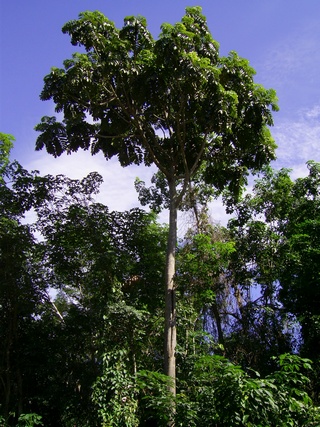 EntawakArtocarpus anisophyllus
- Kwai MukArtocarpus parvus
-
 Elephant JackArtocarpus tamaran
- Monkey-jackArtocarpus rigidus
Compare
Questions and answers
What is the scientific name of the Breadfruit?
The scientific name of the Breadfruit is Artocarpus altilis. Written with its author, the full name is Artocarpus altilis (Parkinson) Fosberg.
Which family does the Breadfruit belong to?
Artocarpus altilis belongs to the family Moraceae, in the order Rosales and the class Magnoliopsida.
Where is the Breadfruit found?
Checklists and occurrence records place Artocarpus altilis in 112 countries, including French Polynesia, Puerto Rico, Indonesia, Colombia, Guadeloupe and United States.
What other names does the Breadfruit have?
Artocarpus altilis is also known in English as Breadfruit Tree and Dugdug.
Is breadfruit a protein or carbohydrate?
Breadfruit is a carbohydrate-rich staple food.[9]
How does a breadfruit tree grow?
Breadfruit trees can reach approximately 26 metres in height. They produce male and female flowers on the same individual, with male flowers emerging first. A single tree can produce up to 200 or more fruits per season.[36][37][14][15]
What is breadfruit used for?
Breadfruit fruit is eaten as a staple food, and its seeds can be cooked and eaten. The fruit can also be dried and ground into flour. Its timber, wood pulp, latex, and discarded parts have uses in manufacturing, construction, paper production, adhesives, and livestock feed.[11][12][13][26][27][28][29][30][31]
Why is ulu called breadfruit?
The English name breadfruit refers to the bread-like texture of the moderately ripe fruit after cooking.[38]
Sources
Passages the profile rests on
- Breadfruit has large, thick leaves that are deeply divided into pinnate lobes. Source passage: “The large and thick leaves are deeply cut into pinnate lobes.” — English Wikipedia
- The breadfruit is an ovoid compound fruit with a rough surface and numerous achenes surrounded by fleshy tissue. Source passage: “The ovoid fruit has a rough surface, and each fruit is divided into many achenes, each surrounded by a fleshy perianth and growing on a fleshy receptacle.” — English Wikipedia
- The fruit surface displays hexagon-like disks corresponding to the flowers from which it develops. Source passage: “originates from 1,500 to 2,000 flowers visible on the skin of the fruit as hexagon-like disks.” — English Wikipedia
- Breadfruit is an equatorial lowland species. Source passage: “Breadfruit is an equatorial, lowland species.” — English Wikipedia
- Breadfruit grows best below elevations of 650 metres but can occur up to 1,550 metres. Source passage: “The plant grows best at elevations below 650 m (2,130 ft), but is found at elevations of 1,550 m (5,090 ft).” — English Wikipedia
- Breadfruit can grow in coral sands and saline soils. Source passage: “Breadfruit is able to grow in coral sands and saline soils.” — English Wikipedia
- Breadfruit grows in soils ranging from sand to sandy clay loam, with a preferred pH of 6.1–7.4. Source passage: “Its preferred soils are neutral to alkaline (pH of 6.1–7.4) and either sand, sandy loam, loam, or sandy clay loam.” — English Wikipedia
- Breadfruit requires temperatures of approximately 16–38 °C and annual rainfall of 2,000–2,500 mm. Source passage: “requiring a temperature range of 16–38 °C (61–100 °F) and an annual rainfall of 2,000–2,500 mm (80–100 in).” — English Wikipedia
- Breadfruit is a carbohydrate-rich staple food. Source passage: “Breadfruit is a long-lived tree crop that is a nutritious, carbohydrate-rich staple” — pmc.ncbi.nlm.nih.gov
- Breadfruit fruit can be consumed both ripe and unripe, although unripe fruit requires cooking. Source passage: “Both ripe and unripe fruit have culinary uses; unripe breadfruit is cooked before consumption.” — English Wikipedia
- Breadfruit can be roasted, baked, fried, or boiled before consumption. Source passage: “Before being eaten, the fruit is roasted, baked, fried, or boiled.” — English Wikipedia
- Breadfruit seeds can be cooked and eaten. Source passage: “the seeds can be cooked for consumption.” — English Wikipedia
- Breadfruit can be dried and ground into flour. Source passage: “breadfruit can be dried and ground into flour” — English Wikipedia
- Breadfruit trees produce male and female flowers on the same individual. Source passage: “The trees are monoecious, with male and female flowers growing on the same tree.” — English Wikipedia
- Male flowers emerge before female flowers on breadfruit trees. Source passage: “The male flowers emerge first, followed shortly afterward by the female flowers.” — English Wikipedia
- Breadfruit female flowers develop into capitula that become capable of pollination approximately three days later. Source passage: “The latter grow into capitula, which are capable of pollination just three days later.” — English Wikipedia
- Fruit bats are the main pollinators of breadfruit. Source passage: “Pollination occurs mainly by fruit bats” — English Wikipedia
- Cultivated breadfruit varieties can produce fruit without pollination. Source passage: “but cultivated varieties produce fruit without pollination.” — English Wikipedia
- Breadfruit is commonly propagated using root cuttings. Source passage: “Breadfruit is usually propagated using root cuttings.” — English Wikipedia
- Seedless breadfruit cultivars can be propagated by transplanting suckers arising from surface roots. Source passage: “seedless cultivars can be propagated by transplanting suckers that grow from the surface roots of the tree.” — English Wikipedia
- Breadfruit root cuttings used for large-scale propagation are approximately 10 centimetres thick and 20 centimetres long. Source passage: “segments about 10 cm (2 in) thick and 20 cm (9 in) long.” — English Wikipedia
- Breadfruit roots may require up to five months to develop during propagation. Source passage: “Roots may take up to 5 months to develop” — English Wikipedia
- Breadfruit trees propagated from root cuttings are ready for orchard planting when they reach approximately 60 centimetres in height. Source passage: “with the young trees ready for planting when they are 60 cm (2 ft) high.” — English Wikipedia
- Breadfruit suitability is projected to increase in both area and quality under the climate projections examined for 2070. Source passage: “Overall, breadfruit suitability increases in area and in quality” — pmc.ncbi.nlm.nih.gov
- Existing breadfruit-producing regions are projected to retain relatively stable production potential under the examined climate scenarios. Source passage: “Current producing regions largely remain unchanged in both projections, indicating relative stability of production potential in current growing regions.” — pmc.ncbi.nlm.nih.gov
- Breadfruit fruit serves as a staple food in many tropical cultures. Source passage: “Breadfruit is a staple food in many tropical regions.” — English Wikipedia
- Breadfruit timber is used to manufacture furniture, houses, and surfboards. Source passage: “the light, sturdy timber of breadfruit has been used for making furniture, houses, and surfboards.” — English Wikipedia
- Breadfruit wood is used to construct structures and outrigger canoes because it is lightweight and resistant to termites and shipworms. Source passage: “Its lightweight wood (specific gravity of 0.27) is resistant to termites and shipworms, so it is used as timber for structures and outrigger canoes.” — English Wikipedia
- Breadfruit wood pulp can be processed into paper known as breadfruit tapa. Source passage: “Its wood pulp can also be used to make paper, called breadfruit tapa.” — English Wikipedia
- Breadfruit latex has been used as glue, caulk, and chewing gum. Source passage: “has been used for glue, caulk, and even chewing gum.” — English Wikipedia
- Discarded breadfruit parts can be used as livestock feed, and cattle can browse its leaves. Source passage: “The parts of the fruits that are discarded can be used to feed livestock. The leaves of breadfruit trees can also be browsed by cattle.” — English Wikipedia
- Breadfruit trees can provide shade, stabilize soil, benefit watersheds, and sequester carbon. Source passage: “their ability to sequester carbon, provide shade, stabilize the soil, benefit watersheds” — pmc.ncbi.nlm.nih.gov
- Breadfruit trees provide habitat and food for pollinators. Source passage: “Breadfruit trees provide habitat and food for many pollinators” — scalar.usc.edu
- Artocarpus camansi differs from breadfruit by having spiny fruits containing numerous seeds. Source passage: “The closely related Artocarpus camansi can be distinguished from A. altilis by having spinier fruits with numerous seeds.” — English Wikipedia
- Artocarpus mariannensis differs from breadfruit by having dark green elongated fruits, darker yellow flesh, and entire or shallowly lobed leaves. Source passage: “Artocarpus mariannensis can be distinguished by having dark green, elongated fruits with darker yellow flesh, as well as entire or shallowly lobed leaves.” — English Wikipedia
- Breadfruit trees can reach approximately 26 metres in height. Source passage: “Breadfruit trees grow to a height of 26 m (85 ft).” — English Wikipedia
- A single breadfruit tree can produce up to 200 or more fruits per season. Source passage: “with a single tree producing up to 200 or more grapefruit-sized fruits per season” — English Wikipedia
- The English name breadfruit refers to the bread-like texture of the moderately ripe fruit after cooking. Source passage: “Its name is derived from the texture of the moderately ripe fruit when cooked, similar to freshly baked bread” — English Wikipedia
Data
- Catalogue of Life, 2026-10-16 XR cc by
- Global Biodiversity Information Facility CC BY 4.0
- Wikidata CC0
- GeoNames CC BY 4.0
- Wikimedia Commons per image; credit shown with each image
- Within the Catalogue of Life, this name comes from Synonymic Checklists of the Vascular Plants of the World cc by
References
- Fosberg. (1941). J. Wash. Acad. Sci. 31: 95 (1941). where the name was published
This species in other databases
Page built on 28 November 2026. See how the catalog is made and all sources and licences.
Cite this page
ScientificNames.org. (2026). Artocarpus altilis (Breadfruit). Retrieved November 28, 2026, from https://scientificnames.org/species/artocarpus-altilis
“Artocarpus altilis (Breadfruit).” ScientificNames.org, 2026, scientificnames.org/species/artocarpus-altilis. Accessed 28 Nov. 2026.
ScientificNames.org. “Artocarpus altilis (Breadfruit).” Accessed November 28, 2026. https://scientificnames.org/species/artocarpus-altilis.
@misc{scientificnames_artocarpus_altilis_breadfruit,
  author = {{ScientificNames.org}},
  title = {Artocarpus altilis (Breadfruit)},
  year = {2026},
  url = {https://scientificnames.org/species/artocarpus-altilis},
  note = {Accessed 2026-11-28}
}