Species · Flowering plants
Terap Artocarpus elasticus
The scientific name of the Terap is Artocarpus elasticus. It is a species of flowering plant in the family Moraceae (mulberry family), order Rosales.
- Scientific name
- Artocarpus elasticus Reinw. ex Blume
- Common name
- Terap
- Genus
- Artocarpus
- Family
- Moraceae (Mulberry Family)
- Order
- Rosales
- Class
- Magnoliopsida
- Red List category
- LC Least Concern
- Recorded in
- 9 countries
- Name status
- accepted in the Catalogue of Life

Overview
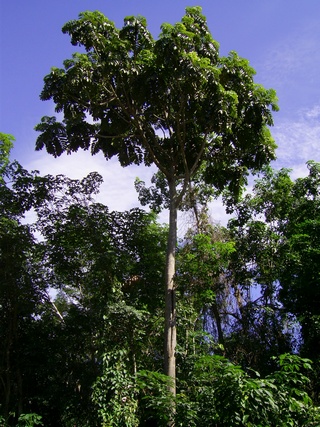
Artocarpus elasticus grows in rainforest environments and occurs in maritime and mainland Southeast Asia. It is distinguished by enormous, deeply lobed leaves and can grow to 45 metres tall, with occasional records reaching 65 metres.
Written 26 November 2026 from the sources listed below. Each statement was checked against the passage it cites; statements that could not be supported were removed.
Appearance
Juvenile trees produce rosettes of enormous, deeply lobed leaves resembling those of white oak. The leaves can reach approximately 2 metres in length and 1.2 metres in width.[1][2]
The tree has stipules that can reach 20 centimetres in length and leaf buds that can reach 18 centimetres in length.[3][4]
The species produces light yellow fruit resembling a small breadfruit. Its seeds are covered in white succulent flesh.[5][6][7]
Habitat
Terap grows in rainforest environments and occurs in maritime and mainland Southeast Asia.[8][9]
Behaviour
Terap is dioecious, with male and female flowers occurring on separate trees.[10]
Reproduction and life cycle
Pollination is apparently carried out by wind. Male flower clusters produce clouds of pollen.[11][12]
Conservation
Terap is locally abundant in primary and secondary forests.[13]
Classification of the Terap
| Kingdom | Plantae |
|---|---|
| Subkingdom | Pteridobiotina |
| Phylum | Tracheophyta |
| Class | Magnoliopsida |
| Order | Rosales |
| Family | Moraceae (Mulberry Family) |
| Tribe | Artocarpeae |
| Genus | Artocarpus (Bread Fruit) |
| Species | Artocarpus elasticus Reinw. ex Blume |
Where the Terap is found
Checklists and occurrence records place Artocarpus elasticus in 9 countries across Asia. GBIF holds 1,028 georeferenced records of it.
Countries where it is native or its origin is not stated
Countries where it has been introduced
Regions and cities with the most records
- Negeri Sembilan, Malaysia 83
- Ang Mo Kio New Town, Singapore 81
- Novena, Singapore 81
- Singapore, Singapore 80
- Yio Chu Kang, Singapore 80
- Anak Bukit, Singapore 79
- Boon Lay, Singapore 79
- Bukit Panjang New Town, Singapore 79
- Bukit Timah, Singapore 79
- Choa Chu Kang New Town, Singapore 79
- Jurong East, Singapore 79
- Jurong Town, Singapore 79
- Jurong West, Singapore 79
- Keat Hong Village, Singapore 79
- Queenstown Estate, Singapore 79
- Teck Whye, Singapore 79
- Yew Tee, Singapore 79
- Eunos, Singapore 78
- MacPherson, Singapore 78
- Sungai Simpang, Singapore 77
- Woodlands, Singapore 77
- Sembawang Estate, Singapore 76
- Yishun New Town, Singapore 76
- Marine Parade, Singapore 75
- Marsiling, Singapore 75
- Kampong Pasir Ris, Singapore 74
- Matilda Estate, Singapore 74
- Punggol, Singapore 74
- Sengkang New Town, Singapore 74
- Ulu Bedok, Singapore 71
- Bedok New Town, Singapore 69
- Kampung Pasir Gudang Baru, Malaysia 69
- Johor Bahru, Malaysia 68
- Kampung Larkin Lama, Malaysia 63
- Taman Permas Jaya, Malaysia 63
- Pasir Gudang, Malaysia 60
Range as the checklists state it
Taiwan [I]; Myanmar (Taninthayi); Thailand; Laos; peninsular Malaysia (common throughout); Singapore; Sumatera; Borneo; Brunei; Sulawesi; Palawan; Jawa; Lesser Sunda Isl. (Bali, Lombok, Sumbawa)
A number beside a place is its count of GBIF occurrence records. A place without a number comes from a checklist alone. Records show where a species has been observed or collected, which can include escapes and vagrants.
Common names
English
- Terap
Names in 5 other languages
- Indonesian
- Benda
- Russian
- Артокарпус эластичный
- Slovak
- chlebovník pružný
- jav
- Benda/Bendo, Bendha
- sun
- Teureup
Synonyms
12 other scientific names have been used for this species and are now treated as synonyms of Artocarpus elasticus.
- Artocarpus blumei Trécul
- Artocarpus blumei var. kunstleri (King) Boerl.
- Artocarpus corneri Kochummen
- Artocarpus jarrettiae Kochummen
- Artocarpus kunstleri King ex Hook.fil.
- Artocarpus scortechinii King
- Saccus blumei (Trécul) Kuntze
- Saccus elasticus (Reinw. ex Blume) Kuntze
- Saccus kuenstleri Kuntze
- Saccus kunstleri (King ex Hook.fil.) Kuntze
- Saccus scortechinii (King) Kuntze
- Artocarpus pubescens Blume ambiguous synonym
Related species
-
 JackfruitArtocarpus heterophyllus
-
 BreadfruitArtocarpus altilis
-
 ChempedakArtocarpus integer
-
 Wild JackArtocarpus hirsutus
-
 EntawakArtocarpus anisophyllus
- Kwai MukArtocarpus parvus
-
 TamaranArtocarpus tamaran
- Monkey-jackArtocarpus rigidus
Compare
Questions and answers
What is the scientific name of the Terap?
The scientific name of the Terap is Artocarpus elasticus. Written with its author, the full name is Artocarpus elasticus Reinw. ex Blume.
Which family does the Terap belong to?
Artocarpus elasticus belongs to the family Moraceae, in the order Rosales and the class Magnoliopsida.
Where is the Terap found?
Checklists and occurrence records place Artocarpus elasticus in 9 countries, including Indonesia, Malaysia, Singapore, Thailand, Brunei and Philippines.
What is the conservation status of the Terap?
The IUCN Red List category recorded for Artocarpus elasticus is Least Concern (LC).
Sources
Passages the profile rests on
- The juvenile trees produce rosettes of enormous, deeply lobed leaves resembling those of white oak. Source passage: “The juvenile trees are noteworthy for producing a rosette of enormous deeply lobed leaves similar in shape to those of the white oak” — English Wikipedia
- The leaves can reach approximately 2 metres in length and 1.2 metres in width. Source passage: “up to 2 metres (6 ft) long by about 1.2 metres (4 ft) in width.” — English Wikipedia
- The tree has stipules that can reach 20 centimetres in length. Source passage: “The stipules are up to eight inches (twenty centimeters) long” — English Wikipedia
- Its leaf buds can reach 18 centimetres in length. Source passage: “These leaves emerge from leaf buds as long as 18 centimetres (7 in).” — English Wikipedia
- The species produces fruit resembling a small breadfruit. Source passage: “It produces a fruit like a small breadfruit.” — English Wikipedia
- Its fruit is light yellow. Source passage: “Fruit is light yellow.” — pmc.ncbi.nlm.nih.gov
- Its seeds are covered in white succulent flesh. Source passage: “Seeds are covered in white succulent flesh” — pmc.ncbi.nlm.nih.gov
- The species grows in rainforest environments. Source passage: “is a rainforest tree” — English Wikipedia
- The species occurs in maritime and mainland Southeast Asia. Source passage: “of maritime and mainland Southeast Asia” — English Wikipedia
- The species is dioecious, with male and female flowers occurring on separate trees. Source passage: “The trees are dioecious (male and female flowers on separate trees).” — English Wikipedia
- Pollination is apparently carried out by wind. Source passage: “pollenisation is apparently by wind.” — English Wikipedia
- The male flower clusters produce clouds of pollen. Source passage: “The male capitulae produce clouds of pollen” — English Wikipedia
- The species is locally abundant in primary and secondary forests. Source passage: “Tree, Locally abundant in primary and secondary” — pmc.ncbi.nlm.nih.gov
Data
- Catalogue of Life, 2026-10-16 XR cc by
- Global Biodiversity Information Facility CC BY 4.0
- Wikidata CC0
- GeoNames CC BY 4.0
- Wikimedia Commons per image; credit shown with each image
- Within the Catalogue of Life, this name comes from Synonymic Checklists of the Vascular Plants of the World cc by
References
- Reinw. ex Blume. Bijdr. Fl. Ned. Ind. 481 (1826). where the name was published
This species in other databases
Page built on 26 November 2026. See how the catalog is made and all sources and licences.
Cite this page
ScientificNames.org. (2026). Artocarpus elasticus (Terap). Retrieved November 26, 2026, from https://scientificnames.org/species/artocarpus-elasticus
“Artocarpus elasticus (Terap).” ScientificNames.org, 2026, scientificnames.org/species/artocarpus-elasticus. Accessed 26 Nov. 2026.
ScientificNames.org. “Artocarpus elasticus (Terap).” Accessed November 26, 2026. https://scientificnames.org/species/artocarpus-elasticus.
@misc{scientificnames_artocarpus_elasticus_terap,
  author = {{ScientificNames.org}},
  title = {Artocarpus elasticus (Terap)},
  year = {2026},
  url = {https://scientificnames.org/species/artocarpus-elasticus},
  note = {Accessed 2026-11-26}
}