Species · Flowering plants
Entawak Artocarpus anisophyllus
The scientific name of the Entawak is Artocarpus anisophyllus. It is a species of flowering plant in the family Moraceae (mulberry family), order Rosales.
- Scientific name
- Artocarpus anisophyllus Miq.
- Common name
- Entawak
- Genus
- Artocarpus
- Family
- Moraceae (Mulberry Family)
- Order
- Rosales
- Class
- Magnoliopsida
- Red List category
- VU Vulnerable
- Recorded in
- 5 countries
- Name status
- accepted in the Catalogue of Life
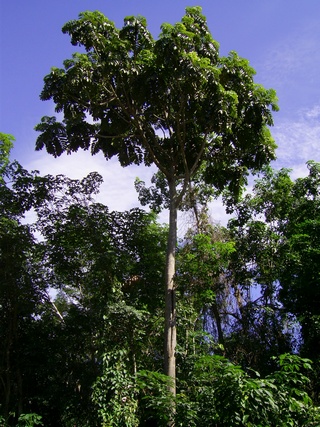
Overview
Entawak grows in tropical rainforest environments and is native to central Southeast Asia. It produces round fruits with brownish-yellow skin and orange-red flesh.
Written 26 November 2026 from the sources listed below. Each statement was checked against the passage it cites; statements that could not be supported were removed.
Appearance
Entawak produces round fruits with brownish-yellow skin and orange-red flesh. The fruit measures approximately 76–102 millimetres in length.[1][2]
The fruit's flesh may have a pumpkin-like flavour.[3]
The entawak tree can grow up to 45 metres tall.[4]
Habitat
Entawak grows in tropical rainforest environments and is native to central Southeast Asia. In Palawan, Philippines, the species is known as popwan.[5][6][7]
The species grows particularly well in tropical climates and is less adapted to subtropical climates. It cannot survive temperatures below 10 °C, and temperatures above 21 °C are required for it to flourish.[8][9][10][11]
Diet
The fruit is eaten fresh. The seeds are edible and are commonly consumed after roasting and salting.[12][13]
Uses
The fruit is consumed as food, while the seeds are used as food after being roasted and salted. The species is rarely cultivated within its native range.[14][15][16]
Reproduction and life cycle
Entawak can be propagated through seeds, grafting and cuttings. Seed germination may take between one and three months.[17][18]
Trees grown from seed are expected to begin bearing fruit within eight to nine years.[19]
Classification of the Entawak
| Kingdom | Plantae |
|---|---|
| Subkingdom | Pteridobiotina |
| Phylum | Tracheophyta |
| Class | Magnoliopsida |
| Order | Rosales |
| Family | Moraceae (Mulberry Family) |
| Tribe | Artocarpeae |
| Genus | Artocarpus (Bread Fruit) |
| Species | Artocarpus anisophyllus Miq. |
Where the Entawak is found
Checklists and occurrence records place Artocarpus anisophyllus in 5 countries across Asia. GBIF holds 356 georeferenced records of it.
Countries
Regions and cities with the most records
- Sabah, Malaysia 26
- Sarawak, Malaysia 14
- Palembang, Indonesia 13
- Jambi, Indonesia 10
- Kampung Larkin Lama, Malaysia 4
- Muntok, Indonesia 4
- Ranau, Malaysia 4
- Riau, Indonesia 4
- Balikpapan, Indonesia 3
- Kampung Kangkar Teberau, Malaysia 3
- Taman Scientex, Malaysia 3
Range as the checklists state it
peninsular Malaysia (Negeri Sembilan, Melaka, Johor); Singapore; Sumatera; Borneo; Brunei; Palawan; Philippines (Basilan, Mindanao)
A number beside a place is its count of GBIF occurrence records. A place without a number comes from a checklist alone. Records show where a species has been observed or collected, which can include escapes and vagrants.
Common names
English
- Entawak
Names in 2 other languages
- iba
- Bintawak, Mentawa
- zsm
- terap ikal
Synonyms
4 other scientific names have been used for this species and are now treated as synonyms of Artocarpus anisophyllus.
- Artocarpus anisophyllus var. sessilifolius Kochummen
- Artocarpus klidang Boerl.
- Artocarpus superba Becc.
- Saccus anisophyllus (Miq.) Kuntze
Related species
-
 JackfruitArtocarpus heterophyllus
-
 BreadfruitArtocarpus altilis
-
 ChempedakArtocarpus integer
-
 Wild JackArtocarpus hirsutus
-
 TerapArtocarpus elasticus
- Kwai MukArtocarpus parvus
-
 Elephant JackArtocarpus tamaran
- Monkey-jackArtocarpus rigidus
Compare
Questions and answers
What is the scientific name of the Entawak?
The scientific name of the Entawak is Artocarpus anisophyllus. Written with its author, the full name is Artocarpus anisophyllus Miq..
Which family does the Entawak belong to?
Artocarpus anisophyllus belongs to the family Moraceae, in the order Rosales and the class Magnoliopsida.
Where is the Entawak found?
Checklists and occurrence records place Artocarpus anisophyllus in 5 countries: Indonesia, Malaysia, Singapore, Brunei and Philippines.
What is the conservation status of the Entawak?
The IUCN Red List category recorded for Artocarpus anisophyllus is Vulnerable (VU).
Sources
Passages the profile rests on
- The entawak produces round fruits with brownish-yellow skin and orange-red flesh. Source passage: “It bears round, 3–4 in (76–102 mm) long, brownish yellow fruit. The entawak's flesh is orange-red” — English Wikipedia
- The fruit measures approximately 76–102 millimetres in length. Source passage: “3–4 in (76–102 mm) long” — English Wikipedia
- The fruit's flesh may have a pumpkin-like flavour. Source passage: “may taste like a pumpkin in flavor” — English Wikipedia
- The entawak tree can grow up to 45 metres tall. Source passage: “it is a large rainforest tree growing up to 45 m (148 ft).” — English Wikipedia
- The entawak grows in tropical rainforest environments. Source passage: “it is a large rainforest tree” — English Wikipedia
- The species is native to central Southeast Asia. Source passage: “It is native to the central parts of Southeast Asia” — English Wikipedia
- In Palawan, Philippines, the species is known as popwan. Source passage: “It is called popwan in Palawan, Philippines.” — English Wikipedia
- The species grows particularly well in tropical climates. Source passage: “While it grows exceedingly well in tropical climates” — English Wikipedia
- The species is less adapted to subtropical climates than to tropical climates. Source passage: “it is not as well-adapted to subtropical climates.” — English Wikipedia
- The species cannot survive temperatures below 10 °C. Source passage: “It cannot survive temperatures below 50 °F (10 °C)” — English Wikipedia
- Temperatures above 21 °C are required for the species to flourish. Source passage: “requires temperatures higher than 70 °F (21 °C) to flourish.” — English Wikipedia
- The fruit is eaten fresh. Source passage: “The fruit is eaten fresh.” — English Wikipedia
- The seeds are edible and are commonly consumed after roasting and salting. Source passage: “it also has edible seeds which are commonly roasted and salted to be eaten.” — English Wikipedia
- The fruit is consumed as food. Source passage: “The fruit is eaten fresh.” — English Wikipedia
- The seeds are used as food after being roasted and salted. Source passage: “it also has edible seeds which are commonly roasted and salted to be eaten.” — English Wikipedia
- The species is rarely cultivated within its native range. Source passage: “Rarely cultivated in its native range” — English Wikipedia
- The species can be propagated through seeds, grafting and cuttings. Source passage: “It is propagated by seeds, grafting and cuttings” — English Wikipedia
- Seed germination may take between one and three months. Source passage: “When grown from seed the germination may take 1–3 months” — English Wikipedia
- Trees grown from seed are expected to begin bearing fruit within eight to nine years. Source passage: “it will probably bear fruit within 8–9 years.” — English Wikipedia
Data
- Catalogue of Life, 2026-10-16 XR cc by
- Global Biodiversity Information Facility CC BY 4.0
- Wikidata CC0
- GeoNames CC BY 4.0
- Wikimedia Commons per image; credit shown with each image
- Within the Catalogue of Life, this name comes from Synonymic Checklists of the Vascular Plants of the World cc by
References
- Miq. Fl. Ned. Ind., Eerste Bijv. 422 (1861). where the name was published
This species in other databases
- Catalogue of Life H248
- Wikidata Q4801374
- iNaturalist 427964
- World Flora Online wfo-0000550430
- GRIN 474576
Page built on 29 November 2026. See how the catalog is made and all sources and licences.
Cite this page
ScientificNames.org. (2026). Artocarpus anisophyllus (Entawak). Retrieved November 29, 2026, from https://scientificnames.org/species/artocarpus-anisophyllus
“Artocarpus anisophyllus (Entawak).” ScientificNames.org, 2026, scientificnames.org/species/artocarpus-anisophyllus. Accessed 29 Nov. 2026.
ScientificNames.org. “Artocarpus anisophyllus (Entawak).” Accessed November 29, 2026. https://scientificnames.org/species/artocarpus-anisophyllus.
@misc{scientificnames_artocarpus_anisophyllus_entawak,
  author = {{ScientificNames.org}},
  title = {Artocarpus anisophyllus (Entawak)},
  year = {2026},
  url = {https://scientificnames.org/species/artocarpus-anisophyllus},
  note = {Accessed 2026-11-29}
}