Species · Flowering plants
Elephant Jack Artocarpus tamaran
The scientific name of the Elephant Jack is Artocarpus tamaran. It is a species of flowering plant in the family Moraceae (mulberry family), order Rosales.
- Scientific name
- Artocarpus tamaran Becc.
- Common name
- Elephant Jack
- Genus
- Artocarpus
- Family
- Moraceae (Mulberry Family)
- Order
- Rosales
- Class
- Magnoliopsida
- Red List category
- VU Vulnerable
- Recorded in
- 3 countries
- Name status
- accepted in the Catalogue of Life

Overview
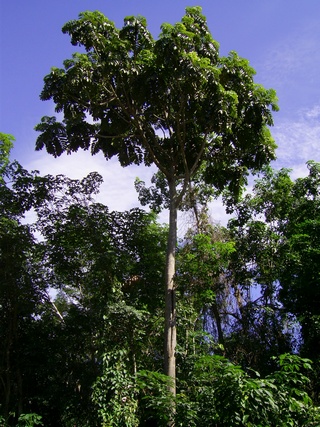
Elephant Jack (Artocarpus tamaran Becc.) is a monoecious tree in the fig family. It is endemic to Borneo and occurs in mixed dipterocarp forest and secondary forest at elevations up to 600 m. Its fruits are cylindrical or oblong, covered with short, flexible spines and contain seeds with an edible, sweet white aril.
Written 26 November 2026 from the sources listed below. Each statement was checked against the passage it cites; statements that could not be supported were removed.
Appearance
Elephant Jack is a monoecious tree with white latex. It can reach 40 m in height, and its bole can reach 10 m in length.[1][2][3]
Its oval leaves measure 27–35 cm long and 10–18 cm wide. Its globular inflorescences develop in the leaf axils.[4][5]
Its fruits are cylindrical or oblong syncarpous infructescences, measuring 10–15 cm in length and approximately 5 cm in diameter. They are covered with short, flexible spines and ripen to a yellowish colour.[6][7][8]
Its seeds are covered by a white aril.[9]
Habitat
Elephant Jack occurs naturally in lowland mixed dipterocarp forest, coastal mixed dipterocarp forest and hill mixed dipterocarp forest. It also occurs in secondary forest.[10][11][12][13]
The species occurs at elevations up to 600 m and is endemic to Borneo.[14][15]
Diet
The fruits of Elephant Jack are eaten. Its seeds have an edible, sweet aril.[16][17]
Uses
The bark was formerly used extensively by the Muruts and other Bornean tribal communities to make barkcloth.[18]
Classification of the Elephant Jack
| Kingdom | Plantae |
|---|---|
| Subkingdom | Pteridobiotina |
| Phylum | Tracheophyta |
| Class | Magnoliopsida |
| Order | Rosales |
| Family | Moraceae (Mulberry Family) |
| Tribe | Artocarpeae |
| Genus | Artocarpus (Bread Fruit) |
| Species | Artocarpus tamaran Becc. |
Where the Elephant Jack is found
Checklists and occurrence records place Artocarpus tamaran in 3 countries across Asia. GBIF holds 86 georeferenced records of it.
Countries
Regions and cities with the most records
Range as the checklists state it
Borneo; Brunei
A number beside a place is its count of GBIF occurrence records. A place without a number comes from a checklist alone. Records show where a species has been observed or collected, which can include escapes and vagrants.
Common names
English
- Elephant Jack
- Tamaran
Names in 2 other languages
- Malay
- terap
- mis
- Timbangan
Related species
-
 JackfruitArtocarpus heterophyllus
-
 BreadfruitArtocarpus altilis
-
 ChempedakArtocarpus integer
-
 Wild JackArtocarpus hirsutus
-
 TerapArtocarpus elasticus
-
 EntawakArtocarpus anisophyllus
- Kwai MukArtocarpus parvus
- Monkey-jackArtocarpus rigidus
Compare
Questions and answers
What is the scientific name of the Elephant Jack?
The scientific name of the Elephant Jack is Artocarpus tamaran. Written with its author, the full name is Artocarpus tamaran Becc..
Which family does the Elephant Jack belong to?
Artocarpus tamaran belongs to the family Moraceae, in the order Rosales and the class Magnoliopsida.
Where is the Elephant Jack found?
Checklists and occurrence records place Artocarpus tamaran in 3 countries: Malaysia, Indonesia and Brunei.
What is the conservation status of the Elephant Jack?
The IUCN Red List category recorded for Artocarpus tamaran is Vulnerable (VU).
What other names does the Elephant Jack have?
Artocarpus tamaran is also known in English as Tamaran.
Sources
Passages the profile rests on
- Artocarpus tamaran is a monoecious tree with white latex. Source passage: “The species grows as a monoecious tree to 40 m in height, with a bole of up to 10 m, buttresses to 3 m, and with white latex.” — English Wikipedia
- The tree can reach 40 m in height. Source passage: “The species grows as a monoecious tree to 40 m in height” — English Wikipedia
- The tree's bole can reach 10 m in length. Source passage: “with a bole of up to 10 m” — English Wikipedia
- Its oval leaves measure 27–35 cm long and 10–18 cm wide. Source passage: “The oval leaves are 27–35 cm long by 10–18 cm wide.” — English Wikipedia
- Its globular inflorescences develop in the leaf axils. Source passage: “The globular inflorescences occur in the leaf axils.” — English Wikipedia
- Its fruits are cylindrical or oblong syncarpous infructescences. Source passage: “The fruits are cylindrical or oblong syncarpous infructescences” — English Wikipedia
- Its fruits measure 10–15 cm in length and approximately 5 cm in diameter. Source passage: “10–15 cm by 5 cm in diameter” — English Wikipedia
- Its fruits are covered with short, flexible spines and ripen to a yellowish colour. Source passage: “covered by short, flexible spines, and ripening yellowish.” — English Wikipedia
- Its seeds are covered by a white aril. Source passage: “The seeds are covered by an edible, sweet, white aril.” — English Wikipedia
- The species occurs naturally in lowland mixed dipterocarp forest. Source passage: “where it occurs naturally in lowland, coastal and hill mixed dipterocarp forest” — English Wikipedia
- The species occurs naturally in coastal mixed dipterocarp forest. Source passage: “lowland, coastal and hill mixed dipterocarp forest” — English Wikipedia
- The species occurs naturally in hill mixed dipterocarp forest. Source passage: “lowland, coastal and hill mixed dipterocarp forest” — English Wikipedia
- The species also occurs in secondary forest. Source passage: “as well as in secondary forest” — English Wikipedia
- The species occurs at elevations up to 600 m. Source passage: “up to an elevation of 600 m.” — English Wikipedia
- The species is endemic to Borneo. Source passage: “The species is endemic to Borneo” — English Wikipedia
- The seeds have an edible, sweet aril. Source passage: “The seeds are covered by an edible, sweet, white aril.” — English Wikipedia
- The fruits of this species are eaten. Source passage: “The fruits of this species are eaten.” — English Wikipedia
- The bark was formerly used extensively by the Muruts and other Bornean tribal communities to make barkcloth. Source passage: “The bark was once extensively used for making barkcloth by the Muruts and other Borneo tribal people.” — English Wikipedia
Data
- Catalogue of Life, 2026-10-16 XR cc by
- Global Biodiversity Information Facility CC BY 4.0
- Wikidata CC0
- GeoNames CC BY 4.0
- Wikimedia Commons per image; credit shown with each image
- Within the Catalogue of Life, this name comes from Synonymic Checklists of the Vascular Plants of the World cc by
References
- Becc. Nelle Foreste di Borneo 626 (1902). where the name was published
This species in other databases
- Catalogue of Life H28D
- Wikidata Q15471565
- iNaturalist 430691
- World Flora Online wfo-0000550611
- GRIN 400028
Page built on 28 November 2026. See how the catalog is made and all sources and licences.
Cite this page
ScientificNames.org. (2026). Artocarpus tamaran (Elephant Jack). Retrieved November 28, 2026, from https://scientificnames.org/species/artocarpus-tamaran
“Artocarpus tamaran (Elephant Jack).” ScientificNames.org, 2026, scientificnames.org/species/artocarpus-tamaran. Accessed 28 Nov. 2026.
ScientificNames.org. “Artocarpus tamaran (Elephant Jack).” Accessed November 28, 2026. https://scientificnames.org/species/artocarpus-tamaran.
@misc{scientificnames_artocarpus_tamaran_elephant_jack,
  author = {{ScientificNames.org}},
  title = {Artocarpus tamaran (Elephant Jack)},
  year = {2026},
  url = {https://scientificnames.org/species/artocarpus-tamaran},
  note = {Accessed 2026-11-28}
}