Species · Mammals
White-bellied Spider Monkey Ateles belzebuth
The scientific name of the White-bellied Spider Monkey is Ateles belzebuth. It is a species of mammal in the family Atelidae (atelids), order Primates. The name dates from 1806.
- Scientific name
- Ateles belzebuth É. Geoffroy Saint-Hilaire, 1806
- Common name
- White-bellied Spider Monkey
- Genus
- Ateles
- Family
- Atelidae (Atelids)
- Order
- Primates
- Class
- Mammalia
- Red List category
- EN Endangered
- Recorded in
- 6 countries
- Name status
- accepted in the Catalogue of Life

Overview
Ateles belzebuth occurs in the north-western Amazon region of Colombia, Ecuador, Venezuela, Peru and Brazil. It is distinguished by its whitish belly, pale forehead patch and prehensile tail with a hairless gripping pad underneath its tip.
Written 26 November 2026 from the sources listed below. Each statement was checked against the passage it cites; statements that could not be supported were removed.
Appearance
Its hands are curved and have long metacarpal bones. The species lacks an external thumb.[1][2]
Habitat
The species occupies large territories and uses multiple nesting trees within them.[3]
Diet
Mature fruits constitute approximately 83% of its diet. It is a generalist frugivore rather than specializing in a particular fruit type, and appears to favour fruits with high lipid or sugar content and fruits from highly productive trees.[4][5][6]
The species also consumes leaves, flowers and bulbs, and very occasionally consumes small insects. It has been observed engaging in geophagy and has been documented using mineral licks.[7][8][9][10]
Behaviour
The species lives in groups containing approximately 20–40 individuals. During activity, groups divide into smaller parties of approximately 1–9 individuals, exhibiting fission-fusion social dynamics in which subgroup composition changes frequently.[11][12][13]
Subgroups travel, feed and sleep together. Females generally use smaller core areas within their home territories alongside their offspring, whereas males use more of the home range.[14][15]
Long-distance vocalizations allow subgroups to communicate across distances of up to one kilometre. Reuniting subgroups greet one another through vocalizing, chasing, hugging and sniffing pectoral glands.[16][17]
The species is an important long-distance seed disperser for fruit-bearing plants and a dominant seed disperser for the palm Oenocarpus bataua.[18][19]
Reproduction and life cycle
The species is believed to reach sexual maturity between four and five years of age. Females usually produce one offspring per birth, although twin births have been reported.[20][21]
The gestation period lasts approximately 226–232 days. Females initiate copulation, and males of the species have been observed committing infanticide.[22][23][24]
Conservation
The species is classified as endangered by the IUCN. Its population declined by approximately 50% over 45 years, equivalent to three generations.[25][26]
Habitat loss and hunting are identified as causes of the species' population decline.[27]
Classification of the White-bellied Spider Monkey
| Kingdom | Animalia |
|---|---|
| Phylum | Chordata |
| Subphylum | Vertebrata |
| Infraphylum | Gnathostomata |
| Parvphylum | Osteichthyes |
| Megaclass | Tetrapoda |
| Class | Mammalia (Mammal) |
| Subclass | Theria |
| Infraclass | Eutheria |
| Order | Primates (Primate) |
| Suborder | Haplorrhini |
| Infraorder | Simiiformes |
| Family | Atelidae (Atelids) |
| Subfamily | Atelinae |
| Genus | Ateles (Spider Monkey) |
| Species | Ateles belzebuth É. Geoffroy Saint-Hilaire, 1806 |
Where the White-bellied Spider Monkey is found
Checklists and occurrence records place Ateles belzebuth in 6 countries across South America. GBIF holds 704 georeferenced records of it.
Countries
Regions and cities with the most records
- Orellana Province, Ecuador 203
- Pastaza Province, Ecuador 90
- Napo, Ecuador 56
- Meta Department, Colombia 44
- Amazonas, Venezuela 36
- Tena, Ecuador 33
- Roraima, Brazil 18
- Sucumbíos, Ecuador 17
- Loreto, Peru 12
- Casanare Department, Colombia 11
- Mato Grosso, Brazil 8
- Amazonas, Brazil 7
- La Paz Department, Bolivia 7
- Amazonas, Peru 6
- Caquetá, Colombia 6
- Guaviare Department, Colombia 4
- Mucajaí, Brazil 4
- Putumayo Department, Colombia 4
- Yopal, Colombia 4
- Boyacá, Colombia 3
- San Martín Department, Peru 3
3 more countries have a few records outside this range
These countries hold a few records of Ateles belzebuth but lie outside the range the checklists give for it. Such records are often zoo or garden specimens, museum material or vagrants, so the species is not counted as occurring there.
Range as the checklists state it
South America
A number beside a place is its count of GBIF occurrence records. A place without a number comes from a checklist alone. Records show where a species has been observed or collected, which can include escapes and vagrants.
Common names
English
- White-bellied Spider Monkey
- Long-haired Spider Monkey
- White-beliied Spider Monkey
- White-fronted Spider Monkey
Names in 21 other languages
- Arabic
- سعدان عنكبوتي طويل الشعر
- Chinese
- 白額蜘蛛猴
- Czech
- chápan dlouhosrstý
- Danish
- Hvidbuget edderkoppeabe
- Dutch
- Witbuikslingeraap
- Finnish
- villahämähäkkiapina
- French
- Atèle Belzébuth, Atèle à ventre blanc, Singe-araignée à ventre blanc
- German
- Goldstirn-Klammeraffe, Weißstirn-Klammeraffe, Weißstirnklammeraffe
- Greek
- Μακρύτριχος Αραχνοπίθηκος
- Hungarian
- sárgáshomlokú pókmajom
- Italian
- Atele belzebù
- Japanese
- ケナガクモザル
- Norwegian Bokmål
- Langhårklamreape
- Polish
- czepiak czarci
- Portuguese
- Macaco-aranha, Macaco-aranha-branco
- Russian
- Белолобая коата
- Spanish
- Braceadora, Coatá, Fiaguai, Macaco Aranha, Maquisapa, Marimba, Marimona, Marimonda
- Turkish
- Beyaz alınlı yünlü örümcek maymunu
- coe
- Painaso
- myy
- Cuata
- tnc
- Cuhatacá
Synonyms
7 other scientific names have been used for this species and are now treated as synonyms of Ateles belzebuth.
- Ateles bartlettii Gray, 1867
- Ateles belzebuth belzebuth É.Geoffroy Saint-Hilaire, 1806
- Ateles braccatus Pelzeln, 1883
- Ateles chuva Schlegel, 1876
- Ateles fuliginosus Kuhl, 1820
- Ateles variegatus Wagner, 1840
- Cebus brissonii Fischer, 1829
Related species
-
 Geoffroy's Spider MonkeyAteles geoffroyi
-
 Brown Spider MonkeyAteles hybridus
-
 Black-headed Spider MonkeyAteles fusciceps
-
 Red-faced Spider MonkeyAteles paniscus
-
 Peruvian Spider MonkeyAteles chamek
-
 White-cheeked Spider MonkeyAteles marginatus
-
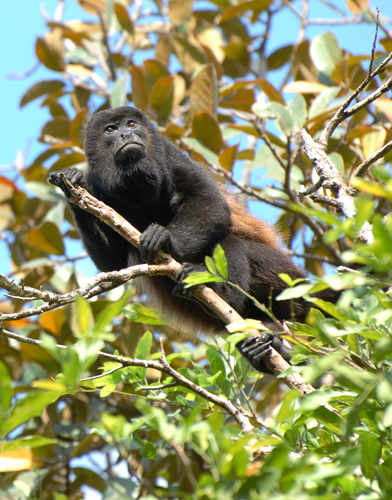 Mantled HowlerAlouatta palliata
-
 Black HowlerAlouatta caraya
Compare
Questions and answers
What is the scientific name of the White-bellied Spider Monkey?
The scientific name of the White-bellied Spider Monkey is Ateles belzebuth. Written with its author, the full name is Ateles belzebuth É. Geoffroy Saint-Hilaire, 1806.
Which family does the White-bellied Spider Monkey belong to?
Ateles belzebuth belongs to the family Atelidae, in the order Primates and the class Mammalia.
Where is the White-bellied Spider Monkey found?
Checklists and occurrence records place Ateles belzebuth in 6 countries: Ecuador, Colombia, Venezuela, Peru, Brazil and Bolivia.
What is the conservation status of the White-bellied Spider Monkey?
The IUCN Red List category recorded for Ateles belzebuth is Endangered (EN).
What other names does the White-bellied Spider Monkey have?
Ateles belzebuth is also known in English as Long-haired Spider Monkey, White-beliied Spider Monkey and White-fronted Spider Monkey.
Why are white-bellied spider monkeys endangered?
Habitat loss and hunting are identified as causes of population decline. Its population declined by approximately 50% over 45 years, equivalent to three generations.[25][26][27]
Sources
Passages the profile rests on
- Its hands are curved and have long metacarpal bones. Source passage: “Their curved hands with long metacarpal bones allows for easy brachiation.” — English Wikipedia
- The species lacks an external thumb. Source passage: “They do not have an external thumb” — English Wikipedia
- The species occupies large territories and uses multiple nesting trees within them. Source passage: “A. belzebuth often occupies a large territory and will utilize multiple nesting trees throughout their territory.” — English Wikipedia
- Mature fruits constitute approximately 83% of the species' diet. Source passage: “The diet of White-bellied spider monkeys is 83% mature fruits” — English Wikipedia
- The species is a generalist frugivore rather than specializing in a particular fruit type. Source passage: “A. belzebuth is a generalist frugivore that doesn't specialize in a particular fruit type” — English Wikipedia
- The species appears to favour fruits with high lipid or sugar content and fruits from highly productive trees. Source passage: “but do appear to prefer fruits with high lipid content, high sugar content, or fruits produced by trees with high fruit productivity.” — English Wikipedia
- The species also consumes leaves, flowers and bulbs. Source passage: “They will also feed on other plant parts such as leaves, flowers, and bulbs” — English Wikipedia
- The species very occasionally consumes small insects. Source passage: “and will very rarely consume small insects.” — English Wikipedia
- The species has been observed engaging in geophagy. Source passage: “A. belzebuth has also been observed engaging in geophagy.” — English Wikipedia
- The species has been documented using mineral licks. Source passage: “Use of mineral licks by white-bellied spider monkeys (Ateles belzebuth) and red howler monkeys (Alouatta seniculus) in eastern Ecuador.” — primate.socgen.ucla.edu
- The species lives in groups containing approximately 20–40 individuals. Source passage: “They live in groups of 20 to 40 individuals” — English Wikipedia
- During activity, groups divide into smaller parties of approximately 1–9 individuals. Source passage: “splitting into small parties of 1 to 9 when in activity.” — English Wikipedia
- The species exhibits fission-fusion social dynamics, with subgroups changing their composition frequently. Source passage: “These groups display great fluidity and will often change composition, sometimes changing several times each day.” — English Wikipedia
- Subgroups travel, feed and sleep together. Source passage: “fragmenting into subgroups that travel, feed and sleep together.” — English Wikipedia
- Females generally use smaller core areas within their home territories alongside their offspring, whereas males use more of the home range. Source passage: “Females will also usually remain in small core ranges within their home territories with their offspring while males will utilize more of their home range.” — English Wikipedia
- Long-distance vocalizations allow subgroups to communicate across distances of up to one kilometre. Source passage: “These long distance vocalizations can be up to a kilometer away.” — English Wikipedia
- Reuniting subgroups greet one another through vocalizing, chasing, hugging and sniffing pectoral glands. Source passage: “they greet each other excitedly by vocalizing, chasing, hugging each other, and sniffing pectoral glands.” — English Wikipedia
- The species is an important long-distance seed disperser for fruit-bearing plants. Source passage: “White-bellied spider monkeys are important long-distance seed dispersal agents for many fruit-bearing species.” — English Wikipedia
- The species is a dominant seed disperser for the palm Oenocarpus bataua. Source passage: “They are a dominant disperser for Oenocarpus bataua, a species of palm.” — English Wikipedia
- The species is believed to reach sexual maturity between four and five years of age. Source passage: “White-bellied spider monkeys are believed to achieve sexual maturity at between 4 and 5 years of age” — English Wikipedia
- Females usually produce one offspring per birth, although twin births have been reported. Source passage: “will usually produce a single offspring although females giving birth to twins has been reported.” — English Wikipedia
- The gestation period lasts approximately 226–232 days. Source passage: “Their gestation period is between 226 and 232 days long.” — English Wikipedia
- Females initiate copulation. Source passage: “Copulations are initiated by females” — English Wikipedia
- Males of the species have been observed committing infanticide. Source passage: “Males have been observed engaging in infanticide.” — English Wikipedia
- The species is classified as endangered by the IUCN. Source passage: “A. belzebuth is listed as endangered by the IUCN.” — English Wikipedia
- Its population declined by approximately 50% over 45 years, equivalent to three generations. Source passage: “Over the last 45 years (3 generations), the population has declined by approximately 50%” — English Wikipedia
- Habitat loss and hunting are identified as causes of the species' population decline. Source passage: “the population has declined by approximately 50% due to habitat loss and hunting.” — English Wikipedia
Data
- Catalogue of Life, 2026-10-16 XR cc by
- Global Biodiversity Information Facility CC BY 4.0
- Wikidata CC0
- GeoNames CC BY 4.0
- Wikimedia Commons per image; credit shown with each image
- Within the Catalogue of Life, this name comes from The Integrated Taxonomic Information System cc0
References
- Ann. Mus. Hist. Nat. Paris vol.7 p.27 where the name was published
- Wilson, Don E., and DeeAnn M. Reeder, eds. (1993). Mammal Species of the World: A Taxonomic and Geographic Reference, 2nd Ed., 3rd Printing.
- Wilson, Don E., and F. Russell Cole. (2000). Common Names of Mammals of the World.
- Wilson, Don E., and DeeAnn M. Reeder, eds. (2005). Mammal Species of the World: A Taxonomic and Geographic Reference, 3rd Ed., Vol. 1.
- Mittermeier, Rusell A., Anthony B. Rylands, and Don E. Wilson, eds. (2013). Handbook of the Mammals of the World. Volume 3. Primates.
This species in other databases
Page built on 27 November 2026. See how the catalog is made and all sources and licences.
Cite this page
ScientificNames.org. (2026). Ateles belzebuth (White-bellied Spider Monkey). Retrieved November 27, 2026, from https://scientificnames.org/species/ateles-belzebuth
“Ateles belzebuth (White-bellied Spider Monkey).” ScientificNames.org, 2026, scientificnames.org/species/ateles-belzebuth. Accessed 27 Nov. 2026.
ScientificNames.org. “Ateles belzebuth (White-bellied Spider Monkey).” Accessed November 27, 2026. https://scientificnames.org/species/ateles-belzebuth.
@misc{scientificnames_ateles_belzebuth_white_bellied_spider_monkey,
  author = {{ScientificNames.org}},
  title = {Ateles belzebuth (White-bellied Spider Monkey)},
  year = {2026},
  url = {https://scientificnames.org/species/ateles-belzebuth},
  note = {Accessed 2026-11-27}
}